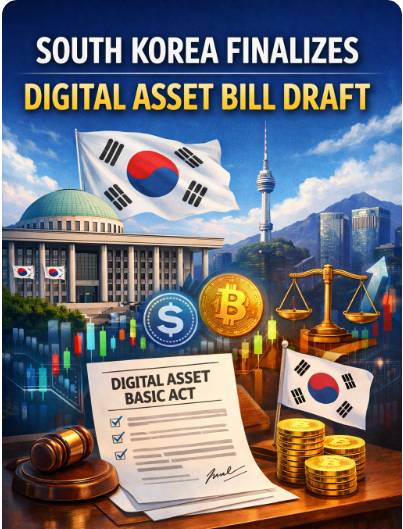
It seems South Korea is finally moving forward with the long-awaited implementation of its digital asset bill as progress has been reported by the ruling party. As per local reports, ChosunBiz, the party has completed its first draft of the proposed framework, and it is now christened the “Digital Asset Basic Act.”
This proposed bill aims to provide the country with its first full framework to regulate digital currencies and provide guidance on the issuance of stablecoins, along with licensing requirements and protections for the investors.
The Digital Asset Task Force (TF) has made the most progress on the proposed bill, and they have finalized most of the outstanding technical and legal provisions. Perhaps the most important decision made in that meeting was the agreement to have a minimum capital requirement of 5 billion won (approximately $3.5 million) for any company that issues stablecoins.
This is to ensure that only major players in the South Korean economy, with the ability to absorb potential losses, will be allowed to offer stablecoins, thereby assuring the market against systemic risks.
The task force has additional plans to coordinate with state officials and members of the party’s policy committee over the next several weeks. They aim to prioritize the submission of the Digital Asset Basic Act to be scheduled for legislative review before the end of next month, indicating that the time frame for the Act’s approval has significantly decreased.
Task force representatives state that most of the issues related to the restrictions on shareholders and the governance of the new norm were settled before the holidays, allowing the drafting to be completed.
The new momentum for the purpose of legislation attempts to push through the recent waves of regulation. The Financial Services Commission (FSC) and the Bank of Korea recently crossed wires over the regulation of the issuers of the (South) Korean Won-pegged Stable Coins and the accompanying indirect control of the Monetary Policy, and the regulation of the issuers, as well. The most of these gaps in regulation remain unresolved but the legislature seems determined to provide regulation for the country’s first unified legislation.
Since the passing of the Digital Asset Basic Act, South Korea has welcomed more pro crypto regulations, Continuing shifts in South Korean financial regulation positioned South Korea as East Asia’s first-ever structured crypto regulator, South Korea’s financial regulators have already enacted new regulations that demonstrate this “first” structuring of crypto regulation.
South Korean financial regulators have welcomed new crypto based exchange traded funds (ETFs). South Korea has hinted towards the launching of a Bitcoin ETF, while institutions have already been encouraged to apply to licensure to create Bitcoin ETPs.
South Korean financial regulators have enacted to new rules that now allow the update of the Capital Markets Act, which introduces tokenized securities. South Korea’s financial regulators have relaxed previously placed restrictions on crypto venture capital, signaling to financial institutions that the funding of blockchain technologies is now open.
These actions taken by South Korean financial regulators demonstrate that they have began to structure crypto regulations. The Digital Asset Basic Act further emphasizes South Korea’s intent to become the crypto capital of East Asia.