Decentralized GPU Markets, a recent development that is revolutionizing AI model training, will be covered in this post. Platforms like Render and Akash make high-performance computing accessible and affordable by facilitating peer-to-peer GPU sharing.
With blockchain-backed security and smart contract automation, developers, entrepreneurs, and research institutions can now work together globally, train huge AI models more quickly, and cut expenses.
What is Decentralized GPU Markets?
Decentralized GPU Markets are platforms that allow individuals and organizations to rent out or access unused GPU computing power through a peer-to-peer network, bypassing traditional centralized cloud providers like AWS or Google Cloud.
By leveraging blockchain and smart contracts, these markets ensure secure, transparent, and automated transactions between GPU providers and users.
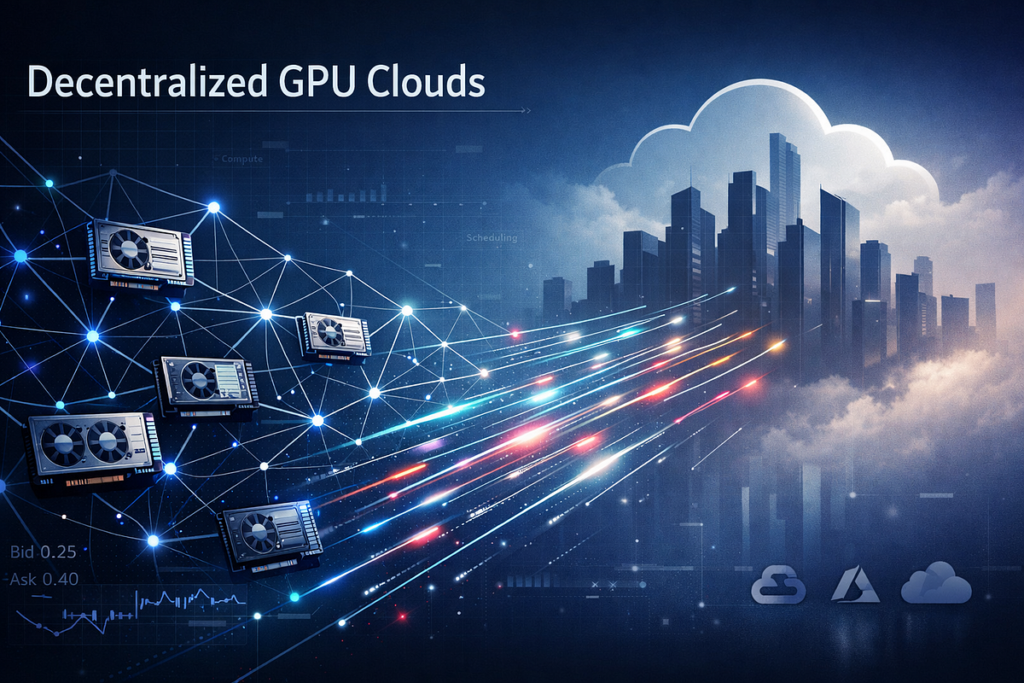
This model democratizes access to high-performance computing, making AI model training more affordable and accessible for startups, researchers, and independent developers.
Platforms like Render and Akash are leading this trend, enabling faster experimentation and large-scale AI training without the high costs of owning dedicated hardware.
How blockchain and smart contracts ensure secure, transparent GPU rentals?
Here is a breakdown of how the security and trust of GPU rentals in a decentralized marketplace is achieved using Blockchain and Smart Contracts:
Permanent and Immutable Storage:
All rental agreements and transactions will be recorded permanently on the blockchain. No one can alter or delete anything from the blockchain. Therefore, all participants will have a record of the payments, duration of usage, and the performance of the rented GPU(s).
Smart Contracts:
Smart Contracts on the blockchain are contracts that are executed by themselves. They autonomously send ** payments to GPU providers if and only if the computed tasks that are agreed upon are executed successfully ** So there is no need to have a 3rd party to manage your trust issues + there are no more trust issues to be had.
Completion of Tasks:
All GPU Providers + Users can verify in real-time if the tasks were performed and if the resources (GPU, etc.) were used. The blockchain makes sure that no one is overstating their performance, and no one is underperforming or providing the resources. No one will be able to default on payments, and everyone will be held accountable.
Bonus: All of these features help to stop fraud, minimize disagreements among Users + GPU Providers, and everyone around the world can interact without the need for a Centralized Authority to help them or give them permission!
Mechanisms Behind Decentralized GPU Platforms
Peer-to-Peer GPU Allocation: Tasks are distributed directly to the available GPUs on the network providing better utilization of resources without the need for a centralized server. global access to idle GPUs for AI training is provided.
Token-Based Incentives GPU providers are compensated with platform specific tokens or cryptocurrency. This encourages providers The GPU economy is decentralized and encourages constant resource availability for clients.
Smart Contract Automation. GPU rentals are automated through smart contracts which go into a rental agreement and only release payments after a task is completed. This fosters trust and removes the need for GPU rental intermediaries.
Dynamic Scaling. GPU resources are distributed according to the demand and size of the workload. Scaling AI training is dynamic and optimizes costs and performance without the need for the user to manage the infrastructure.
Resource Verification & Security. GPU resources are proved and cryptographically secured with proof of work and completed tasks to ensure the protection of data, correctness of calculations, and trust between users and providers.
Why this trend matters for AI developers, startups, and research institutions?
With the rise of decentralized GPU markets, AI developers, startups, and research institutions can now more easily access high-performance computing – an integral part of the AI model development process, and has historically been an expensive and exclusive resource.
Accessing top shelf GPUs has traditionally involved expensive cloud subscriptions which is a massive barrier for small teams and academic labs, especially those underfunded.
In the age of decentralized GPU markets, customers can access GPU computing resources for 30-50% which is a massive drop in price and allows for more experimentation/innovation.
Because of the decreased barriers to access, small teams and underfunded academic labs can now more easily run complex model training on large datasets.
By creating a more level playing field for GPU resource access, decentralized GPU markets have also created a more competitive environment for high performance computing, which has in turn fueled innovation in AI technologies and development.
Advantages Over Traditional Cloud GPU Services
Price Improvement: Customers avoid paying for idle hardware and expensive subscriptions by purchasing only the GPU power used. Decentralized networks exhibit lower prices due to competitive peer-to-peer resource sharing.
Opens Access: High performance GPUs are available to smaller teams and startups. This allows the independent development of AI solutions and fosters innovation and research on a global scale.
Flexibility and Scalability: Users are not tied to limited cloud consumption plans. Decentralized GPU services allow for the rapid scaling and expansion of resources to support multiple experiments and large AI models.
Reliability and Redundancy: Decentralized networks create multiple routes for task completion. Because of this, uninterrupted training of AI models is possible and networks are resilient to the loss of single nodes.
AI for Everyone: Decentralized GPU markets create opportunity for global participation in developing AI. Participants are not restricted based on location. Costs and access to resources are prioritized for model training.
Impact on AI Model Training
Decentralized GPU marketplaces are revolutionizing AI research by offering scalable, adaptable, and reasonably priced processing power. Large and complicated models can now be trained by researchers and startups without the need for expensive infrastructure.
This accessibility shortens the time it takes for AI solutions to reach the market, speeds up experimentation cycles, and allows for innovation in areas that were previously constrained by hardware limitations.
Collaborative AI research is also promoted via platforms like as Render and Akash, which let remote teams to safely share resources, resulting in faster, more effective, and more inclusive model training. In the end, decentralized GPU markets make it easier to enter the market, which will spur further advancements in AI.
Challenges and Considerations
Hardware Variability: Performance and specifications of GPUs are heterogeneous across nodes. It could be the case that the training speed, runtime, or outcomes all become worse. That is all a balancing problem.
Network Latency: Large distributed networks of GPUs have the problem of increased latency. If your AI application is relying on real time processing and/or large quantities of data, you’ll have to fix that.
Security & Data Privacy: Models of AI that are proprietary and shared across different GPUs elicit fears of data breaches. It is best to avoid sharing them or to employ elaborate techniques for secure sharing.
Market Adoption: Decentralized GPU markets have the potential to be very useful, however, they are still relatively new and many companies are not adopting them. Some companies do not consider them to be useful.
Regulatory & Compliance Issues: GPU rentals that span across different countries can pose legal challenges. This is especially true for AI models that are sensitive and are subject to data protection laws in individual jurisdictions.
Future Outlook
The potential of decentralized GPU markets to transform AI development is rooted in their ability to build a global computing marketplace that is open to all.
As decentralized GPU markets continue to expand, GPU liquidity pools will form that will enable startups and researchers to train even the largest AI models with less cost.
When combined with edge computing and AI markets, real-time distributed model training across devices will be possible.
Enhanced blockchain, security, and token incentives will the reliability, transparency, and trust of decentralized GPU platforms to make them a preferred choice over traditional cloud services and a catalyst for future AI development.
Conclusion
Decentralized GPU markets are changing how AI models are being trained. Render and Akash, for example, decentralize and streamline GPU utilization and, thus, are able to save startups 30-50% compared to traditional cloud services.
Startups are able to spend less and experiment more, and large models can be trained more easily, and more people can access AI resources. Since decentralized GPU markets use blockchain and automated smart contracts.
They are a more efficient means to access cloud services because they are more transparent and reliable than centralized models. They are likely to be a major means to democratize AI development as more people use them.
FAQ
What are decentralized GPU markets?
Decentralized GPU markets allow users to rent or share GPU computing power via peer-to-peer networks. Platforms like Render and Akash increase GPU utilization efficiency by up to 40% compared to idle hardware.
How do these platforms reduce AI training costs?
By leveraging unused GPU resources, costs drop 30–50% versus traditional cloud providers. Users pay only for actual usage, avoiding expensive subscriptions or hardware purchases.
Are decentralized GPU platforms secure?
Yes. Blockchain and smart contracts ensure transparent transactions, automated payments, and verification of GPU tasks. Data encryption and sandboxed execution protect models on shared nodes.
Can startups train large AI models using decentralized GPUs?
Absolutely. These platforms allow scaling on-demand without heavy upfront investment, enabling large-scale model training that previously required expensive infrastructure.
What are the main challenges of decentralized GPU markets?
Challenges include hardware variability, network latency, data privacy concerns, and regulatory uncertainty. Adoption is growing, but performance depends on distributed network quality.