According to analysts at JPMorgan, despite the current increase of gold, cash, and other hard assets, Bitcoin still has not experienced a meaningful rally despite the ongoing weakening of the U.S. Dollar. In the last 12 months, the U.S. Dollar Index (DXY) has decreased by roughly 10%.
This can be attributed to issues that impact global trade, such as tariffs and overall market changes. However, JPMorgan claims the current trend of dollar weakness is more attributable to investor sentiment and dollar buying (or selling) as a result of global cash distribution and not due to a change in the forecast for the U.S. economy or the Federal Reserve’s monetary policies.
Strategists stated that interest rate changes have favored the U.S. dollar since the year’s beginning, so the dollar’s weakness is expected to be temporary. This trend has been seen before, as J.P. Morgan is using the example of a dip in April 2022, when the dollar’s value fell and was expected to rise again.
The prediction was correct, as the dollar’s value increased and economic data showed an increase in the strength of the U.S. economy. This is the expectation for the U.S. economy as well. Increases in employment, consumer spending, and inflation control will increase the strength of the U.S. economy.
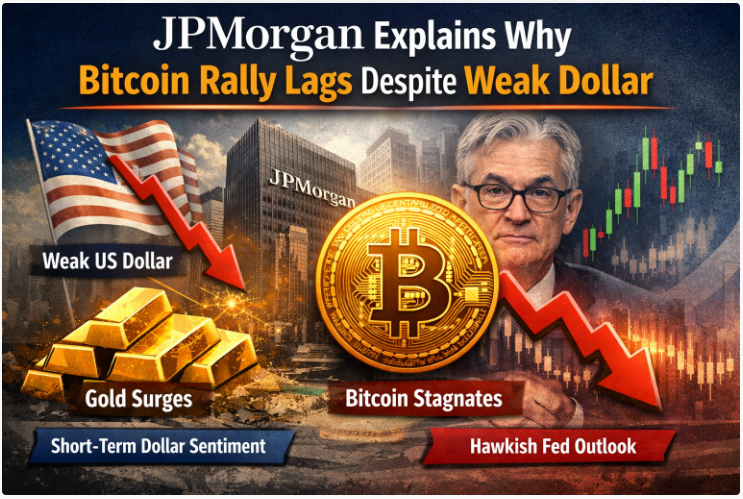
Against the usual bearish dollar trend, Bitcoin’s behavioral anomaly in the past has been a steady correlation with the dollar’s trend in losing value, the U.S. 10-year Treasury yield falling, and Bitcoin’s price rising (because investors look for alternate stores of value). On this occasion, Bitcoin has stayed range-bound. In the same period, the price of oversold gold has rallied, as have other traditional macro hedges, to Bitcoin’s disadvantage.
JPMorgan believes that investors are currently undervaluing Bitcoin as a hedge against currency erosion. Regulatory changing, for the time being, has framed Bitcoin as a risk asset aligned (consensus down) with the prevailing liquidity (macro and financial) of the system. This position is consistent with the price action of Bitcoin being affected by the undershooting of the Fed’s rate adjusting, followed by Powell’s prepared remarks of rate stickiness.
Recent Bloomberg U.S. Dollar Index (DXY) developments show the U.S. dollar has recently successfully posted a break above the 96.0 level. All this has come against the backdrop of Treasury Secretary Scott Bessent’s remarks, which formally curb speculation of the U.S. as a contiguous federal peripheral focusing on supporting the Japanese yen.
With U.S. Fed rate hike expectations pivoting around the June calendar, the new Powell-induced Trump Fed chair is framed to give her first remarks after the Powell/ Yellen (super) cycle ends.
According to the most recent data, Bitcoin has a trading price close to $87,845, trading more than 2% lower than the previous day, with an intraday high of $90,439 and a low of $87,612. There is no significant trading volume which suggests a careful investor market ahead of a critical expiration of crypto options.
As described by JPMorgan, Bitcoin is expected to continue falling behind traditional macro hedges, such as gold, until growth trends or interest rate changes, rather than short-term flows/sentiment, become the market drivers.