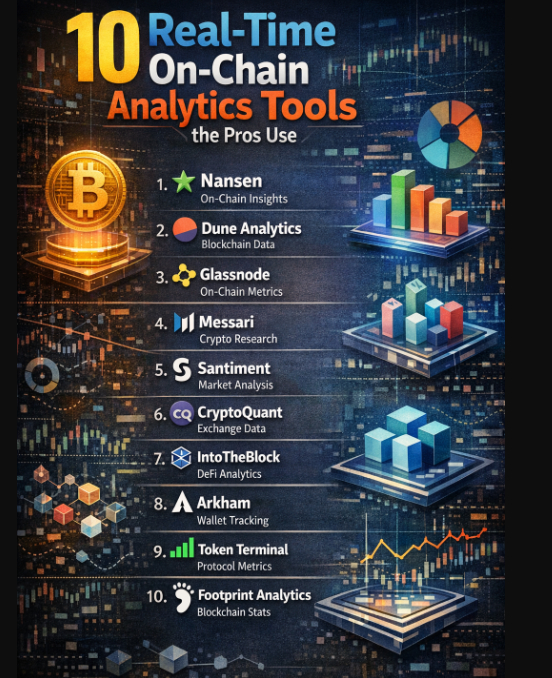
This article will discuss the Real-Time On-Chain Analytics Tools the Pros Use to get an advantage in the crypto trading space.
Tools like Glassnode and Nansen Analytics give traders powerful insights and metrics of blockchain activity in order to help them track movements, trends, and whale activity, as well as help them make smarter, real time, data-driven investment decisions.
What are real-time on-chain analytics tools?
Real-time on-chain analytics tools involve the tracking and analysis of raw blockchain data instantaneously (as it happens) with regards to transactions, wallets, tokens, flow of tokens, and overall network activity.
These tools provide insights from charts, indicators, and dashboards. With Glassnode and Nansen, traders and investors can see whale movements, inflows to exchanges, and other pertinent market data instantaneously.
These tools present data in a clear and recent manner so that users in the crypto market can make decisions based on actual data (as a posed to make decisions based on speculation) in a volatile market.
key points & Real-Time On-Chain Analytics Tools the Pros Use
| Tool Name | Key Point (Pro Insight) |
|---|---|
| Glassnode | Provides advanced on-chain metrics like SOPR, NUPL, and exchange flows to identify market cycles and investor behavior in real time. |
| Nansen | Uses wallet labeling and smart money tracking to reveal where top investors are moving funds across DeFi and NFTs instantly. |
| CryptoQuant | Delivers real-time exchange inflow/outflow data and miner activity to predict potential price movements and market sentiment shifts. |
| Dune Analytics | Offers customizable dashboards powered by SQL queries, enabling analysts to build and track real-time blockchain data visualizations. |
| Santiment | Combines on-chain, social, and development data to give a holistic view of market trends and sentiment analysis. |
| IntoTheBlock | Uses AI-driven insights and on-chain indicators like large holder activity and network growth to forecast price trends. |
| Arkham | Focuses on entity-level tracking, allowing users to trace wallets and identify real-world actors behind blockchain transactions. |
| Messari | Provides real-time data, research reports, and on-chain metrics to support professional-grade crypto analysis and decision-making. |
| Token Terminal | Analyzes blockchain financials like revenue, fees, and valuation metrics to assess the fundamental health of crypto projects. |
| DeFiLlama | Tracks Total Value Locked (TVL) across chains and protocols in real time, helping users monitor liquidity trends and DeFi growth. |
1. Glassnode
Glassnode has advanced and sophisticated on-chain metrics for analyzing Bitcoin and Ethereum and how each behaves within the market.
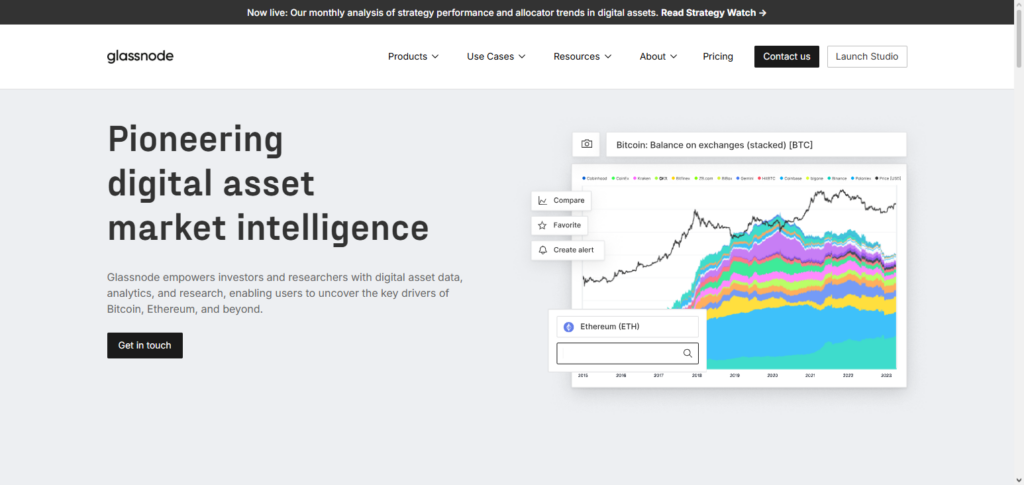
Some of the advanced metrics are SOPR (Spent Output Profit Ratio), NUPL (Net Unrealised Profit/Loss), and other metrics used for evaluating and determining the balance of both market and exchange accumulation and distribution.
Traders think of as the market big picture cycle when they want to analyze market trends and determine the cycle top or bottom to monitor macro trends of whale movements and long-holders liquidity and active positions. From premium insights and premium alerts, investors have the ability to make decisions with a lot of confidence based on data.
Glassnode Features:
- Advanced on-chain indicators (SOPR, NUPL, MVRV)
- Tracking exchange flows in real time
- Analysis of Long and short term holders
- Custom dashboards and alerts
Pros:
- Market insight accuracy is of premium quality
- Institutional clients trust Glassnode
- Interface is professional and clean
- Offers the strongest data for both Ethereum and Bitcoin
Cons:
- Premium plans are costly
- Offers limited data coverage for altcoins
- Platform is complex for newcomers
- Free version has major restrictions
2. Nansen
Nansen has its own distinct and own unique feature of ‘labeling wallets’ and the idea of following ‘smart money’ from other sources.
Nansen labels millions of wallets, thereby allowing users to determine where funds are coming from whether from a hedge fund, a whale or an institution.
By analyzing these funded (labelled) wallets, traders are able to identify a successful strategy and follow that strategy in real time. Nansen** unconfuses other market research tools so investors are able to follow the flow of money, whether that money is going into a DeFi, an NFT, or a new token.
Nansen is useful for discovering a ‘trend’/ alpha, as other users are able to use wallets that are performing well in order to predict market movements before the market actually moves.
Nansen Features:
- Tracking smart money wallets
- A system for labeling wallets
- Analytics for NFTs and DeFi
- Tracking flows of funds in real time
Pros:
- Tracking whale activity is easy
- Early detection of alpha is advantageous
- Dashboards are easy to use
- Provides insights into NFTs
Cons:
- Subscription cost is too high
- Free access is limited
- Platform can be overwhelming
- Data in fast moving markets can be slow
3. CryptoQuant
CryptoQuant is one of the most used platforms to observe the movement of exchanges, miners, and whales. With the help of CryptoQuant, users can understand the volatility of the market based on the exchange and influx flows.
the process of analyzing the market position, CryptoQuant helps to understand whether the investors were buying and/or selling. CryptoQuant includes features that notify users when there are drastic changes in on-chain activities.
It helps supply and demand experts to understand the market and detect the bull and bear early. It can be used by the beginners and experts.
CryptoQuant Features:
- Data on inflow and outflow of exchanges
- Tracking miners and whales
- A system to create alerts in the market
- Charts of on-chain data in real time
Pros:
- Innovative metrics easy to understand
- Platform is good for timing trades
- Compared to competitors pricing is affordable
- Analytics for Bitcoin are very good
Cons:
- Advanced customization is limited
- Fewer metrics for altcoins
- Interface feels basic
- Some indicators need to be interpreted
4. Dune Analytics
Dune Analytics allows users to create custom dashboards via an SQL query on the blockchain, which provides great flexibility. Users can represent the data in the form of a variety of complex visualizations.
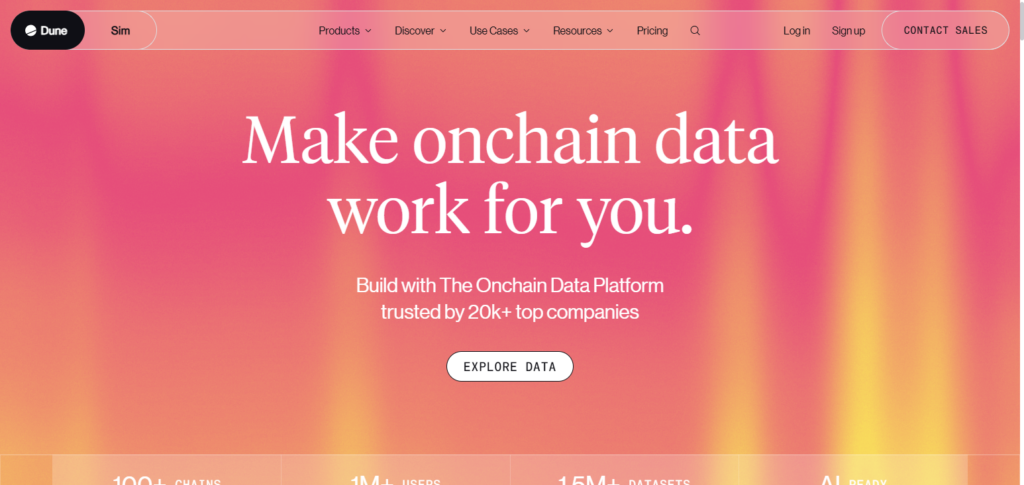
Dune Analytics users can create a variety of charts and presentations based on the data in the blockchain.
Due to the community-driven nature of Dune, there are various dashboards around the subjects of DeFi, NFTs, and governance. Dune Analytics is a great choice for data analysts, researchers, and developers.
Dune Analytics Features:
- Custom queries based on SQL
- Dashboards of the community
- Blockchain data in real time
- Community data access
Pros:
- Customization and personalization
- Strong community insights
- Developers are happy
- Basic use of the platform is free
Cons:
- SQL knowledge is required
- Not suitable for beginners
- Some queries may have delays
- There may be a steep learning curve to using the platform
5. Santiment
Santiment gives a market overview by combining on-chain data, social data, and development data. Santiment analyzes social sentiment metrics, developer activity, and token distribution.
Santiment helps users understand the effect market psychology has on price action. Santiment’s tools are especially good for identifying hype cycles and undervalued assets.
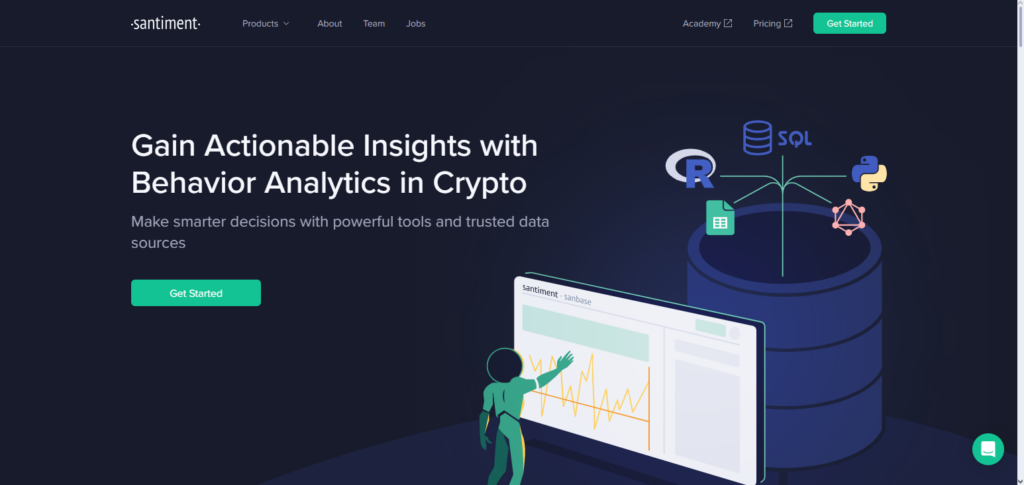
Because Santiment integrates multiple data sources, it gives a more complete view than purely on-chain platforms.
Most traders and investors combine their technical analyses with Santiment’s sentiment analysis tools, which helps improves their timing during trades and their overall strategy when trading in a volatile crypto market.
Santiment Features:
- Social sentiment analytics
- On-chain dev activity analytics
- Alerts
- Analytics for market behavior
Pros:
- Varied data sources
- Sentiment analytics
- Trend prediction service
- User-friendly
Cons:
- Features behind paywall
- Lack of raw data
- Low signal…
- Low metrics depth…
6. IntoTheBlock
IntoTheBlock uses AI and machine learning for more advanced on-chain insights. Some of the indicators it uses are large holder concentration, in/out of the money, and network growth.
IntoTheBlock helps users in their technical evaluation of the blockchain to determine if the asset being evaluated is over or under-value. Institutional investors use IntoTheBlock’s predictive models to estimate price movement and determine the risk associated with that price.
The platform uses its complex analytics to break down the information into signals that are easy to understand. This is especially convenient for traders who are looking for ready-to-use recommendations and do not want to delve into technical analyses.
IntoTheBlock Features:
- Predictive analytics
- Large holder metrics
- Network growth metrics
- In/out of the money metrics
Pros:
- Insights are clear
- Strong market predictive analytics
- Multiple assets covered
- Strong analytics for beginners
Cons:
- Limited AI predictive model
- Premium features are not accessible
- Less custom features
- Not suitable for deep analysis
7. Arkham
Arkham’s primary focus is on tracking specific entities and deanonymizing activities regarding blockchain. Users can see behind curtain real world entities associated with specific wallet addresses and uncover specific funding sources.
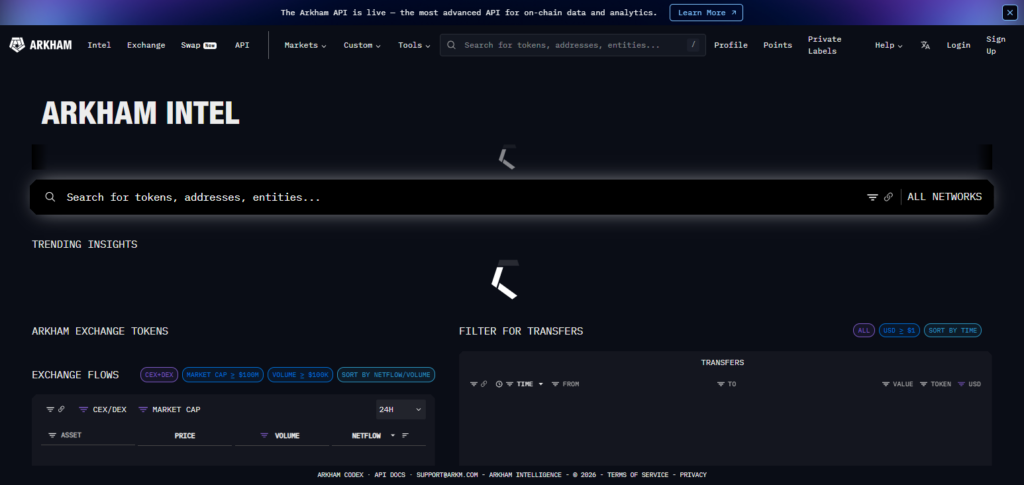
For investigative purposes, Arkham is essential in tracking specific suspicious activities, movements of whales, and the behavior of large institutions. Its intelligence engine attaches linked wallets and exchanges, funds, and people resulting in unparalleled transparency.
It is significant to compliance, security research, and other research that uncovers market and funding activity that cannot be discovered via on-chain metrics.
Arkham Features:
- Wallet tracking by entity
- Address reassociation
- Monitoring tools
- Analytics tools for tracking transactions
Pros:
- High usefulness for investigations
- Investigative analytics
- Monitoring & analytics
Cons:
- High privacy risk
- Limited historical tracking data
- Platform is not fully developed
8. Messari
Messari is an all-inclusive platform which provides, real time updates, research papers, and analytical tools. It encompasses every aspect of crypto assets, such as: tokenomics, governance, and market performance.
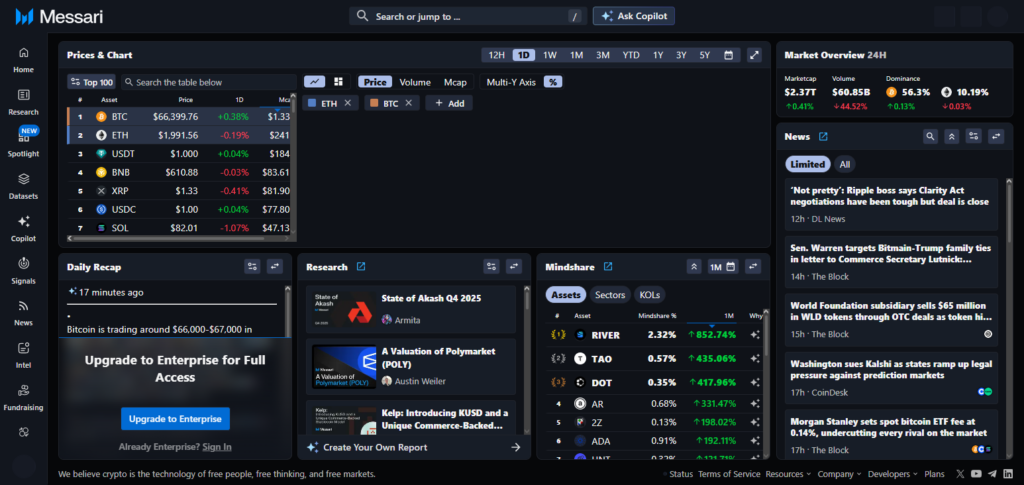
In the midst of strategic decision making, Messari provides customers with empirical research and fundamentals to simplify the investment calculus. It’s customers can utilize dashboards and screener tools for project comparison and performance tracking.
For the purpose of reliable data and comprehensive research, professionals use Messari, making it a necessary source for institutional quality cryptocurrency research and long term investment techniques.
Messari Features:
- Research reports by asset
- Analytics in real-time
- Screener along with analytics
- Governance data and Tokenomics
Pros:
- Analytics with fundamental analysis
- Research of high quality
- Data for analysis of top-tier institutions
- Reliable source of data
Cons:
- Costly subscription
- Low real-time focus
- Initial Overwhelm
9. Token Terminal
Focusing on financial data within the blockchain, Token Terminal analyzes and measures revenues, fees, and valuations. In evaluating the fundamental quality of a cryptocurrency project, investors may find it similar to evaluating a traditional stock.
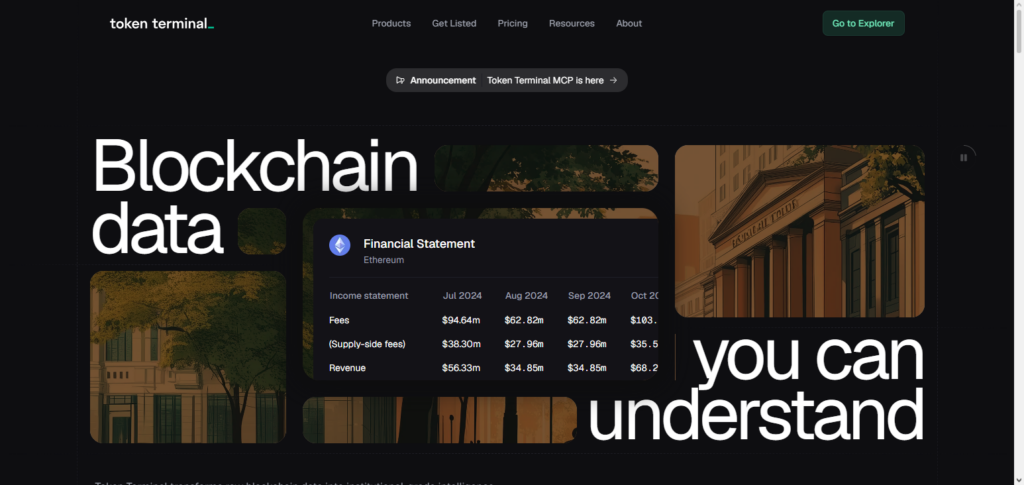
While analyzing a project, Token Terminal provides insight into the earnings of a protocol as well as the activity of its users. Fundamental analysis of the finance world is prevalent on the platform which is a significant driver of professionals searching for viable opportunities in crypto.
Token Terminal Features:
- Analytics for revenue and fees
- Valuation analytics
- Financial dashboards
- Comparative analysis for projects
Pros:
- Great for long-term fundamentals.
- Studies become extremely easy.
- Primary level institutional insights.
Cons:
- Fewer trading signals.
- Paywalls.
- More experienced audience required.
- Asset coverage is smaller.
10. DeFiLlama
DeFiLlama is the premier tracker of Total Value Locked (TVL) across a multitude of blockchains and protocols. It delivers up-to-the-minute analytics concerning liquidity and the growth of the DeFi ecosystem.
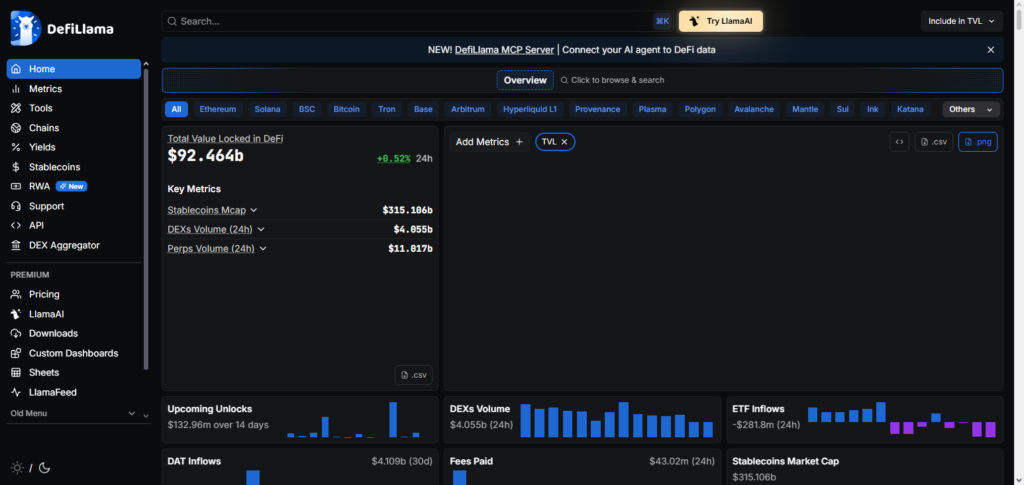
In the middle of market monitoring, DeFiLlama enables users to discover which chains and protocols are winning or losing capital. Its advertising-free and transparent business model is the reason for the trust analysts put in the tracker.
The tracker is an essential tool for liquidity and decentralized finance specialists because it provides analytics concerning yields, stablecoins, and protocol revenues.
DeFiLlama Features:
- Tracking TVL in all chains.
- Rankings of DeFi protocols.
- Yield data and data of stable coins.
- Analytics of several chains together.
Pros:
- Entirely free.
- Data is very reliable.
- DeFi wing has coverage.
- Simple and faster interface.
Cons
- Advanced Analytics is limited.
- Tracking wallets deeply not available.
- Visualization is basic.
- Predictive indicators missing.
Criteria for Selecting the Best On-Chain Analytics Tools
Data Accuracy and Reliability
The data provided must be clear, accurate, and verified in regard to the blockchain with negligible data. Reliable data will help traders and investors establish accurate real-time metrics.
Real-Time Data Processing
Up-to-the-second data updates are very important in the crypto markets. A strong enough tool should be able to deliver real-time data.
User Interface and Ease of Use
An easy and clear user interface will allow instant and effortless use of the tool to facilitate the understanding of the complex data of the blockchain, among other things.
Supported Blockchains and Assets
The best metrics should support other blockchains like Ethereum, and Bitcoin. This ensures that the user can analyze all blockchains, and find opportunities to maximize the value of the assets.
Advanced Metrics and Indicators
Quality metrics should be able to adequate data to allow a user to analyze the data at a quality that is beyond just the basic transaction data.
Customization and Flexibility
An ideal tool will allow the user to utilize data to establish a customizable dashboard, alerts, and queries to help them with their specific needs.
Pricing and Accessibility
An ideal tool will provide a value for what is offered and the pricing should be fair and clear. This will allow the user to determine if the tool is worth the investment.
Integrations and Compatibility
Integration with trading platforms, API’s, or other analytics tools streamlines workflows. Compatibility aids in seamless data utilization for automated trading strategies and detailed market analyses.
Community and Support
Communities, tutorials, and active users contribute to the platform’s learning. Tools with live chat customer support and community dashboards are effective in optimizing the platform’s utilization.
Benefits of Using Real-Time On-Chain Analytics Tools
Improved Market Entry and Exit Timing
Analysts can improve their market entry and exit timing by using real-time data. By using data on currently active transactions and their location, analysts can more quickly identify changes to the market.
Trust and Transparency
Every user can prove data created on the blockchain because it is public. Tools that analyze blockchain data can be used to demonstrate real-time network activity and data retrieved from dubious third parties.
Detecting Whales and Institutions
Users can observe the trading activity of large wallets and institutions. Whale trading is often associated with drastic changes in the market.
Early Detection of Trends and Changes
As time goes on, more users will identify and use the same tools and data that analytics tools detect and analyze changes in real-time.
Loss of Risk Reduction
Users will be able to see when the market will be at risk of losses and will be able to change their tools to avoid the possibility of incurring losses.
Reasonable Actions
Once tools are used to analyze the blockchain, users will be able to determine that their trading actions will be more predictable and less emotional.
Insights from Multiple Chains
Analytics tools are often applicable to multiple blockchains, which allows users to monitor more than one set of actions in traditional and novel blockchain utility systems.
Fundamental Analysis
Active addresses, transaction counts, and general network activity are examples of on-chain metrics that can help measure the long-term health & adoption of a crypto project, independent of price.
Risks and Limitations
Misinterpretation of the Data
Data on-chain can sometimes be misconstrued. For example, someone might misinterpret exchange inflows, whale movements, or on-chain metrics, leading to faulty conclusions and erroneous trading decisions.
Over-Reliance on the Data
Data analysis from an on-chain perspective without taking into account broad macro movements, news, geo-political factors, or the market’s mood can result in biased conclusions. This biased analysis can also result in substantial losses.
Lagging or Incomplete Data
Due to network congestion, indexing, or tools, not all data on the chain is process in real time; there is a chance of some data being processed in a time delayed manner, and so there may be substantial gaps in data.
Cost of Subscription to Premium Tools is High
Analytics tools offer premium subscription analytics. This is a disadvantage to retail analytics, as there is a greater analytical disparity between professionals and retail analytics.
Limited Context Behind Transactions
On-chain data illustrates the transaction, but does not always illustrate the reason for the transaction. For example, misinterpretation of the reason for a large wallet transfer can be misleading, as a simple operational transfer can cloud the real reason for the transfer.
Complexity with Advanced Metrics
Advanced metrics can be difficult to interpret. For example, metrics such as SOPR, NUPL, or token flow analytics are difficult to interpret for the average user, making these tools less usable.
Potential Market Manipulation
Market manipulators can execute specific whale-like operational movements for the sole purpose of misleading the market.
Incomplete Data Coverage for Various Chains
There are a few unsupported tools, such as new chains and tokens, to limit the visibility of emerging ecosystems and to minimize the potential of their use in a multi-chain analyses.
Reliance on Other Services
Users depend on other services to understand the blockchain. Errors, downtime, and changes to their methodology can impact trust and accuracy.
Data Overload
Users can be overwhelmed by an excess of metrics, dashboards, and signals. Without a target, confusion can be an outcome of data instead of better decisions.
Conclusion
Overall, the importance of real-time on-chain analytics tools for navigating the fast-changing crypto market increases as more advanced tools are developed. Using Glassnode, Nansen, and CryptoQuant, professionals can develop an understanding of market structures, liquidity shifts, and the state of the market, as well as how to navigate the crypto market effectively.
Although the tools offered can help professionals make data-driven decisions, they can also help professionals avoid the speculation that comes from trading without the tools.
It is important to remember that when using on-chain analytics, especially when competing in a market that is very data focused and very competitive, one must also practice analytics and risk management.
When everything about on-chain analytics is taken into consideration, one can also effectively navigate the crypto market when using tools like Glassnode, Nansen, and CryptoQuant.
FAQ
Which on-chain analytics tool is best for beginners?
For beginners, user-friendly platforms like IntoTheBlock and DeFiLlama are ideal. They offer simplified dashboards and easy-to-understand metrics without requiring deep technical knowledge or coding skills.
Are free on-chain analytics tools reliable?
Yes, many free tools such as DeFiLlama provide highly reliable data. However, premium platforms like Nansen offer deeper insights, advanced metrics, and more detailed analytics.
How do professionals use these tools effectively?
Professionals often combine multiple platforms like Nansen, Glassnode, and Dune Analytics to cross-verify data, track trends, and build comprehensive trading or investment strategies.
Can on-chain analytics predict crypto prices?
On-chain analytics cannot guarantee exact price predictions, but tools like Santiment and IntoTheBlock provide indicators that help forecast potential trends based on data patterns and market behavior.
Do these tools support multiple blockchains?
Yes, many platforms such as DeFiLlama and Token Terminal support multiple blockchains, allowing users to analyze data across various ecosystems like DeFi, NFTs, and Layer-2 networks.