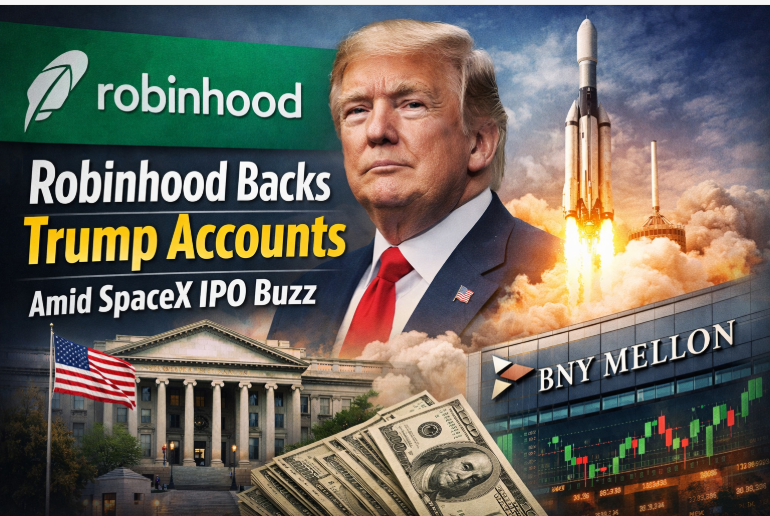
Robinhood has taken on a new life, associating itself with a U.S. government-backed financial endeavor tied to the Trump Accounts initiative. This initiative would see Robinhood serve as the broker-dealer provider and initial trustee in partnership with BNY Mellon, which fulfills their role as financial agents that manage account operations and overall program infrastructure.
The initiative is being handled by the U.S. Department of the Treasury and marks a huge mainstream expansion for Robinhood into government-backed financial services.
The program is designed to offer qualified participants expedited access to accounts designated by Treasury. For this purpose, a white-label app is currently being developed. The app will provide families with a structured interface to monitor and safely manage their accounts, reads a new post on X.
Robinhood is collaborating with the National Design Studio to make sure that the platform is easy for anyone, especially first-time participants. Robinhood is responsible for brokerage functions but Treasury will retain complete operational oversight of the account, including compliance monitoring and performance metrics as well as safeguards to protect taxpayer money.
This partnership comes as Robinhood is undergoing a restructuring period. The company also recently approved a $1.5 billion share buyback program to occur over 3 years starting in Q1 2026. This action underscores Robinhood’s commitment to returning capital to shareholders and enhancing investor confidence.

Robinhood’s stock responded positively to the partnership with the government. Shares climbed 1.92% to $70.22, or up $1.32 from the last close of $68.90. The trading afternoon mirrored short-term profit taking, but also fresh buying interest as investors remained largely undeterred by renewed volatility in the marketplace.
But the company also has uncertainty around a pending SpaceX IPO. The outlet added that the shares could potentially be distributed to individuals through Morgan Stanley’s E*TRADE platform, replacing Robinhood in SpaceX’s allocation plans.
SpaceX aims to make as much as 30% of its IPO shares available to retail investors — a larger percentage than is typically offered — but the final structure remains in flux. If Robinhood still gets an allocation, it is likely to be less than its fair share which means it would be a minor participant in the distribution process.
Ultimately, Robinhood’s participation in Treasury-backed Trump Accounts demonstrates a strategic pivot toward government-aligned finance. The partnership highlights Robinhood’s changing business model and allows the platform to cater to a new group of account holders, even as outside market events like the SpaceX IPO provide new complications and unknowns.