


Provably fair dice DApps are revolutionizing the way Web3 gamers play simple betting games through blind trust with cryptographic verification. Players don’t have to take a casino’s word for it. They are able to verify every single roll was fair by checking server seeds, client seeds, nonces or on-chain transaction records.
Below are ten popular dice sites, Diceon, XPRoll, Satosh.ie, QTUM Dice, Stake, BC.Game, Bitsler, FaucetPay, FreeTRON and BCH.games. It includes support for blockchain, wallet integration, cryptocurrencies, payouts, fees, security and transparency.
What Are Provably Fair Dice DApps?
Provably Fair Dice DApps are blockchain or crypto powered gaming applications that allow players to play online dice-based games and verify how the results are generated.
They use cryptographic methods such as server seeds, client seeds, hash functions, and verifiable randomness, which help users confirm that results were not secretly changed after a bet. Some platforms use smart contract technology, where the game activity is actually performed on a blockchain.

Others operate on centralized systems with seed-based validation. These applications are supposed to bring transparency, but provably fair technology cannot guarantee winnings, do away with house edges or prove that an entire platform is secure.
How to Choose the Best Provably Fair Dice DApp?
Check the fairness: Choose platforms that provide a clear explanation of server seeds, client seeds, hash functions and verification steps, so you can independently check the dice results after each completed game.
Check Blockchain Support: Research the supported blockchain network, transaction speed, reliability, and how it works with your preferred wallet before choosing a dice gaming app.
Check Wallet Integrations: Look for platforms that have popular Web3 wallet integrations and offer easy-to-use connection processes, secure transaction confirmations, and clear information on wallet permissions and asset management.
Check Supported Cryptocurrencies Look at the cryptocurrencies the platform takes for deposits and withdrawals (supported networks, minimum amounts, conversion requirements and transaction fees, etc.).
Know The Betting Rules And How To Win: Before you put your money on any dice game, check the minimum and maximum betting, payout multipliers, chances of winning, withdrawal rules, and the house edge.
Verify Decentralization Level: Determine if games are utilizing smart contract technology or centralized servers, and distinguish fully on-chain applications from platforms that only provide cryptographic fairness verification.
Security and Transparency Check Out . Look for transparent operating practices, independent verification methods, accessible game histories, and clear security information . Don ’ t just take the platform ’ s word for it.
Check availability and legal requirements: Before you get involved, check the regional access, status of operation of the platform, age restrictions and relevant gambling laws, as the availability and legal requirements differ from one jurisdiction to the other.
Key Points of the Top 10 Provably Fair Dice Platforms
| Platform / DApp | Key Features |
|---|---|
| Diceon | Wallet-based dice betting, instant payouts, adjustable odds |
| XPRoll | Daily dice rolls, leaderboards, jackpots, public verification |
| Satosh.ie | Dice, coin flip, mines, slots, Plinko |
| QTUM Dice | Over/under betting, wallet integration, automatic payouts |
| Stake Dice | Adjustable odds, multipliers, automated betting |
| BC.Game Dice | Classic Dice, Hash Dice, customizable betting |
| Bitsler Dice | Custom win chances, automated betting, bet verification |
| FaucetPay Dice | Instant balance settlement, adjustable win probability |
| FreeTRON Dice | Adjustable dice rolls, seed verification, crypto rewards |
| BCH.games Dice | Customizable dice outcomes, transparent calculations |
1. Diceon
Diceon is a lightweight, native Solana dice platform that is designed to be played directly from your wallet, instead of a traditional custodial casino account. Players then connect a Solana wallet, such as Phantom, and place bets in SOL. Players choose a target number or payout multiplier before rolling.
It is built on the Solana blockchain, and bets and roll results are processed and stored on-chain. Its “Open Fairness” system guaranties that each roll is signed, stored and publicly visible and users can verify bets through Solscan.

Wallet integration is non-custodial, meaning that users hold their own funds and no deposits or custodians are made on the platform. It primarily supports SOL, though the platform’s blog also makes generic reference to deposits of “preferred cryptocurrency.”
Payouts are processed through the blockchain and costs are tied to Solana network fees, not to any disclosed separate house fee schedule. Public on-chain records, public game logic and verifiable transaction history give rise to security and transparency.
Main Features
- Dice game on the Solana Blockchain.
- It uses blockchain transactions to ensure transparent game activity.
- Offers a gaming experience with a Web3 focus.
- Lets you interact through compatible crypto wallets.
- Employs provably fair principles to help players check game results.
Restrictions
- Knowledge of crypto wallets and blockchain transactions is required.
- Congestion on the Solana network can affect transaction speed.
- Network fees are dynamic and depend on blockchain activity.
- Availability of games and liquidity may be lower than traditional centralized platforms.
2. XPRoll
XPRoll is a dice product from BlocksForge, presented as a secure, transparent, decentralized, provably fair dice game. It is described in public information as a newer dice offering with recent roll visibility and UTC based game days, but its site provides relatively little operational detail as to licensing, payout policy or coin coverage.
The platform emphasizes provably fair dice, decentralization, and transparency. This implies the results are meant to be independently verifiable, rather than simply trusted. The public material does not clearly state its blockchain support so users should check the network and contract details before wagering.

The wallet integration is also not explicitly documented publicly and players would have to verify if it uses direct wallet connection or an internal balance.
The available source also does not publish the supported cryptocurrencies, payout timing, minimums and fee structure so the cashier and terms are the essential pre-play check. It claims to be “secure, transparent, decentralized,” but the details of the independent audit or the on-chain verification should be checked directly.
Key Features
- Runs as a daily dice game on XPR Network.
- Offers a four dice rolling format.
- Uses SHA-256 secret commitments in its fairness process.
- Uses drand randomness for supported game rounds.
- Gives you a daily gameplay format that repeats.
Limitations
- 1 . The daily format could restrict the frequency of user play.
- 2. The experience is conditional on the availability of its random process.
- 3. Fallback rounds may use a platform-held secret instead of drand.
- 4. it has a smaller selection of games compared to bigger crypto casinos.
3. Satosh.ie
Satosh.ie is a decentralized on-chain gaming platform built on verifiable randomness and non custodial play. It’s a dApp on Base, with Ethereum-only betting and no KYC, as stated in its fairness documentation. The platform employs Chainlink VRF, a cryptographically verifiable source of randomness that is tamper-proof by both player and operator, and the results are auditable on Basescan.

The house edge is hard coded into public contracts and the platforms smart contracts are open source. The wallet integration is direct and non-custodial, meaning users play from their own wallets rather than depositing into a centralized casino balance. It allows ETH wagering on Base, and there is related material that references Base and Arbitrum infrastructure.
Smart agreements take care of payouts and promotional material states Base gas fees are less than $0.01. Open contracts, on-chain auditability, VRF-based randomness, and public house-edge logic ensure security and transparency.
Main Features
- Demonstrates a blockchain dice gaming model.
- Uses Chainlink VRF v2.5 for provably random.
- Links smart-contract functionality with dice-game results.
- Give an example of externally generated verifiable randomness.
- Uses a verification method for games based on Web3.
Limitations
- Its deployment is documented on Base Sepolia testnet.
- Testnet use is no guaranty of production-mainnet availability.
- Testnet tokens usually don’t have any real money value.
- A user may need a technical background to understand its smart-contract workflow.
4. QTUM Dice
QTUM Dice is a fully functional provably fair dice betting game running on the QTUM blockchain testnet. As such it is mostly a developer oriented demo instead of a mainstream production casino. Players bet on whether a dice roll will be over or under a target between 1 and 100 and receive automatic on-chain payouts.
It is built solely for the QTUM blockchain, and uses QTUM’s unit system of satoshis, where 1 QTUM = 100 million satoshis. Its fairness model is a commit-reveal scheme: the frontend generates a player seed, hashes it and submits the hashes to the smart contract, and the scheme prevents either house or player from manipulating the result.

Wallet integration is performed through MetaMask by using the qtum-wallet extension that connects users to the QTUM testnet environment. QTUM is the supported cryptocurrency for making staking bets and getting automated payouts.
Payouts are automatic and on-chain, but tokens usually have no real world monetary value as they are used on the testnet. Security and transparency are provided by smart contract execution, hashed seed commitments, and the verifiable commit-reveal process.
Main Features
- Works with the QTUM blockchain ecosystem.
- Displays a dice game model based on intelligent contracts.
- Use a commit-reveal process to generate the outcome.
- Supports wallet interaction via tools like MetaMask, QTUM Wallet Snap.
- Provides an example of game verification using blockchain.
Constraints
- It is a documented QTUM testnet reference implementation project.
- Testnet deployment is not a confirmation of a live-money gaming service.
- The commit-reveal process has backends.
- For beginners, setting up wallets and networks can be tricky.
5. Dice Stake
Stake Dice is a Stake Originals casino game that allows you to simply bet over/under on dice using Bitcoin and other cryptocurrencies we support. It’s been a part of the Stake’s in-house Originals line-up since 2017, and available within a broader casino and sportsbook account.
Stake doesn’t release one public blockchain for the game, it’s a centralized casino product, not an on-chain dice dApp. It has a provably fair system that allows players to verify each result using cryptographic hashing and seed verification and a published 99% RTP and 1% house edge.

There is no direct betting from a non-custodial wallet, rather a wallet integration with a single Stake account balance. Cryptocurrencies supported are Bitcoin, Ethereum, Dogecoin, Litecoin, Tether, XRP, Bitcoin Cash, TRON, EOS and more.
Withdrawals are normally processed within minutes and the platform doesn’t charge a withdrawal fee, although standard blockchain network fees are applicable. Security and transparency, provably fair Originals, seed-based verification and Curaçao licensed operational framework.
Key Features
- Provides a digital dice game within a larger crypto gaming platform.
- Provides adjustable bet amounts.
- Lets players choose target odds and payout multipliers.
- Implements server-seeds and client-seeds for provably fair verification.
- Shows the game history and betting information.
Limitations
- It is a centralized gaming product, not a full on-chain DApp.
- Players rely on the platform’s account and withdrawal systems.
- Betting results are still affected by the house edge of the game .
- Availability and payment options may differ by location.
6. BC.Game
Dice BC.Game Dice is one of BC.Game’s own “BC Originals”. You can bet on roll-over or roll-under dice with an option to play automatically. It’s part of a massive crypto casino and sportsbook platform with thousands of third-party games. BC.Game is not an on-chain dice protocol, it is a centralized casino that uses its own multi-coin wallet to process bets.

Its Classic Dice uses a server seed, client seed and nonce hashed with SHA-256 . Players can rotate seeds and recompute results through the fairness verifier. The platform supports over 100 to 150 cryptocurrencies depending on the source and date. The platform supports BTC, ETH, USDT, TRX, SOL, DOGE, XRP, LTC, BCH and its native BCD token.
Payouts are often reported within about 5-20 minutes, no internal deposit or withdrawal fee according to operator policy, but blockchain network fees still apply. Security and transparency: Provably fair Originals, published verification methods, independent audit claims for its in-house games.
Key Features
- Offers dice gaming within a larger crypto casino.
- Has variable betting parameters.
- Has different risk and payout combinations.
- Verification through a provably fair seed.
- It supports multiple cryptocurrencies within its gaming ecosystem.
Limitations
- It is not a completely decentralized smart-contract dice app.
- Players use the platform to play games and to make withdrawals.
- Jurisdictions may have different supported currencies and services.
- Proving the provable fairness does not remove the house edge
7. Bitsler Dice
Bitsler Dice is a long-running crypto dice game from Bitsler, a platform that was established in 2015 and has grown from a Bitcoin dice game into a full casino and sportsbook. It features customizable win chance, over/under betting and a published 99% RTP with a 1% house edge. Bitsler is a centralized crypto casino.
Players don’t bet from a self-custody wallet, but from an internal account they fund. Its provably fair system combines a server seed, client seed and nonce; the server seed hash is shown before play, then revealed for verification through Bitsler’s verifier.

Dice supports a whole bunch of cryptocurrencies including Bitcoin, Solana, Tether, Dogecoin, Bitcoin Cash, Ethereum, XRP, TRON, USD Coin and Litecoin. The live cashier displays the current set.
Payout speed and fees vary by coin and network, but one review stated approximately 20-minute withdrawals and a 0.0004 BTC withdrawal fee, which should be checked live. Security and transparency are supported by cryptographic seed verification, a public fairness page and operation under a Curaçao license.
Main Features
- Offers dice gaming via a cryptocurrency gambling platform.
- Allows players to change bet sizes.
- Features variable payout multipliers and chances of winning.
- Uses a provably fair cryptographic seed verification.
- Supports deposits and withdrawals of cryptocurrency.
Limitations of the Study
- The central platform controls the operation of the game.
- Players should be aware of how to check seed verification, to verify outcomes themselves.
- Smaller deposits and withdrawals might be affected by the cryptocurrency transaction fees.
- The house edge of the platform means that repeated play carries a mathematical disadvantage
8. FaucetPay Dice
FaucetPay Dice is a special game in FaucetPay, a platform for crypto micro-wallets and earning from faucets. It is for small balances and instant settlement. Players pick a coin balance, pick roll-over or roll-under, adjust win chance and the round settles instantly in that same coin.

FaucetPay is a centralized wallet service, not an on-chain casino, so dice play is done with the internal FaucetPay balance, not a separate casino wallet. It uses a commit-reveal seed pair that is provably fair: the server seed is hashed and published before play, the client seed is user-controlled, and a nonce increments per bet; after seed rotation, the previous server seed is revealed to recalculate.
Faucet payouts are possible for BTC, ETH, USDT, LTC, DOGE, BCH, DASH, DGB, TRX, ZEC, SOL, BNB, FEY, and USDC, with deposits possibly supporting a larger number of coins. Internal FaucetPay to FaucetPay transfers are instant and fee-free, on-chain withdrawals are dependent on the destination network and congestion. Security and transparency are provided by seed-based verification, user-controlled client seeds and accessible round-history checks.
Main Features
- Adds dice-style gaming to the FaucetPay ecosystem.
- Integrates gameplay with a cryptocurrency micro-wallet environment.
- Supports small-value crypto gaming activities.
- Provides a simple format for users who have used FaucetPay.
- Allows access to dice-based games without a separate full-scale casino account.
Restrictions
- It is not a fully decentralized on-chain dice DApp.
- The games available and the coins supported depend on the current services of the platform.
- Small balances may be subject to minimum withdrawal requirements.
- Users rely on the availability of FaucetPay’s account, wallet and service.
9. FreeTRON Dice
FreeTRON Dice is a dice game on FreeTRON.in, a TRON-focused crypto gaming and earning site. The public fairness page says every game result is calculated from three inputs and players can see all three after each round to recalculate the result themselves.
The platform name and domain hint at a TRON-focused service, but the available public pages do not contain the exact game contract, the way to connect a wallet, or a complete list of supported TRON-based assets.

Its model for provably fair seems to follow the common server-seed, client-seed and nonce structure, allowing for post-round verification instead of having to blindly trust the operator. Unfortunately, the details of wallet integration are not clearly published in the sources that are accessible, so users should check whether FreeTRON uses an internal balance, TRON wallet connection, or something else before playing.
No supported cryptocurrencies, payout timing, minimum withdrawal amounts, and fee schedules are disclosed in the retrieved public material. Security and transparency are largely based on its published provably fair mechanism. Players should look for more evidence of licensing, contract audits and payout reliability before risking funds.
Main Features
- Focused on dice-style gaming in the TRON ecosystem.
- Supports TRON-based cryptocurrency games.
- Has a simple dice-betting format.
- Offers an alternative for users who are used to TRON-based transactions.
- Uses a crypto gaming model based on quick betting rounds.
Limitations
- It should not be automatically considered a fully decentralized smart-contract DApp.
- Available games and payment details may change from time to time.
- Players can rely on the operator for game execution and withdrawals.
- TRON network conditions and transaction requirements can impact user satisfaction
10. BCH.games
BCH.games is a dice platform that is focused on Bitcoin Cash, with branding that indicates BCH is the main currency for playing. There was no authoritative current platform page outlining its full fairness implementation, wallet model, fee schedule or payout policy in the public search results found here, so those points should be verified on the official site prior to use.
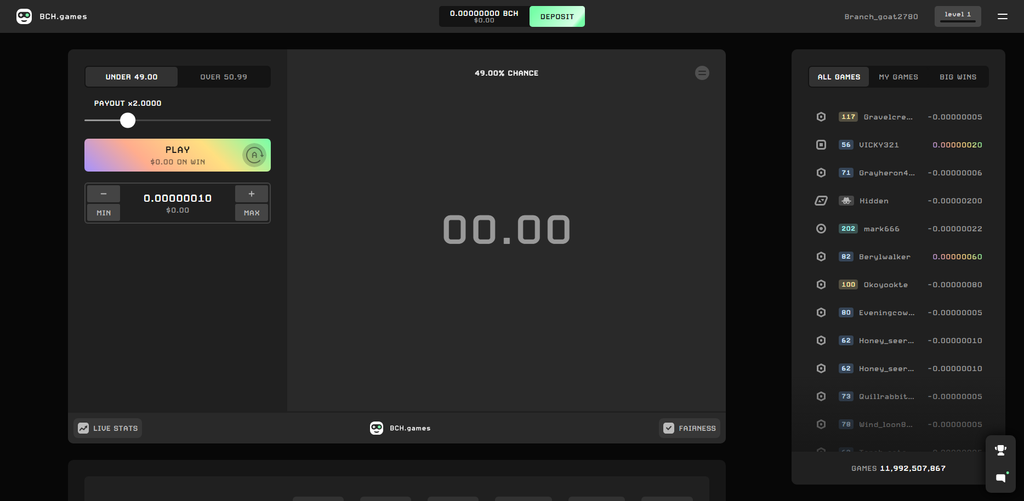
Bitcoin Cash dice betting is the flagship product of the platform, and would usually mean BCH is the asset used for wagers and payouts. BCH is often used for small, high-frequency crypto transactions, so it will likely be attractive for low-cost, high-speed Bitcoin Cash transactions.
However, I could not find any published provably fair specification, supported wallet integration, house edge or withdrawal-fee policy from the available sources, like I could with Diceon, Satosh.ie, QTUM Dice, Stake, BC.Game, Bitsler and FaucetPay. You want a documented seed and nonce verification system before you deposit, for transparency and security. Clear terms. A history of active payouts. Independent community or audit evidence.
Key Features
- Provides dice type cryptocurrency gaming linked to Bitcoin Cash.
- Provides a simple betting structure for BCH users.
- Allows for gameplay with cryptocurrencies.
- Appeals to users who are used to Bitcoin Cash transactions.
- An alternative to conventional fiat-based dice gaming.
Constraints
- Should not be automatically classified as a fully on-chain Dapp.
- The games and payments available may vary according to the current operations of the platform.
- Players can trust the operator for settlement of the game and withdrawals.
- Bitcoin Cash transaction requirements can impact deposits and withdrawals.
Conclusion
These crypto dice platforms provide a variety of experiences for players looking for fast-paced, chance-based gaming with digital currencies. Options such as Stake Dice, BC.Game Dice and Bitsler Dice boast advanced features, customization tools and multi-cryptocurrency support, whereas platforms like FaucetPay Dice, FreeTRON Dice and BCH.games Dice cater to users who prefer simplicity and lower entry requirements.
Common strengths across all platforms are provably fair systems, fast-paced gameplay and flexible betting options. But most have similar downsides, like reliance on luck, cryptocurrency volatility, limited game selection, and possible regional access issues. Ultimately, it comes down to personal preference, cryptocurrencies supported, features required and risk tolerance.
FAQ
Which platforms are most transparent?
Diceon, Satosh.ie, and QTUM Dice stand out for on-chain or verifiable randomness. Diceon records rolls on Solana, Satosh.ie uses Chainlink VRF, and QTUM Dice uses a commit-reveal scheme
Which platforms use internal wallets?
Stake, BC.Game, Bitsler, and FaucetPay use internal account balances rather than direct non-custodial wallet betting
Which cryptocurrencies are commonly supported?
BTC, ETH, USDT, LTC, DOGE, BCH, SOL, TRX, and XRP appear across several platforms; Diceon focuses on SOL and Satosh.ie on ETH via Base
Do these platforms charge fees?
Most platforms pass blockchain network fees to users. BC.Game and Stake state no internal withdrawal fee, while Bitsler’s fees vary by coin and network.


