In the unpredictable global environment we find ourselves in today, investors should brace for sudden disruptions triggered by political tensions, conflicts and economic uncertainty.
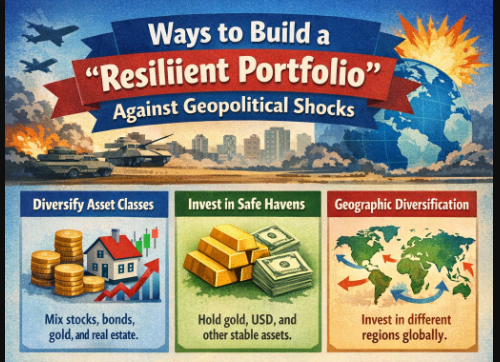
Ways to Build a “Resilient Portfolio” Against Geopolitical Shocks, for example, risk management and tactical asset allocation make it possible to make the investment portfolio less vulnerable to market volatility while enabling its successful adaptation or ability to resist rapidly changing global conditions.
What is Geopolitical Risks?
Geopolitical risks can be defined as the risk for economic instability that occurs, especially in financial markets due to political events like conflicts or international tensions. These risks come from wars, trade disputes, economic sanctions, government policy changes and diplomatic conflicts between nations.
Tensions pose risks to global supply chains as well as investor confidence, currency values and asset prices, often causing volatility in the market. They create challenges for investors and businesses because they are unpredictable, take hold easily, and can get out of hand quickly.
Geopolitical risk classifies knowledge about economic, social and political events that will help one build more inner resilience as you are able to make more educated decisions in creating your strategies that will save your investments during this global uncertainty times.
| Strategy | Key Point |
|---|---|
| Diversify Across Asset Classes | Allocate investments across equities, bonds, commodities, and cash to reduce exposure to any single shock event. |
| Global Geographic Diversification | Invest in multiple regions to avoid concentration risk tied to one country’s political instability. |
| Include Safe-Haven Assets | Allocate to assets like gold or government bonds that historically perform well during crises. |
| Focus on Defensive Sectors | Prioritize sectors like healthcare, utilities, and consumer staples that remain stable during uncertainty. |
| Maintain Liquidity Buffer | Keep a portion of the portfolio in liquid assets to quickly respond to sudden geopolitical developments. |
| Currency Diversification | Hold assets in different currencies to hedge against currency devaluation risks. |
| Limit Overexposure to High-Risk Regions | Avoid excessive allocation to politically volatile or conflict-prone regions. |
| Use Hedging Strategies | Apply tools like options or inverse ETFs to protect against market downturns. |
| Invest in Quality Assets | Choose companies with strong balance sheets and consistent cash flows for stability. |
| Regular Portfolio Rebalancing | P |
1. Diversify Across Asset Classes
Maintaining exposure across asset classes is a cornerstone of portfolio risk management in uncertain markets. Diversification across equities, fixed income, commodities and cash can help investors offset losses the one asset class has underperformed as a result of geopolitical tensions.

Stocks, for example, might go down during times of conflict, while bonds or gold might rise. This balance stabilizes returns and prevents big drawdowns. Ways to Build a “Resilient Portfolio” Against Geopolitical Shocks:
The most effective is to make sure no one asset class dominates your portfolio. A diversified portfolio provides greater flexibility, mitigates volatility and enhances long-term risk-adjusted return.
Diversify Across Asset Classes Key Features:
- Diversifies between equities, bonds, commodities and cash
- Reduces dependency on a single asset class
- Neutralizes risk vs return mechanics
- February, March and December are absolute winners
Pros:
- Minimizes overall portfolio risk
- Delivers better long- run returns
- Protects against market-specific downturns
- Improves long-term performance consistency
Cons:
- Can cap high returns during bull markets
- Requires continuous monitoring
- Complex allocation decisions
- May dilute strong-performing assets
2. Global Geographic Diversification
Investment within various countries and regions helps mitigate the reliance on any single economy or political system. Geopolitical risks like sanctions, trade wars, or regional conflicts can hit individual markets hard, but global exposure cushions those types of localized shocks.
Developed and emerging markets do not always respond in the same way to global events, providing balance within a single portfolio.

An important focus of Ways to Build a “Resilient Portfolio” Against Geopolitical Shocks is really investing in the international markets, so that you can capitalize on diverse growth opportunities and also take into the account risk management.
This strategy provides a degree of stability and adaptability that results in superior risk-adjusted performance particularly in uncertain environments where adverse developments can disproportionately affect overall portfolio performance.
Global Geographic Diversification Key Features:
- Invests across various exiting countries and regions
- Reduces country-specific risk exposure
- Covers developed and emerging markets
- Balances global economic cycles
Pros:
- Protects against regional instability
- Captures global growth opportunities
- Reduces political risk impact
- Enhances diversification benefits
Cons:
- Foreign exchange risk.
- Complex tax regulations
- Requires global market knowledge
- Potential geopolitical uncertainties abroad
3. Include Safe-Haven Assets
Safe-haven assets such as gold, government bonds and some currencies usually hold on to or grow in value when geopolitical tensions arise. Such an asset class serves as a buffer when equities are volatile (war and political tensions, economic sanctions, etc.)

Gold especially spent a long time the best store of value in uncertain times. Adding such assets is one of the well-documented Ways to Construct a “Resilient Portfolio” for Geopolitical Shocks as they offer downside insurance while keeping capital intact.
A judicious allocation to safe havens allows for a reduction of portfolio risk, while enhancing stability during volatility of an unpredictable global order and financial market disruption.
Include Safe-Haven Assets Key Features:
- Such as gold, government bonds and stable currencies
- Performs well during crises
- Provides capital preservation.
- Provides downside protection
Pros:
- Reduces portfolio volatility
- Preserves wealth during uncertainty
- Provides stability in bear markets
- Sheds light on inflation hedge
Cons:
- Returns are depressed when market conditions are stable
- Opportunity cost of keeping non-growth assets
- Price fluctuations in commodities
- Limited income generation
4. Focus on Defensive Sectors
Defensive industries like healthcare, utilities and consumer staples usually hold up well during economic downturns or geopolitical threats. Such industries supply products and services that remain in demand even when external conditions change, leading to relatively stable revenues and earnings.

By investing in such sectors, it can help with protecting portfolios from sharp declines during market stress. In fact, one of the two strategic Ways to Build a “Resilient Portfolio” Against Geopolitical Shocks involves allocating capital to companies in these sectors due to their historical tendency toward lower volatility and consistent performance.
This reliability can create a steady revenue stream and diminish the effects of wide-scale market interruptions.
Focus on Defensive Sectors Key Features:
- Focused on healthcare, utilities, and consumer staples
- Steady demand in any economic environment
- Less volatile than cyclical sectors
- Consistent earnings generation
Pros:
- Reliable performance during downturns
- Provides steady income streams
- More recession-resistant
- Reduces portfolio risk
Cons:
- Limited growth potential
- Underperformance in bull markets
- Sector concentration risk
- Regulatory challenges
5. Maintain Liquidity Buffer
A liquidity buffer means allocating a percentage of the portfolio to cash or to highly liquid instruments, such as money market funds and short-term treasury bills.
This allows investors to react quickly to surprise geopolitical shocks without having to sell long-term investments at depressed prices. Liquidity allows for flexibility to capitalize on opportunities during price corrections.

One of the essential Ways to Build a “Resilient Portfolio” Against Geopolitical Shocks is to ensure sufficient liquidity, in order to reap the fruits of uncertainty.
It provides a cushion for liquidity, enabling investors to hedge, fulfill promises and make moves at times of uncertainty in the market.
Maintain Liquidity Buffer Key Features:
- Maintains its funds in cash or near-cash instruments
- Allows for fast access to fund
- Supports emergency financial needs
- Provides flexibility during volatility
Pros:
- Enables swift reaction to market shifts
- Prevents forced asset selling
- Provides safety during uncertainty
- Enables opportunity buying
Cons:
- Negative returns on cash holdings
- Inflation erodes value
- Reduces overall portfolio growth
- Idle capital risk
6. Currency Diversification
Having multi-currency assets serves as protection against potential depreciation of a state’s currency following geopolitical instability. When one currency decays due to political or economic shocks, others may hold steady, or move up in value, and balance out the worth of the portfolio.

This is particularly important for investors exposed to international markets. A Guide to Building a “Resilient Portfolio” in the Face of Geopolitical Shocks frames diversification away from dependency on one economic system through disparate currency exposures.
Diversifying currencies helps to increase financial resilience by minimizing exchange rate risks and ensuring that geopolitical shocks in one country do not dent overall portfolio returns.
Currency Diversification Key Features:
- Specifies the holding of assets in various currencies
- Diminish dependence on one currency
- Mitigates exchange rate risks
- Supports international investing
Pros:
- Protects against currency devaluation
- Enhances global exposure
- Balances economic fluctuations
- Improves risk management
Cons:
- Complex currency tracking
- Exchange rate volatility
- Additional transaction costs
- Currency movements can be hard to predict
7. Limit Overexposure to High-Risk Regions
Geopolitical risk Geopolitical risk can be managed by avoiding overinvestment in politically unstable or war-prone areas. Markets in such regions are more susceptible to abrupt disruptions, shifts in regulations or capital controls that dampen investments.

Although, they may be areas of high growth potential, but they also have a lot of uncertainty. Maintaining Well-Balanced Exposure and Country-Specific Risk Assessment is one of the many Wise Ways to Build a “Resilient Portfolio” Against Geopolitical Shocks.
The solution is simple: Harness the power of a diversified global portfolio, but protect against concentrations in areas prone to significant adverse risk.
Limit Overexposure to High-Risk Regions Key Features:
- Prevent over-allocation to volatile asset classes
- Focuses on risk-adjusted investments
- Assesses political and economic stability
- Maintains balanced regional exposure
Pros:
- Reduces geopolitical risk impact
- Provides protection against market drops
- Enhances portfolio safety
- Improves long-term sustainability
Cons:
- Missed high-growth opportunities
- Requires continuous risk assessment
- Small exposure to emerging markets
- Potential over-conservatism
8. Use Hedging Strategies
Hedging refers to the practice of using financial derivatives like options, futures, or inverse exchange-traded funds in order to mitigate potential losses in a given portfolio. Such strategies provide insurance during market turbulence stemming from geopolitical developments.
For example, if you’re worried about the stock market falling, you can use put options to shield yourself from such an event; or hedge your precious metals prices through commodity futures.

One of the advanced Ways to Build a “Resilient Portfolio” Against Geopolitical Shocks is Utilizing hedging as an extra layer of protection.
While hedging usually comes at a cost, it is a crucial tool that can heavily mitigate downside risk and stabilize the overall portfolio in these difficult times.
Use Hedging Strategies Key Features:
- Uses options, futures and inverse ETFs
- Protects against downside risk
- Acts as portfolio insurance
- Reduces volatility impact
Pros:
- Limits potential losses
- Enhances risk control
- Provides strategic flexibility
- Useful during market uncertainty
Cons:
- Additional costs involved
- Requires expertise and timing
- Can reduce overall returns
- Complex implementation
9. Invest in Quality Assets
Emphasizing high-quality, fundamentally-centric investments with strong balance sheets, low leverage, and steady cash flows will be the keys to long-term resilience. These businesses are better positioned against economic and geopolitical disruptions than weaker firms.

Quality assets generally bounce back faster and retain investor’s confidence during crises. Investing in such sectors isOne of the Sillegal “Ways to Build a Resilient Portfolio” Against Geopolitical Shocks for stability and durability.
This tactic minimizes exposure to market volatility and strengthens the portfolio’s capacity to deliver consistent returns in the long-term.
Invest in Quality Assets Key Features:
- Strong balance sheets focus
- Targets companies with stable cash flows
- Emphasizes low debt levels
- Prioritizes long-term stability
Pros:
- Better resilience during crises
- Consistent returns over time
- Lower default risk
- Strong investor confidence
Cons:
- Higher valuation costs
- More modest expansion than riskier assets
- Limited short-term gains
- Market saturation risk
10. Regular Portfolio Rebalancing
Regular portfolio rebalancing maintains asset allocations in accordance with an investor’s risk tolerance and financial goals during evolving geopolitical scenarios. Market movements can change the balance of asset classes, increasing risk if the agent does not adjust.
Rebalancing is simply the act of buying or selling assets back to their target allocation on a regular basis.
As a consequence, another one of the best Ways to Build a “Resilient Portfolio” Against Geopolitical Shocks is this disciplined approach that supports you in maintaining diversification as well getting ahead of risk.
Rebalancing is a way for investors to keep pace with shifting forces in the market and maintain long-term stability in their portfolios.
Regular Portfolio Rebalancing Key Features:
- Adjusts asset allocation periodically
- Maintains desired risk levels
- Responds to market changes
- Ensures diversification balance
Pros:
- Maintains consistency with the portfolio goals
- Controls risk exposure
- Encourages disciplined investing
- Locks in profits
Cons:
- Transaction costs involved
- Time-consuming process
- Tax implications on gains
- Requires consistent
How these Risks affect different asset classes
Equities (Stocks)
Geopolitical threats often lead to spikes in market volatility, declines in investor confidence and stresses on corporate earnings. Stocks in impacted areas or sectors may drop dramatically because of uncertainty, sanctions, or less global commerce activity.
Bonds (Fixed Income)
Government bonds are a safe haven and could be pushed higher, while corporate bonds will carry credit risk in periods of instability. Geopolitical tensions also affect interest rate changes and inflation expectations, which in turn influence bond yields and prices.
Commodities
Geopolitical tensions can lead to supply chain problems that drive up commodity prices for oil, gas and metals. Uncertainty tends to increase demand for commodities like gold, causing prices to rise as investors seek security in the face of instability.
Currencies (Forex)
The currencies of stable economies tend to strengthen, and those in conflict zones weaken. Exchange rates are moving because of capital flows, trade interruptions and central bank actions that are being affected by geopolitical events.
Real Estate
Property markets may decelerate from decreased investor confidence and economic volatility. However, geopolitical turbulence will likely spark some reallocation of capital to safer places and stable regions may benefit from such surges in demand.
Cash & Cash Equivalents
Cash is appealing in times of uncertainty for its availability and security. Nevertheless, challenges based on geopolitical risk can fuel inflation, eroding purchasing power and making cash less effective as a long-term investment.
Cryptocurrencies
Geopolitical events can increase volatility in crypto markets. While some see these projects as alternatives to traditional systems, both regulatory uncertainty and market sentiment can lead to volatile price movements.
Defensive Sectors
Sectors such as healthcare and utilities tend to be fairly stable because demand does not stop regardless of political conditions. During times of crisis, these sectors often do well and offer to generate steady returns and lower volatility in the overall portfolio.
Conclusion
Geopolitical risks can be defined as the risk for economic instability that occurs, especially in financial markets due to political events like conflicts or international tensions. These risks come from wars, trade disputes, economic sanctions, government policy changes and diplomatic conflicts between nations.
Tensions pose risks to global supply chains as well as investor confidence, currency values and asset prices, often causing volatility in the market. They create challenges for investors and businesses because they are unpredictable, take hold easily, and can get out of hand quickly.
Geopolitical risk classifies knowledge about economic, social and political events that will help one build more inner resilience as you are able to make more educated decisions in creating your strategies that will save your investments during this global uncertainty times.
FAQ
Why is portfolio diversification important during geopolitical shocks?
Data shows diversified portfolios experience lower drawdowns compared to concentrated ones. When one asset class declines due to geopolitical stress, others like bonds or gold often stabilize overall performance.
Which asset classes perform best during geopolitical crises?
Historically, safe-haven assets such as gold and government bonds perform better during crises, while equities tend to be more volatile due to uncertainty and reduced investor confidence.
How does global diversification reduce risk?
Data indicates that investing across multiple regions reduces exposure to country-specific risks. Economic or political instability in one region is often offset by stability or growth in others.
Do defensive sectors really outperform during uncertainty?
Yes, historical data shows sectors like healthcare, utilities, and consumer staples maintain stable earnings and often outperform cyclical sectors during geopolitical or economic downturns.
Is holding cash a good strategy during geopolitical instability?
Cash provides liquidity and flexibility, allowing investors to manage emergencies or seize opportunities. However, data also shows that excessive cash holdings may lose value due to inflation.