
In the fast evolving Why Crypto Companies Diversify Revenue Beyond Trading Fees. To control market volatility, lessen reliance on transactional revenues, and guarantee long-term growth, cryptocurrency companies are diversifying their sources of income.
These platforms are developing into multifaceted financial ecosystems, increasing customer engagement, strengthening resilience, and setting themselves up for long-term success in a fiercely competitive digital economy by branching out into staking, lending, subscriptions, NFT marketplaces, and institutional services.
Why Crypto Companies Diversify Revenue Beyond Trading Fees
Cryptocurrency firms are diversifying their revenue streams as a way of managing the extreme volatility of the digital asset market and trying to ensure long-term sustainability and the creation of a more sustainable financial ecosystem.
The firms are attempting to manage their market volatility for the firm’s long-term financial health as the firm grows and develops.
As the competition grows together with regulations, firms cannot depend only on revenue from transactions, which, during bear markets, can disappear, creating an unsustainable model for growth.

Hedging against market volatility risk
Smoothing Revenue: Revenue from trading activities is cyclical and may be lost in the crypto winter. The firm may develop revenue from activities such as staking, subscriptions, and earn interest to maintain revenue during winter.
Operational Sustainability: Sustaining positive operational activities helps the firm expand and provide positive growth during winter.
Market Optimism on Future Financial Innovation
Institutional Services: There are custodial services, prime brokerage, and over-the-counter (OTC) trading to provide an additional credible offering to institutional clients in addition to the retail platform.
Derivatives and Lending: There are futures, options, and perpetual contracts which can create a positive stream of revenue. There are also additional trading volumes greater than the average of the spot markets with lending and borrowing activities.
Staking and Validation: Platforms give users the option to stake their crypto assets and in return, share the rewards earned with the users. The primary revenue model becomes providing staking-as-a-service.
Business Ecosystem Development
Listing and Project Fees: Reputable projects will pay to exchanges in order to get their tokens listed.
IEO Launchpads: By enabling exchanges to facilitate capital raises, integrated IEOs help to generate further revenue while also increasing users.
NFT Marketplaces: Platforms can service their clients by creating proprietary marketplaces for the buying and selling of Non-Fungible Tokens (NFTs) in order to participate in the emerging digital collectible ecosystem.
Technology and User Base Monetization
Subscription Services: Monthly revenue generated from premium subscriptions, which are tiered, are used to provide advanced trading features, premium analytics, and reduced trading fees.
Advertising and Partnerships: Partnerships with fintech companies, along with sponsored token launches, are used to monetize the user base.
Infrastructure and White-Label Solutions: Many exchanges monetize their technology by offering to build proprietary blockchain solutions for third parties.
Competition and Fee Pressure Response
“Race to the Bottom”: With the proliferation of competition, trading fees have come down, and in some cases are set to zero, which results in the need for companies to find new sources of revenue.
This is helping revenue and long-term growth stability by transforming platforms like Coinbase and Binance from basic trading venues to fully integrated financial service providers with a comprehensive array of offerings.
Alternative Revenue Streams Beyond Trading Fees
Streamlined for clarity and Google presentation, we present another detailed customer-targeting and value-generating section, this one covering the unique and valuable points for revenue streams:
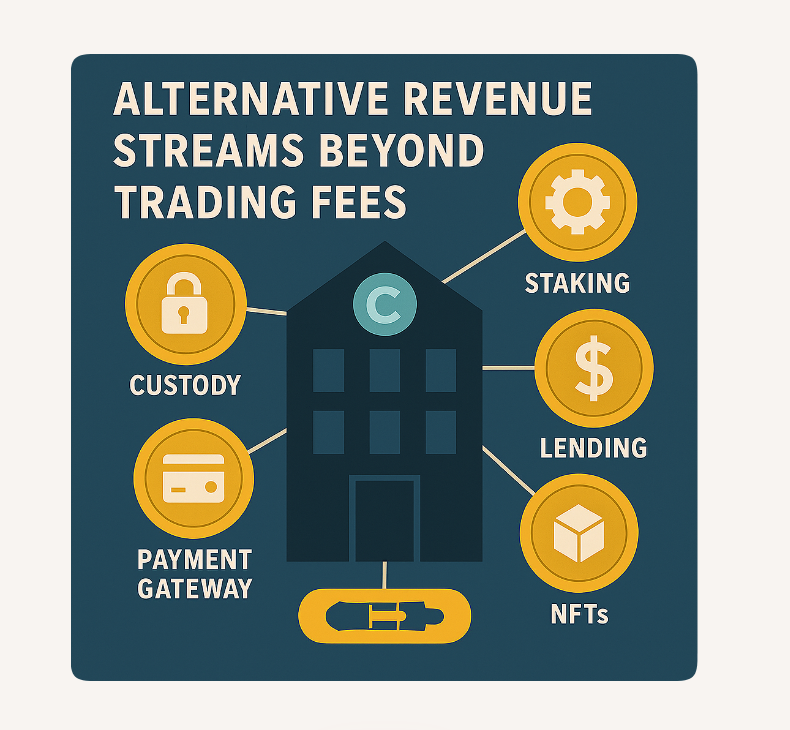
Alternative Revenue Streams Beyond Trading Fees
Marketing strategies for crypto companies branch out in new directions when applied to established, maturing markets for crypto products. Businesses are now able to successfully build steady revenue streams from alternative sources rather than relying on commission-dependent trading models. Furthermore, establishing these new revenue streams helps build user stickiness, brand loyalty, and trust from corporates in the business ecosystem.
Staking and Yield Programs
Crypto platforms provide users the ability to stake their digital tokens by temporarily locking them during a predetermined stake period where users receive a reward on their staked assets. In this revenue model, the platform retains the right to collect a portion of the staking yield revenue, or charge a stake-serve fee. Staking is great for users because they earn not-have-to do income (passive income). It’s great for platforms because they get a line of revenue and keep users from trading (retention).
Crypto Lending and Borrowing Services
Companies lend against cryptocurrency collateral when a user takes out a crypto secured loan or lend their crypto to earn interest. Businesses collect revenue from interest charge spreads, origination fees and liquidation fees. This revenue stream is great for the company and is less dependent on trading volumes. Would most likely be the most successful even during declining or sideways volume markets.
Subscription-Based Premium Tools
Exchanges now sell advanced analytics, portfolio tracking, automation trading, and even tax reporting tools on a monthly or annual basis. Such a stable recurring revenue model works for any business, But, for professional traders or institutional clients, they need better insights and operational efficiency.
NFT Marketplaces and Digital Asset Royalties
Crypto firms make a profit by acquiring NFT platforms, along with minting transaction fees and commissions, and paying creator royalties. This revenue diversification provides a reliance on financial trading activities and provides a slower spectrum of digital artwork, gaming, and even the metaverse, creator economies.
Institutional Services and Crypto Custody
Enterprise-grade solutions such as secure asset custody, OTC desks, compliance tools, and API access for high-frequency trading generate high-value contracts. Such retail shielding services provide a steady, long-term partnership with hedge funds, fintechs, and financial institutions.
White-Label and Blockchain-as-a-Service (BaaS)
Some crypto firms offer a White label exchange platform, and wallet, along with blockchain development tools, to both startups and enterprises. This software (as a service) model creates a diverse income stream that is easily scalable. More importantly, it identifies platforms as tech providers rather than simple trading venues.
Liquidity Pool Rewards and DeFi Integrations
Brands that choose to partner with DeFi ecosystems can earn protocol fees, liquidity provider rewards, and even governance tokens. These linked ecosystems allow brands to grow reputation by tapping into multiple blockchain networks and generating revenue from the still-now performant on-chain activities.
Certification, Research, and Education Programs
Educational content on crypto ecosystems is monetized by researching the market and creating paywalled certification courses. These grow trust and capture the attention of novices and experts alike while establishing the crypto environment as a developing ecosystem and generating revenue.
Understanding the Importance of These Revenue Streams
The need to diversify revenue streams is not just because it will lead to a better overall financial outcome. It is also to enhance the overall ecosystem’s robustness and resiliency against regulatory policies and bear market conditions. Companies that are able to shift from crypto trading to a combination of financial services, tech offerings, and digital ecosystems will find themselves with a long-term sustainable competitive advantage.
Advantages of Diversification
For crypto companies, developing a more robust and adaptable business model that moves beyond a focus on short-term trading can help the company solidify and diversify its revenue streams.
Offering distinct services in various markets means that platforms can mitigate risks, enhance customer loyalty, and create new avenues of growth.
Stable Revenue Despite Economic Downturns
The crypto bear market is often characterized by significant levels of trading volume stagnation. Providing services such as staking, subscriptions, or institutional focused offerings can contribute to a more consistent revenue stream, which can help sustain a company’s operational and investment activities during market downturns, and can mitigate the operational risks associated with fee-reliant transactional activities.
Less Vulnerability to Specific Market Dynamics
A company’s singular revenue stream can be a source of significant vulnerability to the direct or cascading impacts of regulatory adjustments, aggressive pricing strategies, and/or technology substitutes.
Multiple revenue streams within different user segments or across extremely diverse industries and blockchain technologies can improve a company’s long-term profitability by decreasing exposure and increasing the potential of a high-impact counter.
Increased Customer Retention and Engagement
Users appreciate the ability to trade, stake, borrow, learn, and manage portfolios from any single platform. They are then much more likely to remain with that singular platform over others.
More Trust and Brand Authority
When offering enterprise-grade services, educational programs, and institutional solutions, crypto companies become seen as much more than simple exchanges + as full service financial technology providers. This earns the trust of regulators, investors, and mainstream users.
Opportunities for Growth and Scale
Services like blockchain as a service, white label solutions, and APIs greatly and uniquely allow for service delivery on a global scale, independent of local trading volumes. This permits entry into new markets and industries with very little marginal cost.
Competitive Upper Hand in the Fee Wars
With more platforms cutting or even offering zero trading fees to win users over, a more diversified company can continue to offer profitable services and not compromise on the quality of those services. This empowers fierce competition while being able to sustain development and customer support.
Better Market and Data Analytics
With more services, companies get richer data on how users interact, more than enough to help in the refinement of services and optimization of user experiences. This also helps in the formulation of adaptive marketing endeavors that improve conversion and in cross selling.
Less Regulatory Risk and Better Risk Management
If the regulations are such that they mandate against certain trading activities, a diversified platform can continue offering compliant services that pivot around such activities as custody, education, or enterprise solutions. This ensures business continuity and regulatory peace of mind.
Why Diversification Is a Strategic Advantage
As the crypto landscape changes, diversification allows platforms to change from transaction-based businesses to multi-dimensional financial ecosystems. This change improves resilience, strengthens customer relationships, and sets companies up for sustainable long-term success.
Challenges & Considerations
The consideration and challenges section has been expanded with challenges keeping the original point around the same.
Operational Complexity
The implementation of new strategies means that more profit streams can be captured, and as a result, the coordination of units, systems, and people has been diversified, thus, complexifying the operational structure.
Regulatory Compliance
The more varied the services provided, the more jurisdictions that will need to be focused on in order to understand and comply with the unique regulations. Most of the time, this will be needed on the staking, lending, custody, and NFT-related services.
Capital and Technical Resources
In order to initialize the development of new services and products (white label products, staking, and NFT marketplaces), a more strategic plan must be developed in order to ensure that the company is able to allocate the capital, infrastructure, and staff that is needed to avoid being resource constrained.
Market Adoption Risks
New systems in the market will always be facing barriers, especially ones that implement staking, DeFi, or more complex business models. These barriers can result in the market being unable to fully capitalize on profits and, requiring a strong and targeted educational approach for the market.
Security and Risk Management
The increased number of systems will be increasing the company’s value exposure, thus having to ensure more systems and protocols that will protect the company, reducing the risk of being compromised virtually, being more accurate with smart contracts, and improving the operational systems.
Managing Brand Reputation
One of the most important elements of brand management in this case is the ability to differentiate the brand into multiple areas. This gives the ability to fail in areas of the brand, such as NFT scams or lending defaults, without severely impacting the overall brand.
Future Outlook of Crypto Companies Diversify Revenue Beyond Trading Fees
As the cryptocurrency market grows, companies are more likely going to shift from trading companies to full-service financial ecosystems companies. Focus will be on stable, diversified revenue streams that avoid market volatility.
Company Diversification: Companies will continue to diversify, which will strengthen the financial ecosystem and provide stable revenue streams that will ultimately cut out the need for partner retail trading fee revenues.
DeFi and Staking Growth: Companies continue to partner with DeFi protocols and expand staking-as-a-service offered through service level agreements to provide more consistent cash flows from yield-generating products.
NFTs and Digital Assets: There is already demonstrated market potential for digital assets, gaming assets, and the sale of NFTs to yield cash flow in service level agreements, while attracting and maintaining users in the ecosystem.
Technological Expansion: Companies will continue to provide white-label, blockchain, and API products and services to monetize technology.
Resilience to Market Downturns: Overall diversification of services and products will provide greater coverage for any adverse event that may come, such as increased regulation, decreased trading activity during winter months, or fee compression within the ecosystem.
Strategic Positioning: The companies that seamlessly integrate financial services, technology, and ecosystem development will gain competitive advantage, bolster brand strength, and build consumer trust, thereby establishing themselves as frontrunners in the emerging digital economy.
Conclusion
For cryptocurrency businesses looking for long-term viability, diversifying revenue sources beyond trading fees has become strategically essential. Businesses that only rely on transaction-based revenue are vulnerable to regulatory challenges, fierce competition, and the volatility of cryptocurrency markets.
By growing into staking, lending, subscription services, NFT marketplaces, institutional solutions, and technology offerings, firms develop several, complementary revenue sources. This strategy positions businesses as all-inclusive financial technology providers, increases client retention, fosters trust and brand authority, and stabilizes revenue during market downturns.
In the end, revenue diversification turns cryptocurrency platforms from straightforward exchanges into robust, multifaceted ecosystems with long-term competitive advantage and sustainable growth.
FAQ
Why are crypto companies diversifying revenue beyond trading fees?
Crypto companies diversify revenue to manage market volatility, reduce dependency on cyclical trading income, ensure operational sustainability, and create long-term growth opportunities through multiple financial and technological services.
What are the main alternative revenue streams for crypto companies?
Key alternatives include staking and yield programs, crypto lending and borrowing, subscription-based premium tools, NFT marketplaces, institutional services and custody, white-label solutions, DeFi integrations, and educational or research programs.
How does staking generate revenue for platforms?
Platforms allow users to lock tokens for rewards. The company retains a portion of the staking yield or charges a service fee, creating predictable revenue while enhancing user retention.
Can crypto companies remain profitable during bear markets?
Yes. By diversifying into subscriptions, institutional services, staking, and technology offerings, companies generate stable income streams less dependent on market trading volumes.
What role do NFTs play in revenue diversification?
NFT marketplaces provide transaction fees, minting commissions, and royalties, enabling companies to earn revenue from digital collectibles, gaming assets, and the metaverse, beyond traditional financial trading.