The new data further indicates that the ripple and xrp community is a lot less vulnerable to quantum risks, and found only a minority of the total quantity of xrp currently exposed under current conditions.
As per analysis by Vet, roughly 300,000 XRP accounts — containing around 2.4 billion XRP — have never been involved in any transaction. Next they won’t published those public keys, so these accounts are fundamentally immune to possible quantum attacks. This structural feature helps minimize the network’s exposure more than other blockchain systems.
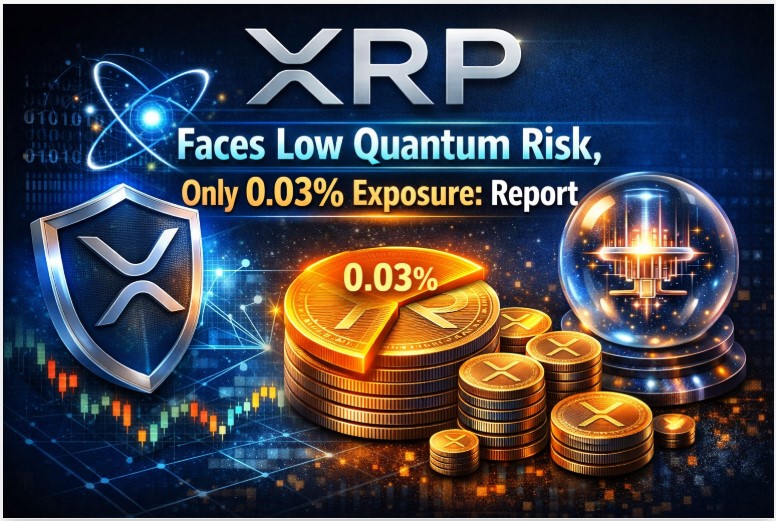
Overall, that means only 0.03% of the entire supply of XRP is vulnerable to quantum threats. Also, the dormant whale accounts with possible vulnerabilities are not common, according to Vet; and the all-time number of XRP wallets actively involved is higher than before.
Users can still rotate keys even in the case of a compromised public key via transactions, which is a positive as it reduces longterm security concerns.
This flexibility is an added defense in the industry’s approach to future quantum computing developments. Echoing this outlook, Grayscale already underscored the XRP Ledger’s robustness and qualities to combat upcoming quantum threats.
As opposed to networks such as Bitcoin, where a large fraction of legacy positions are dormant and possibly have publicly visible keys, the XRP ledger has a more balanced and secure exposure profile. Due to reduced inactive and potentially vulnerable balances, it maintains a much more quantum-resilient position at present.
In the meantime, developers in the XRP Ledger ecosystem are paving the way for forward-looking security best practices. This consists of encouraging key rotation techniques and the design of hardware systems that can unite common encryption techniques with post-quantum algorithms.
These approaches are aimed at providing a smooth transition, although they may not be necessary once quantum-resistant technologies have been widely deployed. Regulatory alignment is making advances as well, such as when SBI Ripple Asia revised its infrastructure to comply with Japan’s Payment Services Act after receiving prepaid payment registration.
In terms of innovation, XRPL Labs have made significant strides towards being post-quantum ready. On December 5, 2025, developer Denis Angell announced that AlphaNet (a testing environment) had successfully integrated CRYSTALS-Dilithium (now known as ML-DSA), a post-quantum signature scheme that had been approved by the National Institute of Standards and Technology.
The Genesis protocol rejuvenated network security and improved cryptography with tools like Quantum Accounts, Quantum Transactions, and the new consensus called Quantum Consensus. The flipside though is that Dilithium signatures are much larger than traditional ones — causing data bloat and potentially compromising speed over size balance/speed retrieval efficiency.
Beyond technical advancements, market data indicates increasing investor confidence. XRP Whale accumulation is turning bullish as large holders are accumulating >11 million XRP daily. Exchange outflows have also jumped, lowering near-term selling pressure.
In parallel, XRP price has risen to ~1.37 USD with a daily increase of 4.27%. Market cap surged $84.63 billion as trading volume reached $2.93 billion after increasing over 85%, indicating liquidity and market dynamic is back.