I’ll go over the Top AI Financial Forecasting Tools in this post, which use advanced analytics and artificial intelligence to assist businesses forecast future financial performance.
These technologies evaluate past data, spot trends, and produce precise projections for income, costs, and financial risks. Organizations may enhance financial planning, make wiser choices, and maintain their competitiveness in a data-driven business climate by utilizing AI-powered forecasting tools.
Key Point & Best AI Financial Forecasting Tools
| Platform | Key Point |
|---|---|
| IBM Planning Analytics with Watson | Combines AI-driven forecasting with powerful multidimensional planning and scenario modeling for enterprise finance teams. |
| Oracle Fusion Cloud EPM | Provides integrated financial planning, budgeting, and AI-powered predictive analytics within the Oracle cloud ecosystem. |
| Workday Adaptive Planning AI | Uses machine learning to improve financial forecasting accuracy and automate workforce and operational planning. |
| Anaplan Predictive Insights | Delivers real-time predictive planning and scenario analysis using connected enterprise data across departments. |
| SAS Financial Forecasting AI | Advanced statistical modeling and AI algorithms help organizations generate highly accurate financial forecasts. |
| Qlik Sense Predictive AI | Augments business intelligence dashboards with AI-powered predictive analytics and automated insights. |
| DataRobot AI Forecasting | Automated machine learning platform designed to create highly accurate financial and operational forecasting models. |
| Palantir Foundry Finance AI | Integrates complex financial datasets with AI analytics to support strategic decision-making and risk analysis. |
| Jedox AI Forecasting | Provides AI-assisted financial planning, budgeting, and forecasting integrated with Excel-style modeling. |
| SAP Analytics Cloud | Combines business intelligence, planning, and AI-driven forecasting in a single cloud analytics platform. |
1. IBM Planning Analytics with Watson
IBM Planning Analytics with Watson is a comprehensive enterprise planning tool that helps organizations conduct financial planning, budgeting, and forecasting using artificial intelligence. The platform is built on the TM1 in-memory engine, and provides finance teams the ability to perform complex calculations, analyze large datasets, and evaluate models in real-time.
The AI forecasting capabilities analyze data and identify patterns that help improve the accuracy of finances. Among the Best AI Financial Forecasting Tools, IBM Planning Analytics with Watson offers driver-based planning, automatic forecasting, and dependable financial projections. Its ability to integrate with enterprise systems enhances cross-functional collaboration and streamlines operations.
IBM Planning Analytics with Watson Features, Pros & Cons
Features
- AI-powered forecasting with Watson to recognize patterns and trends.
- In-memory TM1 engine for rapid, multidimensional financial analyses.
- Scenario modeling and “what-if” simulations for strategic development.
- Compatible with Excel and ERP systems.
- Natural language AI assistant for automated insights and reporting.
Pros
- AI forecasting and predictive insights are tremendously accurate.
- Powerful in-memory processing allows for real-time analyses.
- Flexibility in deployment (cloud or on-premise).
- Strong financial modeling and scenario planning capabilities.
- Enterprise level security and governance.
Cons
- Difficult for novices.
- Advanced modeling requires training.
- A high cost for small businesses.
- Setup may take an extensive time.
- Outdated interface.
2. Oracle Fusion Cloud EPM
Oracle Fusion Cloud EPM is a comprehensive enterprise performance management solution that focuses on improving financial planning, consolidation, reporting, and forecasting in a cloud-based solution.
The platform uses AI and machine learning to improve model forecasting, anomaly detection, and financial predictions. Finance teams have the ability to utilize predictive analytics and advanced scenarios in order to evaluate revenue, cost, and operational performance.
Oracle Fusion Cloud EPM is often noted for its ability to provide seamless integration with other Oracle applications, like ERP and supply chain systems.
This means that businesses can forecast with greater accuracy, integrating operations data. Oracle Fusion Cloud EPM enhances real time data for better operational and managerial strategic decisions for global enterprises and their operational and budgeting cycles.
Oracle Fusion Cloud EPM Features, Pros & Cons
Features
- Integrated financial planning, budgeting, and forecasting solutions.
- AI predictive planning and anomaly detection.
- Real-time dashboards along with advanced analytics.
- Integrative with Oracle ERP and financial systems.
- Scenario modeling and risk analysis.
Pros
- It offers highly sophisticated capabilities in enterprise performance management.
- It offers a unique embedded technology with the Oracle products.
- It offers the most sophisticated capabilities with respect to the unique needs of multinational corporations.
- It offers advanced capabilities with respect to financial consolidation and reporting.
- It offers a cloud-based flexible architecture.
Cons
- Smaller companies may find the pricing prohibitive.
- The methodology may be a bit difficult to understand.
- The system may be difficult to customize without the requisite technical skills.
- The system works best with companies that already own Oracle applications.
- It a system that requires a busy user to move through the system very quickly.
3. Workday Adaptive Planning AI
Workday Adaptive Planning AI is a cloud-based financial planning and analysis (FP\&A) solution that utilizes machine learning and predictive analytics to enhance budgeting, forecasting, and operational planning capabilities.
This solution enables finance teams to build adaptive financial planning models that dynamically revise forecasts as business conditions and historical data patterns evolve. Using cloud-powered dashboards and workflow automation, teams can work cross-functionally to revise and update forecasts collaboratively and in real time.
Workday Adaptive Planning has a positive reputation as one of the Best AI Financial Forecasting Tools for being user-friendly and seamlessly integrating with HR, finance, and operational data systems. Incorporating predictive analytics coupled with scenario planning empowers organizations to enhance financial forecasting accuracy and accelerate time to insight with respect to changing market conditions.
Workday Adaptive Planning Features, Pros & Cons
Features
- AI-based financial forecasting and budgeting.
- Workforce and financial integrated data.
- Real-time cloud collaborative dashboards.
- Predictive and scenario planning analytics.
- Integration with ERP, HR, and CRM.
Pros
- Interface is highly intuitive.
- Collaboration capabilities are excellent.
- Offers real-time cloud updates and scalability.
- Integration with HR and workforce planning is excellent.
- It is applicable for medium and large size corporations.
Cons
- Compared to its competitors, the customization capabilities may be limited.
- Smaller companies may find the pricing prohibitive.
- The implementation may be consulting intensive.
- Extremely large data sets may introduce performance issues.
- The analytics that are advanced may be available in other tools.
4. Anaplan Predictive Insights
Anaplan Predictive Insights is a planning solution with integrated AI that provides organizations the capability of predictive modeling, financial forecasting, and scenario planning analysis across various business functions.
Predictive modeling, forecasting, and scenario planning analyses are performed via the use of machine learning to detect patterns and trends, predict future states, and provide prescriptive guidance to users via real-time analytics.
Its in-memory calculation engine allows organizations to instantaneously and comprehensively execute large-scale data processing as well as the execution of numerous and multifaceted scenarios.
Anaplan Predictive Insights has earned the praise of many experts in the field of financial forecasting due to its explainable AI forecasting systems, predictive analytics, and AI-driven Collaborative Enterprise Planning.
Their offering has included Conversational AI, which enables users to pose inquiries utilizing natural language and receive insights from their underlying datasets, increasing the velocity and quality of strategic financial decisions made by users.
Anaplan (Predictive Insights) Features, Pros & Cons
Features
- Predictive analytics and forecasting that is powered by AI.
- Integrated planning for connected enterprises across sections.
- Live scenario simulations.
- Processing data in memory on a large scale.
- Tools for collaborative financial planning.
Pros
- Excellent for planning at the enterprise level.
- Supports planning and processing at scale for large data sets.
- Collaboration and modeling tools are robust.
- Powerful calculation engine.
- Supports multiple functions beyond finance.
Cons
- Licensing is expensive.
- Needs trained model builders.
- Overly complex for small companies.
- Less visualization than BI tools.
- Maintenance of custom models may need consultancy.
5. SAS Financial Forecasting AI
SAS Financial Forecasting AI uses highly advanced statistical models, machine learning, and time-series forecasting to predict financial models. As a result, it has found a significant number of large corporations and financial services companies as clientele who are looking to develop a highly precise predictive revenue, risk and investments models.
It provides users with the ability to develop models in real time, identify outliers, and conduct scenario modeling using historical and real-time financial data. It has made a significant contribution towards defining the Best AI Financial Forecasting Tools as a result of its predictive analytics component and its ability to manage large predictive models. SAS Financial Forecasting AI enables companies to enhance strategic planning and financial forecasting to a higher level by reducing financial risk and uncertainty.
SAS Financial Forecasting Features, Pros & Cons
Features
- Statistical forecasting models of a higher order.
- Predictive analytics integrated with machine learning.
- Risk analysis and simulation of scenarios.
- Processing data in memory on a large scale.
- Ability to integrate with enterprise data systems.
Pros
- Algorithms for forecasting are superior.
- Excellent data science and analytics.
- Large enterprises and financial institutions are the best fit.
- Massive amounts of data are handled with ease.
- Excellent analytics and reporting.
Cons
- Enterprise solutions are very costly.
- High level analysts or data scientists are needed.
- Complicated design and configuration.
- Less friendly to non-technical groups.
- The time to implement may be extended.
6. Qlik Sense Predictive AI
Business intelligence, data visualization, and predictive analytics are all integrated into one environment using Qlik Sense Predictive AI, a cutting-edge analytics platform. Through the platform, businesses may interactively examine financial data and use machine learning models to produce forecast insights.
Its AI engine helps finance teams predict future results by autonomously analyzing datasets, seeing trends, and making recommendations.
Qlik Sense Predictive AI stands out among the Best AI Financial Forecasting Tools due to its enhanced analytics features that make complicated data processing easier. The platform helps firms find opportunities, lower financial risks, and make quicker strategic planning decisions by combining forecasting models with visual dashboards and automated analytics.
Qlik Sense (Predictive AI) Features, Pros & Cons
Features
- Analytics augmented and predictive modeling.
- Data visualization and dashboards that are interactive.
- Analytics self-service with AI-based insights.
- Identification of patterns and automated analysis of trends.
- Combination with several other sources of data.
Pros
- Invaluable tools for visualization and construction of dashboards.
- Seamless exploration of data for the users of the business.
- AI-based insights available without the need for coding.
- Integration with other data systems is structured and flexible.
- Community support is available and strong.
Cons
- Training may be necessary for the use of advanced systems.
- High licensing costs may be necessary.
- Advanced forecasting may require the use of extensions.
- Complex and large business units experience difficult systems deployment.
- Modeling of data is sometimes difficult.
7. DataRobot AI Forecasting
DataRobot AI Forecasting enables companies to create machine learning models to help predict financial and operational data. This platform uses automated data preparation, automated feature engineering, automated model selection, and automated performance tuning to help businesses create useful forecasts.
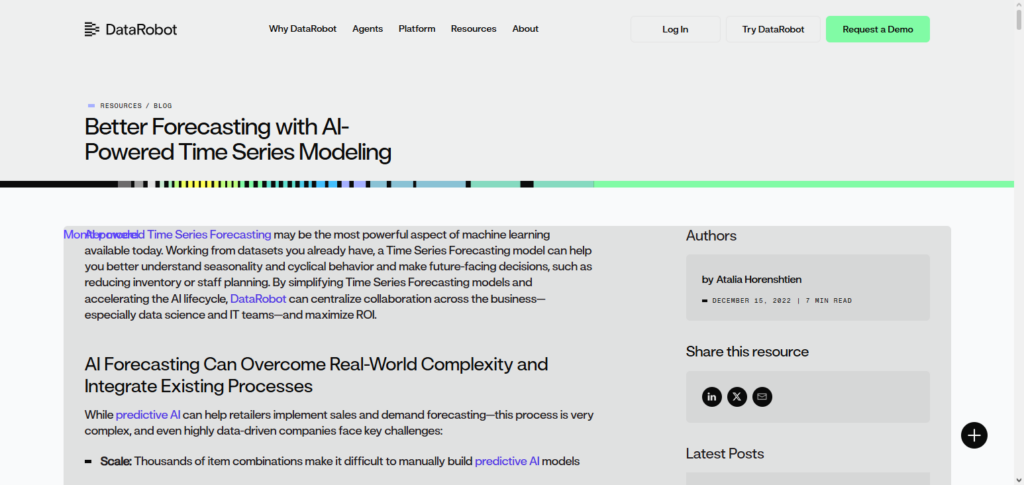
DataRobot allows multiple users to leverage machine learning and aids organizations in making accurate forecasts and quick financial decisions.
DataRobots AI forecasting tools allows users to gather useful information from automated pipelines and AI to evaluate revenue, demand, and financial risks. It is often mentioned in reference to AI Financial Forecasting tools because of how quickly, and easily, users can create complex forecasting models.
DataRobot (AI Forecasting) Features, Pros & Cons
Features
- Forecasting models created through automated machine learning.
- Automation of selection of features and models along with engineering.
- AI that is explainable to promote the transparency of predictions.
- Incorporation of enterprise data systems.
- Capabilities for the forecasting of time series
Pros
- Excellent forecasting abilities through AutoML.
- Less need for extensive data science knowledge.
- Predictive models of great accuracy.
- AI models deployed quickly.
- Tools for explainability are strong.
Cons
- National enterprise pricing.
- Data of good quality is needed for the best outcome.
- Complex arrangements for novices.
- Data science knowledge is necessary to make advanced customizations.
- Technical arrangements may be needed for the integration.
8. Palantir Foundry Finance AI
Palantir Foundry Finance AI is one of the most robust platforms for financial data integration and analytics. It enables organizations to assimilate disparate financial datasets and, using the power of machine learning, provides predictive analytics and operational and financial transaction metrics with external market data signals to integrate frameworks in one analytical environment.
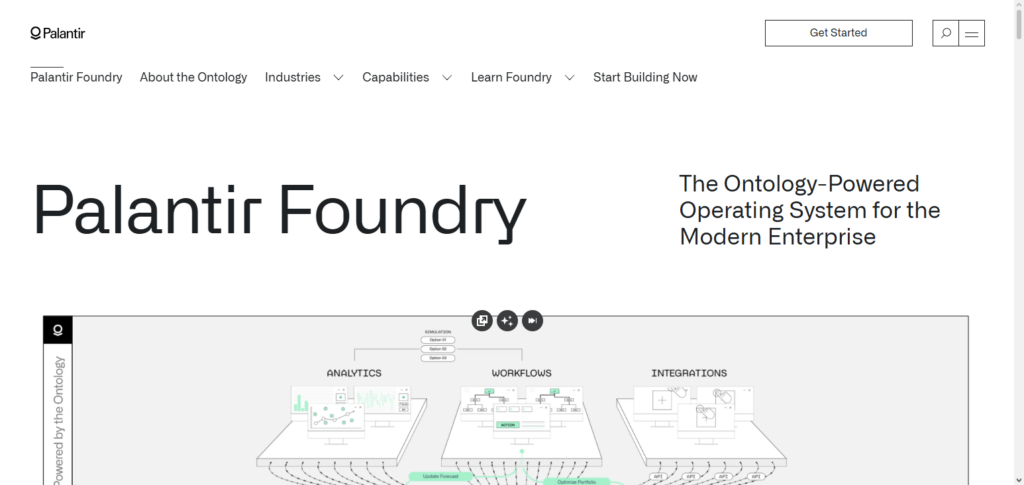
AI models within Foundry are able to forecast financial performance, pinpoint and predict anomalies, and aid in the strategic positioning of scenarios. Within the arena of Best AI Financial Forecasting Tools,
Palantir Foundry Finance AI stands tall because of its capability to integrate advanced analytics and provide large-scale data analytics for the construction of highly customizable predictive models. This increases and facilitates organizations’ financial decision-making processes in their complex operational environments.
Palantir Foundry (Finance AI) Features, Pros & Cons
Features
- Integration of data is unified across the systems of the enterprise.
- Forecasting and analysis of finance through AI.
- Simulation & modeling of scenarios that are advanced.
- Dashboards and pipelines of data that are real-time.
- Finance & Analytics. Collaboration tools.
Pros
- The ability to integrate data is extremely powerful.
- Enterprise-level advanced analytics.
- Financial modeling of large-scale scenarios is supported.
- Insights of real-time analytics are better for decision-making.
- Security and governance.
Cons
- Platforms for enterprises that are extremely expensive.
- Technical proficiency is needed to execute it.
- Companies with smaller sizes have a structure that is more complicated.
- Deployment time is a long.
- There is a lot of needed customization.
9. Jedox AI Forecasting
Jedox AI Forecasting is a cloud-based platform based on enterprise performance management which is designed to bring ease to financial planning and predictive forecasting. The platform utilizes AI and ML to generate automated financial predictions.
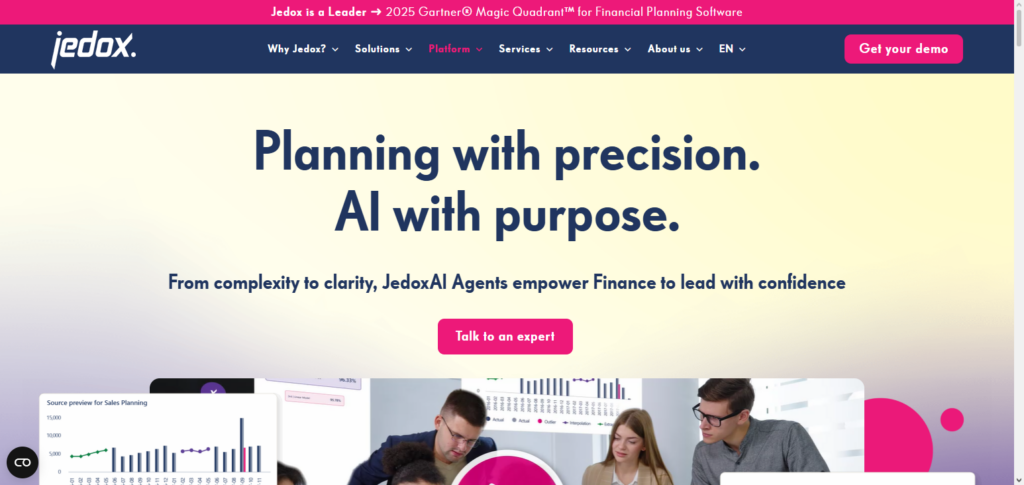
The platform also comes with Excel modeling capabilities. So finance professionals can work in a space they are familiar with while utilizing AI capabilities.
In reference to Best AI Financial forecasting tools, Jedox is often mentioned due to its flexibility and ability to integrate with several major ERP and CRM systems. In addition to AI forecasting, planning collaboration tools streamline and enhance budget formulation, financial performance optimization, and strategic planning improvement.
Jedox (AI Forecasting) Features, Pros & Cons
Features
- Financial planning and forecasting driven by AI.
- Environment for modeling similar to Excel.
- Analytics that are predictive and planning of scenarios.
- Systems of ERP & BI integrated.
- Dashboards & reporting that is automated.
Pros
- Interface that is similar to spreadsheet is more familiar.
- Finance teams will find it easy to adopt.
- Features for planning and budgeting are strong.
- Systems of enterprise have flexible integration.
- Tools for collaboration are good.
Cons
- Tools for BI have less visualization ability than others.
- It may take technical proficiency to use advanced features.
- Smaller organizations may find the pricing too high.
- Hiring consultants may be necessary for customization.
- Compared to the major vendors, the community is smaller.
10. SAP Analytics Cloud
SAP Analytics Cloud is a business intelligence and planning solution that incorporates data visualization, financial planning, and forecasting. The solution’s machine learning analyzes financial data to create forecasts and automate planning.
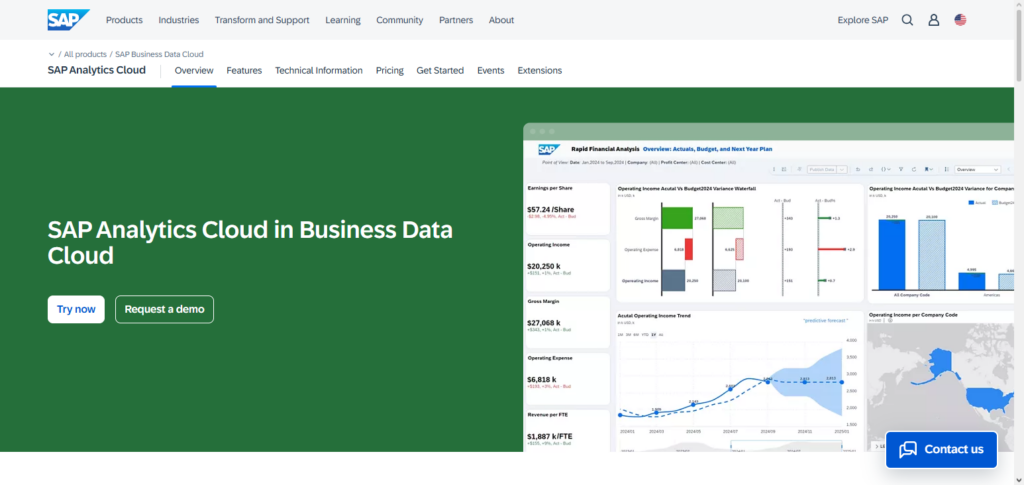
Finance teams perform simulations, risk analysis and revenue forecasting with interactive dashboards and data in real-time. SAP Analytics Cloud is a leader as a financial forecasting tool because it consolidates analytics, planning, and predictive forecasting in a cloud application.
Additionally, SAP Analytics Cloud’s predictive forecasting financial analytics is highly integrated with SAP enterprise systems to provide precise forecasting and value stream alignment to financial operational strategies.
SAP Analytics Cloud Features, Pros & Cons
Features
- Analytics that are predictive, BI and planning that is integrated.
- Models of forecasting that use automated machine-learning.Here is a break down of some features, pros, and cons of the analytics and forecasting tool from the cloud-based company planning analytics.
- Dashboards that show data and real-time analytics.
- Financial planning, and scenario simulation.
- SAP enterprise system integration.
Pros
- A platform that provides analytics and planning services in a single solution.
- Integration that is SAP-ecosystem reliable.
- Predictive insights and foresight forecasting that is not only automated but also AI-driven.
- The system is based upon cloud technology and is therefore scalable.
- A dashboard with real-time analytics that is interactive.
Cons
- This solution is most suited for the SAP users
- The implementation of frameworks will possibly require an SAP expertise.
- The licensing fees for using the system is possibly the highest compared to other competitors.
- There is a significant knowledge acquisition gap for the new users.
- The analytics system is, most of the time, custom and therefore requires additional adjustments.
Conclusion
Selecting the Best AI Financial Forecasting Tools may greatly enhance how businesses manage future risks and plan their financial strategy. Businesses can analyze massive datasets, find trends, and produce precise forecasts for income, costs, and financial risks with the aid of contemporary AI-powered forecasting platforms.
Workday Adaptive Planning, SAP Analytics Cloud, Oracle Fusion Cloud EPM, IBM Planning Analytics with Watson, and other solutions offer sophisticated machine learning capabilities that let businesses automate forecasting and budgeting procedures.
These platforms enable businesses to run scenario simulations, provide more accurate projections, and react swiftly to changes in the market by fusing predictive analytics with financial planning. Financial forecasting tools will grow even more sophisticated as AI technology develops, assisting companies in making quicker data-driven decisions and preserving a competitive edge in an increasingly complicated economic climate.
FAQ
What are AI financial forecasting tools?
AI financial forecasting tools are software platforms that use artificial intelligence, machine learning, and predictive analytics to estimate future financial outcomes such as revenue, expenses, and cash flow. These tools analyze historical financial data, market trends, and operational metrics to generate accurate forecasts. By automating complex calculations and identifying patterns, AI forecasting systems help finance teams make faster and more informed decisions. IBM Planning Analytics with Watson and Oracle Fusion Cloud EPM are examples of solutions that use AI models to improve planning accuracy and automate financial forecasting processes.
Why are AI financial forecasting tools important for businesses?
AI financial forecasting tools are important because they improve prediction accuracy, automate financial analysis, and help organizations respond quickly to market changes. Traditional forecasting methods often rely on spreadsheets and manual calculations, which can be slow and prone to errors. AI systems analyze large datasets and identify hidden patterns to generate more reliable forecasts. They also support scenario modeling, allowing businesses to simulate different economic conditions and make better strategic decisions.
How do AI forecasting tools improve financial planning?
AI forecasting tools improve financial planning by analyzing historical financial data, detecting trends, and automatically generating predictive models. Machine learning algorithms continuously learn from new data, improving forecast accuracy over time. These tools can also run “what-if” scenarios to evaluate different business strategies and identify potential risks before they occur. As a result, finance teams can plan budgets, allocate resources, and manage risks more effectively using data-driven insights.