


The Top Platforms for Trading Green Energy and On-Chain Carbon Credits will be covered in this post. By fusing blockchain technology with markets for renewable energy and carbon credits, these platforms are transforming sustainability.
These solutions, which range from decentralized energy trading to tokenized carbon credits, offer transparency, efficiency, and worldwide access, empowering companies and individuals to actively contribute to lowering carbon footprints and promoting green energy initiatives.
Why Use Platforms for Trading On-Chain Carbon Credits & Energy
Trust & Transparency – every transaction on the blockchain is recorded and is accessible publicly. Hence users can trust the system fraud is minimized.
Trade Anytime, Anywhere – the system pairs the buyers and seller and gives access to all the users to the carbon market so that they can trade credits without restrictions geographically and provides access to users to trade worldwide.

Time Saving – Automation via smart contracts eliminates step such as credit issuing, retirements, and settlements so the user does not have to do all the processes manually.
Access to New Markets – Trading, Selling and Buying, and improved Tokenized Carbon credits, renewables, and liquidity.
Achieving Sustainability Goals – platforms will help users in foot, carbon, and renewable energy burning investments and help users achieve their ESG goals or climactic place goals.
Scalability – digital carbon trading saves administrative efforts in comparison to other carbon trading, and the blockchain technology is adaptable to change.
Instant Reporting – all platform users have tools that can report their carbon credits, certificates of energy, and report their impacts on the environment to the platform instantly.
Key Point & Best Platforms for Trading On-Chain Carbon Credits & Green Energy
| Platform | Key Point |
|---|---|
| Toucan Protocol | Bridges real-world carbon credits to blockchain, enabling tokenized carbon trading for transparency and liquidity. |
| KlimaDAO | Creates a decentralized carbon market using tokenized carbon assets to incentivize eco-friendly actions. |
| C3 Protocol | Focuses on decentralized carbon credit creation, retirement, and trading on-chain for climate impact. |
| Carbonplace | Connects corporates with carbon credit projects globally, offering secure digital carbon transactions. |
| Flowcarbon | Tokenizes verified carbon credits, providing easy access to transparent and tradeable carbon assets. |
| Powerledger | Blockchain platform for renewable energy trading, enabling peer-to-peer green energy transactions. |
| WePower | Facilitates green energy financing and trading through tokenized renewable energy certificates. |
| Senken | Provides an on-chain marketplace for carbon offsets and sustainability tracking for businesses. |
| Regen Network | Uses blockchain to track ecological health and issue verified carbon credits for regenerative projects. |
| AirCarbon Exchange (ACX) | A digital exchange for carbon credits, allowing instant trading and settlement of verified carbon offsets. |
1. Toucan Protocol
Toucan Protocol is the first bridge that enables the trading of real-world carbon credits on the blockchain. By converting real-world verified carbon credits into on-chain tokens, participants of sustainable finance, both individuals and businesses, can on-chain carbon trade.
The platform fosters liquidity in carbon markets while sustaining credibility, thanks to its fully transparent, tokenized, and verifiable registry system.
Among the Best Platforms for Trading On-Chain Carbon Credits & Green Energy,Toucan Protocol is the most prominent, providing both institutional-grade and fully decentralized solutions for financing environmental impact. Its ecosystem enables collaborations with diverse global carbon credit registries.
Toucan Protocol Features, Advantages & Disadvantages
Features:
- On-chain cross-integration of real world carbon credits.
- Trackable carbon credits via tokenization.
- Partnerships with several carbon registries.
- Smart contracts for added transparency.
- Carbon asset liquidity pools.
Advantages:
- Truly sustainable carbon markets.
- Trade and stake carbon credits.
- Retail and institutional market participation.
- Sustainablity market investments!
- Conventional + decentralized market access.
Disadvantages
- The price of gas can be high for carbon markets.
- For some the registries might be confusing.
- obsession with the data registries.
- Token pricing.
- Some may find the market too small.
2. KlimaDAO
KlimaDAO is a decentralized autonomous organization with the mission of establishing a new token economy that is carbon-backed incentivizing sustainable behaviors. It gives users the ability to stake tokenized carbon credits and get rewarded while restoring the environment.
The DAO buys and retires carbon credits, creating a positive climate impact and driving demand. For the past several years, KlimaDAO has been rated One of the Best Services for Purchasing On-Chain Carbon Credits & Renewable Energy for being transparent and offering automated market tools.
Its community members contribute to the governance, providing a more equitable framework for decision making around a climate carbon economy. KlimaDAO is fusing the principles of decentralized finance (DeFi) with climate activism and enabling people to earn money by supporting verified carbon offset projects worldwide.
KlimaDAO Features, Advantages & Disadvantages
Features:
- Tokens with a carbon credit backing.
- Governance based on a Decentralized Autonomous Organization (DAO).
- Carbon credits automatically get burned/retired.
- Rewards for protocol governance token staking.
- Integration with decentralized finance (DeFi) ecosystems.
Advantages:
- Tokens with a carbon credit backing.
- Governance based on a Decentralized Autonomous Organization (DAO).
- Carbon credits automatically get burned/retired.
- Rewards for protocol governance token staking.
- Integration with decentralized finance (DeFi) ecosystems.
Disadvantages:
- DAOs with token price volatility.
- A lot of moving parts that can be confusing for non-DeFi folks.
- Participants must have a foundational level crypto knowledge.
- It’s a bit of a grey area right now and might not be for everyone.
- The network might get blocked and transactions will take a long time.
3. C3 Protocol
C3 Protocol enables the creation, verification, and trading of decentralized carbon credits on the blockchain. Using blockchain technology, the platform maintains transparency, tracking the issuance, retirement, and transfer of carbon credits. C3 Protocol connects multiple registries for decentralized and standardized carbon credit tokenization and borderless trading.

Named among the Best Platforms for Trading On-Chain Carbon Credits & Green Energy, the platform provides corporations and retail investors a trustworthy Digital Emission Reduction (DER) mechanism. The platform also provides automated services using smart contracts, which reduces friction and costs in the carbon market while increasing the adoption of verified carbon credits in a sustainable ecosystem.
C3 Protocol Features, Advantages & Disadvantages
Features:
- Ability to create decentralized carbon credits.
- On-chain credit validation.
- Marketplace for carbon credit trading.
- Integration with cross-border registries.
- Automation with smart contracts.
Advantages:
- Carbon credits are transparent, and verifiable.
- Global carbon trading is enabled.
- Process automation is efficient.
- Manual labor and errors are reduced.
- Climate-positive funding is facilitated.
Disadvantages:
- Investors have low levels of awareness.
- Corporates have complex configurations.
- Reliance on stability of the blockchain.
- Onboarding must be done with tech.
- There may be a lack of initial liquidity.
4. Carbonplace
Carbonplace links corporations with global verified carbon offset projects. Blockchain guarantees secure transactions, audits, and real-time reporting for carbon credit purchases. Corporate sustainability is simplified with integrated payment and retirement systems.
Carbonplace is ranked as one of the Best Platforms for Trading On-Chain Carbon Credits & Green Energy because of the transparent network connecting buyers with financial institutions and project developers.
Carbonplace ecosystem fosters trust, scalability, and accountability, driving investment to proven climate-positive projects. Carbonplace streamlines carbon compliance and corporate ESG integration with enterprise-grade solutions.
Carbonplace Features, Advantages & Disadvantages
Features:
- Carbon trading specifically for Corporates.
- Integration of verified projects.
- Digital payment and retirement services.
- ESG compliance mechanisms.
- Tools for reporting in real-time.
Advantages:
- Coporate carbon management is made easier.
- Transactions are safe and auditable.
- Global projects that are verified can be used.
- Administrative tasks are less.
- Adoption of ESG is incentivized.
Disadvantages:
- Retail participation is low.
- Small investors may not find it very suitable.
- Fees on the platform may be higher.
- There is a reliance on project verification.
- Adoption is growing, but not on a global scale yet.
5. Flowcarbon
Flowcarbon’s platform converts carbon credits that are tokenized into tradable digital assets on-chain. Their innovative solution improves liquidity and transparency in carbon markets and helps businesses and investors engage.

Flowcarbon has presences in various verified global carbon offset projects and ensures credits are properly retired using blockchain.
For seamlessly integrating proprietary carbon offset credits with decentralized finance, Flowcarbon has become one of the Best Trading Platforms for On-Chain Carbon Credits and Renewable Energy. By providing carbon markets that are accessible and data-based verified trust, it enables users to meaningfully address one of the world’s most pressing challenges: climate change.
Flowcarbon Features, Advantages & Disadvantages
Features:
- Carbon credits that have been verified are tokenized.
- Retirement and trading is supported.
- Blockchain transparency.
- Integration with eco-projects.
- Tracking of verified projects.
Advantages:
- Improvements in the carbon markets increase liquidity.
- Transparency and security are guaranteed.
- Easy to reach for investors and businesses.
- Backed by verified environmental initiatives.
- Less friction for trading carbon credits.
Disadvantages:
- There are gas fees.
- Knowledge of crypto required.
- Priced tokenized credits may be unpredictable.
- Retail awareness is limited.
6. Powerledger
Powerledger allows consumers to trade electricity and carbon credits from a decentralized network. Through the application, consumers can trade green electricity with one another and the grid in real time.
This enhances operational efficiency and sustainability. Powerledger’s application allows users to receive and trade carbon credits for the production of renewables, thereby monetizing the environmental impact.
Powerledger is a recipient of the Award for Best Platforms for Trading On-Chain Carbon Credits & Green Energy. Powerledger allows for the trading of renewable credits to create a decentralized market for energy, low cost, and carbon free.
Powerledger pioneered the trading of electricity on the blockchain. This enhances operational transparency, accountability, and efficiency. It allows communities to take part in the adoption of renewables and the reduction of carbon globally.
Powerledger Features, Advantages & Disadvantages
Features:
- Trading of renewable energy on a peer-to-peer basis.
- Platform that is based on blockchain technology.
- For energy projects, carbon credits can be issued.
- Settlements in real time.
- Support for community energy projects.
Advantages:
- Markets for decentralized energy.
- Promotes the adoption of clean energy.
- Transactions are transparent.
- Active community participation.
- Trading and settlement in real time.
Disadvantages:
- Prerequisite of smart meters and additional infrastructure.
- Dependency on specific local regulations.
- The user experience is technically complex.
- Significant initial installation expense.
7. WePower
WePower links investors to renewable energy producers using tokenized receipts for green energy. With the power of blockchain, fractional ownership and trading of liquid and transparent energy assets is made possible.
Investors receive tokenized energy credits for direct funding of renewable projects, balancing monetary profit and eco-sustainability.
Creating pathways for financing clean energy, WePower is among the Best Platforms for Trading On-Chain Carbon Credits and Green Energy. WePower makes carbon accounting and sustainability reporting affordable and accessible to businesses, thus helping them achieve ESG goals.
WePower Features, Advantages & Disadvantages
Features:
- Blockchain-based renewable energy certificates that are tokenized.
- Crowdfunding for environmentally friendly projects.
- Trading based on blockchain technology.
- Energy assets can be owned in fractions.
- Tools for reporting ESG compliance.
Advantages:
- Direct investment on renewable energy is made possible.
- Energy markets can be made more liquid.
- Transparent and secure.
- Corporate ESG compliance is supported.
- Energy trading is democratized.
Disadvantages:
- There is little adoption of the platform.
- The regulations are unclear.
- The market is unpredictable.
- Knowledge of crypto required.
- Dependent on individual projects.
8. Senken
Senken is a carbon credit marketplace that is fully integrated on the blockchain. It features tokenized carbon credits that the user can trade, retire, and audit right on the blockchain. Senken provides businesses the ability to track their data and see how they are for the environment, while also giving them rewards for lowering their carbon emissions.
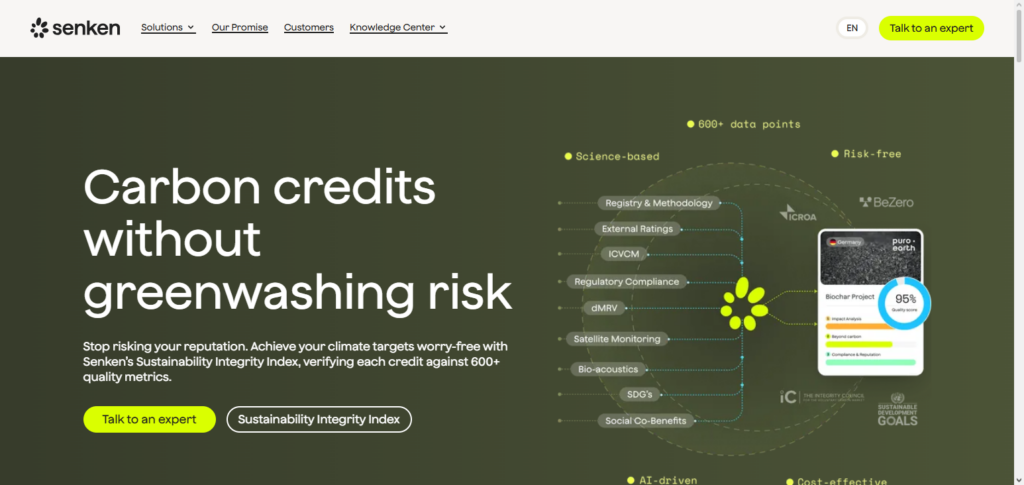
Senken is a leader in the industry as one of the Finest Markets for the Purchase and Sale of On-Chain Carbon Credits and Green Energy. Senken provides businesses with digital tools that ensure they meet compliance standards, track, and report on their goals, as well as verify the impact of their trading.
Because of the blockchain, pure digital trading, and the lack of a central authority, Senken provides trading to small and medium-sized businesses that monopolized the carbon trade prior to Senken. Senken is a supporter of verified sustainable practices while also helping with the climate emergency.
Senken Features, Advantages & Disadvantages
Features:
- Marketplace for carbon credits on the blockchain.
- The carbon offsets are tokenized.
- Transactions that are secure and can be audited.
- Tools for tracking sustainability.
- Ecosystem focused on businesses.
Advantages:
- Retirement of credits and trading is transparent.
- Assists SMEs and businesses.
- Verified carbon offsets are encouraged.
- Governance is decentralized.
- The platform is automated and streamlines processes.
Disadvantages:
- Retail focus is lacking.
- Knowledge of blockchain is needed.
- Adoption stage is maturing.
- Liquidity is variable.
- Subject to project verification.
9. Regen Network
Regen Network uses verified carbon credits for regenerative land-use projects, and blockchain to track ecological health. Its smart contracts and remote sensing keep data transparent and connect real world positive environmental changes to on-chain, tradeable assets.
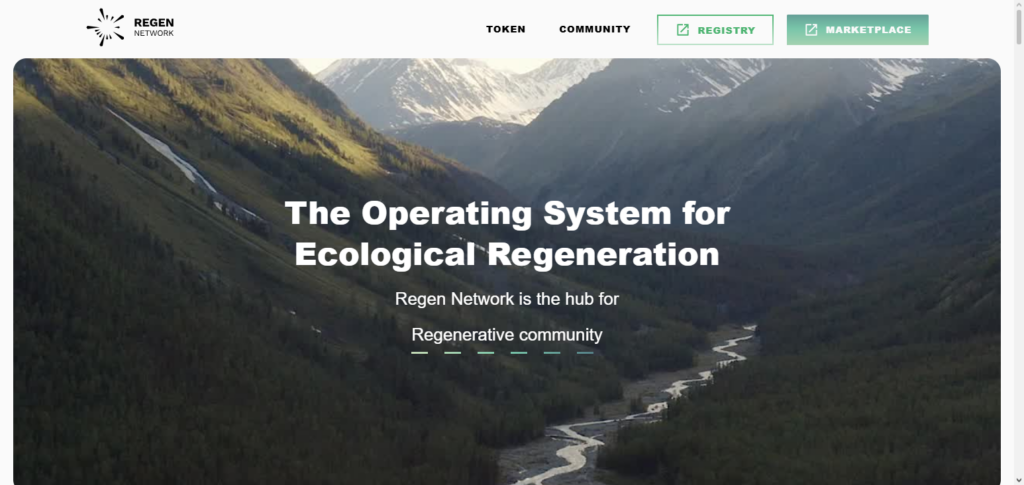
Ranked in the Best Platforms for Trading On-Chain Carbon Credits & Green Energy category, Regen Network enables investors to promote land sustainable, positive growing agro systems, and the conservation of forests.
Supporting accountability, ecological restoration, and a positive impact, their platform is unique. With scientific blockchain verification, they build trust in the ecosystem of trading carbon credits to land stewards and, positive, eco-projects to scale their impact.
Regen Network Features, Advantages & Disadvantages
Features:
- Monitors the state of the ecosystem.
- Offers carbon credits that are verified.
- Verification through blockchain technology.
- Facilitates regenerative initiatives.
- Marketplace for credits that is transparent.
Advantages:
- Effect measurable of the ecosystem.
- Assists regenerative initiatives of farming and forestry.
- Utilization of blockchain technology for transparency.
- Supports positive climate actions.
- Communities and investors can trust it.
Disadvantages:
- Adoption in specialized areas.
- Few options for the trading of wholesale.
- Requires some level of specialization.
- Dependent on the ecological data provided.
- Costs incurred for setting up initial project.
10. AirCarbon Exchange (ACX)
AirCarbon Exchange (ACX) focuses on trading verified carbon credits on digital marketplaces. By tokenizing carbon credits, ACX enables instant settlements, transparency, and accessibility. Supporting various registries, ACX is compliant and credible to carbon credit market standards.
In fact, ACX is one of the Best Platforms for Trading On-Chain Carbon Credits & Green Energy. ACX, along with utilizing blockchain technology, is one of the few platforms that minimizes market frustrations with rapid transaction, tracking, and credit retirement. ACX promotes liquidity, transparency, and accountability to encourage active participation and accelerate climate action.
AirCarbon Exchange (ACX) Features, Advantages & Disadvantages
Features:
- Exchange for digital credits in carbon.
- Tokenized carbon offsets.
- Settlement is instant.
- Integration with the global registry.
- Tools for audit and compliance.
Advantages:
- An effective platform for trading.
- Transactions are secure and transparent.
- Settlement delays are minimized.
- Accessibility on a global scale.
- Participation of corporations and retail is supported.
Disadvantages
- Costs involved with using platforms.
- Requires knowledge of cryptocurrency.
- Prices of tokens may be volatile.
- Depends on quality of registry.
- Increasing adoption by small investors.
Conclusion
To sum up, the Best Platforms for Trading On-Chain Carbon Credits & Green Energy are transforming the way individuals, companies, and investors interact with sustainability.
Carbon markets are made more transparent and liquid by platforms like Toucan Protocol, KlimaDAO, C3 Protocol, and Flowcarbon, while Powerledger, WePower, and Regen Network combine blockchain technology with trade in renewable energy.
Global transactions are safe, auditable, and effective thanks to solutions like Carbonplace, Senken, and AirCarbon Exchange. When combined, these platforms establish a decentralized, verified ecosystem that democratizes access to carbon markets, encourages environmental action, and speeds up the shift to a low-carbon, greener economy.


