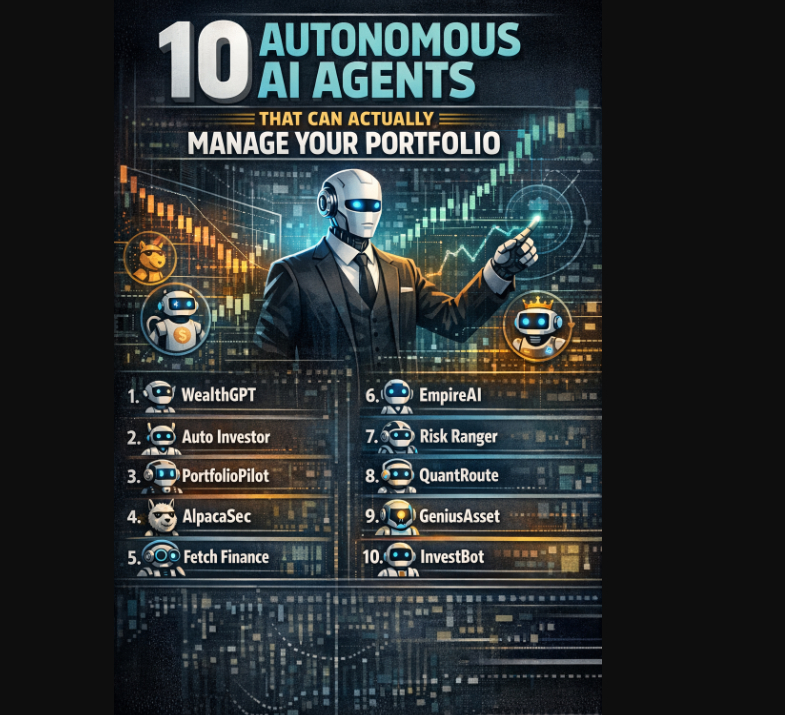
We are entering a new Autonomous AI Agents That Can Actually Manage Your Portfolio, which make investment decisions on the fly with the help of real-time data analysis, machine learning, big data, and automated processes.
These systems are created to function entirely on their own and make real-time decisions that change the allocation of investments, optimize trading, and analyze the market with no assistance from a human. Due to the continuous improvement of AI systems, investors have a preference of AI-driven mechanisms for the management and perpetuation of their financial assets.
What are Autonomous AI Portfolio Agents?
Autonomous AI Portfolio Agents represent a new generation of sophisticated software that applies AI technology to manage investment portfolios with little to no human activity.
These agents evaluate and respond to changes in risk and opportunity in real time to determine optimal distribution of investments among equities, cryptocurrency, ETFs, and other financial instruments.

They can learn from previous periods to improve their strategies for the future and adapt to the current market conditions to trade on their own.
These agents strive to enhance human error, do AI Portfolio Agents take into consideration the unique objectives and risk levels of each investor in their personalized approach to portfolio management.
Key Points & Autonomous AI Agents for Portfolio Management
| AI Agent / Platform | Key Point |
|---|---|
| Numerai | Uses crowdsourced AI models to trade hedge fund strategies with encrypted data. |
| QuantConnect | Enables algorithmic trading using AI models with full automation and backtesting. |
| Alpaca (AI Trading API) | Provides commission-free trading API for building autonomous AI trading bots. |
| Kavout | Uses machine learning (“Kai Score”) to rank stocks and optimize portfolios. |
| Wealthfront | Robo-advisor that automates portfolio allocation, rebalancing, and tax optimization. |
| Betterment | AI-driven robo-advisor focusing on goal-based investing and automatic rebalancing. |
| Trade Ideas (HOLLY AI) | AI engine that scans markets in real-time and executes strategy-based trades. |
| TuringTrader | Open-source AI trading bot framework for systematic portfolio strategies. |
| Composer (AI Investing Platform) | Allows automated portfolio strategies using AI logic and “no-code” rules. |
| BlackRock Aladdin | Institutional-grade AI risk management and portfolio analytics system used globally. |
1. Numerai
Numerai is a distinct hedge fund and employs a decentralized hedge fund model, utilizing crowdsourced machine learning models from data scientists around the world.
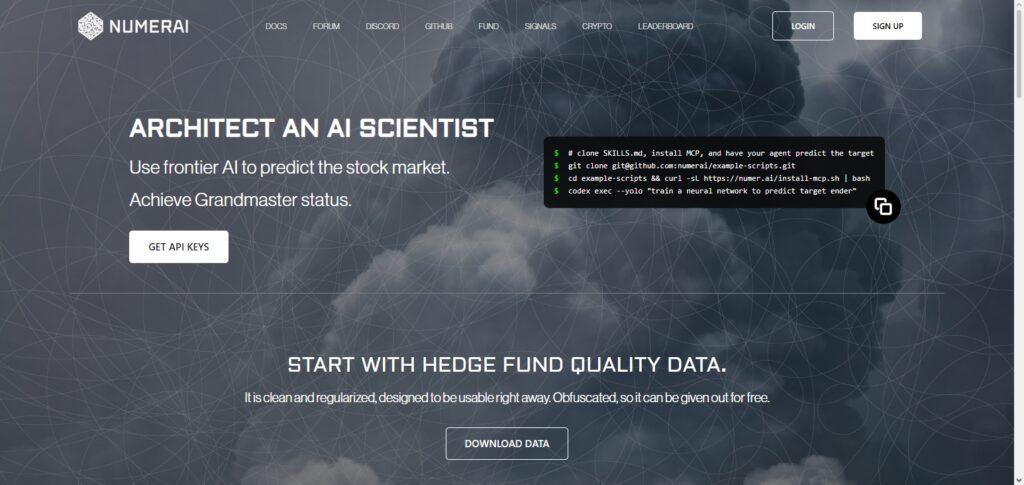
Instead of providing the financial data, Numerai shares obfuscated datasets. Numerai modelers AI with the Metamodel and stake ETH, Numerai’s cryptocurrency. Numerai’s model encapsulates thousands of models and guides real money trades in the middle of Numerai’s process.
Numerai’s model improves bias as a result of decentralization. Autonomous globally collaborating AI in portfolio optimization for returns is numerai’s model’s representation of singles
Numerai Features & pros & Cons
Features
- Competing on an AI model
- Financial datasets are encrypted
- A system for aggregating multiple data models
- Stake crypto (NMR token)
Pros
- Global intelligence diversifies data
- Privacy is maintained through data encryption
- Staking for predictive models
- Decentralized is new
Cons
- Beginners may find it difficult
- Requires data science
- The end trades are opaque
- Participant quality is critical
2. QuantConnect
QuantConnect is an algorithmic trading platform and offers developers and quants the ability to create, test, and implement AI strategies for trading in various asset classes.
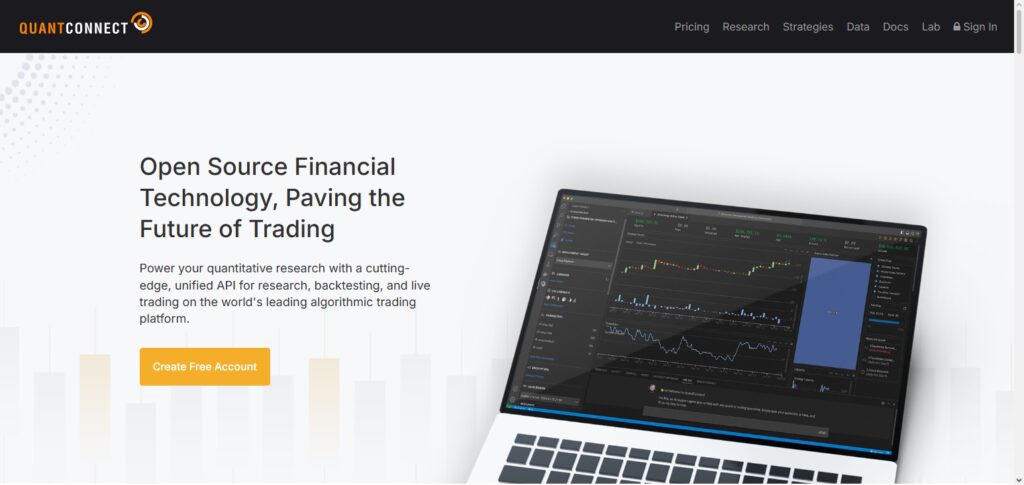
QuantConnect is compatible with C# and Python for the advanced user and developing community. QuantConnect has a mini-cloud in the middle of the ecosystem to implement and train machine learning models to trade automatically.
The models must be used with a trading logic. LEAN engine open source QuantConnect for hedge funds and others to be used in an AI portfolio for autonomous management.
QuantConnect Features & pros & Cons
Features
- Coding in Python & C# is supported
- Open-source engine LEAN
- Access to data historically is abundant
- Backtesting in the cloud
Pros
- Strategy customization is very high
- Tools of a professional in a field are available
- Trading in multiple assets is supported
- The community of developers is strong
Cons
- Cost for data may be high
- Not beginner friendly
- Coding experience is needed
- Steep curve on learning
3. Alpaca
Alpaca’s commission-free trading API allows developers to create and launch fully autonomous AI trading bots effortlessly. This platform features real-time market data, paper trading, and brokerage integration.
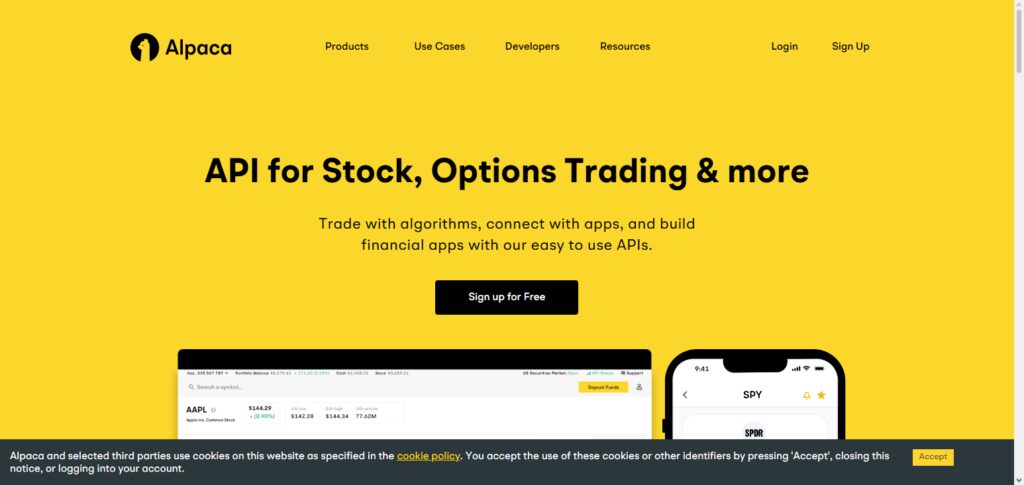
Perhaps most impressively, Alpaca provides its customers the unique opportunity to integrate machine learning models into trading decisions, completely eliminating the need for human interaction. It is this ease of use and the ability to customize solutions that attracts many developers within the fintech and retail trading community.
Alpaca provides the ability for customers to build fully autonomous AI trading bots that dynamically adjust to market conditions within set parameters on their trading account. This allows for truly unlimited trading potential.
Alpaca Features & pros & Cons
Features
- An API for trading with no commissions
- Access to data in real-time and historically
- A trading environment for paper trading
- Integration of brokerage is simple
Pros
- The access to API is simple
- No commissions on trades
- Automation is simple for trading
- Extreme scale of the system for bot trading
Cons
- There is a lack of access to the world markets
- Knowledge of a programming language is needed
- Fewer advanced analytics tools
- API stability is poor
4. Kavout
Kavout is an investment platform that utilizes AI technology to rank stocks using their proprietary “Kai Score,” a unique analytical method that employs machine learning.
This platform goes a step further than its competitors by processing extremely large data sets from financial markets, news, and other relevant sources to then detect emerging investment opportunities.
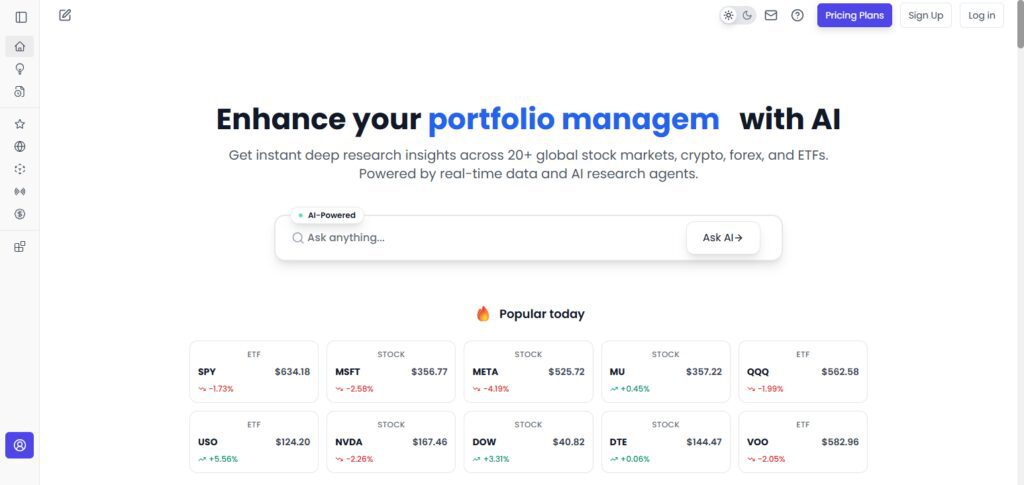
In the middle of its system, Kavout uses predictive analytics to generate actionable insights for portfolio optimization. Investors can rely on these scores to make data-driven decisions without the need for market understanding, further simplifying the complexity of financial analysis.
The AI-driven portfolio management that Kavout offers is unparalleled and further enhances the efficiency of stock-selecting strategies while offering unprecedented accuracy.
Kavout Features & pros & Cons
Features
- Stock ranking by Kai Score
- Predictions aided by machine learning
- Aggregated market data
- Portfolio insights tools
Pros
- Better stocks selection
- More insights with data
- Interface is easy to use
- Retail investor friendly
Cons
- More opacity with models made by AI
- Features with subscriptions only
- Listed options are insufficient for strategy development
- Trading is not fully autonomous
5. Wealthfront
One of the major robo-advisors is Wealthfront, which uses automation to manage investment portfolios. Wealthfront uses ETFs to create a diversified portfolio which is actively managed using algo and modern portfolio theory to manage and optimize performance.
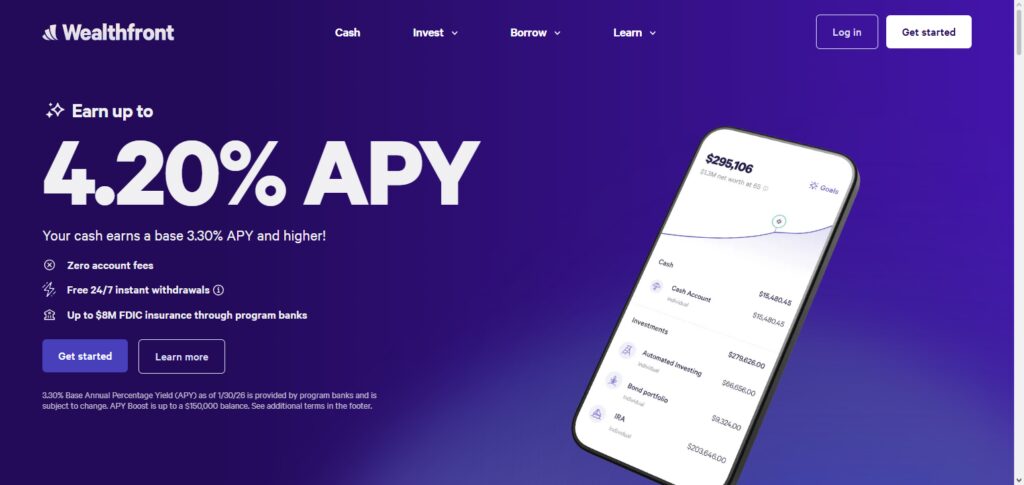
In the middle of Wealthfront’s services, the company will do automatic rebalancing and tax-loss harvesting to maximize after-tax returns. Wealthfront offers services and tools to plan finances, allowing a long term investor to create goals and structures.
Wealthfront allows the investors to make emotional decisions, as their platform is fully managed through technology. Portfolio Management is a fully automated and Wealthfront has a very strong and disciplined investment strategy.
Wealthfront Features & pros & Cons
Features
- Automated portfolio assignment
- Continuous tax loss harvesting
- Rebalancing
- Various automated financial support services
Pros
- Managing accounts is fully automated
- Various tax evasion schemes via trade harvesting
- Fees managed are lower-than-average for the industry
- Account management is a novice activity
Cons
- Urge to limit trade options is bound to arise
- Emotionless services provided still attract fees
- Control/steering engagement is diminished considerably
6. Betterment
Betterment is a competing robo-advising company that allows the customer to create goals, which then the company’s AI will create a customized investment portfolio. Betterment focuses on goal-based investing, which allows users to create a company targets as goals.
Betterment has a very simple UI, which allows even the most novice of investors to utilize their services. Betterment has applied concepts from behavioral finance and artificial intelligence to create a services that allow clients to achieve long term goals with very little risk and ensure their investment is always alive.
Betterment uses a fully automated system, meaning they do the investing for the client and use tax-less harvesting to optimize the taxes on the client’s investments. Betterment encourages retirement and ‘spend less, save more’ goals.
Betterment Features & pros & Cons
Features
- Investment goals
- Re-balancing services
- Tax focused services
- Portfolios with customization
Pros
- To work with is unintimidating
- Good/strong financial planning components
- Portfolios are automated, telling users is an advanced activity
- Services are amply sufficient for novices
Cons
- Competitive fees
- Range of available investments is poor
- Trading is not advanced
- Expert users will find it difficult
7. Trade Ideas (HOLLY AI)
Trade Ideas is an AI-powered trading platform with its own system HOLLY AI, which offers real-time algorithmic trade strategies.
Trade Ideas considers trading opportunities with the highest probability by examining millions of market data points daily. Trade Ideas generates and executes the best strategies out of the multiple strategies created in the engine mid-set.
Over time, HOLLY AI becomes more accurate, as it learns market behavior. This platform allows active traders to utilize an automatic system to trade.
Trade Ideas (HOLLY AI) Features & pros & Cons
Features
- HOLLY AI trading engine
- Scans the market live
- Simulated strategies
- Signals for automated trading
Pros
- Analysis of markets is fast
- AI strategies are proven
- Users will become hands-on
- System thinks for itself learning strategy
Cons
- Monthly payment for trade strategies is high
- Mainly stocks are taken into account
- Trading background is mandatory
- Totally hands off is not an option
8. TuringTrader
TuringTrader is an example of an open-source algorithmic trading framework that allows users to develop systematic and AI-based investment models.

Users can design, backtest, and automate trading models using historical data. TuringTrader offers traders the opportunity to customize models to implement portfolio strategies to the fullest.
Developers and quantitative analysts are attracted to TuringTrader because of its open-source transparency. TuringTrader allows full automation and AI-defined rules to be created around trading, making it a low-cost autonomous trading system.
TuringTrader Features & pros & Cons
Features
- The platform is open source.
- There is strategy backtesting.
- Algorithms can be customized.
- There is the ability to add automation.
Pros
- There is no cost to use it.
- It can be many things.
- The system is transparent.
- Strategies that are custom can be incorporated.
Cons
- It is necessary to have coding skills.
- Brokerage services are not built in.
- There is not much community around it.
- The setup is difficult.
9. Composer
Composer is an investing app using AI technology, designed for users interested in automating portfolio strategies without any coding.
Users can build strategies using the AI visual interface, in which users can construct “symphonies” or strategies. Users choose from an array of market or economic conditions. Composer mid-level users can automate execution and rebalancing.
This makes portfolio automation more accessible for users who don’t have technical experience. Investors can utilize AI-automated strategies and investment functions with Composer’s functionality and ease.
Composer Features & pros & Cons
Features
- You can make pieces of strategies without coding.
- Rebalancing is done automatically.
- AI to dictate rules.
Pros
- It is geared toward beginners.
- Drafting strategies does not require coding.
- Simple automation
- Visual design of the strategy
Cons
- Advanced customization is limited
- Smaller ecosystem of the platform
- Varying performance of the strategy
- Predefined rules dependancy
10. BlackRock Aladdin
BlackRock Aladdin is an AI portfolio management and risk analytics tool used by institutional investors that is extremely advanced. The technology encompasses trading, risk management, and portfolio management with an all-in-one approach to services.

The platform’s infrastructure includes real-time market risk, asset reallocation, and strategic decision analytics through the assessment of large, complex datasets; this technology is used by the world’s leading banks, asset management firms, and governments and is considered the best in meaningful AI-powered finance.
Aladdin’s technology enables large-format portfolio management with precision, effectiveness, and comprehensive risk analysis.
BlackRock Aladdin Features & pros & Cons
Features
- Risk analytics integrated
- Portfolio management system
- Data processing in real time
- Tools of institutional level
Pros
- Extremely powerful analytics
- Global institutions use it
- Risk management is deep
- Highly scalable
Cons
- Not available to retail investors
- Very high cost
- Complex system
- Professional knowledge is required
Criteria for Choosing Autonomous AI Portfolio Platforms
Accuracy & Predictive Power
Center AI Portfolio Platforms focusing on advanced and machine-learning automation to predict the future and consistently improve investment decisions at all times in all subsets of the marketplace.
Track Record & Performance History
Long-term success on AI should validate the AI and prove consistent success during all subsets/variations of the marketplace/market cycles.
Risk Management System
AI should have built-in stop losses, built-in risk management systems, and automated protection and risk loss systems in the event of a bullish bear market/market crash.
Level of Automation
Select frameworks/portfolios that are fully automated, including automated trade execution, monitoring, and automated market fluctuational rebalancing to defined strategy rebalancing market volatility frameworks.
Data Quality & Real-Time Access
Data should be real-time and high quality to foster better AI predictive abilities. Data should be free of contamination and all no-data market decisions/market-contaminated AI decisions.
Customization & Flexibility
The AI platforms should have the ability to customize the AI to change its focus and adapt to your financial/monetary goals and investment preferences, including risk tolerance.
Transparency & Explainability
The AI model should be explainable liquidity models to diminish the investment risk model and the risk of the algorithm investment models.
Simulation & Backtesting Tools
Trustworthy providers include tools for evaluating specific strategies via historical data. This feature allows users to check the strategy’s results without setting unrealistic goals, prior to incorporating AI in actual active trading.
User Friendly
A well designed interfaces that include clear dashboards, streamlined navigation, and demo tools make it easy for users to control and manage their portfolio. This allows even inexperienced users with little to no technical or trading skills to manage their portfolio successfully.
Fees & Cost Structure
High fees and hidden costs such as management and subscription fees can cut your periodic profit and reduce the overall value of your portfolio in the long run. So make sure you are clear on the total costs involved.
Risks and Challenges
Market Unpredictability Black swan events can strike the economy at any time and the AI models prediction capabilities are weak and faulty in these situations and therefore untrustworthy.
Overfitting of AI Models Overfitting of models show the AI learned unnecessarily from its training set. This limits and cripples its ability to recognize the patterns and other variables of the real-world economy.
Lack of Transparency (Black-Box AI) Lack of AI model transparency creates uncertainty in the model. If the model fails expect the user to lose faith and refuse to use the model again.
Data Quality Issues AI models can only be reliable, and produce applicable/sharable investment strategies again only when the data inputs are of the highest quality, current, and most accurately bias-free.
Technical Failures & System Errors Automated systems crash. Bugs and other issues create breaks in the connection from the AI model to the adjustment capability of the model. This creates all types of investment risks.
Regulatory & Compliance Risks AI models face compliance difficulties and uncertainty of regulations from country to country. As regulations get tighter and countries create more laws these models are at risk of being rendered illegal.
Security & Cyber Threats Automated programs not exempt from the risks of hacking, data breaches, and other cyberattacks. They may expose private and sensitive information, disrupt business operations, and cause financial and reputational losses to the business.
Lack of Human Judgment AI’s inability to demonstrate intuition and emotional intelligence may overlook important factors, especially during atypical and emergent market circumstances, and lead to decisions that may be too inflexible and not sufficiently adaptive to the financial circumstances.
Key Technologies Behind AI Portfolio Agents
Machine Learning (ML)
ML-based AI portfolio managers take real time and historical data and machine learn from it to optimize how to allocate the portfolio with the least human input.
Deep Learning (Neural Networks)
Deep Learning & Neural Networks choose data to improve price predictions, market sentiments, and risk which improves the sophistication and adaptability to market changes of the portfolio management.
Natural Language Processing (NLP)
The NLP tool helps AI agents to analyze and process news, earnings reports, social media, and other sentiments. This tool has unorganized texts converted to organized texts for trading.
Algorithmic Trading Systems
Algorithmic trading helps with executing and making trades. It helps with no emotional trades and having AI to make data changes, as well as helps with remaining an organized portfolio.
Big Data Analytics
Big Data helps with the AI agents that are analyzing and looking to find investments and patterns for the portfolios. Big Data helps with an organized portfolio.
Cloud Computing
The Cloud Computing AI models, data storage, and trade execution creates and improves the systems with speed and efficient organization for autonomy portfolio management.
Reinforcement Learning
An example of how an AI agent learns is how it uses reinforcement learning. By interacting with the markets, it finds best strategies by either receiving a positive reinforcement (reward) or a negative reinforcement (loss).
Blockchain Technology
Thanks to the characteristics of Blockchain Technology, AI agents can function better. With the ability to work in a trustless environment due to decentralized, transparent, and secure data management, AIs simplify fraud mitigation and secure transaction monitoring and tracking in crypto and DeFi portfolios.
Conclusion
Utilizing machine learning, big data, and automation, Predictive AI portfolio agents have the potential to revolutionize investing. Predictive AI agents make data-driven decisions quickly, and have the potential to be more efficient and minimize emotional bias.
Even so, some risks, such as a lack of transparency, overfitting, and unpredictable costs, may show a need for careful selection and monitoring agents. For risk and performance, predictive AI agents with proven data and risk management systems should be prioritized.
Extensive tools can be used to affect decisions, and investing with AI provides some of those tools, despite the lack of possibility of guaranteed profit.
The predictive AI agents will demonstrate the smart and resilient strategies of the future, and show the potential of portfolio management with the combination of AI, data, and humans.
FAQ
Are AI portfolio managers safe to use?
They can be safe if you choose regulated platforms with strong security and risk management systems. However, market risks and technical issues still exist, so monitoring and diversification are important.
Can AI really outperform the stock market?
AI can improve decision-making and efficiency, but it does not guarantee market-beating returns. Performance depends on data quality, strategy design, and changing market conditions over time.
Do I need coding skills to use AI investing platforms?
Not always. Some platforms offer no-code solutions for beginners, while others require programming knowledge for building custom AI trading strategies and advanced portfolio automation.
What is the difference between robo-advisors and AI agents?
Robo-advisors follow predefined strategies with limited flexibility, while autonomous AI agents use advanced learning models to adapt, optimize, and make dynamic investment decisions in real time.
What are the biggest risks of AI portfolio management?
Major risks include market unpredictability, overfitting of models, lack of transparency, data quality issues, and potential technical failures that can impact trading performance and investment outcomes.