

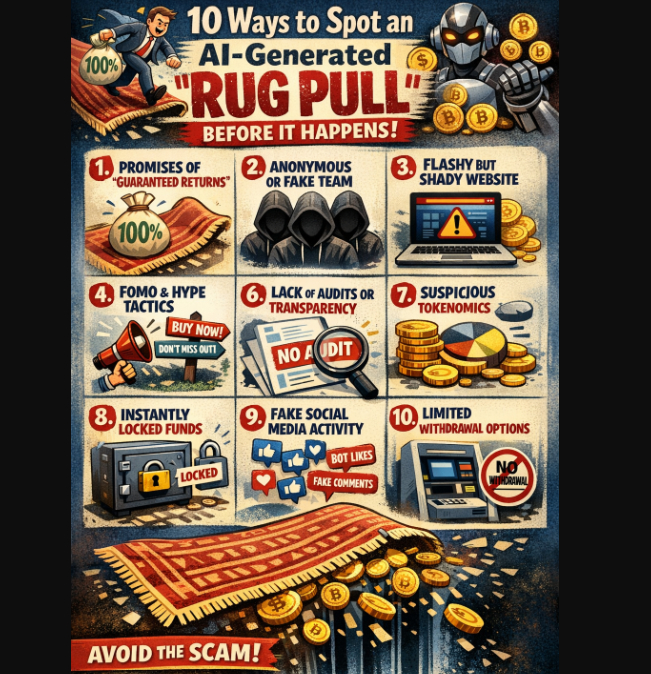
This article will focus on Ways to Spot an AI-Generated “Rug Pull” Before It Happens. Scam artists are becoming extremely sophisticated and it is becoming more important to look out for warning signs such as anonymous teams, overhyped whitepapers, unrealistic roadmaps, and suspicious wallet behavior.
Identifying these warning signs early allows fraudulent AI crypto projects to be avoided, leads to more informed decisions and ultimately allows investors to protect their capital.
What is an AI-generated rug pull?
AI-generated rug pulls are scams in the cryptocurrency and blockchain industries where developers use artificial intelligence to design fake projects. These include deceptive whitepapers, fraudulent tokenomics, scam websites, and fake marketing. Using AI, criminals can produce convincing, yet fraudulent, copy aimed at convincing people to invest in the fraudulent project.
When enough people invest to fund the scam, developers (or automated bot systems) pull the liquidity, and/or steal the funds, leaving behind worthless tokens. AI-generated rug pulls are difficult to detect because the AI hype and documentation can easily fool any scam detectors.

Key Point & Ways to Spot an AI-Generated
| Key Point | Why It Matters |
|---|---|
| Anonymous Team | No verifiable founders or fake LinkedIn profiles often signal fraud. |
| Overhyped Whitepaper | Buzzwords without technical depth show lack of real utility. |
| Unrealistic Roadmap | Promises of rapid growth or guaranteed returns are classic traps. |
| No Audit Reports | Smart contracts without third-party audits are highly risky. |
| Locked Liquidity Absence | If liquidity isn’t locked, developers can drain funds instantly. |
| Aggressive Marketing | Heavy reliance on influencers and hype instead of product substance. |
| Copy-Paste Tokenomics | Identical structures to past scams suggest recycled fraud schemes. |
| Unclear Utility | Tokens with no real-world use case are prone to collapse. |
| Suspicious Wallet Activity | Large insider holdings or sudden transfers indicate manipulation. |
| No Community Transparency | Closed communication channels or censored discussions hide critical issues. |
1. Anonymous Team
Any crypto project that has an Anonymous Team lacks transparency. Founders, developers, and advisors hiding their identities means little to no accountability, giving investors no means to verify credibility, experience, or track record.

Increased risk for fraud is a realistic possibility because scam projects leverage anonymity, allowing their creators to pull the project and disappear with no legal consequences. While pseudonymous identities aren’t entirely uncommon in crypto, completely
anonymized teams tend to be the most concerning. Always investigate LinkedIn, previous projects, and contributions to GitHub repositories. If you can’t put a name behind a project, assume the worst. Anonymous Team members are often responsible for rug pulls.
Anonymous Team Features, Pros & Cons
Features
- Team members are hidden or anonymous.
- No public record of previous experience.
- No social profile or portfolio.
- Projects themselves are used for credibility.
Pros
- Team members can innovate freely without fear of bias.
- Developers in dangerous locations can keep their identities secret.
- Early adopters may become interested as anonymity can often be intriguing.
- The potential of anonymity lessens legal liability.
Cons
- The legitimacy of projects is hard to verify.
- Fraud and rug pulls are more likely.
- Without direct accountability, poor decisions can be made.
- Investor trust is hard to achieve.
2. Overhyped Whitepaper
An Overhyped Whitepaper is a tool for attracting investors, and in order to achieve that goal, it is often full of buzz words. Each investor might be swayed based on this marketing technique, especially when the project lacks technical explanations or a roadmap for matters to control.

Scammers rely on the illusion of legitimacy, with documents created by AI or with content that has been copied and pasted. A Whitepaper for a legitimate project is transparent in terms of tokenomics, project goals, and project mechanisms.
If a document lacks details or exaggerates to the point of being offensive, it is a big red flag. If the document does not provide details for investor consideration, this is likely a rug pull.
Overhyped Whitepaper Features, Pros & Cons
Features
- Contains overhyped, exaggerated, and buzzword-filled claims.
- No technical depth or understanding.
- AI generation or copy-paste content is often prevalent.
- More substance is placed on the marketing than content.
Pros
- Potential investors may become hyped and excited initially.
- Beginners may find the whitepaper easy to comprehend.
- The perception of professionalism may be created.
- Increased media coverage may result.
Cons
- The potential of the project may be misrepresented to the investors.
- The technical shortcomings of the project may be hidden.
- The chances of the project failing increases.
- Investors may lose money as the funds may be misallocated.
3. Unrealistic Roadmap
Long-standing projects with an Unrealistic Roadmap display milestones and deadlines that cannot be met. Most often, short-term promises of rapid development, high returns, and worldwide adoption are used as bullshit bingo tactics to lure inexperienced investors.

Especially scammers, as they create an artificial hype and urgency over their projects to trigger FOMO among investors. Hiding behind AI-generated project descriptions that AI claims to be revolutionary, serve as cover to overstate their project.
A reputable roadmap captures its reality through technical descriptions of development phases and specifics to KPIs.
Most importantly, promises should be substantiated, and with due diligence, should be reassured through marketing that project milestones are achievable objectives, internally. To date, an Unrealistic Roadmap consistently precedes the deteriorating state of a project or disappearing funds.
Unrealistic Roadmap Features, Pros & Cons
Features
- Premature goals are set for project milestones.
- Deadlines are too optimistic.
- The potential of the team or resources is overestimated.
- Hype is prevalent over substance.
Pros
- Investors are likely to feel a sense of urgency.
- Interest and buzz of the project will be created.
- The team will feel a sense of motivation to push the project along.
- Creates an ambitious vision for marketing.
Cons:
- High miss deadline rate.
- Projects can fail from taking on too much.
- Credibility is lost over time.
- Investors can become frustrated or even panicked.
4. No Audit Reports
Lack of transparency in code is as dangerous as Auditing is critical. Without No Audit Reports, projects become avenues for investors to be exploited. VULNERABILITIES of smart contract audits are CLOSURES for developers and or malicious actors to dRAIN wherever there are found funds.

Legitimate projects typically attract the eyes of third-party auditors to report the body of the Audit. Scammers, in fact, prefer to do No Audit Reports due to the audit scrutiny they attain.
The absence of No Audit Reports or dead audits is synonymous to rug pull. Most importantly, do not invest in an insecure project with an audit. Always invest to access the unassessed secure contract.
No Audit Reports Features, Pros & Cons
Features:
- Smart contracts lack audits.
- Unknown security vulnerabilities.
- No independent code verification.
- High risk of exploitation and hacking.
Pros:
- Developer time and costs are saved.
- Rapid project launch is possible.
- Adjustments can be made to code before audits.
- Overtly strict auditing constraints can be avoided.
Cons:
- High risk of losing funds.
- Hacks and exploitation are possible.
- Investor confidence is decreased.
- A scam or rug pull may be suggested.
5. Absence of Locked Liquidity
Absence of Locked Liquidity shows that developers can withdraw liquidity at any time, making them able to execute a rug pull at any moment. For instance, Locked liquidity gives confidence to investors that tokens can’t be dumped immediately.

Scammers typically create short term hype to get people to buy, and subsequently, execute a pull on Decentralized Exchanges.
These can be checked on Uniswap and PancakeSwap. To check for liquidity locked is basic due diligence. Projects with Locked Liquidity Absence are high risk since they allow investors to pull funds quickly, putting insiders at a high risk.
Absence of Locked Liquidity Features, Pros & Cons
Features:
- Developer control of liquidity.
- No time lock mechanism.
- Tokens are freely withdrawable.
- Market stability is endangered.
Pros:
- Control is given to developers.
- Adjustments to tokenomics or project direction are easier.
- Initial setup complexity is lowered.
- Speculators seeking rapid profits are drawn.
Cons:
- Very likely to be an instant rug pull.
- Extreme volatility is created.
- Investor confidence is decreased.
- If liquidity is removed, the market crashes.
6. Overzealous Marketing
Overzealous Marketing projects use pressure tactics to get investors through promotions, persistent DMs, and shilling. These all create hype, and fear, and get users to invest, all without any due diligence.

Overzealous Marketing is often accompanied by fake generated text, spam, and testimonials to make it look legitimate.
Trustworthy projects focus on community building, and effective communication, and not fake promotion. Overzealous Marketing is a primary indicator of a scam, and is often seen right before a rug pull.
Aggressive Marketing Features, Pros & Cons
Features:
- Persistent advertisements on social media.
- Heavy utilization of influencers or bots.
- Campaigns driven by FOMO.
- Focus on hype instead of substance.
Pros:
- Rapid development of investor interest.
- Initial token sales are likely to increase.
- Community growth is possible.
- Short term buzz is created.
Cons:
- Misleading for investors that do not know better.
- Could show a sense of desperation to collect donations.
- Typically, has no value that can be sustained.
- Could cover up weaknesses of the project.
7. Copy-Paste Tokenomics
Successful projects have custom token distribution mechanisms, so seeing Copy-Paste Tokenomics is a huge red flag. Copy-paste distribution, staking, or rewards mechanisms show a project is trying to scam or is being lazy.

Copy-paste mechanisms show a lack of thought or understand of the project’s revenue model or goals, and show the project is there to just take money from investors.
Look at the distribution of allocations to founders, private investors, and project liquidity to see if there is a disproportionate allocation. It is a certainty to be un sustainable, and risks the devs cashing out if the project has Copy-Paste Tokenomics.
Copy-Paste Tokenomics Features, Pros & Cons
Features:
- Copies token allocation of other projects.
- Same staking reward system.
- No synchronization with the project’s actual objectives.
- Usually a basic design is put together.
Pros:
- No new tokenomics design.
- Can use successful systems as a model.
- Easier for investors to grasp.
- Can facilitate the expedite of the project’s launch.
Cons:
- May not be appropriate for the project’s ecosystem.
- Can create an insider’s advantage.
- Could show signs of laziness or fraud.
- Shows a lack of originality and long-term sustainability.
8. Unclear Utility
All project tokens need to have utility in their own economy in order for the token to be an asset and not a liability. Unclear Utility means the scam focuses on money and not solving a problem or enabling a platform.

If a project lacks utility, the hype around the project will die and leave it to ultimately collapse. If a project lacks utility, focus on the whitepaper, and assess if the token is necessary for governance, transactions, or the operation of the economy.
If the token lacks utility, the project is definitely a pump and dump, and investors have no utility to hold long-term. This ultimately makes the project a scapegoat for a rug pull.
Unclear Utility Features, Pros & Cons
Features:
- No good rationale for a token.
- No utility is demonstrated with real-world use.
- Often use vague descriptions in the whitepaper for utility.
- There is minimal to no ecosystem dependency.
Pros:
- Can be easier to promote as a speculative asset.
- Less design complexity in the system.
- Can draw in short-term traders.
- Initially permits some flexibility in the use of the token.
Cons:
- Low long-term utility and adoption.
- Investors may quickly lose interest.
- May lead to the complete failure of the project.
- Encourages pump and dump schemes.
9. Walled Wallet Activity
Fraudulent Wallet Activity includes significant numbers of acquisitions, divestitures, or wallet concentration. Developers, or insiders, seem like they intend to exit by moving large amounts.
An early instance of such activity, particularly when accompanied by proprietary AI-fraud detection software, can turn out to be a fraudulent wallet.
A Walled Wallet Activity pattern can be magnified by low liquidity or by paint-the-farm liquidity-shifting frauds.
A distributed fraud risk, in regard to its liability, will be blocked in trust. By default, the Walled Wallet Activity pattern will act as a signal for the fraudulent wallet.
Walled Wallet Activity Features, Pros & Cons
Features:
- Large transactions in wallets of the developers.
- Large token dumps or concentrations in a small number of wallets.
- Unusual and inconsistent trading.
- Movements that are not transparent.
Pros:
- Developers can control liquidity.
- Can help execute planned tokenomics.
- May help capture attention from monitoring systems.
- Can be used to adapt to market conditions before trading.
Cons:
- Could indicate a rug pull.
- Chance of investor loss is high.
- It reduces confidence in the stability of the tokens.
- It may draw regulatory attention.
10. Little to no Community Engagement
Vigilant projects are transparent. Little to no Community Engagement suggests developers dodge, and look to avoid, the odd AMA or post. Limited-interaction environments attempt to circumvent scrutiny and limit revealing mistakes.

There may be significant channel moderation in Community Engagement, and undesirable comments and questions may be deleted. Acceptable Engagement, lawfully, permits progress updates and governance.
The absence of Community Engagement takes the projects for the Developers to act. The Developers may abandon the Project when the truth emerges in the Community.
Little to no Community Engagement Features, Pros & Cons
Features:
- Developers skimp on answering questions or AMAs.
- Feedback is often dismissed and purged.
- There is little to no communication about progress.
- There is extreme moderation over community communication.
Pros:
- Public panic is calmed during development.
- Industry competitors can’t see the development strategy.
- There is less public relation work to be done.
- There is more control over the narrative.
Cons:
- Trust in the project from investors is diminished.
- There is no feedback from the community to help build the project.
- Project deficiencies may be concealed.
- There is usually little separating this from a rug pull or a project exit.
How to Choose Ways to Spot an AI-Generated Rug Pull Before It Happens
Anonymous Team – Not having a known team is a severe risk indicator. Lack of accountability means they can pull the rug and vanish the project without facing consequences.
Overhyped Whitepaper – Your whitepaper should convey the truth. Over the top AI generated content brings benefits and overlooks dangers, inviting the risk of AI-pulling.
Unrealistic Roadmap – If there is a chance of goals and deadlines to be hit, it seems there is a chance of a scam. Don’t be highly hyped.
No Audit Reports – Less reports means more risk. Unverified smart contracts are likely to be hacked and funds stolen.
Locked Liquidity Absence – Risk of lagging is present if liquidity remains unlocked. Developers can withdraw without limit, which is bumping risk.
Aggressive Marketing – FOMO should be a scam indicator. Marketing is often void of value, and if it’s value is hosed, the marketing for it should be thick.
Copy-Paste Tokenomics – If distributions don’t indicate originality, scam is likely. Tokenomics that are identical tend to benefit the insiders.
Unclear Utility – Utility design that is speculative can cause dangerous risk to collaps. There should be an honest use and purpose for the token.
Suspicious Wallet Activity – Keep an eye on wallet mechanics, particularly big dump transactions or clustering of activity to a small number of addresses. Such activity is often a precursor to a rug pull.
Community Transparency – The absence of developer transparency concerning the community and the unexplained silence are a potential red flag and an indicator of fraud. This is especially true when it comes to community engagement, AMAs, and community updates.
Benefits of Spotting Red Flags Early
Safeguards the Investors’ Capital – Understanding the risks associated with a project allows to make bets that will most likely not lose money to fraud or scams.
Prevents Exposure to Fraud/Scams – Recognition of the risks allows to skate past rug pulls, incompetent tokenomics, or malicious developers.
Augments Risk Assessment – Understanding risks allows the investor to be more rationale, methodical, and strategic with their investments avoiding irrational and emotionally driven bets.
Costs Less Emotionally – Recognition of hype, abuse of marketing, or fear of missing out (FOMO) helps avoid emotionally driven bets.
Improves Research – Recognition of the risks improves diligence on the project team, audits, the utility of the token, and the legitimacy of the project.
The Longterm Costs Less – By not investing in the project, the investor spares money that can be invested in the longterm, and avoids projects that may collapse or fail to deliver.
Trust Increases – Recognition of the risks improves the trust and confidence in the ability to evaluate other new projects.
Conclusion
The significance of spotting AI rug pulls lies in protecting one’s investment. Early identification of major warning signs, such as the presence of anonymous development teams, inflated white papers, unrealistic project road maps, un-audited projects, no liquidity locks, excessive marketing, irrational tokenomics, no community utility, suspicious activity in wallets, and limited activity in the community can redirect an investor’s effort in the right direction.
A community formed by investors and individuals interested in crypto projects can protect their rights. Profitable and reliable projects can be found in the crypto industry by eliminating fake and unsustainable projects.
FAQ
How can I identify an anonymous team?
Look for verifiable identities, social profiles, and previous project experience. Projects with hidden or pseudonymous teams are high-risk.
Why is an overhyped whitepaper a warning sign?
AI-generated or exaggerated whitepapers often exaggerate profits, use buzzwords, and lack technical clarity, misleading investors about project feasibility.
How do I check for liquidity risks?
Verify if liquidity is time-locked or secured. Absence of locked liquidity allows developers to withdraw funds suddenly, causing price crashes.
Are audits really necessary?
Yes. Independent smart contract audits reduce vulnerability to hacks and exploits, ensuring project security.
Why is community transparency important?
Transparent updates, AMAs, and engagement ensure accountability, build trust, and allow investors to detect early warning signs.