
This article explore the Perps Exchanges with the Lowest Fees in April 2026 focusing on financially efficient perpetual trading can choose various positions to optimize their gain.MEXC, Lighter, KCEX, and Binance Futures as well as Aster, Hyperliquid, edgeX, dYdX, Bybit, and OKX Futures have the lowest maker and taker fees, high liquidity, and low flexibility leverage. Picking a low-fee exchange strategically can optimize costs, execution, and your trading strategy.
What is a Perpetual (Perps) contract?
Perpetual contracts (perps) are a type of derivative in which a trader speculates on the value of an asset that has no expiration date. While traditional future contracts come with an expiration date, a trader may hold perpetual contracts for those longer or shorter time frames.
These contracts also come with high leverage, allowing a trader to take on more risk (and potentially more reward) when using borrowed funds.
Perps contracts are elongated Funding rates to maintain the price of the contract in relation to the asset. In cryptocurrency markets, these are also used for Hedging, speculation, and Arbitrage.

Key Point & Perps Exchanges with the Lowest Fees
| Exchange | Key Fee‑Point (Apr 2026) |
|---|---|
| MEXC | Zero maker fees; among lowest taker fees on perps. |
| Lighter | No maker/taker fees for standard users. |
| KCEX | Zero maker and extremely low taker. |
| Binance Futures | Competitive perpetual fees with BNB discounts available. |
| Aster | Very low maker/taker with native token discount. |
| Hyperliquid | Among lowest DEX perp fees. |
| edgeX | Low fees with self‑custody and low taker. |
| dYdX | Institutional‑grade perp DEX with well‑balanced fees. |
| Bybit | Low perp fees (spot/futures) with volume tier discounts. |
| OKX Futures | Competitive perp fees, especially at higher VIP tiers. |
1. MEXC
MEXC stands out among numerous competitors by providing extremely low fees on perpetual futures contracts.
Active traders will find a MEXC Futures fee structure of 0.000–0.020% on maker/taker fees (who add/remove liquidity respectively) much more reasonable than that of most competitors.
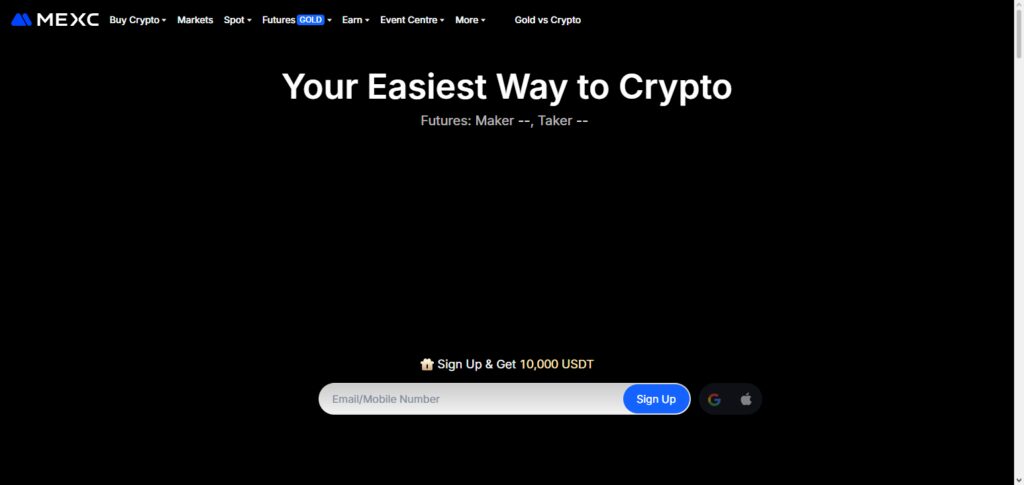
Further discounts are available through the use of the exchange’s MX token, whether paying fees on futures or spot market transactions.
Discounts may be as much as 50%. MEXC includes deep liquidity up to 500× high leverage through hundreds of perpetual contracts, making the exchange ideal for scalping as well as for other professional trader strategies.
MEXC Features , Pros & Cons
Features:
- Perpetual futures with 500× leverage.
- Zero maker and low taker fees.
- Hundreds of supported crypto pairs.
- Discounts via MX token.
Pros:
- Extremely low trading costs for active traders.
- Deep liquidity across many markets.
- Fast execution for scalping and high frequency trading.
- MX token incentivizes traders and further reduces fees.
Cons:
- Customer support can be slow during rush hours.
- Fewer charting tools compared to some CEXs.
- More leverage comes more risks.
- Not every country may have access to regulation.
2. Lighter
Lighter is a new decentralized perpetual exchange (DEX) that has received interest because of their zero-fee trading on perpetual contracts.
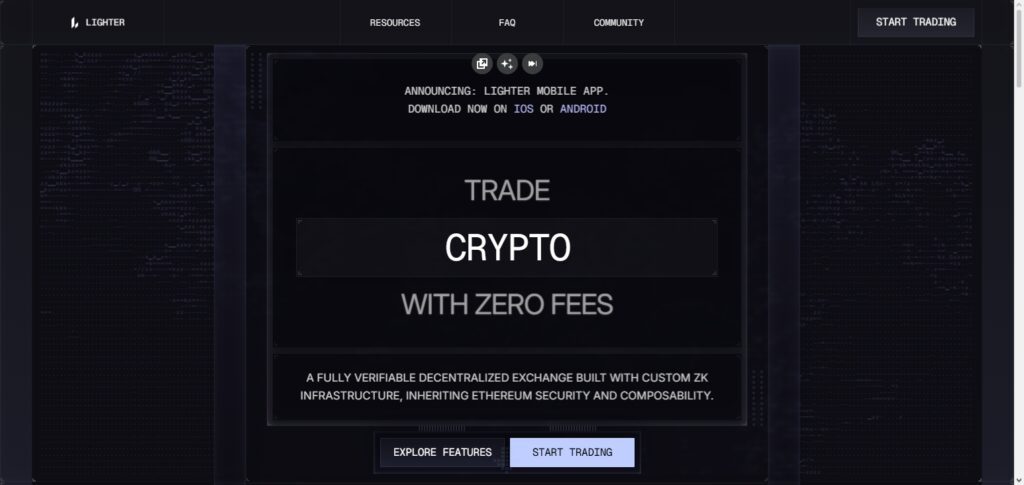
Operational through a Layer-2 Derivatives focused on zero maker or taker fees, Lighter allows retail traders to execute their high-frequency trading strategies at little to no cost. Lighter’s zero-fee model, in contrast to centralized exchanges, reduces friction for on-chain perpetual trading.
Despite competition, Lighter’s high user engagement is indicative of demand for frictionless access to perpetual trading at low cost.
Lighter Features , Pros & Cons
Features:
- Decentralized perpetual exchange (DEX).
- Zero maker and taker fees for standard users.
- Layer‑2 scaling for faster trades.
- Funds are held on chain.
Pros:
- No cost barriers to trade.
- No centralized custody, more control over funds.
- Layer 2 scaling means faster execution.
- No trust required, operations are smart contracts.
Cons:
- Less liquidity closed to the top centralized exchanges.
- Advanced order types may be more limited.
- Less experience DEX users will have to learn more.
- There is some risk with smart contracts.
3. KCEX
KCEX is a worldwide crypto trading platform that focuses on very low fees and high leverage for perpetual futures traders.
Their futures markets are typically advertised to have very low fees on makers, often approaching zero, and very low fees on takers, which can be as low as 0.01%. Because of this, traders can perform short- to medium-term high-frequency trading without worrying about costs.
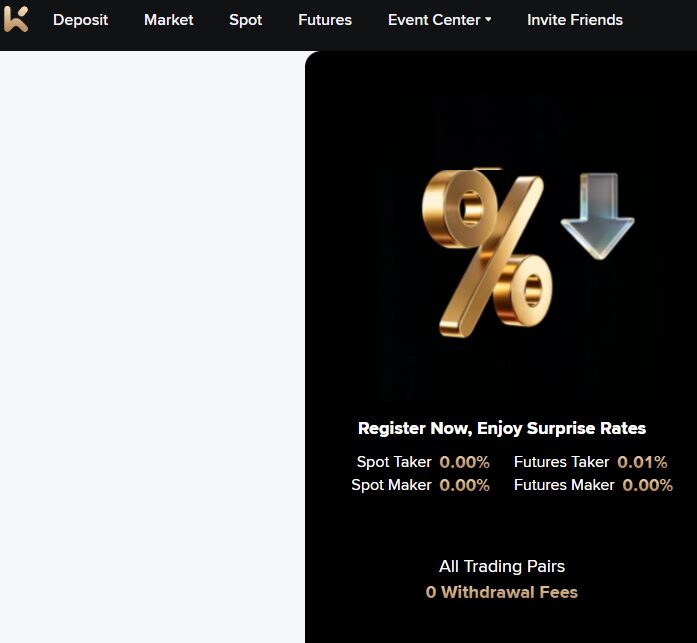
KCEX offers USDT-margined perpetual contracts on all major crypto assets and offers several order types and margin modes, giving traders flexibility and freedom to choose how, and with which parameters, they want to trade.
The order types and margin modes offered by KCEX allow them to trade with a high degree of strategic freedom. KCEX attempts to balance trading costs by charging low fees compared to competitors, therefore KCEX is a preferred trading platform among scalpers and traders using algorithmic trading.
KCEX Features , Pros & Cons
Features:
- Centralized crypto exchange with low costs.
- Perpetual contracts with flexible margin options.
- Maker fees are nearly zero and taker fees are extremely low.
- Acceptance of popular cryptocurrencies.
Pros:
- Low transaction fees for regular traders.
- Acceptable for institutional and retail traders.
- Rapid execution of trades.
- Interface is uncomplicated.
Cons:
- Less active users in comparison to the top Cryptocurrency Exchanges.
- Less trading tokens than most competitors.
- Different fees for withdrawal.
- Less targeted regulation.
4. Binance Futures
As one of the largest global trading platforms and liquidity providers, Binance Futures is the perpetual derivatives trading area of Binance.
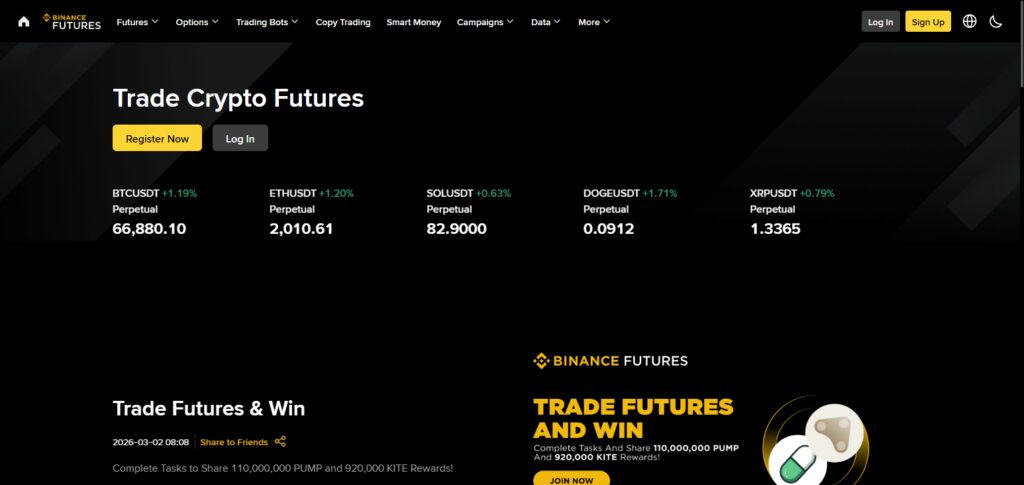
With deep order books and rapid execution, Binance Futures is distinguished by a broad offering of perpetual contracts as well as tiered maker and taker fees, which are typically ~0.018–0.02% makers and ~0.04–0.05% takers for the base tiers.
Large volume traders and self-dedicated to Binance currency (BNB) holders receive good discounts on takers. As one of the largest platforms offering perpetual contracts, Binance offers narrow spreads and high liquidity in addition to low fees for trading, which are very important for professional traders.
Binance Futures Features , Pros & Cons
Features:
- Worldwide centralised blockchain.
- Tiered fees and discounts with BNB.
- High liquidity for many contract pairs.
- Up to 125× leverage on select contracts.
Pros:
- High liquidity = low slippage.
- Lower maker/taker fees with BNB.
- Many contracts to trade.
- Trading tools and analytics are advanced.
Cons:
- Simple for beginners to advanced.
- Greater risk with high leverage.
- Regulations in many countries.
- Volatile markets = sudden margin calls.
5. Aster
Aster is a decentralized perpetual exchange that has achieved significant trading volume and liquidity, ranking among the largest DEX perpetual platforms.
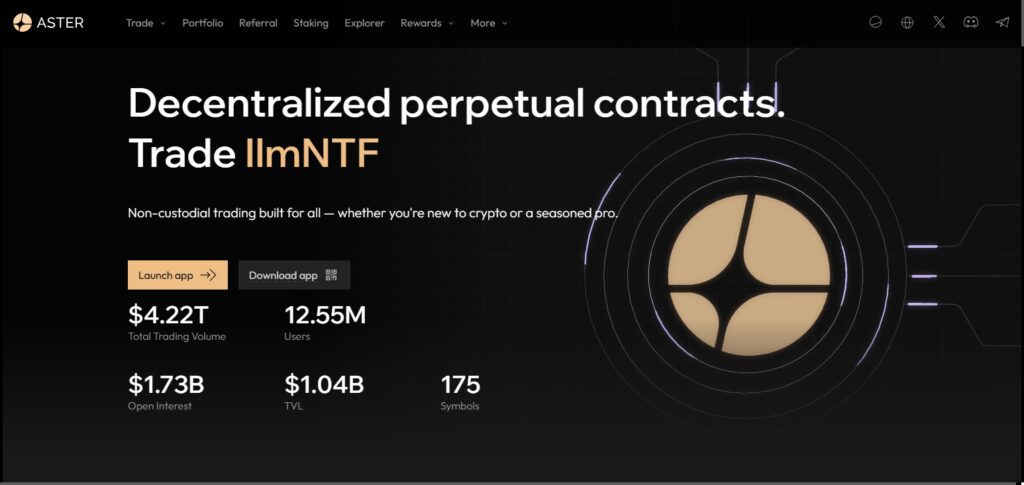
With competitive fees, a rich single-page blockchain-embedded educational platform, and a user-friendly DEX interface, Aster enables both novice and experienced traders to adopt the perpetual trading model through its ecosystem additions that facilitate the adoption of perpetual contracts.
Aster has been described as a top decentralized platform alongside Hyperliquid and Lighter based on substantial monthly trading volumes and ecosystem activities. Aster prioritizes accessibility and increasing trading volume to manage liquidity and customer retention.
Aster Features , Pros & Cons
Features:
- Decentralized perpetual exchange.
- User-friendly interface.
- Trading fees are low and competitive.
- Layer 2 for trade scalability.
Pros:
- Simple for beginners.
- Low trading fees reduce friction.
- Fast execution = scalable.
- On-chain, they maintain custody of funds.
Cons:
- Lower liquidity than leading CEXs.
- Fewer advanced charts.
- Risk of smart contracts.
- Smaller-sized competitors have better market share.
6. Hyperliquid
Hyperliquid is one of the top most liquid decentralized perpetual exchanges, and because of this, liquidity and trading volumes reached significant levels, and it has deep order books comparable to centralized exchanges.
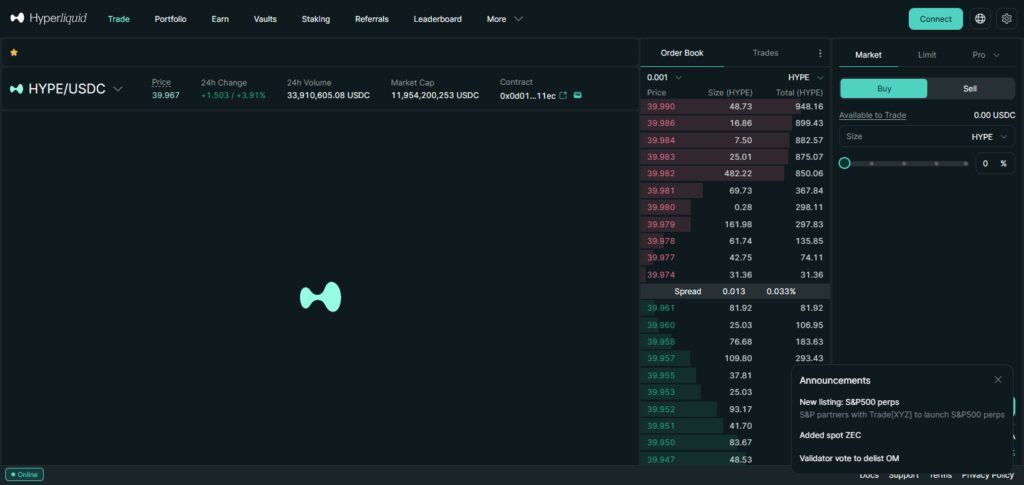
Hyperliquid has its own blockchain, which is specifically tailored to derivatives, offering high throughput as well as low trading latency. Hyperliquid also has competitive fee structures (e.g. low maker/taker fees) and, in some situations, offers liquidity provider rebates.
With solid liquidity, execution, and user retention, Hyperliquid has become a favorite to traders looking for rapid on-chain permutations with no limitations on speed and access to the market.
Hyperliquid Features , Pros & Cons
Features:
- Decentralized perpetual exchange of high-performance.
- High trading volume and liquidity.
- Competitive fees for makers/takers.
- Liquidity providers have incentives.
Pros:
- Minimal slippage on large volumes of trade.
- Low fees simplify cost management.
- Rapid execution due to solid infrastructure.
- Improved security through decentralized custody.
Cons:
- New user challenges.
- Restricted token options.
- Risk from layer-2 or blockchain.
- Less developed ecosystem than leading CEXs.
7. edgeX
edgeX is also a high-performance decentralized perpetual platform with a focus on institutional trading. It offers rapid execution, narrow spreads, and low fees relative to other DEX platforms.
edgeX is based on a scalable layer-2 technology, enabling it to achieve high throughput as well as sub-millisecond order execution latency. Additionally, edgeX provides professional-style trading tools.
Its trading fees are competitive, and both makers and takers can benefit from low fees and a rewards system which can lower their effective trading fees.
The platform’s design, combined with liquidity aggregation, allows edgeX to be an advanced solution for on-chain derivatives trading.
edgeX Features , Pros & Cons
Features:
- Optimized derivatives decentralized platform.
- Competitive maker and taker fees.
- Tools for professional traders.
- Speed-focused layer-2 scaling.
Pros:
- High-frequency strategies benefit from rapid execution.
- Trading costs are low.
- Trading tools are professional-grade.
- Custody is fully on-chain.
Cons:
- Pair-wise liquidity might differ.
- Risk of smart contract vulnerabilities.
- Advanced traders will find the interface more user-friendly.
- Social liquidity is capped due to the smaller user base.
8. dYdX
dYdX offers a well-developed decentralized exchange for perpetual futures. It uses a centralized limit order book that is built on layer 2 of the Ethereum blockchain.
dYdX is known for its sophisticated trading of perpetual contracts in addition to its excellent risk management and order matching transparency .
dYdX also allows clients to trade with on-chain custody while having access to professional derivatives trading features like margin and order type customization.
dYdX is an attractive trading platform to clients that prioritize decentralized perpetual contracts due to dYdX’s trading infrastructure and trading system transparency, compliance, and security.
dYdX Features , Pros & Cons
Features:
- Decentralized exchange on layer-2.
- System of central limit order books.
- Numerous perpetual markets for crypto.
- On-chain operations are clear.
Pros:
- Advanced users will find professional trading features.
- Enhanced custody security with on-chain.
- Transparent trade execution.
- Advanced users will appreciate the ability to set complex orders and margins.
Cons:
- Charges may exceed those of zero-fee DEXs.
- Steeper learning curve for recent arrivals.
- Limited liquidity.
- DEXs offer greater token availability than CEXs.
9. Bybit
Bybit is considered one of the largest centralized derivatives exchanges. It has one of the best perpetual futures ecosystems, as well as excellent liquidity and a wide range of trading instruments.
Bybit’s perpetual markets currently charge approximately 0.02% maker and 0.055% taker fees on each side, with additional discounts based on VIP tier, 30-day trading volume, or native token holdings.
Advanced trading features, such as conditional orders and trailing stop orders, and a large amount of liquidity, are available on Bybit for a variety of perpetual contracts.
Bybit’s platform and mobile application are user-friendly for novices, while still being powerful enough for experienced traders to take advantage of low fees and high liquidity.
Bybit Features , Pros & Cons
Features:
- Focus on derivatives centralized exchange.
- High leverage perpetual futures.
- Discounts by volume and VIP tier.
- Advanced order types.
Pros:
- Decreased slippage due to high liquidity.
- Significant options for perpetual contracts.
- Low fees for VIP users.
- Supports advanced strategies professional trading tools.
Cons:
- High leverage risks.
- Some countries have legal limitations.
- Margin calls can be quite aggressive.
- The design of the platform can be confusing for novice traders.
10. OKX Futures
The Futures and Perpetual divisions of the global crypto exchange OKX are known for having a large volume of derivatives and sophisticated trading features.
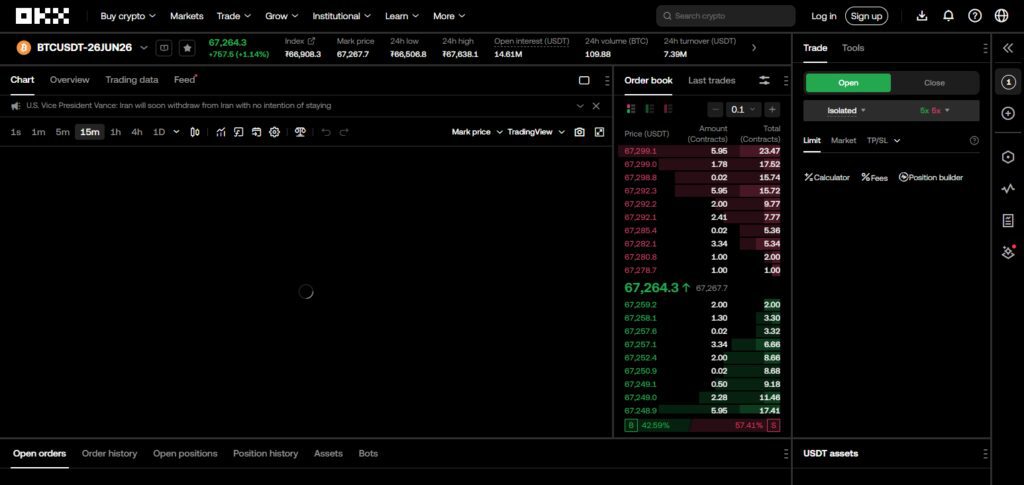
OKX’s tiered fees are advantageous for high-volume traders, as they can achieve negative maker fees and taker fees as low as 0.015%–0.05% based on their tier and the trading instrument.
The exchange has a wide variety of perpetual markets, multi-asset leverage, and institution tools, thereby catering to traders who value a combination of **liquidity, flexibility, and scalable fee reductions** as they increase their trading volume.
OKX Futures Features , Pros & Cons
Features:
- One of the largest global centralized exchanges.
- Perpetual contracts with tiered fees structure.
- Good liquidity and leverage.
- Trading tools of institutional quality.
Pros:
- Good prices for traders with high volume.
- Large number of perpetual markets.
- Advanced order types supported.
- Deep liquidity means less slippage.
Cons:
- The platform can be overwhelming for beginner traders.
- The potential loss increases with high leverage.
- Country-based legal limitations apply.
- Old accounts may have access to features that new accounts do not.
Criteria for Selection of Low-Fee Perpetual Exchanges
Check Cross Exchange Fees – Depending on your trading volume and repeated trading strategy, you will want to trade where your maker, taker, and funding rate fees will be lowest.
Take Advantage of Fees – If you have a discount VIP tier, a token discount, or some referral deal, you can take advantage of lower trading fees on exchanges such as Binance Futures, MEXC, or Bybit.
Take Into Consideration Liquidity – Look for exchanges with a lot of liquidity so that your large orders and high-frequency trades can be executed without a lot of slippage.
Use Leverage Wisely – Increased leverage means more risk and higher potential downside. Modify the size of your position based on your strategy, your experience, and the level of volatility in the market.
Select CEX vs DEX Carefully – Choose a CEX (centralized exchange) for your high liquidity and rapid trade execution, or a DEX (decentralized exchange) for your trade control and potential no-fee trades, but be wary of smart contract risk.
Pay Attention to Funding Rates – With low fees, your funding payments on long or short positions may impact your profitability in perpetual trades, so factor these funding rates in.
Execute Small Orders to Test – To determine an exchange’s hidden fees, execution speed, and interface, execute small trades before large orders.
Prioritize Security – Exchanging high liquidity or high leverage trades will require you to maintain two-factor authentication, effective hardware wallets, and passcodes.
Monitor Changes to the Platforms You Use – Many exchanges make regular adjustments to their fees, the assets they support, and their margin rules, so understanding the details helps to avoid surprises and keeps trading costs down.
Think About Cost Versus Convenience – Fees that seem to be the lowest may not be the best option overall. In addition to the fees, factors that affect the overall efficiency of trading should be considered, including speed, ease of use of the interface, and customer support.
Tips for Traders
Compare Fees Across Exchanges
Always evaluate maker, taker, and funding rates on various exchanges to find which ones offer the lowest fees based on your trading strategy and your volume.
Use Fee Discounts
On exchanges like Binance Futures, MEXC, or Bybit, you may be able to lower your trading fees by taking advantage of native token discounts, VIP tier discounts, or referral discounts.
Evaluate Liquidity
In trading, the more resources an exchange has, the more it reduces your chances of losing money when putting large trades and when making trades back-to-back.
Leverage Responsibly
Although possessing a large amount of power can improve your chances of winning, it can be a double-edged sword. Balance it appropriately based on your experience and overall market volatility.
Choose CEX vs DEX Wisely
Centralized exchanges (CEX) are better for trading large amounts of assets quick and easily; DeCentralized exchanges (DEX) give you a trading advantage of controlling your assets.
Monitor Funding Rates
An exchange offers low trading fees, but you will still be responsible to pay funding rates; this can lower your profit to loss ratio on perpetual positions.
Test With Small Orders First
Try making a small trades on an exchange before making a decide to place a large trade; you can judge the execution speed and interface.
Keep Security in Mind
Use 2-factor authentication, a hardware wallet, and a strong password on an exchange that has a high trading volume or offers high trades to keep your account secure.
Keep abreast of changes within the exchange
Knowing how the exchange works will save you time and money as far as trading goes. Knowing how the exchange works will also save you time and money as far as time is concerned. Things such as fees, which assets are supported and their margin rules can and are often changed by the exchange without prior notice.
Low fees vs high fees
Not all fees are equal as other factors such as time, and speed should be taken into account. When trading, the use of the website and customer service should also be considered and weighed against the fees in order to selectively trade more optimally.
Benefits of Low-Fee Perpetual Exchange Platforms
Cost of Trading Reduced (Increased Profit) – Lower fees for makers and takers translates into direct profit.
Increased Profit – The more a trader trades, the more noticeable the profit, thus day traders, scalpers, and high-frequency traders benefit more.
Efficiency of Capital – Less fees mean more money to be used for margins, leverage, or more contracts to trade with.
Freedom of Strategy – Trading with less fees allows traders to try out different strategies regardless of how much they cost.
Trading Period – The longer a trader trades, the more low fees will help trade profit because low fees help to minimize profit loss.
Advantage – Traders who trade on low fees can trade much more frequently than traders with high fees.
Remaining within the Risk Tolerance – Lower costs of trading allows the trader to remain within the risk of the position being traded.
Conclusion
Perpetual traders looking for cheaper alternatives in April 2026 will still have many options in centralized and decentralized exchanges. For example, rapid and almost zero maker fees are seen at MEXC, Lighter and KCEX, whereas tiered discounts are offered at Binance Futures, Bybit, and OKX Futures.
For decentralized exchanges, Aster, Hyperliquid, edgeX, and dYdX offer low fees with complete on-chain custody and transparency. Decentralized exchanges offer low fees for custody and transparency, and low fee exchanges maximize profitability, flexibility in trading, and long term cost reduction.
Moreover, traders must consider performance and risk in balancing fees, liquidity, leverage, and reliability.
FAQ
Why are low fees important for perpetual trading?
Low fees reduce trading costs, maximize profitability, and allow frequent trading strategies like scalping or arbitrage without eroding gains.
Which exchanges currently have the lowest fees?
Top low-fee exchanges include MEXC, Lighter, KCEX, Binance Futures, Aster, Hyperliquid, edgeX, dYdX, Bybit, and OKX Futures.
Are decentralized exchanges better than centralized ones?
DEXs provide on-chain custody, transparency, and often zero-fee trading, while CEXs offer higher liquidity, faster execution, and professional trading tools.
What should I consider besides fees?
Always assess liquidity, funding rates, spreads, leverage, platform reliability, and security to ensure safe and efficient trading.
How can I further reduce fees on these platforms?
Use native token discounts, VIP tiers, referral bonuses, or volume-based rebates to lower effective trading costs.