

Circle Sued Following Hack Of Drift Protocol
Drift Protocol investors have brought a class‑action lawsuit against it in the Massachusetts District Court seeking to recoup money lost in its $280 million hack. The case is brought by law firm Gibbs Mura on behalf of lead plaintiff Joshua McCollum, and it argues that Circle Internet Financial could have both frozen the USDC taken from Jacobs and prevented its use elsewhere.
Using Circle’s Cross‑Chain Transfer Protocol (CCTP), attackers, who are believed to be government-affiliated North Korean hackers redirected over $230 million in stolen USDC from Solana to Ethereum.

More than 100 s of transactions executed via the exploit over eight hours. The criminals spent six months masquerading as a quantitative trading firm utilising long expiry nonce accounts to pre-sign transactions and defer execution according to Drift Protocol.
Citing the multi‑hour period, which occurred during daylight hours in U.S. time zones, on‑chain investigator ZachXBT chastised Circle for not getting involved earlier. Drift Protocol has been the latest to announce a recovery plan worth $150 million in collaboration with Tether, stating that it will change its main settlement token from USDC to Tether (USDT).

Circle CEO’s Defense
Circle CEO Jeremy Allaire justified the decision for the firm not to freeze USDC that was stolen. Circle is only freezing assets at the request of official law enforcement or pursuant to court orders, he said. Allaire added that unilateral action would raise “ethical dilemmas” and also bring unnecessary legal risk to Circle, according to his comments.
And that’s there are others who probably think that Circle should just step away from what the law says, and do its own, make its own decision.
Allaire has called for safe harbors in proposed legislation such as that found in the CLARITY Act, which would codify the responsibilities of stablecoin issuers under the circumstances seen here. In other matters, Circle has been criticized for freezing wallets that had no connection to the regulatory issue at hand, suggesting a rather flexible approach to enforcement across different cases.
CRCL Stock Price Impact
Circle’s CRCL stock price has taken a direct hit due to the lawsuit. CRCL pushed up 1.84% from last close at $107.46 on Thursday after a potential yuan‑backed stablecoin sparked talk of bullish sentiment But the stock dropped 1.42% in after‑market trading, almost wiping out all of the gains, as news of the lawsuit hit mainstream media.
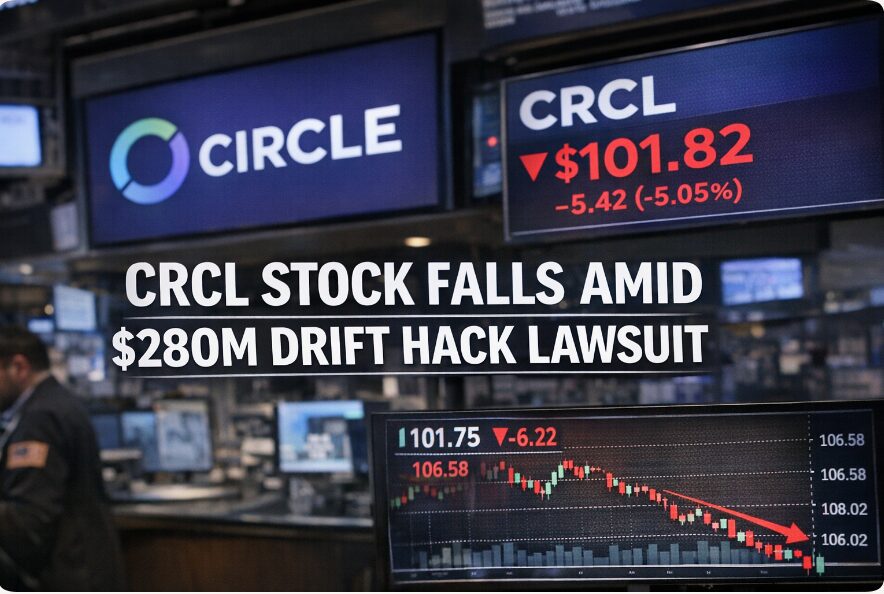
The stock sank to an intraday low of $101.75 and a high of $108.02. Investors seemed a little less confident and trading volume fell under a 12-million-average. For the week, CRCL spiked more than 22%, and through Friday afternoon, was down 18% for the month despite the lawsuit. Year‑to‑date, the stock of Circle has rebounded nearly 28%, able to hold steady through volatility.
Analyst sentiment has turned cautious. Compass Point downgraded CRCL from neutral to sell, reducing its price target from $79 to $77 after previous directors selling shares. This downgrade pushes the stock further into the doldrums, as investors worry about governance and risk management.
Conclusion
Circle — the tough mix of strong market data and increasing legal risk Now, although CRCL stock has posted strong gains—up more than 22% this week and almost 28% year-to-date—the $280 million Drift Protocol hack lawsuit has soured investor sentiment with unusual rapidity.
The after-hours selloff and analyst downgrade whisper concerns about regulatory exposure, operational accountability, and confidence in not just the stock but also this insider.
Meanwhile, Circle’s stringent follow of the law in stopping USDC additionally highlights a part of the strain that exists within the business as a complete; Management and compliance with regulation must be weighed towards Ethereum decentralisation below pressure by way of want for fast response.
This marks caution among institutional players following the heavy action prevailing due to historic bullish momentum, with Compass Point downgrading our company while insiders are starting to sell.
CRCL seems to be performance relying on some outcome of the law, regulatory clarity, and trustworthiness of its stablecoin infrastructure. Although the company retains growth potential, current developments indicate a higher volatility and risk appetite in the current outlook for investors.