This article covers the top enterprise AI platforms for large organizations. The platforms automate processes and enhance decision-making and the scalability of AI.
The platforms comprise sophisticated features, including machine-learning, generative AI, automation, data analytic, and AI governance. We will analyze their features, advantages, and disadvantages. We will detail how these platforms aid enterprise digital transformation in 2026.
Why Use Enterprise AI Platforms for Large Organizations
Automate Business Processes: Large Corporations need to automate business processes. Enterprise AI platforms enable large organizations to eliminate, streamline, and reduce manual business processes for departments such as finance, HR, customer services, and operations.
Data-Based Decisions: Predictive analytics and AI-based recommendations and insights provide businesses the ability to make real-time and accurate decisions based on the analysis of large amounts of business data.

Operational Efficiency: Enterprise AI apps drive efficiency, reduce the complexity of business operations, and improve the output of business activities by eliminating the error-based activities associated with most business processes.
Application Scalability: Enterprise AI platforms provide the infrastructure and the cloud-based services that enable organizations to design, build, AI solutions, and manage large-scale global operations.
Improve Customer Satisfaction: AI-based technologies provide the ability to enhance customer satisfaction through intelligent chatbots, automated support, and the ability to provide faster and personalized recommendations.
Increased Data Protection: Advanced enterprise AI solutions incorporate the protective, compliance, and governance solutions of AI, which provide controls on the sensitive data of the customers of the enterprise.
Lower Business Costs: Process efficiencies, intelligent resource allocations, and the automation of formerly manual business activities reduce the operating costs of an enterprise.
Generative AI Offerings: Building generative AI assistants, customized content-generating systems, and intelligent agents and enterprise-specific AI solutions drive business offerings.
Predictive Business Models: Enterprise AI solutions enable the modeling of AI business activities to provide the enterprise with the ability to predict impacts on customers, business operations, and evaluate the business risks for the enterprise.
Drive Digital Transformation: Enterprise AI platforms offer businesses the ability to upgrade their technology frameworks, foster innovation at an accelerated pace, and sustain their competitive edge amid the rapidly maturing AI-centric global marketplace.
Key Features Of Enterprise AI Platforms for Large Organizations
Generative AI Capabilities: Enterprise AI platforms offer businesses sophisticated generative AI tools for building AI assistants and business applications, as well as for automating the generation and summarization of content.
Machine Learning Model Development: Large organizations can use these AI platforms to design, develop, train, test, deploy, and maintain ML models for automation and analytics.
AI Automation & Workflow Management: Enterprise AI platforms automate business functions, advance process optimization, and elevate productivity in business units, such as finance, sales, customer support, and operations.
Natural Language Processing (NLP): Advanced NLP enables AI systems to interpret and generate human language and is used in chatbots, virtual assistants, document processing, and customer engagement.
Data Analytics & Business Intelligence: These AI platforms help analyze structured and unstructured data and provide insights and business intelligence to derive intelligent and informed business decisions and strategies.
AI Model Governance & Security: These AI platforms have built-in security controls, monitoring, and AI governance to support the safe and responsible use of AI.
Cloud-Based Scalability: The use of cloud infrastructure enables businesses to scale their AI tools, manage large volumes of data, and deploy their AI tools globally.
AI Agent Development: A number of enterprise AI platforms allow businesses to create intelligent AI Agents that complete business functions and assist employees.
Integration With Enterprise Systems: Enterprise AI platforms augment existing enterprise business systems, such as CRM, ERP, and cloud-based business applications, with AI capabilities.
Predictive Analytics & Forecasting: AI assists organizations in optimizing their decisions through the prediction of customer behavior, changes in the market, the risks of disruption to their operations, and/or any future trends that may be present.
Computer Vision & Speech AI: Image recognition technology, speech to text, voice assistants, and analysis of the visual data through the lens of an industry-specific application are among the offerings of the advanced AI platforms.
Customization & Industry Solutions: AI platforms tailored to the needs of enterprises allow the customization of AI models and workflows based on the specific requirements of an industry and the operational targets of the enterprise.
Best Enterprise AI Platforms for Large Organizations List
- Microsoft Azure AI
- Google Vertex AI
- AWS Bedrock & SageMaker
- IBM watsonx
- Salesforce Agentforce
- Oracle AI Cloud
- SAP Business AI
- UiPath AI Center
- DataRobot AI Cloud
- Palantir AIP
10 Best Enterprise AI Platforms for Large Organizations
1. Microsoft Azure AI
Among the Best Enterprise AI Platforms for Large Organizations, Microsoft Azure AI is a top contender. It has the most comprehensive range of AI services to build, deploy, and manage enterprise scale AI solutions.
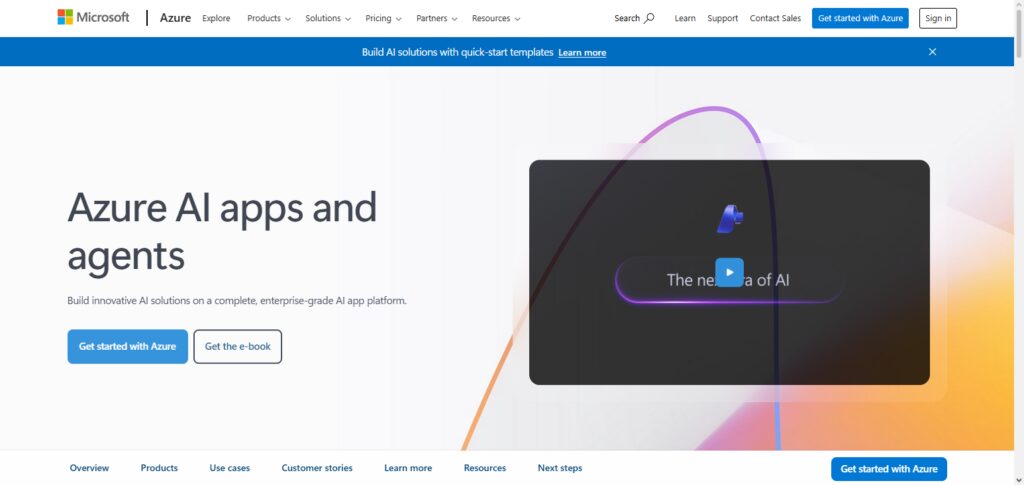
It has the Machine Learning, Natural Language, Computer Vision, Generative AI and AI Agents all cloud-based. Azure AI is used by major corporations to automate processes, analyze huge data sets, enhance customer experience and create smart applications.
Azure AI is also fortified with high-security, compliance, and flexibility for integration with Microsoft business solutions. It helps enterprises to expand the use of AI with governance, reliability and performance demanded for worldwide operations.
Microsoft Azure AI – Key Features
- Generative AI Capabilities: Enterprises can choose AI models, AI assistants, and custom generative AI solutions that suit their needs.
- Machine Learning Services: Organizations can build, train, deploy, and manage machine learning models at scale.
- AI Language & Vision Tools: Natural language processing and speech recognition, computer vision, and document intelligence.
- Enterprise Security & Compliance: Comprehensive features for data protection, identity management, and regulatory compliance.
- Microsoft Ecosystem Integration: Easy integration with Microsoft 365, Dynamics 365, Power Platform, and other business applications.
Microsoft Azure AI Benefits & Drawbacks
| Benefits | Drawbacks |
|---|---|
| Provides a complete AI ecosystem with machine learning, generative AI, computer vision, and natural language processing tools. | Can become complex for beginners due to its wide range of services and configuration options. |
| Offers strong integration with Microsoft products like Dynamics 365, Power Platform, and Microsoft 365. | Enterprise-level usage can become expensive depending on computing resources and workloads. |
| Provides advanced security, compliance, and data governance features for large organizations. | Requires skilled professionals for advanced AI development and management. |
| Supports scalable AI deployment through global cloud infrastructure. | Managing multiple Azure AI services may require additional technical expertise. |
| Helps enterprises build customized AI applications and automation solutions. | Some advanced AI features may involve a steep learning curve. |
2. Google Vertex AI
Google Vertex AI is also one of the Best Enterprise AI Platforms for Large Organizations. It helps enterprises build, train, and deploy machine learning and generative AI applications with ease.
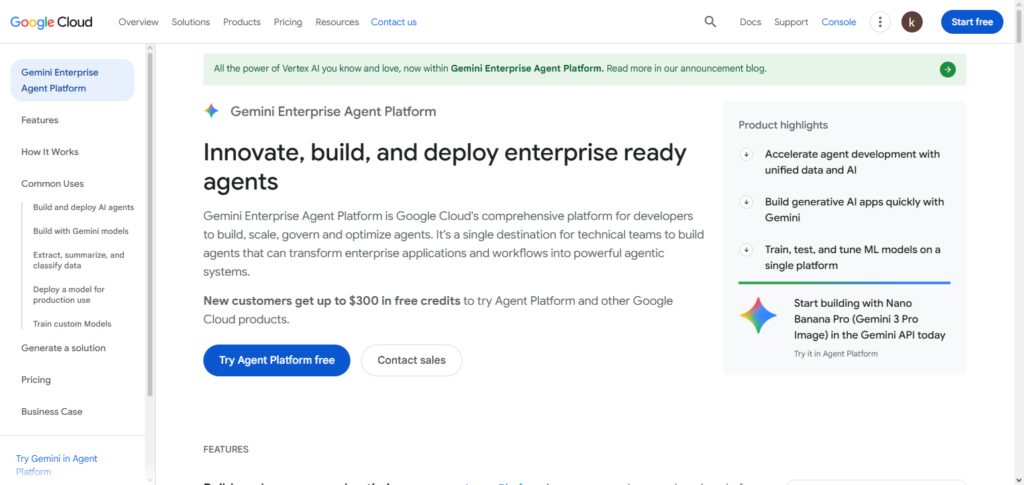
Vertex AI is built on the cutting-edge Google Cloud Infrastructure and affords enterprise users access to foundational models with AI development tools, data, and a host of automated machine learning capabilities. Businesses use Vertex AI to build predictive models, recommendation engines, and even automate customer service and core business functions.
Because of its integration with Google’s AI Research and a flexible Cloud Infrastructure, Vertex AI is a robust offering to enterprises for greater return on investment with faster AI innovation, enterprise grade AI solutions and improved business decisions.
Google Vertex AI – Key Features
- AI Model Development Platform: Supports the building, testing, deploying, and managing of machine learning and generative AI models.
- Foundation Model Access: Google’s advanced AI models are accessible for enterprise AI application development.
- Automated Machine Learning: Predictive modeling with significantly reduced manual effort.
- Data Analytics Integration: AI models are integrated with advanced data services on Google Cloud for business analytics.
- Scalable AI Infrastructure: Flexible cloud computing and deployment to support enterprise workloads.
Google Vertex AI Benefits & Drawbacks
| Benefits | Drawbacks |
|---|---|
| Provides powerful machine learning and generative AI development tools with Google Cloud infrastructure. | Pricing can become difficult to predict for large-scale AI workloads. |
| Offers access to advanced foundation models and AI research technologies. | Requires knowledge of Google Cloud services for effective implementation. |
| Supports automated machine learning, model training, and AI deployment. | Limited enterprise adoption compared with some older cloud ecosystems. |
| Enables fast development of AI applications with strong data analytics integration. | Migration from other cloud platforms may require additional effort. |
| Provides scalable solutions for predictive analytics and intelligent applications. | Some organizations may need specialized experts to optimize performance. |
3. AWS Bedrock & SageMaker
Combining AWS Bedrock and SageMaker results in one of the Best Enterprise AI Platforms for Large Organizations. Bedrock integrates easily with different large AI companies, allowing customers easy access to powerful business AI models. SageMaker simplifies the process of developing and deploying ML models.
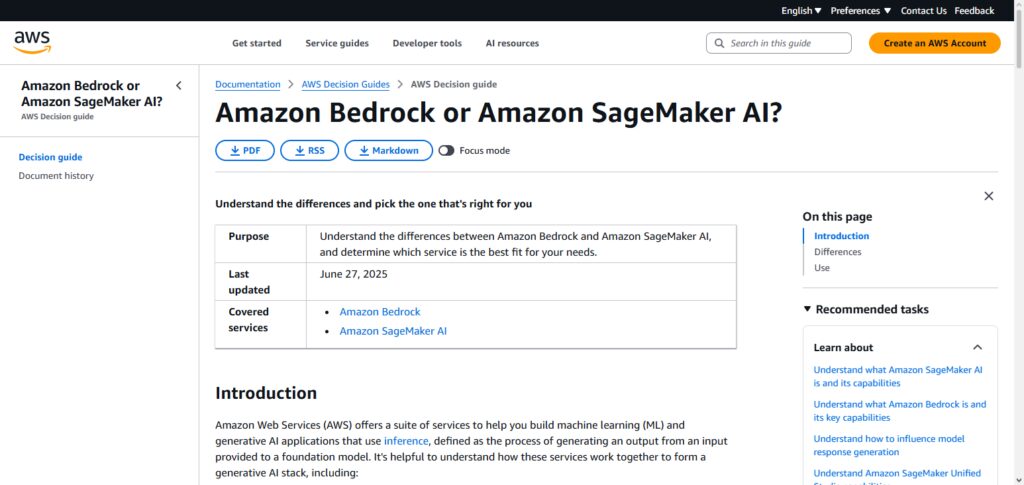
Companies can use this pairing for the secure development of generative AI systems tailored to the unique needs of their business, including the automation of corporate operations and the analysis of corporate data.
The ease of use and extensive options to adapt Bedrock and SageMaker to a company’s IT infrastructure, combined with the strong security of the AWS cloud, allows companies to develop advanced AI solutions without investing significant resource on the development of the underlying infrastructure.
AWS Bedrock & SageMaker – Key Features
- Generative AI Model Access: Multiple foundation models to develop AI applications are available through Amazon Bedrock.
- Machine Learning Development: SageMaker provides training, testing, deployment, and monitoring of models.
- Custom AI Applications: Businesses are enabled to adapt AI models to specific requirements of their industries.
- Phenomenal Cloud Scalability: Provides the flexibility to create the infrastructure necessary to support large enterprise AI workloads.
- AWS Service Integration: Connects AI solutions to AWS databases, analytics, storage and other AWS Cloud services.
AWS Bedrock & SageMaker Benefits & Drawbacks
| Benefits | Drawbacks |
|---|---|
| Provides flexible AI infrastructure for building, training, and deploying machine learning models. | AWS AI services can be complex because of the large number of available tools. |
| Amazon Bedrock allows businesses to use multiple foundation models for generative AI applications. | Managing costs requires careful monitoring due to usage-based pricing. |
| SageMaker supports advanced machine learning workflows and model management. | Requires experienced cloud engineers for efficient deployment. |
| Offers strong security, scalability, and integration with AWS services. | Beginners may find the platform difficult to understand. |
| Suitable for large enterprises needing customized AI solutions. | AI development processes may require significant technical resources. |
4. IBM watsonx
IBM watsonx is one of the Best Enterprise AI Platforms for Large Organizations due to its focus on trusted, governed, and scalable AI solutions. The platform cultivates the development of responsible AI and provides foundation models,
AI development, and data governance. With IBM watsonx, companies can develop automation and AI solutions for business analysis, support, and even industry-specific and risk-related AI frameworks.
The focus on transparency and security makes this an ideal platform for highly regulated industries. Because of its governed nature, IBM watsonx offers companies the possibility of employing AI while retaining the control of data and models.
IBM watsonx – Key Features
- AI Governance Tools: Provides management, monitoring and compliance for responsible AI.
- Foundation AI Models: Provides AI Models to support enterprise-level business applications.
- Data Management Platform: Preps enterprise data and provides tools for the analysis and management of enterprise data for AI.
- Explainable AI Capabilities: Provides transparency of AI and model performance.
- Industry Specific Solutions: Provides AI for finance, healthcare, and government.
IBM watsonx Benefits & Drawbacks
| Benefits | Drawbacks |
|---|---|
| Focuses on trusted AI with strong governance, security, and compliance features. | May require more time and resources for implementation. |
| Helps enterprises build responsible and explainable AI applications. | Pricing can be higher for large-scale enterprise deployments. |
| Provides AI models, data management, and governance tools in one platform. | Some features may require IBM-specific expertise. |
| Suitable for regulated industries such as finance and healthcare. | Smaller businesses may find it too enterprise-focused. |
| Supports secure AI adoption with strong data control capabilities. | Integration with non-IBM environments may require additional configuration. |
5. Salesforce Agentforce
Salesforce Agentforce is classified as one of the Best Enterprise AI Platforms for Large Organizations because of its ability to generate AI agents for sales support, customer service, and marketing, and business operations. As a part of the Salesforce Platform,
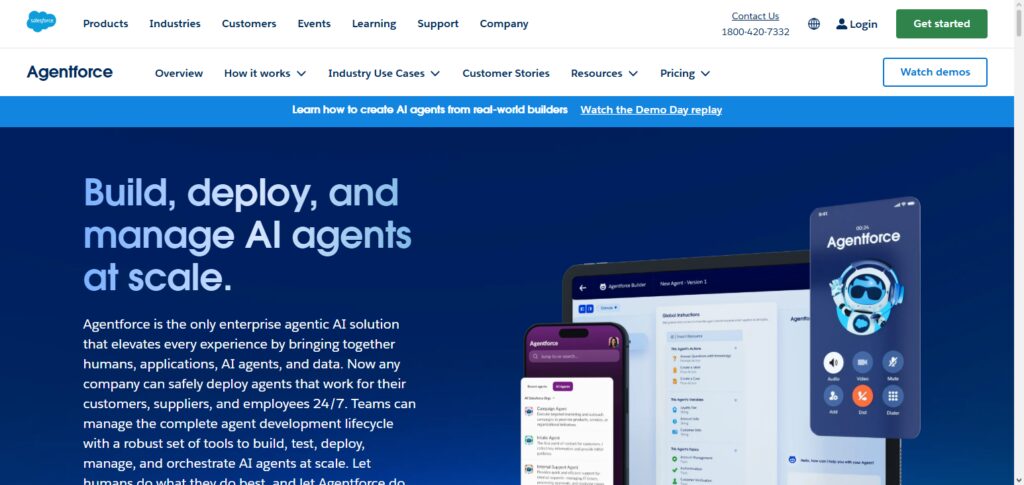
Agentforce focuses on helping organizations automate their customer-facing business processes, make recommendations, and increase the productivity of their employees. It uses a company’s data in a secure manner to create AI-based answers and automated processes.
Large organizations take advantage of its plug-and-play integration with CRM software, its low-code development model, and its ability to generate tailored AI agents. Salesforce Agentforce assists organizations to elevate their customer engagements by decreasing the effort of staff through improved automation of business processes.
Salesforce Agentforce – Key Features
- AI Agent Creation: Creates intelligent AI Agents for customer service, sales and operations.
- CRM Data Integration: Provides personalized and AI driven interactions through Salesforce customer data.
- Workflow Automation: Increases employee productivity through automation of repetitive tasks.
- Low-Code Development: Provides teams the ability to create and customize AI Agents with minimal coding.
- Customer Experience Enhancement: Provides faster and smarter Customer Support solutions.
Salesforce Agentforce Benefits & Drawbacks
| Benefits | Drawbacks |
|---|---|
| Enables businesses to create AI agents for sales, customer service, and operations. | Works best within the Salesforce ecosystem, limiting flexibility for some users. |
| Provides seamless integration with Salesforce CRM data and workflows. | Additional Salesforce licenses and services may increase costs. |
| Helps improve customer engagement through personalized AI interactions. | Requires proper data management to ensure accurate AI responses. |
| Offers low-code tools for creating customized AI solutions. | Advanced customization may require Salesforce expertise. |
| Reduces manual customer support tasks through AI automation. | Businesses outside the Salesforce environment may not gain full value. |
6. Oracle AI Cloud
Oracle AI Cloud is a robust addition to the Best Enterprise AI Platforms for Large Organizations because of its combination of enterprise-AI and the vast cloud infrastructure and enterprise applications of Oracle.
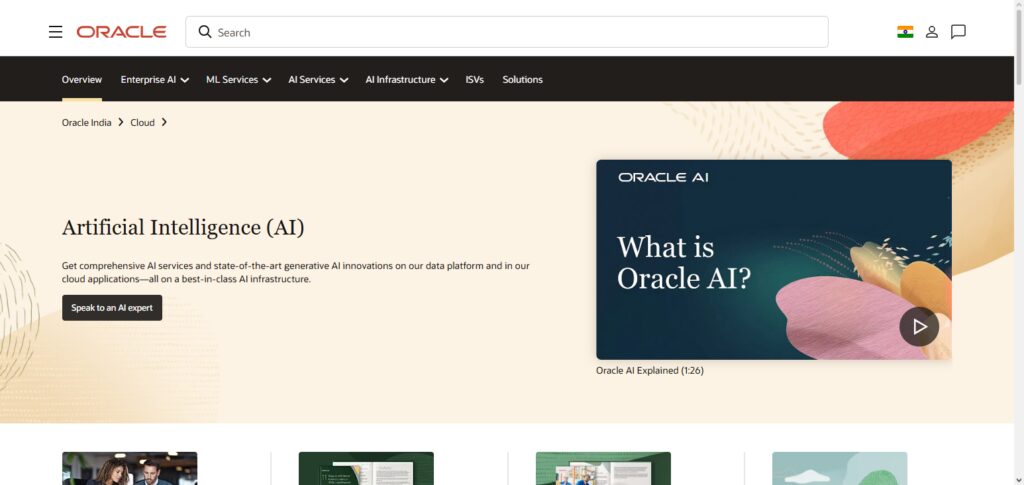
Organizations are able to bring AI-based business automation closer through its incorporation of machine learning, generative AI, and intelligent data. AI can be utilized by organizations for financial and business forecasting, customer and supply chain management, and many other operational optimizations.
The robust integration of Oracle’s databases, the enterprise-grade security, and the varied offerings of AI-Ready solutions for different industry verticals, all enable AI at a large-scale for most enterprises.
Organizations that use Oracle applications have an added advantage of seamlessly integrating AI features within their operating automation to improve overall productivity and performance of the business and assist with data-based decision making.
Oracle AI Cloud – Key Features
- Enterprise AI Applications: Embeds AI into Oracle business applications and cloud services.
- Machine Learning Services: Provides predictive analytics, automation, and intelligent decision making.
- Database AI Integration: Provides AI and analytics through the Oracle database.
- Business Process Automation: Optimizes finance, supply chain, HR, and operational processes.
- Enterprise Security Controls: Provides strong data security and compliance controls.
Oracle AI Cloud Benefits & Drawbacks
| Benefits | Drawbacks |
|---|---|
| Integrates AI capabilities with Oracle enterprise applications and databases. | Best suited for organizations already using Oracle technologies. |
| Helps businesses improve forecasting, automation, and business analytics. | Implementation can be complex for organizations without Oracle expertise. |
| Provides strong enterprise security and data management capabilities. | Licensing and enterprise costs can be high. |
| Supports industry-specific AI solutions for large organizations. | May require specialized professionals for configuration. |
| Enables AI-powered decision-making across business operations. | Less flexible compared with some open AI ecosystems. |
7. SAP Business AI
SAP Business AI is one of the Best Enterprise AI Platforms for Large Organizations as it assists businesses with the incorporation of AI into foundational business operations processes.
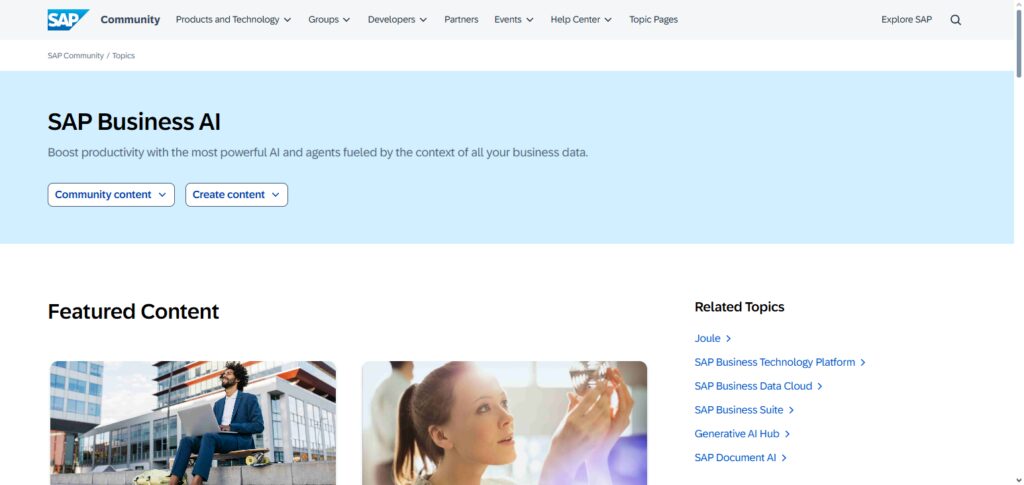
SAP Business AI combines AI with enterprise resource planning solutions from SAP to enhance finance, supply chain, human resources, and customer operations. It also offers predictive insights, automated tasks, smart suggestions, and assists users with AI-based decisions.
This platform is developed primarily for large businesses, and thus focuses on secure data, compliance, and the responsible use of AI. Businesses can utilize AI to make processes more intelligent through automation.
SAP Business AI – Key Features
- AI-Powered Business Processes: AI is embedded within SAP’s ERP, finance, supply chain, and HR.
- Intelligent Data Insights: Analyzes business data and offers recommendations and predictive insights.
- AI Automation Tools: Automates enterprise workflows and tasks.
- Secure Enterprise AI: Corporate governance, privacy, and compliance are built in.
- SAP Ecosystem Integration: Optimizes the SAP applications for enhanced productivity and operational efficacy.
SAP Business AI Benefits & Drawbacks
| Benefits | Drawbacks |
|---|---|
| Integrates artificial intelligence into SAP ERP and business management solutions. | Mainly benefits companies already using SAP systems. |
| Helps automate finance, supply chain, HR, and operational processes. | SAP AI solutions can involve complex implementation processes. |
| Provides enterprise-grade security and compliance features. | Requires trained SAP professionals for management. |
| Uses business data to deliver intelligent recommendations and insights. | Costs can be significant for smaller organizations. |
| Supports large-scale digital transformation initiatives. | Customization may require additional SAP consulting services. |
8. UiPath AI Center
UiPath AI Center is one of the Best Enterprise AI Platforms for Large Organizations as it merges AI and robotic process automation (RPA) to automate sophisticated business processes. This platform permits the deployment, management, and monitoring of machine learning models within the realm of business process automation.
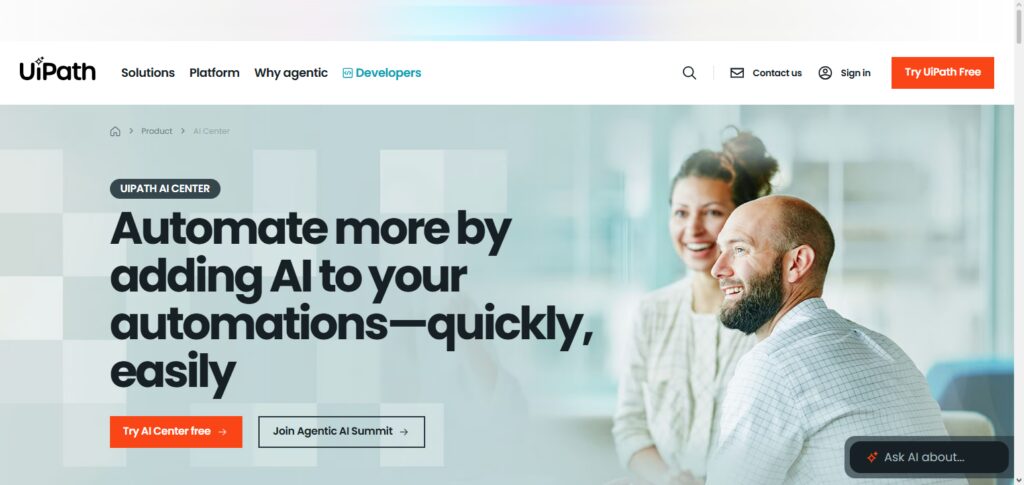
Document processing, customer service automation, fraud detection, and improvement of business operations are some use cases that benefit from the AI Center.
Large organizations using the platform can expect an automation of mundane tasks, a positive impact on productivity, and a framework that allows for the secure and scalable implementation of AI-based business processes.
UiPath AI Center – Key Features
- AI-Powered Automation: Advanced workflows are generated through the combination of AI and Robotic Process Automation.
- Machine Learning Model Management: Simplifies the deployment and management of AI models for enterprises.
- Document Intelligence: Automates the data extraction of invoices, forms, and business documents.
- Automation Workflow Integration: AI models are linked to UiPath Digital Workers.
- Enterprise Process Optimization: Lessens the number of manual tasks and enhances the overall efficiency of operations.
UiPath AI Center Benefits & Drawbacks
| Benefits | Drawbacks |
|---|---|
| Combines AI capabilities with robotic process automation for intelligent automation. | Best results require existing knowledge of UiPath automation tools. |
| Helps automate repetitive business workflows and document processing. | Advanced AI automation may require technical expertise. |
| Supports machine learning model deployment and management. | Pricing may increase with enterprise automation requirements. |
| Improves productivity by connecting AI models with digital workers. | Limited compared with full cloud AI platforms for advanced AI research. |
| Provides scalable automation solutions for large businesses. | Setup and maintenance can require additional resources. |
9. DataRobot AI Cloud
Highlighted as one of the Best Enterprise AI Platforms for Large Organizations, DataRobot AI Cloud offers enterprise automated machine learning and AI development services.
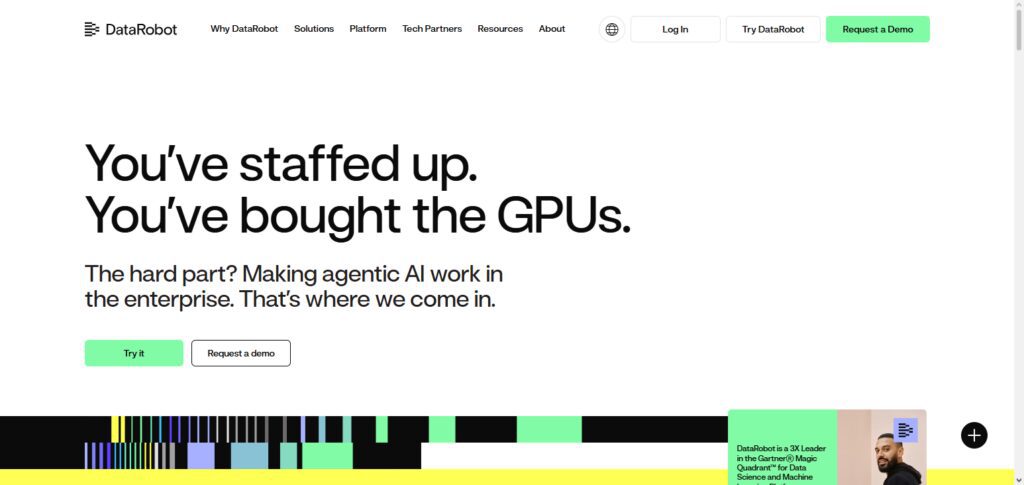
Using DataRobot, organizations create, deploy, and manage predictive AI models with minimal coding. DataRobot customers develop models to optimize forecasting, risk, and insights; to prevent fraud; and to improve operations.
DataRobot provides automated model development and monitoring as well as AI governance and explainability features. With a focus on the simplification of AI, DataRobot customers are able to better use their data and generate insights in the most transparent, scalable, and controllable way.
DataRobot AI Cloud – Key Features
- Automated Machine Learning (AutoML): Fast-tracks AI model development and deployment with minimal coding for businesses.
- Predictive Analytics Tools: Assists businesses in anticipating trends, threats, and outcomes.
- AI Model Monitoring: Ensures operational trust of AI by monitoring model performance.
- Explainable AI Features: Justifies AI predictions and the rationale behind decisions.
- Enterprise AI Governance: Provides the compliant control of secure AI.
DataRobot AI Cloud Benefits & Drawbacks
| Benefits | Drawbacks |
|---|---|
| Provides automated machine learning tools for faster AI model development. | Less suitable for organizations needing complete AI customization. |
| Allows businesses to create predictive models with less coding knowledge. | Enterprise pricing can be expensive. |
| Offers AI monitoring, governance, and explainability features. | Advanced users may prefer more flexible development environments. |
| Helps organizations make data-driven decisions quickly. | Requires high-quality data for accurate AI results. |
| Supports enterprise AI adoption with simplified workflows. | Some complex AI projects may require additional tools. |
10. Palantir AIP
Also ranked among the Best Enterprise AI Platforms for Large Organizations, Palantir AIP offers the capability to embed AI with the operations of most large, complex enterprises. Palantir AIP combines data from the enterprise, AI models, and the workflows of enterprise processes to create advanced AI applications tailored for a specific use.
Palantir AIP is used across many industries and fields, including supply chain, defense, healthcare, finance, and operational intelligence.
Palantir AIP offers safe and highly governed AI use, along with high data and dynamic real-time processing integration. By embedding AI with operations, Palantir AIP allows large enterprises to rapidly execute workflows and improve the use of their enterprise data.
Palantir AIP – Key Features
- AI Decision Intelligence: Bridges AI models to business processes for actual better decisions.
- Enterprise Data Integration: Integrates data from various sources into one consolidated AI ecosystem.
- AI Workflow Automation: Assists organizations in the automation of their intricate operational workflows.
- Secure AI Deployment: Offers robust security provisions for client/server enterprise applications.
- Industry Specific AI Solutions: Delivers tailor-made AI solutions for healthcare, defense, manufacturing, finance, and other industries.
Palantir AIP Benefits & Drawbacks
| Benefits | Drawbacks |
|---|---|
| Helps organizations connect AI models with real-world business operations. | Typically has high costs compared with smaller AI platforms. |
| Provides strong data integration and operational intelligence capabilities. | Implementation can be complex and time-consuming. |
| Supports secure AI deployment for critical industries. | Requires specialized knowledge to maximize platform value. |
| Enables faster decision-making through AI-powered insights. | May be more suitable for large enterprises than small businesses. |
| Offers powerful AI workflows for industries like healthcare, defense, and finance. | Limited transparency around pricing and customization options. |
Conclusion
Large organizations are understanding that their processes will be easier to manage with automation, enhanced by AI.
The Best Enterprise AI Platforms for Large Organizations, such as Microsoft Azure AI, Google Vertex AI, AWS Bedrock & SageMaker, IBM watsonx, Salesforce Agentforce, Oracle AI Cloud, SAP Business AI, UiPath AI Center, DataRobot AI Cloud, and Palantir AIP, are perfect for building, managing and scaling organizational AI.
Using one of these platforms’ AI tools that offer generative AI, machine learning, and automated AI services, organizations can pick a platform that fits aligned with security and AI governance and shaped for their industry.
This lets organizations quickly develop the tools they need for AI and gives them a competitive advantage as the tools will be ready to use in 2026.
FAQ
What Are Enterprise AI Platforms for Large Organizations?
Enterprise AI platforms are advanced software solutions that help large businesses develop, deploy, and manage artificial intelligence applications at scale. These platforms provide machine learning, generative AI, automation, data analytics, AI agents, and governance tools to improve business operations. Organizations use them to automate workflows, analyze complex data, enhance customer experiences, and make faster data-driven decisions.
Why Are Enterprise AI Platforms Important for Large Organizations?
Enterprise AI platforms help large organizations improve efficiency, reduce operational costs, and automate repetitive tasks. They enable businesses to analyze large amounts of data, create intelligent applications, optimize workflows, and improve decision-making. With advanced security and governance features, these platforms allow companies to adopt AI while maintaining compliance and control.
What Are the Best Enterprise AI Platforms for Large Organizations in 2026?
Some of the leading Best Enterprise AI Platforms for Large Organizations in 2026 include Microsoft Azure AI, Google Vertex AI, AWS Bedrock & SageMaker, IBM watsonx, Salesforce Agentforce, Oracle AI Cloud, SAP Business AI, UiPath AI Center, DataRobot AI Cloud, and Palantir AIP. Each platform provides different AI capabilities suitable for various enterprise needs.
How Do Enterprise AI Platforms Help Businesses?
Enterprise AI platforms help businesses automate processes, improve customer service, predict market trends, optimize resources, and generate valuable insights from data. They support applications such as AI assistants, predictive analytics, fraud detection, workflow automation, and intelligent decision-making systems across different industries.