Thinking about AI agencies means thinking about technology, but it also means thinking about the way we work and the way we transform our businesses—together. To me, the right agency should act more like a partner than a vendor and should help us with compliance, integration, and innovation.
We work in different industries and in different stages of development. AI agencies help startups, address the challenges of enterprises, and help multinational organizations expand. They have mastered AI technologies, like LLMs and agents, RAG pipelines, and industry specialization. This means that we can trust them to do the work in a collaborative and scalable manner. Our shared future with AI will rely on collaboration.
“How We Selected the Agencies”
Proven Track Record – Agencies with a track record of end-to-end delivery of enterprise AI solutions, validated by measurable ROI and scalability across diverse industry verticals, leading to sustained client success.
Core AI Expertise – Firms that focus on core AI competencies of machine learning, generative AI, and automation to provide the breadth and depth of innovation in enterprise AI adoption.

Integration Capability – Ability to embed AI seamlessly to enhance operational effectiveness and drive enterprise AI adoption in ERP, CRM, SaaS, and cloud systems.
LLM & Agent Expertise – Agencies with proven track records of fine-tuning large language models and building intelligent AI agents capable of automating enterprise workflows.
RAG & Data Expertise – Strong ease-of-use, advanced data pipelines, and data governance infrastructure for building AI systems that are accurate and compliant while addressing industry-specific needs.
Industry Specialization – Extensive industry experience in always-on regulated industries (Healthcare, Finance, Manufacturing, Telecommunications) to develop AI solutions with industry-specific challenges and workflow differences.
Global Delivery & Scalability – Capable of operating at scale and providing AI services to large enterprises (Fortune 500) and to the midsize market.
“Who Should Hire an AI Agency?”
Enterprises – large companies needing scalable integration of AI, compliance, and automation frameworks across their ERP, CRM, and cloud systems. They need to modernize their legacy systems and infrastructure safely and speedily in order to accomplish digital transformation.
Startups – need quick, iterative cycles of AI development and deployment, along with features of generative AI to help them quickly innovate and develop products to stay competitive with their agile market offerings.
SME’s (Mid-Market Firms) – aim for rapid adoption of AI at little to no cost, aiming for engagement and automation of workflows. This without having to develop an expensive in-house AI infrastructure and related teams.
Regulated Industries – i.e. banking, insurance, and healthcare services – require AI with built in compliance, governance, risk management, and AI software solutions to assist in satisfying their regulatory obligations.
E-commerce – requires AI software to assist with personalization, customer engagement, and recommender systems to increase customer satisfaction and sales.
Tech Firms – require AI solutions to assist with chatbots, RAG pipelines, customizations to recently released LLMs, and AI workflows in their digital products.
Global Enterprises – AI partnerships for multinational corporations with the ability to conduct cross-border business spanning various industries, serving a diverse customer base, with an AI delivery network.
Key Points
| Agency | Best-Fit Use Case |
|---|---|
| Accenture | Large enterprises needing secure AI integration into existing systems |
| Deloitte | Enterprises needing production-grade MLOps with compliance |
| Capgemini | Regulated industries integrating ML & GenAI across systems |
| Netguru | Mid-market product teams needing production-ready AI |
| DataRobot | Enterprises managing drift across multiple deployed models |
| Weights & Biases | Data science teams scaling research to production |
| Turing | US firms needing rapid AI staff augmentation |
| Uvik Software | Fortune 500 & mid-market AI automation builds |
| Cognizant | Enterprises modernizing legacy systems with AI |
| Infosys | Global enterprises seeking scalable AI adoption |
1. Accenture
As the world’s largest AI implementation services company, Accenture provides end-to-end enterprise solutions across industries. When it comes to AI, Accenture specializes in the responsible development of AI and frameworks that ensure compliance and governance. Accenture has deep integration expertise.
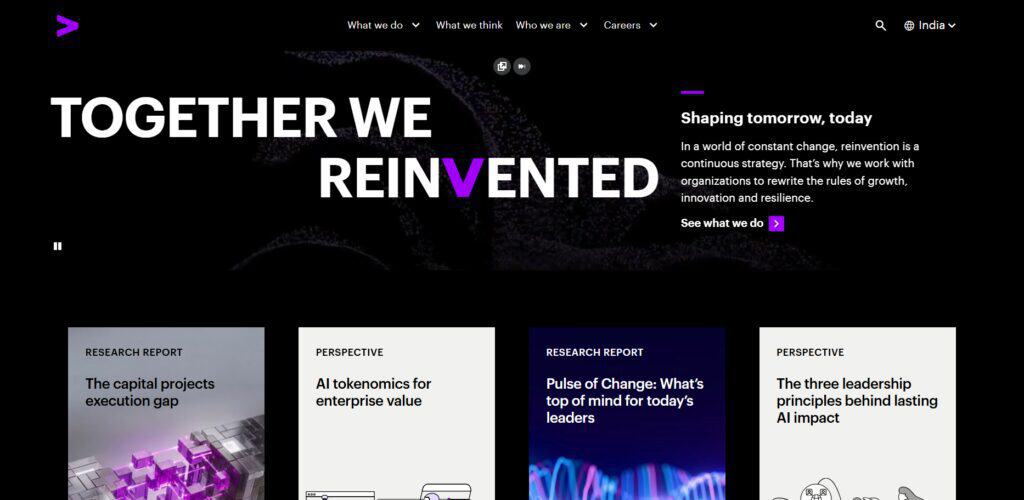
AI is integrated seamlessly into legacy systems, cloud environments, and elsewhere. Excellent in LLM, Accenture AI focuses on the fine-tuning of large language models for enterprise and operations. AI agents enable intelligent automation in customer service and operations.
Accenture leads in the RAG pipeline and data expertise and offers knowledge-intensive industries retrieval-augmented generation (RAG). Combining deep expertise in finance, healthcare and manufacturing industries, Accenture’s trusted AI systems are developed at scale, secure, and ready for production use by Fortune 500 companies.
Accenture Use Cases:
- Frameworks for enterprise AI governance
- AI customer service automation
- AI and machine learning in the cloud
- Predictive finance analytics
- AI compliance in healthcare
Pros:
- Compliance and governance
- Global reach
- Industry networks
- Scalable enterprise services
Cons:
- Services cost prohibitive for smaller firms
- Difficult client onboarding
- Risk of lock-in
- Lengthy innovation cycles
2. Deloitte
Responsible AI adoption is Deloitte’s area of specialization, focusing on governance, compliance and ethics. Deloitte’s strength in AI is predictive analytics and machine learning, as well as enterprise AI strategies. Deloitte’s integration expertise allows for ease of deployment of AI across enterprise resource planning (ERP), customer relationship management (CRM) systems and cloud ecosystems.
Deloitte’s LLM expertise centers around modeling for regulated industries and in finance and supply chains. AI Agents expertise supports intelligent automation. Deloitte’s RAG and data expertise focuses on compliance-related retrieval.
Possessing deep expertise in banking, insurance and healthcare industries, Deloitte enables responsible AI implementation balancing operational excellence with innovation and risk management, truly positioning them as a trusted partner to clients for AI transformation requiring compliance.
Deloitte Use Cases:
- Governance of AI in banking
- AI and machine learning in risk management
- Predictive analytics in insurance
- Compliance in healthcare
- AI in the optimized supply chain
Pros:
- Compliance frameworks
- Trusted in highly regulated industries
- Significant consulting experience
- Good innovation and risk balance
Cons:
- Cost prohibitive for mid-market firms
- Lengthy implementation
- Balanced innovation and risk
- Heavy enterprise client reliance
3. Capgemini
Capgemini has a strong focus on MLOps and lifecycle monitoring of AI models to ensure model accuracy and compliance. It has expertise across the entire range of AI technologies, from machine and generative AI to intelligent automation. Capgemini has deep integration capabilities that allow it to apply AI solutions across enterprise workflows, cloud services, and IoT platforms.

For LLMs, it focuses primarily on multilingual and cross-border adaptation of models. Capgemini has developed workspace automation in manufacturing and logistics using its AI agents, while its expertise in RAG & data ensures that retrieval-augmented generation is used in knowledge-intensive industries.
Capgemini has industry expertise in automotive and energy, thus making it a preferred choice for enterprises looking to scale their AI implementations. It has a good mix of innovation and efficiency with compliance.
Capgemini Use Cases:
- Monitoring the machine learning lifecycle
- AI and machine learning integrated with the Internet of Things (IoT)
- Personalization in retail
- Predictive maintenance in automotive
- AI and machine learning in the energy sector
Pros:
- High degree of expertise in machine learning operations
- Worldwide reach
- Industry specific solutions
- Good balance of innovation and compliance
Cons:
- Heavy enterprise client reliance
- High cost for small and medium enterprises
- Difficult integrations
- Slow innovation compared to niche firms
4. Netguru
Netguru is a quickly expanding AI development agency focused on generative AI and LLM pipelines. Netguru custom builds AI solutions for startups and midsized companies. Because of their great integration skills, Netguru can add AI to digital products and mobile apps as well as SaaS apps.
Netguru’s LLM focus is on user engagement and product customization. Netguru AI agents can help with automating tasks and creating smart assistants. Their RAG (retrieve, analyze, generate) data expertise helps them create efficient systems for applications that rely on data.
Their product development expertise is in fintech, e-commerce, and healthcare, making them excellent for AI product teams seeking production-ready AI. Netguru’s agile methodology fosters rapid product deployment and scalability.
Netguru Use Cases:
- Product development in generative AI
- AI integrated with software as a service (SaaS)
- Personalization in Financial Technology (Fintech)
- AI in healthcare
- AI in e-commerce
Pros:
- Flexible development
- Generative AI specialization
- Favorable pricing for startups
- Short implementation
Cons:
- Limited enterprise compliance expertise
- Smaller global footprint
- Less focus on regulated industries
- May lack scalability for Fortune 500s
5. DataRobot
DataRobot leads the market in automated MLOps and AI lifecycle management for businesses deploying and monitoring models on a large scale. DataRobot’s core AI expertise is in automating predictive modeling and machine learning. With its integration skills, DataRobot integrates AI systems with enterprise data pipelines and the cloud.
DataRobot’s LLM expertise is focused on domain-specific tasks. DataRobot’s AI agents facilitate analytics and robotic process automation. DataRobot’s RAG and data expertise provides systems for compliance-based domains.
Their product development expertise is in finance, healthcare, and retail, making DataRobot a premium choice for enterprises that have numerous model deployments. DataRobot prides itself on being automation-first, allowing them to deliver at scale.
DataRobot Use Cases:
- Automate MLOps
- Financial predictive analytics
- Monitor the AI lifecycle
- Demand forecasting in retail
- Healthcare compliance AI
Pros:
- Automation is their strong suit
- Scalable management of the AI lifecycle
- Enterprise trust
- Swift deployment
Cons:
- Platform is proprietary
- Generative AI is a blindspot
- Pricey licenses
- Less flexible for startups
6. Weights & Biases
Weights & Biases (W&B) tracks and manages versions of machine learning (ML) experiments for research teams scaling artificial intelligence (AI) projects. W&B’s AI knowledge focuses on model monitoring, reproducibility, and collaboration. W&B has deep integrations with ML frameworks, pipelines, and clouds.
W&B’s LLM competencies cover the fine-tuning and evaluation of large language models. W&B’s AI agent capabilities serve to automate workflows for data science teams. W&B’s RAG & Data competencies cover efficient retrieval and data knowledge management for AI research.
W&B’s industry expertise spans academia, startups, and enterprise R&D, thus making it vital for the scaling of AI innovation. W&B allows teams to efficiently move from research to practice.
Weights & Biases Use Cases:
- ML experimentation
- Evaluation of fine-tuned large language models
- Collaboration in AI research
- Automation in the data science cycle
- Retrieval-augmented neural networks
Pros:
- Automation of the ML cycle is state-of-the-art
- Strong developer community
- Cloud services at the flick of a switch
- Supports repeatability
Cons:
- Limited consulting services
- Relatively research oriented
- Technical prerequisites
- Less suited for non-technical firms
7. Turing
Approaching LMM deployment and AI-integrated workforce innovation, Turing is an AI talent and integration platform. Builders of intelligent applications from large language models and generative AI, Turing embeds AI for enterprise workflows, SaaS platforms, and customer interface applications.
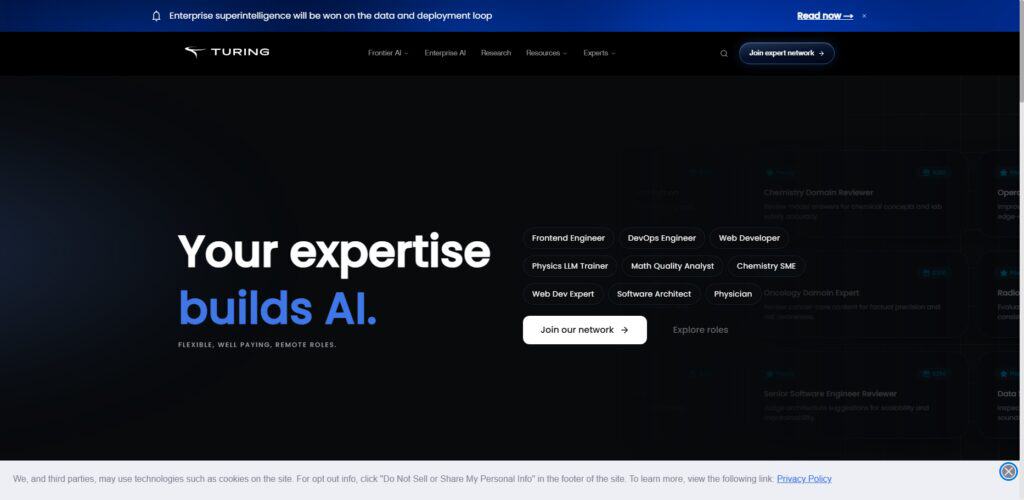
With LLMs, fine-tuning the models around a “use case” is a focus of Turing, while AI agents assist in intelligent automation of HR and customer service workflows. Bringing enterprise knowledge systems closer to innovation with RAG and data-related expertise, Turing offers its services to the Technology, Finance, and Healthcare sectors of the US.
Turing Use Cases:
- AI talent
- Deployment of large language models
- AI-integrated SaaS
- Automation of customer services
- HR AI Assistants
Pros:
- Large AI talent pool
- Fast deployment
- Flexible for both startups and enterprises
- Focused on LLMs
Cons:
- Compliance is a blindspot
- Smaller industry presence
- Reliance on external talent
- Less focus on MLOps
8. Uvik Software
Focusing on intelligent assistants, autonomous agents, and generative AI solutions, Uvik Software is an AI agency focused on automation workflows. With enterprise-level integration and AI, Uvik embeds AI for enterprise systems, SaaS platforms, and cloud computing. With LLM, enterprise automation is a focus for Uvik.
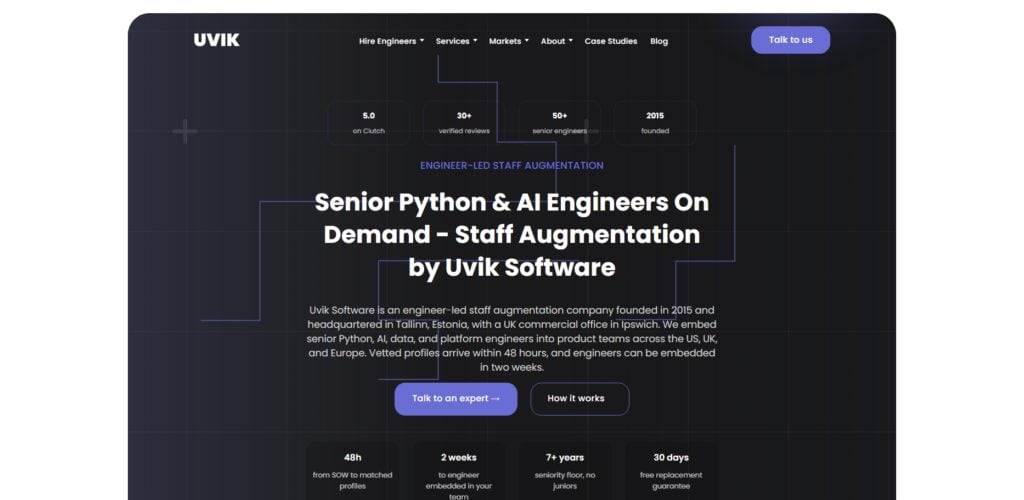
AI agents assist intelligent workflow automation across industries. Uvik’s RAG and data-related expertise guarantee retrieval-augmented generation for complex applications. Offering automation-related services in the Fortune 500, fintech, and logistics sectors, Uvik’s focus on agentic AI workflows makes them the first choice for Enterprise Automation.
Uvik Software Use Cases:
- AI agent workflows
- Enterprise automation systems
- Fintech AI assistants
- Logistics optimization
- Fortune 500 AI transformation
Pros:
- Strong AI agent expertise
- Focused on automation workflows
- Adaptability for start-ups and enterprises
- Agile development cycles
Cons:
- Slightly reduced global presence
- Limited compliance frameworks
- Less emphasis on research AI
- May not scale to very large enterprises
9. Cognizant
Cognizant is a leader in transforming legacy systems of businesses using AI. The company is strong in areas of ML, predictive analytics, and generative AI. With significant integration services experience, Cognizant embeds AI Services across ERP, CRM, and cloud ecosystems. Using LLMs, Cognizant focuses on enterprise-scale AI models, while using AI agents to automate customer interactions and ceremonies in a supply chain.
Cognizant’s expertise in RAG & data helps them leverage retrieval-augmented generation as a tool for compliance in heavily regulated industries. Cognizant has good industry-spanning coverage in healthcare, banking & finance, and retail, and hence is a trusted global services partner. Cognizant strikes a good balance between AI innovation, scale, and compliance.
Cognizant Use Cases:
- AI-based digital transformation
- AI in ERP and CRM
- Automation in healthcare
- Predictive analytics for banking
- Personalization engines for retail
Pros:
- Leading enterprise integration
- Global delivery capability
- Strong partnerships in multiple industries
- Balanced compliance and innovation
Cons:
- Costly for small and medium enterprises (SMEs)
- Longer deployment time
- Complicated onboarding
- Lock-in risk
10. Infosys
Infosys is a global leader in enterprise AI platforms and Automation. Infosys is strong in building Automated AI systems in combination with ML & Generative AI. Using its integration services, Infosys embeds AI services in enterprise workflows, cloud, and digital platforms. Using LLMs, Infosys is building enterprise models in multiple languages and for specific industries.

Infosys uses its AI Agents to automate customer services, HR, and supply chain services. Infosys’ RAG & data services help build retrieval-augmented generation in industries that involve a lot of knowledge work. Infosys has significant banking, telecom & manufacturing industry experience and therefore offers an enterprise AI platform for digital transformation services.
Infosys Use Cases:
- AI in enterprise platforms
- Telecom automation with AI
- Banking compliance with AI
- Predictive analytics for manufacturing
- Deployment of multilingual LLM
Pros:
- Excellent enterprise AI
- Global delivery capability
- Solutions for various industries
- AI adoption is scalable
Cons:
- Limited focus on start-ups
- Costly for SMEs
- Longer innovation cycles
- Complex integrations
Conclusion
The data reveals that the top AI integration and development companies—Accenture, Deloitte, Capgemini, Netguru, DataRobot, Weights & Biases, Turing, Uvik Software, Cognizant, and Infosys—are the best partners for enterprises, startups, and mid-market companies for scaling their AI usage.
Each of these companies is proficient in core AI services, fine-tuning of LLMs, building AI agents, RAG pipelines, and has industry-specific compliance for banking, healthcare, retail, telecom, and manufacturing.
While the Global AI leaders like Accenture and Deloitte specialize in compliance across different industries, firms like Netguru and Uvik Software focus more on automation and generative AI and excel in their respective areas. These firms provide the best services for enterprise AI transformations.
FAQ
What is an AI integration agency?
An AI integration agency helps businesses embed artificial intelligence into existing systems, ensuring seamless workflows, compliance, and scalability across ERP, CRM, SaaS, and cloud platforms.
Why should enterprises hire AI agencies?
Enterprises hire AI agencies to modernize legacy systems, ensure compliance in regulated industries, and deploy scalable AI solutions like predictive analytics, LLM fine-tuning, and intelligent automation.
Which industries benefit most from AI agencies?
Industries like finance, healthcare, telecom, manufacturing, and retail benefit most, as agencies deliver tailored AI solutions for compliance, automation, personalization, and predictive analytics.
What expertise do top agencies provide?
Top agencies provide expertise in core AI development, LLM fine-tuning, AI agents, RAG pipelines, and industry-specific compliance frameworks, ensuring production-ready AI adoption.
Are AI agencies suitable for startups?
Yes, agencies like Netguru and Uvik Software specialize in agile AI development, generative AI, and automation workflows, making them ideal for startups and mid-market firms.