

When we compare the best AI financial advisors and tax-loss harvesting apps, we’re comparing ways to streamline the finances of the everyday investor. Many of us want our portfolios to be managed automatically with lower fees and better after-tax returns, all without us having to log into our accounts and monitor the markets daily.
AI-powered services assist us in performing all these tasks, along with loss-harvesting and retirement planning. We can check out the apps that offer well-automated, hybrid-guided, tax-focused options catering to retirement.
What Is Automated Tax-Loss Harvesting?
Automated tax-loss harvesting is a technology that uses AI to find securities trading at a loss in the portfolio automatically. This system sells loss positions to harvest taxable capital gains. It replaces the sold securities with similar ones to maintain portfolio balance. It also complies with IRS wash-sale rules.
It can offset up to $3,000 of ordinary income yearly. Automated tax-loss harvesting improves after-tax returns for investors. Investors don’t need to be overly involved in selling loss positions and replacing them. Betterment and Wealthfront automatically harvest tax losses for investors.

How We Selected the Best AI Financial Advisors?
Company Reputation: trustworthy AI-based financial advisors who assist with tax-loss harvesting and financial planning will be more valuable to our customers in the long run and also be easier to rely on.
Pricing Transparency: Advisors were evaluated based on fee structures with a preference for either flat fees or fees at lower percentages. Advisors with hidden fees were not considered.
AI Capabilities: Better ranking was given to advisors who employ advanced AI technology for portfolio optimization, tax loss harvesting, and compliance to the IRS wash sale rule.
Investment Features: Advisors were evaluated based on the features listed that included investment at every level (from beginner to high net worth), access to ETFs and direct indexing, retirement accounts, and cash management.
Tax Optimization: Advisors were ranked based on tax-loss harvesting and withdrawal tax strategies to assist investors in lowering overall tax liability.
User Suitability: Advisors were ranked based on how well they served a range of investors, from beginner DIY investors to professional advisors and retirees.
Human + AI Balance: Advisors who offer a balance of CFP services in combination with AI ranked the highest. These services provided automated portfolio management as well as tax strategy and planning services.
Key Points
| Platform | Key Point |
|---|---|
| OptiVault | Daily tax-loss harvesting, lowest flat fee ($100/year), integrates budgeting + investing. |
| Betterment | Strong ESG portfolios, automated rebalancing, tax-loss harvesting with minimum balance. |
| Wealthfront | High-yield cash accounts, automated bond laddering, direct indexing with tax-loss harvesting. |
| Vanguard Digital Advisor | Low-cost digital advisor, tax-aware portfolio management. |
| Schwab Intelligent Portfolios Premium | Automated tax-loss harvesting, integrated financial planning. |
| HedgePath | Editor’s pick for structured tax-loss harvesting automation. |
| M1 Finance | Custom portfolio automation with free basic plan, tax-efficient rebalancing. |
| Vanguard Personal Advisor Services | Combines CFP access with automated tax-loss harvesting. |
| Boldin (NewRetirement) | AI-driven scenario analysis, Monte Carlo simulations for tax-efficient withdrawals. |
| Column Tax | AI-first, fully automated tax filing with tax-loss harvesting integration. |
1. OptiVault
Wealth management used to be restricted to the affluent. Now OptiVault brings wealth management to the masses in a frictionless and cost-efficient way. OptiVault charges an annual fee of $100 versus robo-advisors with percentage-based fees. For OptiVault, artificial intelligence (AI) is the center of its operations. Once your assets are invested, OptiVault uses its AI engine to perform daily analyses of your portfolio to make trades as needed. It even predicts the market.

For your investments, OptiVault offers broad-based Exchange Traded Funds (ETFs) and corporate bonds. For its tax-efficient methodologies, OptiVault utilizes the IRS wash-sale rule, which prohibits tax-loss harvesting for a period of time, and enables tax-loss harvesting on a continuous basis. Users of its services also have the ability to manage their budgets and plan their retirements. For the majority of its users desiring a low-cost solution to investment and financial management, OptiVault has AI-embedded services to manage their finances.
OptiVault
- Daily automated Tax-Loss Harvesting of ETFs and equities and bonds.
- AI scans for loss opportunities in your portfolio on an ongoing basis.
- Uses wash sale avoiding replacement.
- Charges a flat fee, which makes frequent harvesting cost effective.
- Planning for retirement and budgeting integrated for full tax optimization.
Pros
- Low yearly $100 cost.
- AI tax loss harvesting done daily.
- Helps with budgeting and retirement planning.
- Has no hidden fees.
Cons
- Less known platform.
- Has very little human advisor support.
- Has a more limited ecosystem compared to Vanguard and Schwab.
Best For
- Those who are high net worth.
- Individuals who are looking to gain lower costs and automated help.
2. Betterment
Betterment initiated its robo-advisor services in 2008 and now caters to over one million investors. Betterment allows its users a choice between digital plans which incur a 0.25% fee and prudent plans which charge a 0.40% fee and provide access to human Certified Financial Planners (CFPs). Betterment’s AI technologies offer smart reinvestment of dividends, personalized portfolio creation, and automated rebalancing.

Betterment focuses its investments on diversified ETFs, ESG-focused portfolios, and retirement account investments. Tax-loss harvesting is available to investors with a minimum of $50,000 and the additional service of tax-coordinated investments across retirement and taxable accounts. Betterment is geared to investors looking for a well-established service that provides them with the
Betterment
- Available with account balances over $50,000.
- Automated rebalancing initiates Tax Loss Harvesting.
- Tax‑coordinated portfolios across accounts.
- Wash‑sale rule compliance occurs via ETF replacements.
- Tax‑efficient dividend reinvestment.
Pros
- Robo-advisor with a strong reputation.
- Has various options with options of ESG.
- Has dividend reinvestment and automatic rebalancing.
- Has the CFP model.
Cons
- Has tax-loss harvesting with a minimum of $50,000.
- Has premium plan with elevated fees.
- Offer less customization than the DIY platforms.
Best For
- Automatic long term saving.
- Is focused on ESG.
3. Wealthfront
Wealthfront was founded in 2008 and is a great robo‑advisor with a focus on innovation. With a price of 0.25% annually and no trading fees, it is a great option for investors of all levels. Their AI engine is amazing. It can do things like direct indexing and automated rebalancing, and it can even predict cash flows. There are various investment options such as bond laddering and high-yield cash accounts as well as ETFs. Wealthfront uses advanced tax optimization and can do things like tax loss harvesting and direct indexing for accounts over $100k.
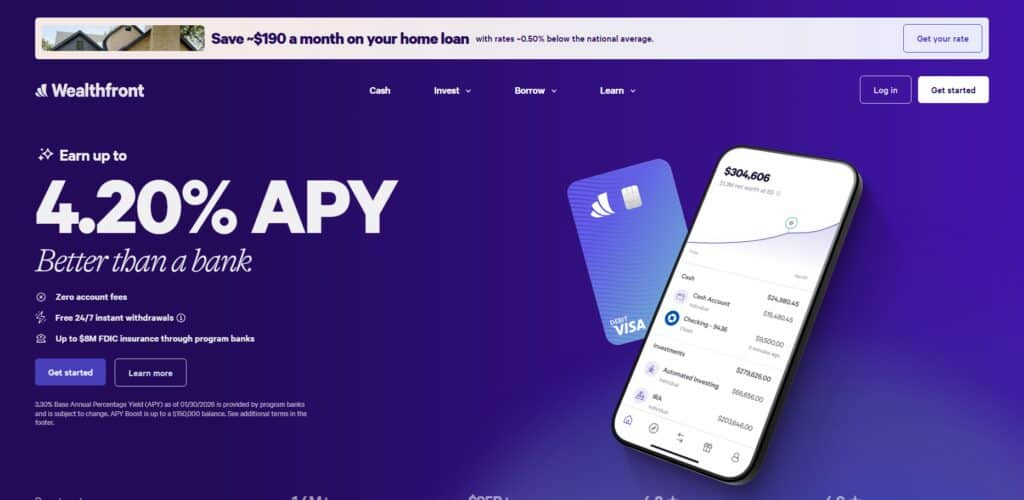
This can help with personalized tax efficiency. They are great for the tech-savvy investor who wants both banking and investing in the same place. This includes young professionals and high net worth individuals, especially for those who want an advanced tax strategy with minimal human interaction. The Wealthfront app is great and their automation is top of the line, making it perfect for digital-first investors who are looking for the best service.
Wealthfront
- Tax loss harvesting occurs daily on ETFs and stocks.
- Direct indexing available for accounts greater than $100,000.
- Uses AI to identify individual stock losses.
- Sells and replaces securities to ensure compliance with wash sale avoidance.
- Tax Aware investing via cash and bond ladders are integrated.
Pros
- Offers daily tax-loss harvesting.
- Offers tax-loss harvesting advanced with direct indexing.
- Bank and investing integration.
- Strong mobile app experience.
Cons
- Direct indexing requires a minimum of $100,000.
- Has no human advisor support.
- Has limited international investment.
Best For
- Those who are tech aware and invested.
- Those who are high net worth.
4. Vanguard Digital Advisor
The Vanguard Digital Advisor service uses AI to advise investors on ETF investments within the Vanguard ecosystem. At 0.15% annually, a fee that is a significant draw to investors, this service aims to provide investors with AI capabilities that will rebalance their portfolios and track their investments toward their anticipated retirement goals within a tax-advantaged framework. Digital Vanguard Advisor focuses on Vanguard’s ETFs and retirement accounts and allows users to tailor their investment glide path.

Although the competition provides a suite of offerings that are more focused on tax-optimized investments, Vanguard Digital Advisor offers investors the opportunity to invest a significant portion of their retirement portfolio at a fee competing with the lowest in the industry. Vanguard Digital Advisor suits investors who prefer to invest within the resources available from Vanguard’s offerings and who are cost sensitive. It also benefits retirement savers and those looking for simplified automation within a tax-advantaged framework.
Vanguard Digital Advisor
- Does Tax Loss Harvesting less frequently than competitors.
- Focuses on tax‑efficient choice of Vanguard ETFs.
- Rebalances portfolios with tax efficiency.
- Glide path portfolios designed for tax efficiency during retirement.
- Focus is simplicity, as opposed to advanced harvesting, carried out by a low‑cost structure.
Pros:
- Excellent pricing at 0.15% fee annually.
- Highly trusted Vanguard.
- Automated retirement glide paths.
- Very easy to use system.
Cons:
- Limitations to tax-loss harvesting.
- No direct indexing.
- Short on features.
Best For
- $300 setup fee charged upfront.
- Limited flexibility outside of Schwab products.
5. Schwab Intelligent Portfolios Premium
Combining AI with hands-on CFP assistance, Schwab’s Intelligent Portfolios Premium provides its clients with a hybrid robo-advisor for a fee of $30 per month, plus a $300 set-up fee. This service offers fully automated AI-based portfolio construction and rebalancing, including tax loss harvesting. Investment automation allows Schwab clients to set their desired risk level while utilizing Schwab’s ETF, bond, and cash investments.
Tax loss harvesting and tax-optimized rebalancing are available within Schwab Intelligent Portfolios Premium. Automating financial planning is made easy with Schwab Intelligent Portfolios Premium. It offers full service automation to Schwab clients and provides convenient hybrid service offerings to clients who prefer a trusted source. Automation, coupled with human financial assistance, focuses on a predictable monthly fee and comprehensive financial planning, making the Intelligent Port
Schwab Intelligent Portfolios Premium
- Automated harvesting ETFs in taxable accounts.
- AI driven rebalancing that is tax aware.
- Systematic wash sale compliance.
- A CFP can help you build and guide your tax strategy.
- A monthly subscription keeps the harvesting class in session.
Pros:
- Hybrid model for CFP access.
- Features automated tax-loss harvesting.
- Lets choose own risk settings.
- Part of Schwab’s connected system.
Cons:
- $30 per month is $360/year.
- $300 first-time charge.
- Only uses Schwab stuff mostly.
Best For: Schwab customers who want hybrid control.
6. HedgePath
Hedge Path is a newer AI-based platform focusing on advisor workflows and automation tools for tax-loss harvesting. Pricing is based on advisor subscription tiers, and typically is charged on a flat monthly basis. Their AI tools encompass options for predictive tax-loss harvesting, compliance monitoring, and portfolio optimization. From an investment standpoint, HedgePath has adopted an advisor-centric approach, offering automated ETF and stock portfolio tools and with rebalancing features.

From a differentiating standpoint, tax-loss harvesting, is its most appealing feature, incorporating automation tools designed specifically for financial advisors and their clients. HedgePath caters to the needs of professional advisors and wealth managers searching for scalable tax-loss harvesting solutions. From this perspective, it is an excellent resource for firms focused on improving efficiency, meeting compliance concerns, and using AI to optimize their portfolio management efforts. HedgePath’s narrow focus makes it less applicable to retail investors, but powerful to professionals.
Pros:
- Automated tax‑loss harvesting focused on advisors.
- Predictive AI for compliance.
- Multiple portfolios.
- Advisors workflow integration.
Cons:
- Difficult to use for retail investors.
- Unpredictable subscription fees.
- Poor public recognition.
Best For: Advisors and Wealth Management.
7. M1 Finance
M1 Finance is a broker for investors looking for flexibility and a DIY option for investment management. Designed in 2015, this platform is free for basic accounts and for M1 Plus accounts at $125 a year. M1 does not include advanced tools for managing taxes or taxes, but does offer automated cash management and rebalancing.

Investors also have the ability to design their own portfolios using ETFs and stocks. M1 Finance is a good option for the hands-on investor looking for an automation platform. M1 Finance is cost efficient, making it a good option for self-directed investors.
M1 Finance
- Tax-efficient rebalancing instead of active harvesting.
- Automated portfolio “pies” create fewer taxable events.
- Tax-aware dividend reinvestment.
- Advanced harvesting options require upgraded plan.
- Asset management for taxable accounts is best suited for self-directed investors.
Pros:
- Free basic plan.
- Customizable portfolio “pies.”
- Automatic rebalancing.
- Flexible DIY features.
Cons:
- No advanced tax‑loss harvesting.
- Limited adviser support.
- $125 annual Premium plan.
Best For: Automated control with flexibility.
8. Vanguard Personal Advisor Services
Vanguard Personal Advisor Services (PAS) offers automation of portfolio management tools using AI and human Certified Financial Planners. The annual cost for this service is 0.30% which is higher than Vanguard Digital Advisor due to the inclusion of human financial advice. AI options for portfolio management include automation for retirement and tax loss harvesting.

The investment options for Vanguard’s Personal Advisor Services include ETFs and mutual funds. Automated tax loss harvesting and personalized tax strategy make PAS a good option for all investors. PAS is a good option for investors needing automation to help manage wealth for personal and professional goals and for those needing wealth management solutions for personal financial planning.
Vanguard Personal Advisor Services
- Hybrid automation combines AI with human CFPs.
- Taxable accounts use tax-loss harvesting.
- Tax-related strategies customized by advisors.
- Compliance for wash sales is handled through Vanguard.
- Tax planning for retirement and estates.
Pros:
- CFPs in a hybrid model.
- Automatic portfolio rebalancing.
- Tax‑loss harvesting.
- Reliable Vanguard name.
Cons:
- High 0.30% annual fee.
- Minimal flexibility beyond Vanguard funds.
- Higher balance requirements for full‑service.
Best For: Complex investors.
9. Boldin (NewRetirement)
Boldin, a part of NewRetirement, offers an AI-powered $120 per year retirement planning tool. One of its AI retirement planning features is scenario analysis along with Monte Carlo simulations. Retirement planning includes retirement account investments and withdrawals along with portfolio planning. Tax planning is focused on taxation of retirement plan withdrawals, Roth conversions, and Social Security optimizations.
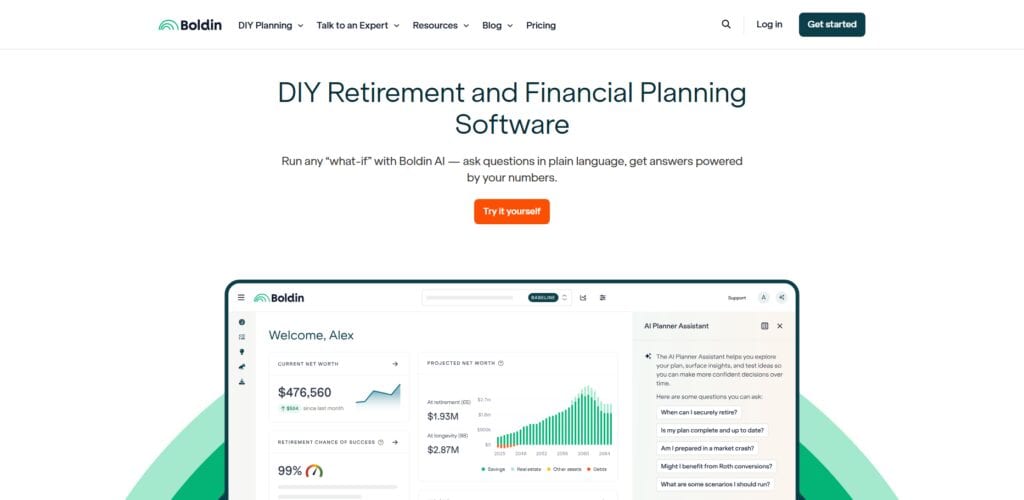
Boldin is geared towards those conducting advanced retirement planning beyond basic investments. Users include pre-retirees, retirees, and those looking for direction towards achieving desired long-term financial goals. The powerful AI simulation, along with tax planning, provides users with assurance regarding their retirement finances.
Boldin (NewRetirement)
- Withdrawals are prioritized to be as tax-efficient as possible.
- Roth conversions are optimized via A.I.
- Tax-efficient simulations are used via Monte Carlo.
- Tax-efficient strategies for timing Social Security.
- Advanced harvesting is done via withdrawal optimization.
Pros:
- AI retirement simulations.
- Roth conversion and withdrawal planning.
- Tax‑optimal withdrawal strategies.
- Cost‑effective subscription.
Cons:
- Limited tax‑loss harvesting.
- Geared primarily toward retirement planning.
- Not meant for
Best For: Retail investors and gig workers wanting tax optimization.
10. Column Tax
Column Tax is an AI-based tax filing and optimization tool. Pricing is similar to other fintech tools with a $10 per month subscription. Automated tax filing along with tax deduction identification and tax loss harvesting are included as AI features. Limited investment features focus on tax-reportable investments.
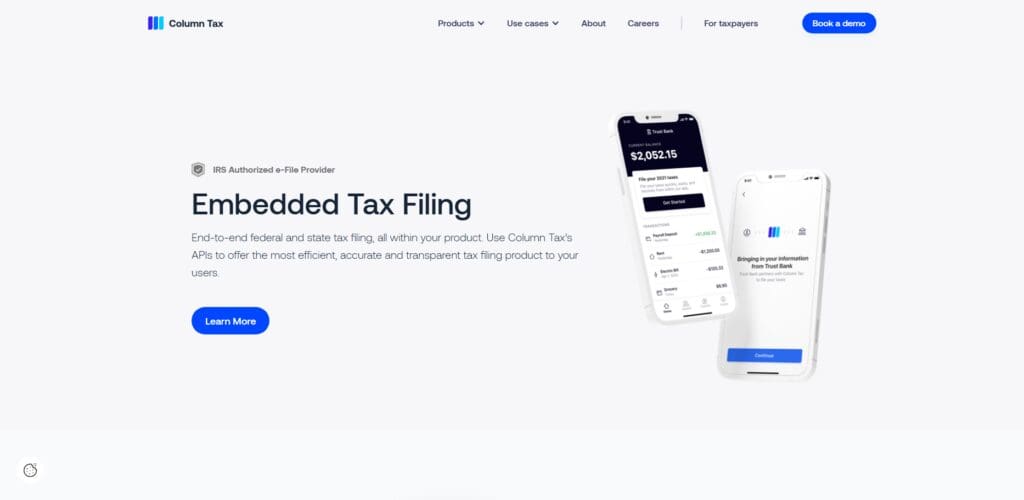
Tax optimization is the primary focus as AI identifies tax loss harvesting opportunities. Column Tax is best suited for simpler tax filing and writing investors. Users include gig economy workers, retail investors, and featured tax plan automation. Compared to robo-advisors, Column Tax is not a full-scale investment planning platform. Being focused on tax planning and filing makes it complementary to tax optimization tools.
Column Tax
- AI integrates tax filings and harvesting.
- Deductions and investment account tax-loss harvesting are automated.
- Tax-loss harvesting is identified during filing.
- Compliance for wash sales is built into reporting.
- Subscription cost is low for retail investors.
Pros:
- AI‑powered tax filing automation.
- Affordable $10/month subscription.
- Integrated deduction discovery.
- Tax‑loss harvesting compliance built in.
Cons:
- Limited investment features.
- Focused mainly on tax filing.
- Best as a complement, not standalone advisor.
Best For: Retail investors and gig workers needing tax optimization.
Conclusion
The various AI financial advisors and tax-loss harvesting apps show clear differences in the (sub) categories in which they excel. Automation with tax-loss harvesting at the highest level, OptiVault and Wealthfront, harvest and predict tax-loss harvesting at the optimal level.
Other apps such as Betterment, Schwab Intelligent Portfolios Premium, and Vanguard Personal Advisor Services strike a balance between the automation of tax-loss harvesting and the human guidance of Certified Financial Planners.
Smaller, more focused apps such as HedgePath, and Column Tax, cater to financial advisors and tax planning for retirement, respectively. M1 Finance retains its spot for the best tax-loss harvesting app for the DIY investor, even with the absence of full harvesting.
The “best” choice for the user is dependent on their profile. Automation-centered users benefit most from OptiVault/Wealthfront. Vanguard/Schwab have the best hybrid guidance, while Boldin has the best retirement planning.
FAQ
What is automated tax‑loss harvesting?
It’s an AI‑driven process where platforms sell investments at a loss to offset taxable gains, reducing your tax bill while maintaining portfolio balance and IRS wash‑sale compliance.
Which platforms offer daily tax‑loss harvesting?
OptiVault and Wealthfront provide daily automated harvesting, maximizing efficiency compared to platforms with limited or threshold‑based harvesting.
Do all robo‑advisors include tax‑loss harvesting?
No. M1 Finance uses tax‑efficient rebalancing but does not offer full harvesting. Vanguard Digital Advisor also has limited capabilities.
What are the fees for these platforms?
Fees range from flat $100/year (OptiVault) to 0.25% AUM (Betterment, Wealthfront) or subscription models like $30/month (Schwab Premium). Costs vary by service level and features.
Who benefits most from tax‑loss harvesting?
High‑net‑worth investors in higher tax brackets benefit most, but even smaller portfolios can save hundreds annually depending on gains and losses.