

In 2026, businesses that manage digital assets will have to deal with greater demands to reconcile transactions and comply with taxes while also ensuring seamless integrations with QuickBooks. The best crypto accounting integrations, including enterprises like Cryptio and Ledgible and some more SMB-friendly options such as CoinLedger and Koinly, provide scalable, compliance, and affordability solutions. Navigating these options will depend on factors such as the volume of transactions, the level of support for DeFi, and the level of audit readiness, ensuring you are not overspending.
How to Choose the Right Crypto Accounting Integration in 2026
Pricing fit
Price your possible subscription options against your expected volume of transactions. Enterprise tools like Cryptio cost thousands of dollars monthly, while tools like CoinLedger and Koinly start under $50 per report.
Integration type
See if the tool offers sync with Quickbooks accounts, API mapping, or manual uploads using CSV files. In this case, Sync with Quickbooks accounts is preferable as they require less accounting work and have fewer errors.
Transaction volume
Always match the limits of transaction volume to the scale of your business. Tools like Breezing and Cryptio process millions of transactions each month, whereas Coin Tracker and Koinly limit the size of transactions processed.

Support for DeFi
Always ensure the tools have support for staking, liquidity pools, and spam token filtering. Here, enterprise tools have more features built in than SMB focused tools.
Tax compliance
Confirm the alignment with the Rev. Proc. 2024-28 and DAC8. In the cases where firms face excessive scrutiny, firms with cross border operations will require tools that provide audit ready reporting.
Reconciliation
Check for tools that provide automated reconciliation, closure of invoices, and tracking cost basis. Here a tool like Breezing stands out. In the case of SMB tools, adjustments will be needed.
Business type fit
Scale the tools for your business.Smaller firms tend to use CoinLedger or Koinly, while larger firms need SoftLedger or Cryptio for multi entity reconciliations.
Limits
Know the upper limits of API calls, the high prices, or the absence of tools that support staking. Knowledge of tool limitations avoids inefficient spending.
Key Point
| Integration | Key Point (2026) |
|---|---|
| Breezing | Deep QuickBooks integration with native invoice closure and double-sided journal entries. |
| Summ | Handles 3,500+ integrations, IRS-ready audit reports, spam token filtering. |
| Ledgible | Enterprise-grade crypto tax + accounting platform trusted by institutions. |
| Cryptio | Enterprise back-office solution with DeFi, staking, and audit-ready reporting. |
| Bitwave | Automates crypto bookkeeping, revenue recognition, and compliance workflows. |
| SoftLedger | Real-time subledger for digital assets, integrates with QuickBooks Online. |
| CoinLedger | Simplifies tax reporting, integrates with QuickBooks for SMBs. |
| CoinTracker | Portfolio + tax tracking with QuickBooks sync, ideal for startups. |
| Gilded | Crypto invoicing + payments directly reconciled into QuickBooks. |
| Koinly | Tax-focused integration with QuickBooks for capital gains and compliance. |
1. Breezing
Breezing’s price point for SMBs is $499/month, and scales to enterprise tiers. Breezing has QuickBooks Online integration with two-way sync that gets rid of clearing accounts. Breezing also supports 39 different blockchains, and most major exchanges and wallets. Breezing supports DeFi and staking, and offers spam token filtering. Breezing can accommodate transaction volumes in the millions and has automated reconciliation with FIFO and HIFO.
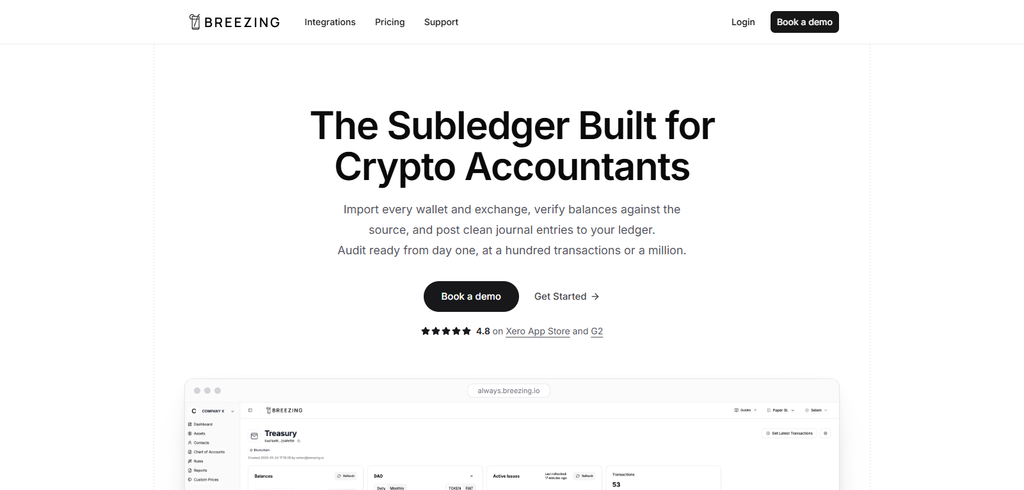
Breezing offers tax-reports that are ready to be submitted to the IRS, and are in alignment with compliance in India. Breezing has some updates planned for 2026 that include AI spam detection and automated invoice closure. Breezing is best suited for mid-market businesses, and has the best subledgering for crypto audit preparation. Breezing’s biggest con is lack of robust multi-entity consolidation, which is a standard offering for enterprise ERPs.
Pros:
- Native two-way sync with QuickBooks
- AI-based token spam filtering
- Supports over 39 blockchains
- Handles millions of transactions
- Reconciliations ready for audits
Cons:
- Multi-entity consolidations limited
- Higher cost for small and medium-sized businesses (SMBs)
- Requires tech and set up training
- No NetSuite integration
Best For:
- Mid-market companies
- Crypto related companies
- Accountants focused on audits
- Treasury groups
2. Summ
Summ (previously known as Crypto Tax Calculator) has a business plan that costs $299/month. Summ supports integrations with QuickBooks Online, and has a rollup option via API, with a choice of daily or monthly rollup. Summ supports all major exchanges and wallets, and supports staking and rewards for DeFi. Summ supports a transaction volume of 100,000 plus, and has bulk edit and reconcile options.

Cost basis options are FIFO, LIFO and specific. Summ offers ready to be submitted audit tax reports with form 8949 and schedule D. The 2026 updates for Summ include spam filtering, and an option to track your treasury. Summ is best suited for accounting firms, with the greatest ability to prepare for a number of clients. The biggest con for Summ is the need for rollups on large datasets, as Summ has a restriction of syncing 1,000 transactions per API.
Pros:
- Several low-cost tiers
- API-based QuickBooks mappings
- Covers DeFi and staking rewards
- Reconciliation at one go
- Tax reports ready for IRS
Cons:
- API batch limits
- Limited enterprise support
- Large datasets need manual rollup
- No SOC compliance
Best For:
- Accounting companies
- SMBs with some form of exposure to crypto
- Tax-related professionals
- Multi-client managers
3. Ledgible
Ledgible has a starting price of $200/month on the Silver plan, and scales to enterprise pricing. Ledgible has the ability to sync with QuickBooks Online and supports a choice of transaction or summary posting on a daily basis. Ledgible supports major exchanges and custodians and DeFi, although the support for DeFi is limited.
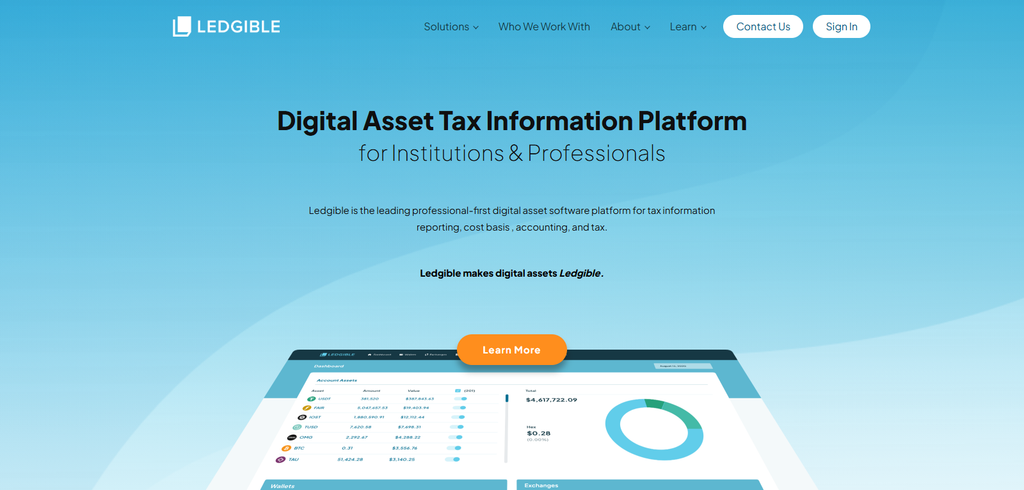
Ledgible supports a transaction volume in excess of hundreds of thousands and has options for cost basis of FIFO and HIFO. Ledgible supports GAAP fair value reporting and offers tax support that
The 2026 update added wallet-specific mappings and minimum thresholds. Ideal for institutions and enterprises requiring compliance-grade reports. Limitation: API rate limits restrict sync for ultra-high-frequency traders.
Pros:
- Syncs with QuickBooks on a daily basis
- Supports custodians and wallets
- Fair value reporting compliant with GAAP
- DAC8 compliant
- Mappings for wallets
Cons:
- API rate limits
- DeFi coverage limited
- Enterprise costs on the higher side
- Limited support for small and medium businesses (SMBs)
Best For:
- Institutions
- Large companies
- Firms focused on compliance
- Auditing teams
4. Cryptio
Cryptio costs $1,500+/month enterprise tier. Syncs with QuickBooks Online via API subledger for multi-entity support. Serves 400+ clients across 30+ countries with a $3T+ transaction volume. Covers DeFi, staking, liquidity provision, and cross-chain assets. Supports millions of monthly transactions with SOC 1/2 audit trails.
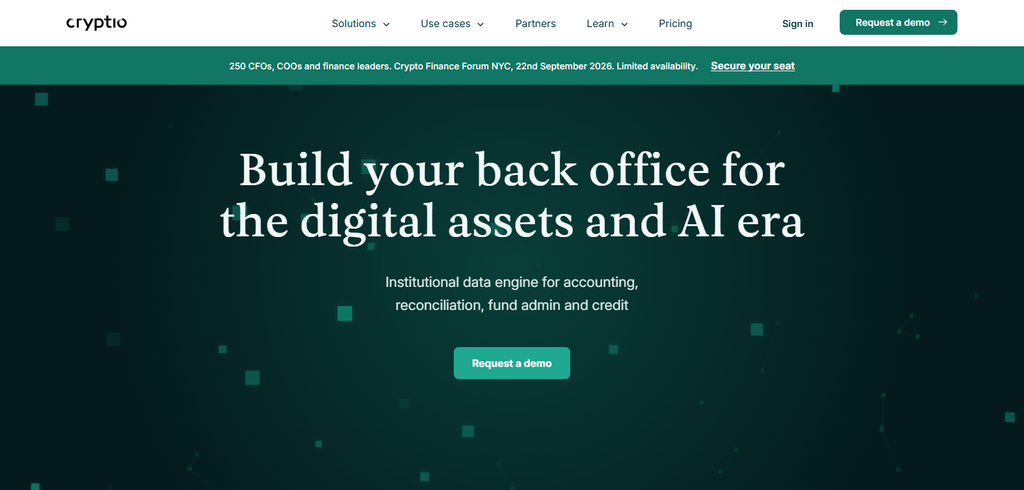
FIFO, HIFO, and specific ID support for tax and cost-basis tracking. Tax support aligned with FASB ASU 2023-08 fair value guidance. The 2026 update added SOC 2 Type 2 compliance with PwC audit. Best for regulated enterprises and institutions. Limitation: high costs make it unsuitable for SMBs.
Pros:
- A sync subledger for enterprise
- Audit trails for SOC 1/2
- Supports multi-entity
- Covers DeFi and LPs and staking
- Compliance framework audited by PwC
Cons:
- Costly
- Onboarding complex and hard to use
- Overkill for SMBs
- Limited features for QuickBooks
Best For:
- Highly regulated entities
- Enterprises
- Funds with the need for multi-entity
- Firms focused on audits
5. Bitwave
Bitwave custom quote pricing is per user, per month, plus transaction fees. Direct integration with QuickBooks Online offers automated workflow. Supports multi-sig wallets and DeFi with invoicing/bill pay. Supports large volume, mark-to-market transactions.
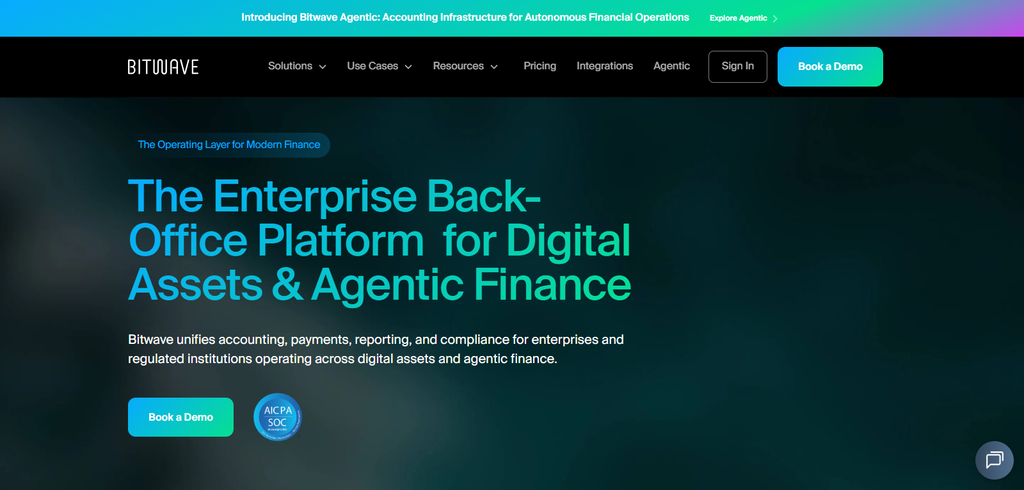
Cost-basis tracking and tax support is automated per transaction for gains and losses with IRS compliance. The 2026 update added crypto bill pay with multiple user workflows. Best for QuickBooks or NetSuite oriented SMBs and enterprises. Limitation: QuickBooks rounding (2 decimal places) may distort ETH and lower level accounting.
Pros:
- QuickBooks direct connection
- Bill-pay automation with crypto
- Supports Multi-sig wallets
- Automated cost-basis
- Compliance with IRS
Cons:
- Decimal issues
- Custom pricing
- Expensive for SMBs
- Needs custom workflows
Best For:
- Small and Medium Businesses
- Large Businesses
- Crypto focused businesses
- Users of QuickBooks and NetSuite
6. SoftLedger
SoftLedger pricing for their digital asset module is $13,500/year. Primarily a standalone ERP, but QuickBooks Online is a possible integration. Supports multiple entities, currencies, and crypto wallets. Suitable for enterprise grade transaction volumes.
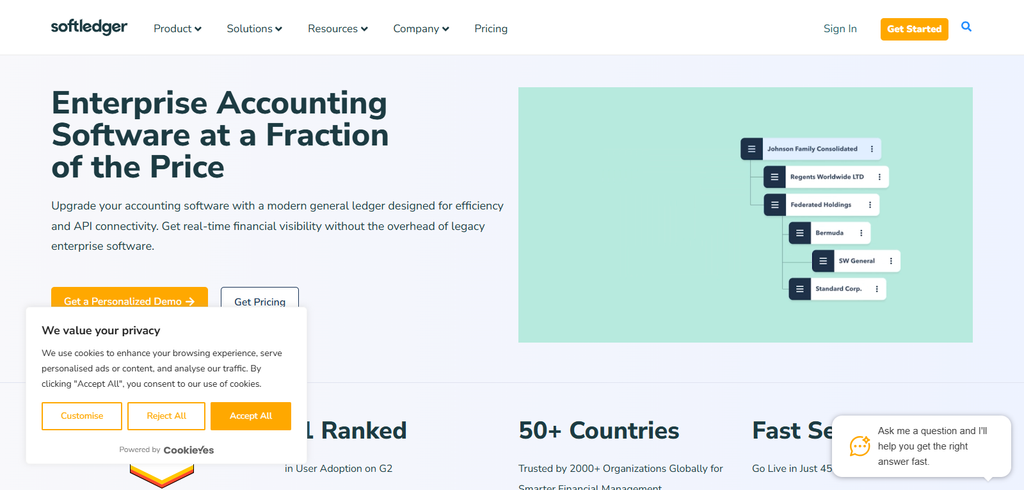
Cost-basis tracking supports FIFO and HIFO. Tax support with gain/loss and audit log tracking. The 2026 update added their API-centered architecture with continuous integration. Best for multi-entity enterprises and funds.
Pros:
- Crypto accounting at the ERP level
- Consolidation of multiple entities
- Ability to report in real-time
- FIFO & HIFO tracking
- Logs of audits
Cons:
- Expensive
- Not for SMBs
- Complex ERP systems
- Not a QuickBooks product
Best For:
- Large Businesses
- Investment Funds
- Firms with multiple entities
- CFOs that need consolidation
7. CoinLedger
CoinLedger costs $49 per tax report (free imports) and charges $25 for each report after that. Taxes and costs can be calculated for up to 50k transactions. Supports FIFO, LIFO, IRS Rev. Proc. 2024-28. Forms 8949, schedule D and 1099-DA are prep Tax Forms. Supports Coinbase, Kraken, Binance, Gemini, KuCoin, along with hardware wallets and MetaMask and Phantom wallets.
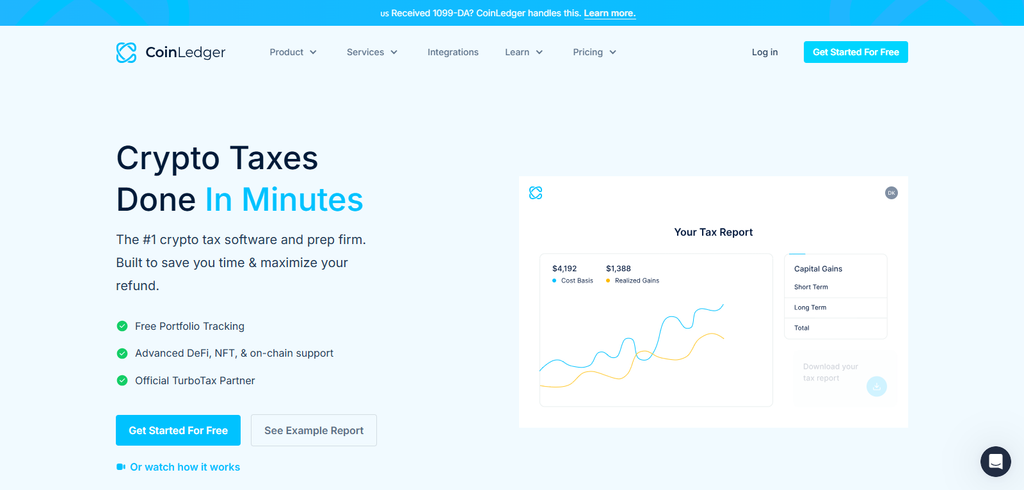
Cost basis compliance for at least 50 wallets is available since the 2026 update. Best for SMBs and Startups with Tax Sync needs at a lower cost. Limitation: no enterprise level multi-entity support or reconciliation.
Pros:
- Low cost
- Sync with public addresses or API
- Supports a large number of exchanges and wallets
- Tax forms ready for the IRS
- Cost basis for each wallet
Cons:
- Enterprise features lacking
- No support for multiple entities
- Limits number of transactions
- Basic reconciliation
Best For:
- Small and Medium Businesses
- New Businesses
- Tax experts
- Those seeking affordable compliance
8. CoinTracker
The cost for CoinTracker is based on volume and ranges between $59 and $599. Accounts can be booked through a QuickBooks Api. CoinTracker supports most exchanges, wallets, and portfolios. Cost basis methods can be either FIFO or specific ID.

Tax exports can include capital gains and IRS forms and are prep for TurboTax forms. The 2026 update also added GAAP fair value compliance. Best for Startups and Small Businesses. Limitation: a lack of enterprise tools for DeFi and staking.
Pros:
- Cost effective
- Sync with QuickBooks via API
- Portfolio and tax tracking
- TurboTax exports
- GAAP compliance
Cons:
- Limited Decentralized Finance coverage
- Transaction caps at SMB level
- No enterprise features
- Limited reconciliation
Best For:
- New Businesses
- Small and Medium Businesses
- Tax filers
- Crypto focused hobbyists
9. Gilded
Gilded is an enterprise subscription. It’s a QuickBooks Online subscription and invoicing support add on. Gilded supports QuickBooks by mapping through Compass. It supports several blockchains (Coinbase, Eth, Matic, BSC, and Ronin) and is best for mid market supportive transaction volumes.

Cost basis is tracked with the spot price at the time of the transaction. Supports gain/loss reporting and audit trails for tax. The 2026 update added wallet mapping and support for Compass reconciliation. Gilded has no staking or liquidity pair token support.
Pros:
- Mapping tool
- Supports major chains
- Invoicing and bill -pay
- Audit trails
- Mapping
Cons:
- No support for staking
- Limited enterprise support
- Focused on mid-market
- Needs an add-on for Compass
Best For:
- Focused on Crypto Startups
- Small and Medium Businesses
- Firms with a lot of invoices
10. Koinly
Koinly pricing starts at $49 for a tax report. Business accounts are more expensive. Supports 900+ blockchains, wallets and exchanges. Integrates with QuickBooks Online via Api sync Supports 1000 transactions in a sync batch. FIFO, LIFO, HIFO, and specific ID are some of the cost-basis methods provided.
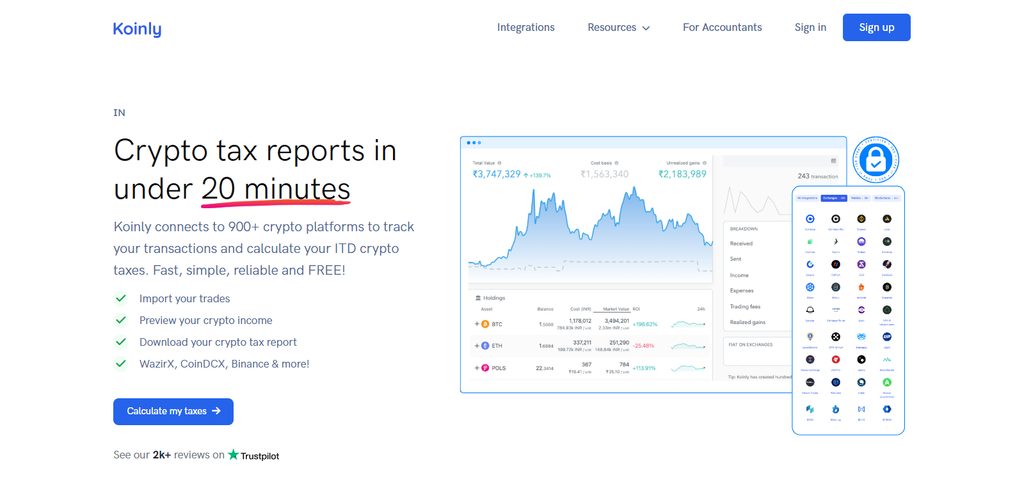
Forms 8949, 8949, and Schedule D are provided, along with international support. The 2026 version introduced AI error reconciliation and Rev. Proc. 2024-28. Global small and medium-sized businesses and accountants are the target customers. High-volume firms are impacted by the 1000 transaction sync batch limit.
Pros:
- Good prices at all levels
- Supports 900+ blockchains
- Various cost-basis accounting
- Worldwide tax compliance
- AI-assisted reconciliation
Cons:
- Sync limits per batch
- Few enterprise features
- Only for small and medium sized businesses
- Manual rollups needed
Best For:
- Worldwide small and medium sized businesses
- Accountants
- Tax practitioners
- Those who want low priced compliance
How We Ranked These Crypto Accounting Integrations
QuickBooks Integration Type
Native two-way sync, API mapping and CSV/manual uploads were put in order of preference. The ability to easily reconcile was prioritized.
Transaction Volume Capacity
Tools were assessed in terms of their ability to handle thousands vs millions of monthly transactions without hitting API batch limits or experiencing sync failures.
Exchange & Wallet Coverage
The range of supported exchanges, custodians, and wallets was assessed for the ability to accommodate diverse portfolios.
Blockchain & DeFi Support
Coverage of staking and LPs with spam filtering and multi-chain was prioritized.
Reconciliation & Cost-Basis
Audit-ready reconciliation and invoice closure and the ability to support FIFO/HIFO/specific ID cost-basis methods were key ranking factors.
Tax & Compliance
SOX 1 and 2 audit trails and the ability to address the Rev. Proc. 2024-28, DAC8, and IRS rulings were prioritized.
Latest Product Updates
Last-minute 2026 updates like AI-based reconciliation, spam filters, and multi-entity consolidation were prioritized.
Conclusion
When considering integrated crypto accounting for QuickBooks in 2026, one must evaluate scale, compliance, and affordability. Large enterprise platforms such as Cryptio and SoftLedger offer multi-entity consolidation and audit reporting at the cost of SOC compliance, but do an excellent job of addressing user scaling needs.
The mid-market platforms Breezing and Bitwave focus on transaction automation and DeFi. Affordable tools such as CoinLedger, Koinly, and CoinTracker have a strong product offering at a lower price for tax compliance, but do not do as well in the affordability and scaling department. Choosing the most appropriate of the three based on the business case is the best course of action.
FAQ
What is the most affordable crypto accounting tool?
Tools like CoinLedger, CoinTracker, and Koinly start under $50 per report or year, making them ideal for SMBs and startups with limited budgets.
Which integration offers enterprise-grade compliance?
Cryptio and SoftLedger deliver SOC 1/2 audit trails, multi-entity consolidation, and GAAP/IFRS compliance, best suited for regulated institutions and large enterprises.
Do these tools support DeFi and staking?
Yes, but coverage varies. Breezing, Bitwave, and Cryptio provide full DeFi/staking reconciliation, while CoinTracker and Gilded have limited support.
How many transactions can these platforms handle?
Enterprise tools like Cryptio and Breezing handle millions monthly, while SMB tools like CoinLedger and Koinly cap at 50k–100k transactions per batch.
Which cost-basis methods are supported?
Most platforms support FIFO, LIFO, HIFO, and Specific ID. Enterprise tools also align with IRS Rev. Proc. 2024-28 for per-wallet tracking.