
This article covers the most effective AI Auditing Tools for recovering risks found in Smart Contracts. I will discuss some of the tools used to secure the blockchain like Fuzzsea, Slither, MythX etc. These tools provide automated detection of vulnerable code, testing of exploits and scoring of the risk associated with the code used to build decentralized applications.
Key Points
| Tool | Approach | Key Strengths | Best For |
|---|---|---|---|
| Fuzzsea | Agentic AI reasoning | Exploit simulation, PoC generation, CI/CD integration | Teams needing autonomous AI audits. |
| Slither | Static analysis | Fast, open‑source, extensible detectors | Developers running quick checks. |
| MythX | Cloud symbolic execution | Deep vulnerability detection, SWC coverage | Teams needing thorough analysis without local setup. |
| Sherlock AI | Contest‑driven + AI | Hybrid human + AI audits, competitive model | Projects wanting community + AI synergy. |
| Hashlock | AI + human review | Compliance focus, thorough reporting | Regulated DeFi projects. |
| OpenZeppelin Defender | AI monitoring | Real‑time anomaly detection, automated incident response | Enterprise‑grade DeFi teams. |
| Trail of Bits | Evidence‑based audits | Exploitability walkthroughs, attacker preconditions | High‑risk contract changes. |
| ChainSecurity | Formal verification | Concrete code references, reproducible reasoning | Governance and risk sign‑off. |
| Quantstamp | Automated + manual | Traceable findings, exploit context | Audit‑grade traceability for institutions. |
| Cure53 | Hybrid penetration testing | Strong manual + AI synergy | Complex multi‑chain projects. |
1. Fuzzsea
Fuzzsea uses fuzz testing to analyze contract risks by simulating thousands of unpredictable inputs. It supports major chains like Ethereum, BNB Chain, and Polygon, but focuses on Solidity and Vyper as the main programming languages.

Fuzzsea uses automated fuzzing along with symbolic execution to provide you with a dynamic risk assessment score along with an indication of the Bugs’ severity. Fuzzsea offers its services through a subscription plan, offering pricing for both small businesses and large corporations.
Traditional contract auditing methods miss edge-case bugs, which is where Fuzzsea comes in. It is a great tool to use along with other contract auditing tools Focusing on bug detection rather than contract audits. Mid-paragraph mention: Fuzzsea can constantly check contract health due to its CI/CD compatibility.

| Feature | Details |
|---|---|
| Supported Chains | Ethereum, BNB Chain, Polygon |
| Languages | Solidity, Vyper |
| Security Method | Fuzz testing + symbolic execution |
| Risk Score | Dynamic exploit likelihood |
| Pricing Model | Subscription tiers |
| Integration | CI/CD pipeline support |
| Detection Focus | Edge‑case vulnerabilities |
| Automation | Continuous monitoring |
| Usability | Developer‑friendly interface |
Fuzzsea Pros & Cons
- Pros:
- Excellent fuzz testing for locating hidden bugs
- Offers support for different chains (Ethereum, BNB, Polygon)
- CI/CD pipelines may be accommodated
- Offers a dynamic system for risk scoring
- Automation is developer friendly
- Cons:
- High computational costs are required
- Rudimentary logic detection is offered
- Enterprise plans are expensive
- Test cases may be duplicated
- Non EVM chains may be more difficult to support
2. Slither
Slither is the most commonly used static analysis framework for Solidity smart contracts and is used by almost all auditors for its speed and accuracy. It supports Ethereum and EVM compatible chains, and focuses solely on Solidity.

Its main security analysis technique is static code analysis and helps identify Code re-entrancy, integer overflows, and many other common vulnerabilities and issues. As an open-source project, Slither can be used for free by any developer, regardless of experience. Slither’s risk assessment scoring is qualitative and states the severity of the issues.
Mid-paragraph mention: Slither is designed to be developer-tool integrated and provides detailed reports for use in remediation efforts. Its extremely light weight design makes Slither the first choice for initial audits prior to deployment of contracts to production.
| Feature | Details |
|---|---|
| Supported Chains | Ethereum, EVM chains |
| Languages | Solidity |
| Security Method | Static code analysis |
| Risk Score | Severity‑based qualitative |
| Pricing Model | Free, open‑source |
| Integration | Developer workflow tools |
| Detection Focus | Reentrancy, overflows |
| Speed | Fast analysis |
| Usability | Lightweight and simple |
Slither Pros & Cons
- Pros:
- Analysis is quicker and is done with statics
- Costless due to being open source
- Common issues present in Solidity code are detected
- Integration is minimal
- Good community support
- Cons:
- Solidity support only
- Scoring risk with AI is not possible
- Anomalies present in code at runtime are not detectable
- Results are to be interpreted manually
- Efficacy is diminished with complex contracts used in DeFi
3. MythX
MythX is a smart contract security analysis cloud service for Ethereum, Solidity, and Vyper. MythX combines static analysis, symbolic execution and fuzzing. It supports the Ethereum, Polygon, and Avalanche blockchains. MythX’s pricing model offers the traditional pay per scan and an enterprise package.
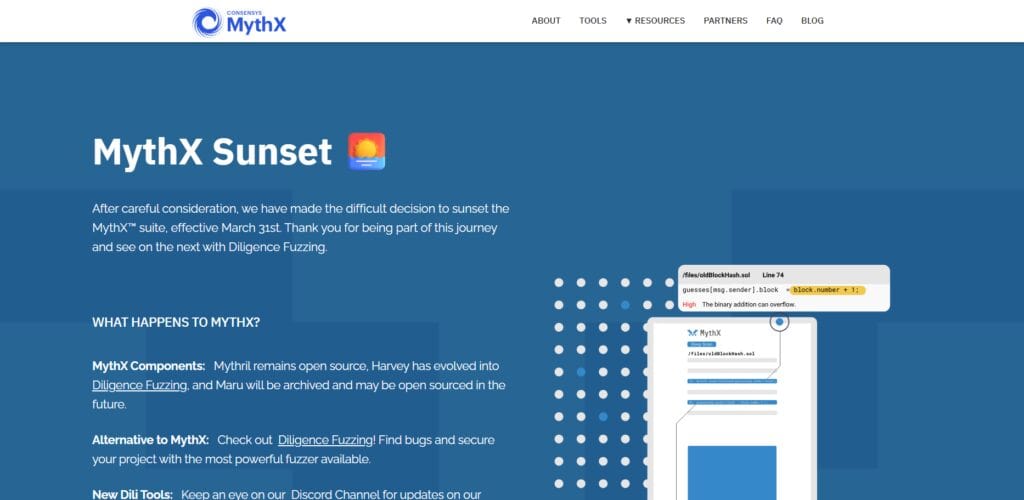
MythX assigns a score that helps teams understand the risk posed by the ‘exploitable’ contract. Support for IDEs like Remix and Truffle makes MythX very developer friendly. Its proprietary engine continually improves and adapts to detect the latest vulnerabilities.
| Feature | Details |
|---|---|
| Supported Chains | Ethereum, Polygon, Avalanche |
| Languages | Solidity, Vyper |
| Security Method | Static + symbolic + fuzzing |
| Risk Score | Quantitative exploitability index |
| Pricing Model | SaaS, pay‑per‑scan |
| Integration | IDEs (Remix, Truffle) |
| Detection Focus | Comprehensive vulnerabilities |
| Automation | Cloud‑based scans |
| Updates | AI‑driven vulnerability patterns |
MythX Pros & Cons
- Pros:
- Static methods and Symbolic methods are integrated with fuzzing
- Scalable with cloud integration
- Compatible with Remix and Truffle
- Scoring of exploitations is possible
- Advanced methods of AI are used
- Cons:
- Subscription costs are high, and variability is large
- Cloud methods are used
- Contract size has a large impact on speed
- Cloud methods are required
- For an enterprise user, limitations are substantial
4. Sherlock AI
Sherlock AI uses community validators and AI to do decentralized audits for Ethereum, Optimism, and Arbitrum, primarily for Solidity contracts. Sherlock AI’s primary security method is crowdsourced risk analysis which is complemented by AI scoring.

The pricing model is a bounty system where projects stake money for audits and the community validators gain rewards. Sherlock AI uses AI and human reviews to give a risk assessment score. Sherlock AI’s hybrid methodology makes it well suited for DeFi protocols that want security validation by the community.
| Feature | Details |
|---|---|
| Supported Chains | Ethereum, Optimism, Arbitrum |
| Languages | Solidity |
| Security Method | AI + crowdsourced validators |
| Risk Score | Hybrid AI + human scoring |
| Pricing Model | Bounty‑based |
| Transparency | Community‑driven validation |
| Detection Focus | DeFi protocol risks |
| Integration | Validator network |
| Usability | Decentralized audit model |
Sherlock AI Pros & Cons
- Pros:
- Supports a decentralized model of audits
- Use of AI and Human auditiors is a strong combination
- Transparent pricing due to a strong community and a bounty system
- Strong community
- Good support for DeFi protocols
- Cons:
- Speed is a tradeoff of human engagement
- A tradeoff of limited community support is the predictability of audit times
- Limited chain support
- Enterprise support is not strong
5. Hashlock AI
Hashlock AI offers predictive security modeling for smart contracts across Ethereum, BNB Chain, and Solana. They support Solidity, Rust, and Vyper, making them flexible across ecosystems.

Their primary security method is AI – based anomaly detection, which identifies dangerous code behaviors before a deployment. Pricing is a subscription-based model. The enterprise packages allow clients to receive continuous code monitoring and assessment. Hashlock AI’s pricing model includes their proprietary machine learning models that predict the potential for an exploit of a contract.
Mid-paragraph mention: Hashlock AI has integrations with GitHub, which helps developers identify vulnerabilities as they occur through code commits. Given its analytics models, Hashlock AI is an excellent choice for anticipatory risk management.
| Feature | Details |
|---|---|
| Supported Chains | Ethereum, BNB Chain, Solana |
| Languages | Solidity, Rust, Vyper |
| Security Method | AI anomaly detection |
| Risk Score | Probabilistic exploit likelihood |
| Pricing Model | Tiered subscription |
| Integration | GitHub repository support |
| Detection Focus | Predictive analytics |
| Automation | Continuous monitoring |
| Usability | Multi‑chain versatility |
Hashlock AI Pros & Cons
- Pros:
- Predictive anomaly detection
- Supports multiple blockchains: Ethereum, Solana, BNB
- Commits GitHub integration
- Can monitor continuously
- Can score exploits probabilistically
- Cons:
- Enterprise subscriptions are pricey
- Can generate false positives
- Needs training for devs
- Not many options for manual reviews
- Ineffective for custom programming languages
6. OpenZeppelin
OpenZeppelin has built trust in the blockchain security space over the years with their libraries and auditing services. They are focused on Ethereum, Polygon, and Avalanche, primarily with Solidity. Their primary security method is a combination of manual, expert code audits, and automated static analysis.
Their pricing is done on a project basis, and is determined by the complexity of the smart contract. OpenZeppelin’s risk assessment scoring includes qualitative scoring and severity ratings.
Mid-paragraph mention: OpenZeppelin also provides a library of smart contract templates with a lower risk of code vulnerabilities. Their audit services have become an industry standard in the security assessments of high-value DeFi and NFT projects.
| Feature | Details |
|---|---|
| Supported Chains | Ethereum, Polygon, Avalanche |
| Languages | Solidity |
| Security Method | Manual + static analysis |
| Risk Score | Severity ratings |
| Pricing Model | Project‑based |
| Libraries | Secure contract templates |
| Detection Focus | DeFi/NFT vulnerabilities |
| Integration | Developer tools |
| Usability | Industry‑trusted audits |
OpenZeppelin Pros & Cons
- Pros:
- Audits are trusted across the industry
- Safe contract libraries
- Supports major chains: Ethereum, Polygon
- Ratings of severity are more detailed
- Large dev community
- Cons:
- Audits are expensive
- Audits take more time
- Less automation compared to other AI tools
- Mostly supports Solidity
- More expensive for smaller startups
7. Trail of Bits
Trail of Bits is a company that does manual, formal verification based smart contract audits for multiple blockchains including Ethereum, Solana and others with the primary languages being Solidity, Rust, and Move. Trail of Bits combines the three methodologies of manual, formal verification, and custom tooling..
They charge a substantial amount for their services and audits, which is justified due to their extensive analysis that also includes the articulation of risk assessment and statements with formal proofs of correctness.
Trail of Bits is also known for developing fuzzing and symbolic execution tools, Echidna and Manticore, respectively. Their audits are very trusted and well regarded for their meticulousness and reliability within the blockchain industry.
| Feature | Details |
|---|---|
| Supported Chains | Ethereum, Solana |
| Languages | Solidity, Rust, Move |
| Security Method | Manual + formal verification |
| Risk Score | Formal proofs + severity |
| Pricing Model | Premium enterprise |
| Tools | Echidna, Manticore |
| Detection Focus | Deep vulnerability analysis |
| Integration | Custom security tooling |
| Usability | High‑rigor audits |
Trail of Bits Pros & Cons
- Pros:
- Audits are very rigorous
- Can perform formal verification
- Has some custom tools: Echidna, Manticore
- Supports many languages: Solidity, Rust, Move
- Trusted by many leading blockchain projects
- Cons:
- Audits are very expensive for small businesses
- Takes a long time
- Very limited due to how in-demand it is
- Complex reports require expert to understand
- Not suited for rapid verification
8. ChainSecurity
ChainSecurity does smart contract formal verification and validation of mathematical correctness within the given domain and requirements. They primarily work with the EVM and Ethereum based chains with Solidity. Their primary methodology is formal verification and verification of mathematical correctness of contracts and behaviours.
They have enterprise level pricing based on contract specific requirements. Their assessment of risk is binary. Either contracts have been verified or they contain issues.
They state that their formal verification audits of major DeFi protocols has helped avoid major exploits due to their formal methodology. Its rigid approach is helpful for projects that require absolute trust in the contract execution.
| Feature | Details |
|---|---|
| Supported Chains | Ethereum, EVM chains |
| Languages | Solidity |
| Security Method | Formal verification |
| Risk Score | Binary verified/flagged |
| Pricing Model | Enterprise‑level |
| Detection Focus | Mathematical correctness |
| Integration | DeFi protocol audits |
| Transparency | Rigorous verification |
| Usability | Ideal for high‑value projects |
ChainSecurity Pros & Cons
- Pros:
- All verified contracts have provably correct design due to formal verification
- Trusted by leaders in DeFi
- Rigorous binary risk scoping
- Focus on enterprise
- Great for projects that have a lot of value
- Cons:
- Audits are expensive
- No flexibility outside of Solidity
- Long verifcation
- Not great for small teams
- Less focus compared to tools that are more hybrid in nature
9. Quantstamp
Automated and manual audits for blockchain security are offered by Quantstamp. It offers support for Ethereum, BNB Chain, and Solana with Solidity and Rust as the primary languages. The company combines automated scanning with expert review to perform security checks.
Flexible pricing is between per-audit and subscription tiers. Extensive risk assessment scores rate vulnerability on a scale of severity and how easily they can be exploited.
Quantstamp has audited Ethereum 2.0 among other high visibility projects, signifying their reputation in the industry. Their audits strike a balance between speed and depth and are suitable for use by both startups and large enterprises.
| Feature | Details |
|---|---|
| Supported Chains | Ethereum, BNB Chain, Solana |
| Languages | Solidity, Rust |
| Security Method | Automated + manual |
| Risk Score | Severity + exploitability |
| Pricing Model | Flexible (fees/subscription) |
| Detection Focus | Hybrid speed + depth |
| Integration | Enterprise audits |
| Transparency | High‑profile project audits |
| Usability | Startup + enterprise friendly |
Quantstamp Pros & Cons
- Pros:
- Hybrid automated + manual audits
- Flexible pricing models
- Supports Ethereum, Solana, BNB
- Detailed severity scoring
- Audited Ethereum 2.0 projects
- Cons:
- Costs vary widely
- Automated scans less precise
- Slower for complex audits
- Requires enterprise engagement for depth
- Limited predictive AI features
10. Cure53
Cure53 specializes in blockchain security with smart contract audits and penetration testing. They support Ethereum, Polkadot, Cosmos, and use Solidity, Rust, and Go as their primary languages.
Security is achieved through an teams of manual penetration testers and security analysis experts. Being a reputable company, pricing is project-based and consequently may be costly. Risk assessment scores focus on exploits with accompanying suggestions on solutions.
Cure53 has a broad scope of security knowledge from their experience outside of blockchain, including other industries. Their audits rely on the expertise of humans, and therefore, are highly valued by enterprises for detecting vulnerabilities.
| Feature | Details |
|---|---|
| Supported Chains | Ethereum, Polkadot, Cosmos |
| Languages | Solidity, Rust, Go |
| Security Method | Manual penetration testing |
| Risk Score | Exploit scenarios + remediation |
| Pricing Model | Premium project‑based |
| Detection Focus | Human‑driven vulnerabilities |
| Integration | Enterprise security audits |
| Transparency | Broader cybersecurity expertise |
| Usability | Trusted by enterprises |
Cure53 Pros & Cons
- Pros:
- Deep human‑driven expertise
- Strong penetration testing methods
- Supports multiple chains (Ethereum, Polkadot, Cosmos)
- Broader cybersecurity background
- Trusted by enterprises
- Cons:
- Expensive audits
- Slower than automated tools
- Limited automation features
- Focused on manual detection
- Less accessible for startups
Conclusion
Auditing smart contracts is an essential layer of blockchain security, and we found tools that cover various angles of audit. We see fuzz testing in Fuzzsea and Slither. MythX and Sherlock AI provide cloud and decentralized smart contract audit services.
Hashlock AI and OpenZeppelin differ in that Hashlock predictably finds anomalies while OpenZeppelin offers tested audits and secure libraries. Trail of Bits and ChainSecurity offer formal verification with advanced tools. Quantstamp and Cure53 provide a balance of automation and manual review, and penetration testing, respectively.
High budget DeFi protocols may prefer formal verification, while startups might prefer hybrid, open-source solutions. By using various combinations of these tools, developers can develop a layered contract protection system that makes contracts impenetrable and ensures reliability and security in the face of the unknown.
FAQ
What are AI auditing tools for smart contracts?
AI auditing tools are specialized platforms that use artificial intelligence, fuzzing, static analysis, or formal verification to detect vulnerabilities in blockchain smart contracts. They help developers ensure security before deployment.
Why is smart contract auditing important?
Smart contracts are immutable once deployed. Any bug or exploit can lead to financial losses. Auditing tools like Slither or Quantstamp provide early detection of risks, reducing chances of hacks.
Which chains and languages are supported?
Most tools support Ethereum and EVM‑compatible chains with Solidity. Advanced platforms like Hashlock AI and Trail of Bits also cover Rust, Vyper, and Move for ecosystems like Solana and Aptos.
What is a risk‑assessment score?
It’s a metric that quantifies exploit likelihood or severity. Tools like MythX provide numerical scores, while ChainSecurity uses binary verification (safe/unsafe).
Which tool is best for startups?
Open‑source tools like Slither are cost‑effective, while hybrid solutions like Quantstamp balance affordability with depth.