I’m excited to write this article about online brokers in South Africa because picking the right trading platform can shape your trading experience greatly. In South Africa you have a number of options, from more budget friendly brokerages like EasyEquities, to the globally more recognized brokers, like Interactive Brokers and IG. In this article I will analyze the fees, platforms and their regulation, and what broker might work best for your trading style and how you can fit it into your goals.
How to Choose the Best Online Broker in South Africa?
Regulation & Safety FSCA and international regulators like the FCA, CySEC, and ASIC regulate the best online brokers in South Africa. Broker regulation shields clients’ funds and provides the lawful right to initiate a complaint against the broker for fraud, unfair practices, or unfair trading.
Fee Transparency The best online brokers will disclose their brokerage, spreads, and costs associated with their services and FX conversion. ETF TERs will depend on the selected ETF, and their cost will have an adverse effect on the long-term growth of an investment.
Minimum Deposit The best online brokers will have stated a minimum deposit amount, with some allowing clients to invest as little as R10 with EasyEquities, while others require an initial minimum of R500 like aStockTrade. Clients need to consider their options based on their investment amount and intent.

Supported Assets The best online brokers allow clients the option to trade shares, forex, crypto, and even U.S. stocks. Client preferences determine the choice of broker, whether the client is beginning with ETFs or trading several asset types.
Trading Platforms There is a plethora of trading platforms. MT4, MT5, WebTrader, and even platforms developed by a broker offer various tools and features, including ease of use and mobile accessibility. A trading platform should also allow client access to research and educational tools.
Tax-Free Accounts A broker offering an investment account that complies with a Tax-Free Savings Account (TFSA) would be of great advantage to clients. South African brokers EasyEquities and SatrixNOW offer a TFSA.
Customer Support The best online brokers provide’ prompt local and multilingual customer support; especially during trading hours via phone, chat, or email.
Global Access For diversity in offshore investments, consider brokers like Interactive Brokers or Webull SA. They offer access to both the U.S. and foreign markets, but be mindful of FX conversion costs.
What Does an Online Broker Really Cost in South Africa?
Brokerage Fees
Local services charge about 0.25% per trade (EasyEquities, SatrixNOW). Discount brokers may offer flat fee (R9-R49) or tiered trading fee structures.
Platform/Admin Fees
Some brokers have monthly/annual admin costs. For example, SatrixNOW will cost you 0.50% per annum, while Investec Clarity has zero platform fees.
FX Conversion Costs
Exchange-traded orders incur 0.5% – 1.5% cost for currency Conversion. EasyEquities charges about 2.3% round trip (cost of currency conversion and trade), making U.S. stock trading frequently very expensive.
Fund Management Costs
Providers of ETFs like Satrix charge Total Investment Charges (TIC) of 1.03% – 1.22% p.a. on their investment funds.
Custody & Account Fees
Brokers charge anywhere from R0 – R200 per month, or 0% – 0.5% p.a., depending on the broker. Robo-advisors and wealth platforms charge AUM (0.25% – 0.85%).
Inactivity Fees
Some brokers levy a R25 – R75 monthly charge on inactive accounts. This charging system works for active traders, but buy-and-hold investors should be cautious.
Key Points
| Broker | Key Point |
|---|---|
| Interactive Brokers | Global leader with ultra-low fees, advanced trading tools, and wide asset coverage including stocks, ETFs, forex, and bonds. |
| XTB | User-friendly platform with strong forex & CFD offerings, competitive spreads, and excellent educational resources. |
| Capital.com | AI-powered trading insights, commission-free stock trading, and intuitive mobile-first design. |
| Swissquote | Trusted Swiss bank-backed broker offering strong security, multi-asset trading, and advanced research tools. |
| Admirals | Well-regulated broker with MetaTrader support, strong forex focus, and competitive account types. |
| MEXEM | South Africa–based partner of Interactive Brokers, offering local support with global market access. |
| Forex.com | Specialist in forex trading with deep liquidity, strong regulation, and advanced charting tools. |
| Fusion Markets | Known for ultra-low commissions, transparent pricing, and strong forex execution. |
| Plus500 | Simplified CFD trading platform with fixed spreads, easy-to-use interface, and strong mobile app. |
| IG | Long-established broker with wide market coverage, strong research, and excellent trading education. |
1. Interactive Brokers
Based in Greenwich, Connecticut, with a founding year of 1977, Interactive Brokers (IBKR) has global branches and is subject to several regulators including the SEC, FINRA, FCA, ASIC, CBI, and others ensuring full regulatory compliance. It has over 5 million clients and is a publicly traded company on NASDAQ.
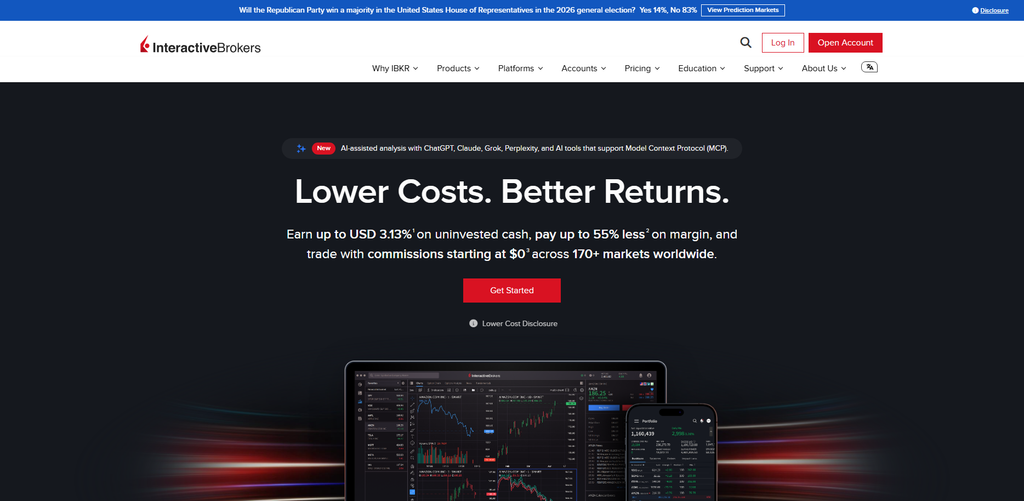
With no minimum cash deposit, and a minimum deposit of $2,000 for margin accounts, IBKR covers stocks, ETFs, options, futures, bonds, forex, mutual funds, metals, and crypto CFDs in 150+ markets worldwide.
IBKR boasts transparent pricing with commission free trades on U.S. stocks with IBKR Lite, and pricing with IBKR Pro that is either by tier, or has a fixed cost. Advanced trading analytics and execution order systems are available through Trader Workstation (TWS), IBKR Mobile, Client Portal, and APIs.
Key Features:
- Access 150+ markets globally
- Trader Workstation (TWS)
- Tiered or fixed price options
- API and algorithm trading
- Multi-asset (stocks, ETFs, options, futures, bonds, forex, and crypto CFDs)
Pros:
- Low fees
- Extensive range of assets
- Excellent global regulation
- Sophisticated trading tools
Cons:
- Interface is not user friendly
- Difficult to learn
- Fees charged for account inactivity
2. XTB
Founded in 2002 and based out of Poland, XTB is a publicly traded company on the Warsaw Stock Exchange. Regulatory branches include the FCA (UK) KNF (Poland), CySEC (Cyprus), ASIC (Australia), FSCA (South Africa), DFSA (Dubai), among others.
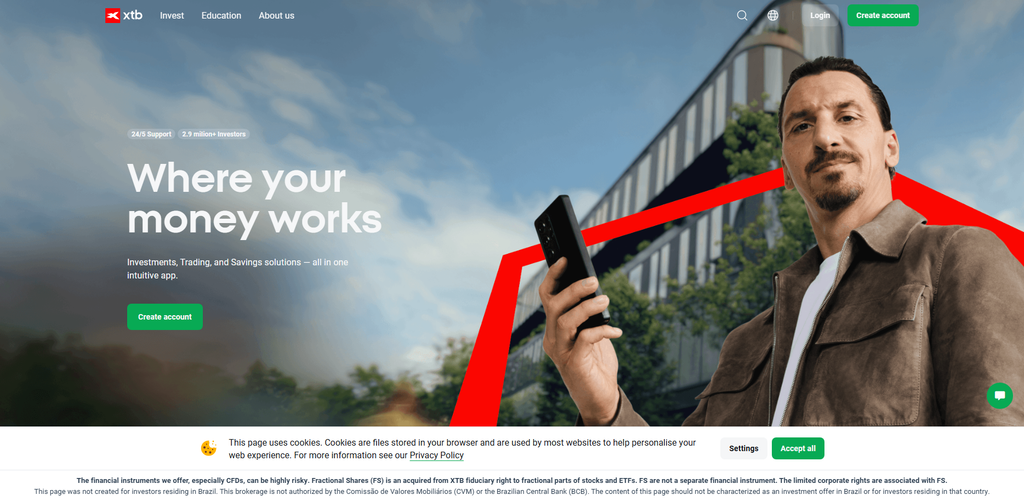
XTB offers zero minimum deposit accounts, and some regions require a minimum deposit of $100. Access to over 10,000 financial instruments are available including forex, stocks, ETFs, indices, commodities, and crypto CFDs.
XTB’s pricing model is spread based; Standard accounts incur no commission and have spreads starting at 0.6 pips, whereas Pro accounts charge a commission of $7 per lot with even tighter spreads. The xStation 5 platform has advanced charting tools and trade order systems.
Key Features:
- xStation 5 platform
- 10,000+ instruments
- FCA, CySEC, KNF regulation
- No minimum deposit
- Great education
Pros:
- Platform is easy to use
- No commission account is available
- Strong regulation and large asset selection
Cons:
- U.S. usage is limited
- Spreads are account dependent
- Less order types available
3. Capital.com
Founded in 2016 and based in London, along with Cyprus, Capital.com is regulated by FCA (UK), CySEC (Cyprus), ASIC (Australia), SCB (Bahamas), SCA (UAE).
Minimum deposit of $20 makes the broker suitable for beginners. It supports more than 6400 financial instruments across forex, equities, indices, commodities, and crypto.
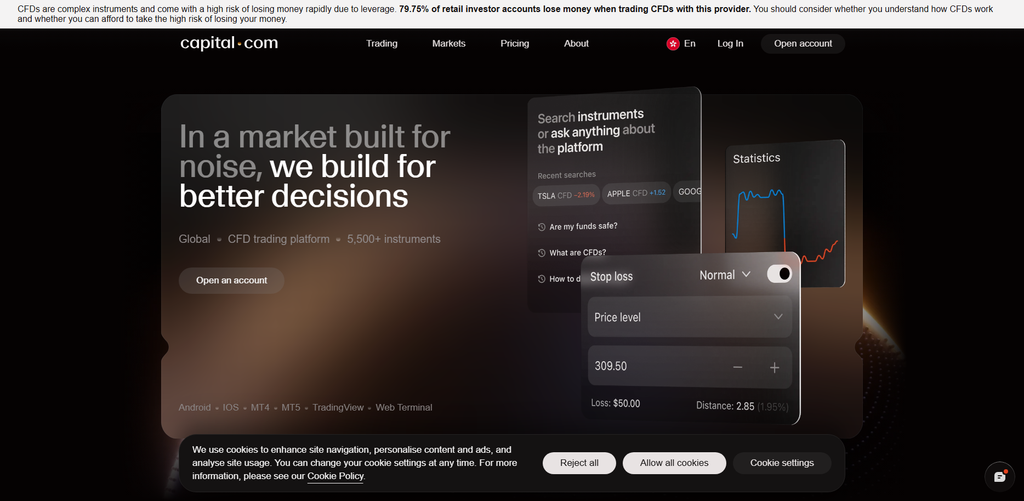
Capital.com charges zero commissions working on a spread-only model with spreads starting from 0.6-0.8 pips (EUR/USD). Its proprietary AI-based platform and tools, along with MT4, TradingView, mobile apps, and behavioral analytics to assist and reduce trading errors, are some of the offerings.
Key Features:
- AI trading
- FCA, CySEC, ASIC regulation
- $20 deposit
- 6,400 instruments (CFDs)
- Spread pricing
Pros:
- Low cost to start
- Easy to use
- Strong regulation
- No commission trading
Cons:
- Only CFDs (no real stock trading)
- Less advanced tools
- Fees charged to withdraw
4. Swissquote
Swissquote (1996) is publicly listed on the SIX Swiss Exchange, and a Swiss FINMA banking license holder with additional DFSA, CySEC, MFSA, SFC HK regulations.
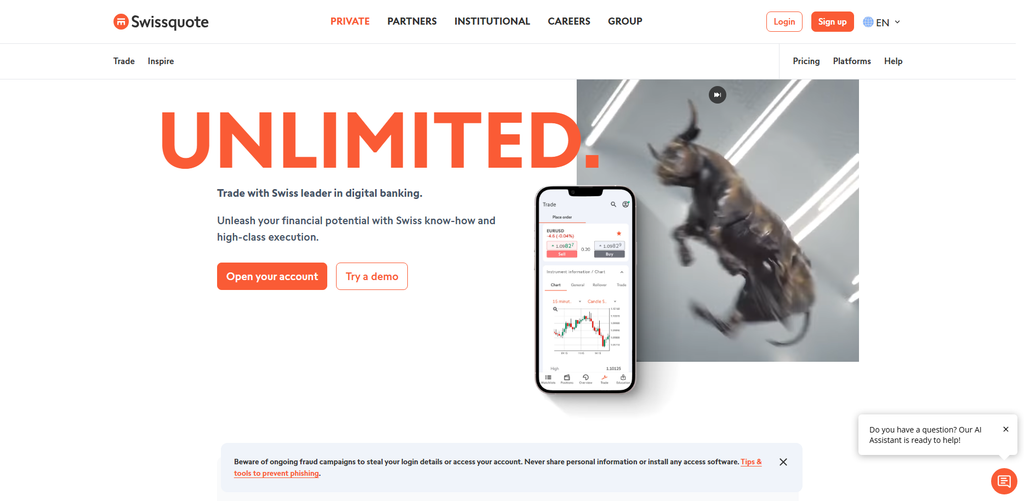
The broker prefers serious traders with minimum deposits of $1000. It supports 3 million trading instruments across forex, equities, ETFs, bonds, options, commodities, and crypto.
Swissquote offers spreads from 1.1 pips on standard accounts, while premium accounts offers better offerings. Its platforms include Advanced Trader, MT4, MT5, Mobile, with integrated Swiss banking and trading services, IBAN accounts, and debit cards
Key Features:
- FINMA Swiss Banking License
- 3+ million instruments
- $1,000 deposit
- MT4/MT5, Advanced Trader
- Banking services
Pros:
- Excellent Swiss regulation
- Huge range of assets
- Integrated banking
- Advanced
Cons:
- High minimum deposit
- High spreads
- High cost services
5. Admirals
Founded in Estonia in 2001 and regulated by the FCA (UK), CySEC (Cyprus), ASIC (Australia), EFSA (Estonia), FSCA (South Africa) and FSA (Seychelles), Admirals (formerly Admiral Markets) maintains minimum deposits from $1 to $25 depending on account type. Its more than 8000 instruments cover forex, CFDs, stocks, ETFs, and crypto.
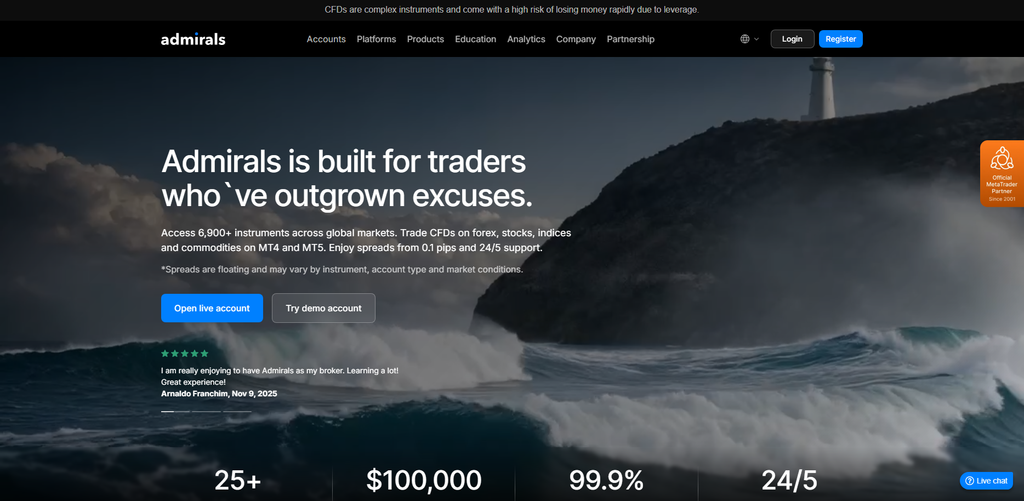
Admirals charges spreads between 0.5-0.8 pips; ECN accounts charge a $6 USD commission per lot. The trading platforms are MT4, MT5, Admirals App, and Invest.MT5 for real ownership of stock and ETFs.
Key Features:
- MT4 and MT5 platforms
- 8,000+ instruments
- FCA, CYSEC, ASIC regulations
- Low deposit ($1–$25)
- Invest.MT5 accounts for stocks and ETFs
Pros:
- Good regulation coverage
- Various asset classes
- Multiple accounts
- Excellent educational resources
Cons:
- Limited unique tools
- Different spreads
- Limited access to crypto
6. MEXEM
Established in 2018, and located in Cyprus, MEXEM is an introducing broker for Interactive Brokers. It is regulated by CySEC, AFM (Netherlands), FSMA (Belgium), MNB (Hungary).
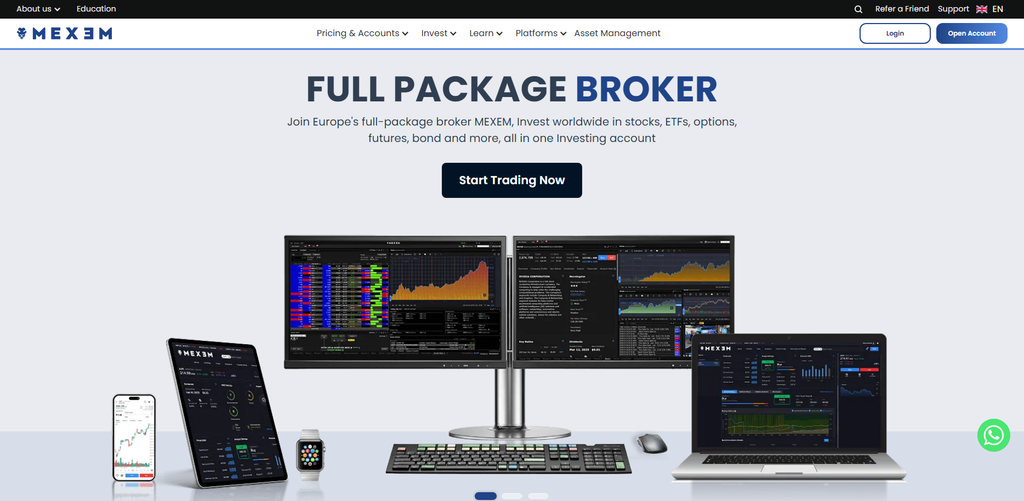
MEXEM has a $0 minimum deposit on cash accounts, and a $2,000 minimum deposit for margin accounts. They provide access to over 30,000 instruments in over 150 markets, provided in stocks, ETFs, options, futures, forex, and bonds.
Their fees are similar to IBKR’s: $1 USD per trade on U.S. stocks, 0.06% on European stocks, and 0.005% on forex. Trading platforms include Trader Workstation (TWS), WebTrader, Mobile App, and TradingView.
Key Features:
- Introducing broker for IBKR
- CySEC and EU regulations
- 30,000+ instruments
- Trader Work Station platform
- Clear fee structure
Pros:
- Large market access
- IBKR tech
- Good EU regulation
- Low fees
Cons:
- Limited IBKR systems
- Complex tools
- Margin requirements
7. Forex.com
Founded in 1999, and operating under the GAIN Capital group and now StoneX, Forex.com is based in New Jersey, USA. It is regulated by CFTC (US), FCA (UK), ASIC (Australia), CySEC (EU), MAS (Singapore), CIRO (Canada).
The broker requires a minimum deposit of $100. Forex.com supports access to 5,500+ instruments, including forex, CFDs, indices, commodities, metals, stocks, and crypto trading outside the U.S.
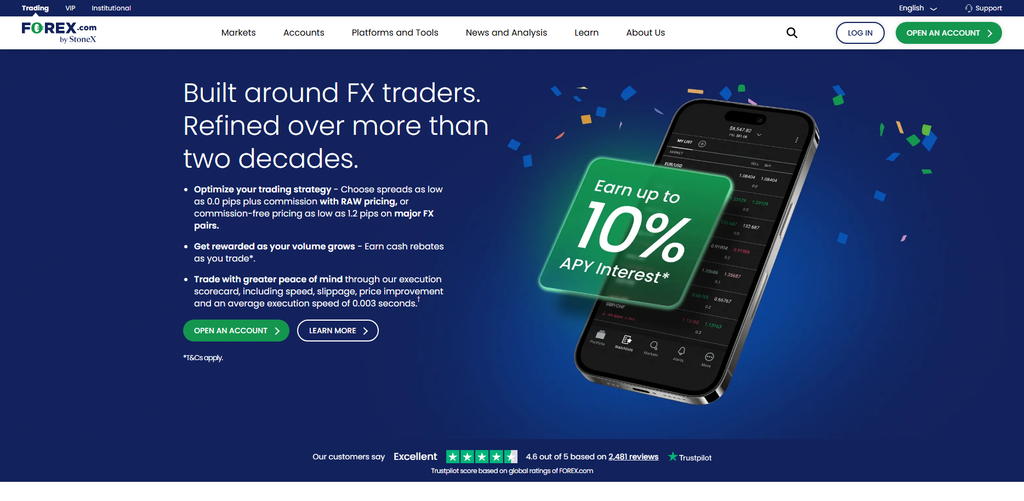
Forex.com charges a spread of 1.2 pips for EUR/USD, and has commission-free standard accounts and DMA accounts with raw spreads and commission. The trading platforms are MT4 and MT5, as well as Forex.com’s native trading platform.
Key Features:
- Established in 1999, a StoneX subsidiary
- CFTC, FCA, ASIC regulations
- $100 deposit
- MT4/MT5 and owned platform
- DMA accounts
Pros:
- Excellent global regulations
- Extensive asset coverage
- Owned platform
- Educational tools
Cons:
- High spreads
- Limited crypto coverage
- Withdrawal fees
8. Fusion Markets
Established in 2017 as an Australian firm, Fusion Markets is regulated by ASIC (Australia), VFSC (Vanuatu), FSA (Seychelles). They have no minimum deposit, providing access to over 250 instruments forex, indices, commodities, metals, stocks, and crypto CFD trading.
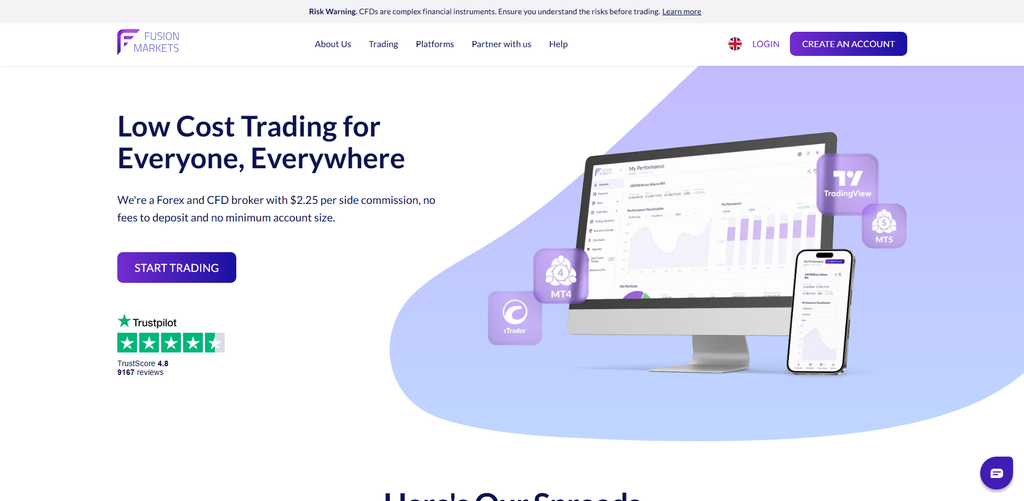
Fusion Markets quotes raw spreads starting from 0.0 pips with a per lot commission of $2.25 and wants to lure retail customers with its spread-only Classic accounts starting from 0.9 pips. It gives access to several trading platforms, including MT4, MT5, cTrader, and even TradingView, and copy trading through DupliTrade.
Key Features:
- ASIC regulation
- No deposit
- MT4, MT5, cTrader
- Raw spreads from 0.0 pips
- Copy trading DupliTrade
Pros:
- Low fees
- Various platforms
- High regulation
- Easy to use
Cons:
- Small asset range
- Limited research tools
- Offshore regulation (VFSC)
9. Plus500
This broker started its journey in 2008 in Israel and has its shares on the London Stock Exchange (FTSE 250). It is authorized and regulated in the UK (FCA), Australia (ASIC), Cyprus (CySEC), Singapore (MAS), UAE (SCA), and Canada (CIRO).
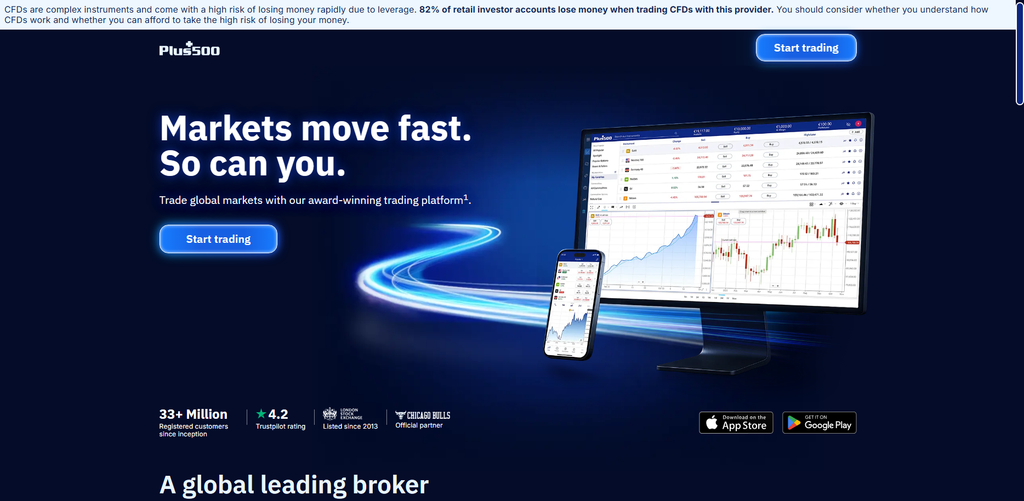
The minimum opening deposit varies from $100 to $200 based on the payment method. Plus500 offers around 2,800 CFDs on forex, stocks, indices, commodities, ETFs, options, and cryptos.
Plus500 does not charge any commissions. In line with its spread-only policy, the EUR/USD currency pair has a starting spread of 0.8 pips. It also offers a proprietary WebTrader that provides guaranteed Stop Loss orders. However, it does not support MT4/MT5.
Key Features:
- WebTrader, Owned platform
- FCA, ASIC, CySEC regulation
- $100 – $200 deposit
- 2,800+ CFDs
- Pricing based on spreads
Pros:
- Easy to use platform
- High regulation
- Stop-loss orders guarantee
- No commission trading
Cons:
- No MT4/MT5
- Limited offerings
- CFDs only
10. IG
Operating since 1974, and with headquarters in London, IG Group is a broker on the FTSE 250 that is regulated in the UK (FCA) and Australia (ASIC), among others, including Singapore (MAS), Germany (BaFin), UAE (DFSA), and South Africa (FSCA).
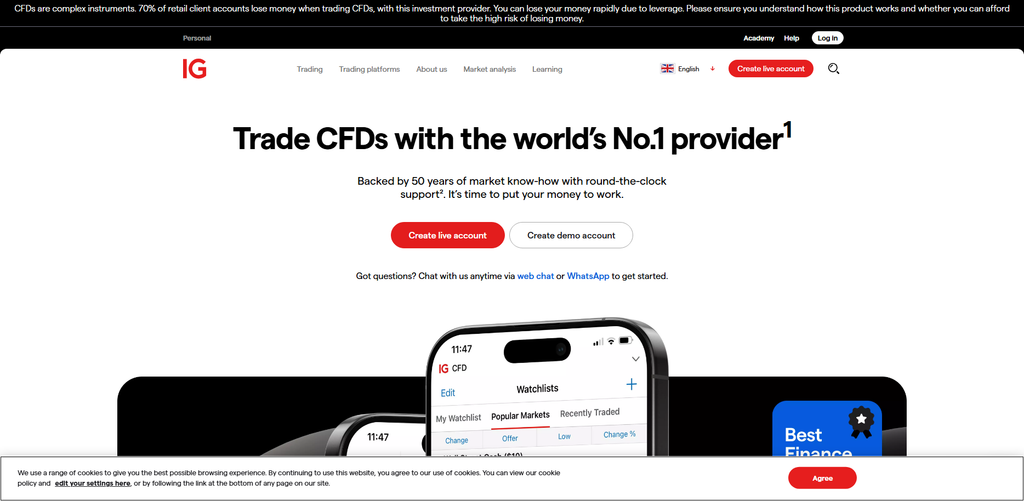
The minimum deposit for trading at IG is $0 for money wired, and $250 for payments through cards or PayPal. The broker offers around 17,000 trading instruments that include forex, CFDs, stocks, indices, commodities, options, futures, and cryptocurrency.
IG charges a commission on CFD and forex trades. It is spread-based for forex trades, and starts as low as 0.6–0.9 pips for EUR/USD pair, whereas stock trading is commission-free for active traders. Trading platforms are provided in MT4 as well as the firm’s L2 Dealer and the IG trading platform. The firm also has extensive educational content via the IG Academy.
Key Points:
- Founded 1974, listed on FTSE 250
- Regulated by FCA, ASIC, MAS, and CFTC
- 17,000+ instruments
- MT4, L2 Dealer, proprietary platform
- IG Academy
Pros:
- Established & reputable
- Extensive range of assets
- Excellent regulation
- Detailed education
Cons:
- Higher minimum deposit via card
- Variable spreads
- More intricate for beginners
Conclusion
The South African market features local brokers offering easy entry into investing with affordable tax-free accounts, and international brokers who cover more ground with international markets and trading tools. While each type of broker offers something unique, local brokers often offer less trading tools and resources. All brokers charge hidden costs like currency exchange and money market costs.
Design is key for easy-to-use, beginner-friendly platforms. For more advanced trading brokers offering access to a wider range of markets and trading tools are helpful. Selecting the ‘best’ online broker for South Africa comes down to what investment goals you hope to accomplish, what features you need, and how disciplined you are with your finances.
FAQ
Which regulator oversees brokers in South Africa?
The FSCA (Financial Sector Conduct Authority) regulates local brokers, ensuring investor protection, fair practices, and compliance with financial laws.
What is the minimum deposit for South African brokers?
It varies: EasyEquities allows starting with R10, while global brokers like Interactive Brokers may require $0–$2,000 depending on account type.
Do brokers charge hidden fees? Yes.
Beyond commissions, costs include FX conversion, platform/admin fees, and ETF fund charges. Always check the full fee schedule.
Can South Africans invest in U.S. or global stocks?
Yes. Brokers like Interactive Brokers, IG, and Webull SA provide international market access, though FX costs apply.
Which broker is best for beginners?
EasyEquities is ideal due to fractional shares, low deposits, and tax‑free savings accounts.