

Digital asset managers need more than just secure storage. They need reliable transaction controls, regulatory compliance and infrastructure that can scale with their portfolios. Cobo provides institutional custody and wallet solutions, but other organizations may want to look into other providers with specialized features and service models.
In this guide, I’ll walk you through the best Cobo Custody alternatives for asset managers, comparing their key features, security, supported assets, pricing considerations, and risks to help you find the right fit for your institutional needs.
How to Choose the Best Cobo Custody Alternative for Asset Managers?
Check Security Features: Look at the security features such as the MPC technology, multi-signature wallets, cold storage, private-key management and transaction approval controls to make sure the provider would help prevent unauthorized access and operational threats to institutional digital information.
Check Supported Assets: Choose a custodian that supports the cryptocurrencies, stablecoins, blockchain networks and token standards that you hold in your portfolio, ensuring compatibility with your existing holdings and any future digital asset diversification plans.

Compare pricing structures: Look at custody fees, transaction fees, withdrawal fees, staking fees and enterprise contracts to understand total ownership costs and avoid surprise expenses as your portfolio grows.
Confirm Regulatory Compliance: Review licensing, jurisdictional scope, anti-money laundering policies, audit documentation and custody agreements to confirm the provider’s compliance with your institution’s regulatory obligations and compliance policies.
Evaluate Scalability: Choose a platform that can accommodate a growing number of assets under custody, multiple investment funds, increased transaction volumes, and other blockchain networks without sacrificing operational efficiency or security standards.
Review Integration Capabilities: Review API capabilities, portfolio reporting, accounting integrations and automated workflows to ensure the custody platform integrates well with your current investment management systems and operational workflows.
Know Risk Protection: Look at insurance coverage, asset segregation, recovery procedures, counterparty exposure and incident-response policies to understand potential losses and how well the provider mitigates custody-related risks.
Compare Institutional Support: Evaluate the onboarding support, technical support, account management, reporting tools, and service-level agreements to choose a provider that meets your institution’s operational needs and long-term investment goals.
| Alternative | Key Point |
|---|---|
| BitGo | Institutional-grade digital asset custody with multi-signature security, qualified custody services, staking, and insurance coverage for asset managers. |
| Fireblocks | MPC-based custody platform offering secure asset transfers, policy controls, treasury management, and extensive blockchain support. |
| Coinbase Custody | Regulated institutional custody solution integrated with Coinbase Prime, offering cold storage, governance controls, and asset management tools. |
| Anchorage Digital | OCC-chartered digital asset bank providing regulated custody, staking, governance, and institutional asset management services. |
| Fidelity Digital Assets | Custody platform focused on institutional investors, offering secure storage, execution services, and support for major crypto assets. |
| Zodia Custody | Institutional custodian backed by traditional banking expertise, emphasizing regulatory compliance and secure digital asset storage. |
| Gemini Custody | NYDFS-regulated custody service featuring cold storage architecture, compliance controls, and insurance for eligible assets. |
| BNY Mellon Digital Asset Custody | Bank-backed custody solution combining traditional asset servicing capabilities with digital asset safekeeping. ] |
| State Street Digital Custody | Institutional custody offering from a major global custodian, designed for regulated digital asset management and administration. |
| Bitcoin Suisse Custody | Swiss-regulated digital asset custody provider offering secure storage, staking, and crypto wealth management services. |
1. BitGo
BitGo is one of the longest standing institutional digital asset custodians, serving hedge funds, asset managers, exchanges and financial institutions. It is known for its multi-signature and MPC-based security architecture that helps protect digital resources from single points of failure.
Pricing is usually customized according to assets under custody, transaction volume and other services like staking and trading. The platform supports different cryptocurrencies and blockchain networks.
BitGo, a regulated trust company, highlights compliance, governance controls, insurance options and scalable infrastructure for emerging and large-scale asset management operations.
Features That Count
- Institutional-grade wallet infrastructure and digital asset custody.
- Multi-signature and multi-party computation (MPC) security choices.
- It supports Bitcoin, Ethereum and other eligible digital currencies.
- Staking and institutional transaction services.
- Wallet management and operational controls, transaction authorizations.
Major Risks
- Additional services and transaction volumes may lead to increases in Institutional Pricing.
- Supported Assets & Services are governed by jurisdiction.
- The insurance coverage may have exclusions and limitations.
- Technical resources may be needed for integration and operational setup
2. Fireblocks
Fireblocks is a digital asset infrastructure and custody platform used by asset managers, banks, fintech firms and trading organizations. Its core security model is based on Multi-Party Computation (MPC) that allows for secure transaction approval without exposing private keys. Pricing is typically enterprise-oriented and based on asset volume and operational needs.
It supports a lot of blockchains, cryptocurrencies and tokenized assets. Fireblocks is designed to scale and grow with institutions as their transaction volume increases. The company also includes policy-based controls, workflow automation and compliance capabilities to help regulated organizations maintain security and operational efficiency.
Things to Know
- MPC wallet security and transaction signing.
- Customizable transaction policies and approval workflows.
- Supported electronic assets blockchain compatibility.
- Treasury management and infrastructure for digital asset transfers.
- API integrations and automation of institutional workflows.
Principal Risks
- The price can get pretty steep as the platform gets more usage.
- Technical integration might need expert know-how.
- Security relies partly on correct policy configuration and access management.
- Supported features and custody arrangements differ from product to product.
3. Coinbase Custody.
Coinbase Custody is a custody solution for institutions and professional investors that need to securely store digital currencies. It offers an offline cold storage combination, as well as hardware security protections and governance controls, to help protect client assets. Pricing is usually customized based on assets under management and services used.
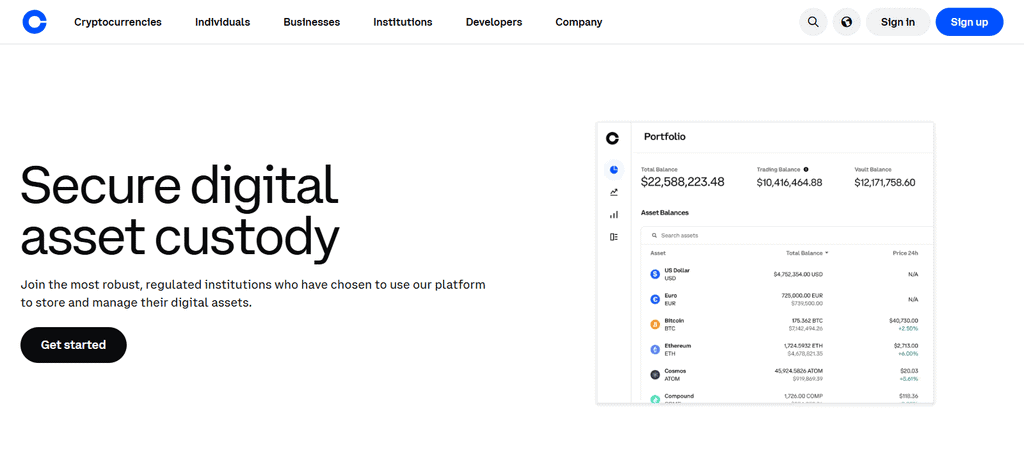
Coinbase Custody is built to support a broad set of crypto assets and is integrated with institutional trading solutions. We focus heavily on regulatory compliance and the platform is run through regulated structures and stringent operational standards. Its scalable infrastructure makes it suitable for investment funds, asset managers and financial institutions around the world.
Main Features
- Custody services for electronic assets, institutional.
- Security controls to safeguard institutional assets.
- Support for eligible cryptocurrencies and selected blockchains.
4.Integration with broader institutional trading and portfolio services. - Tools for institutional reporting and account management.
Principal Risks
- Availability of assets may vary by jurisdiction and custody product.
- Total costs may include custody fees and charges for other services.
- Operational exposure to counterparty risk arising from reliance on a centralized provider.
- Some services have eligibility requirements.
4. Anchorage Digital
Anchorage Digital provides institutional custody through a security architecture featuring MPC technology, hardware protections and governance-based controls. As a federally chartered digital asset bank in the United States, it emphasizes regulatory compliance and institutional grade operations.
Pricing will vary depending on custody requirements, products supported and levels of service. Anchorage offers a wide range of online assets, along with staking and governance solutions for supported networks.
This platform is for institutions that hold large portfolios of digital investments. Its mix of security, compliance and operational infrastructure is appealing to professional asset managers.
Main Features
- Custody with an institution such as a federally chartered digital asset bank in the US.
- Secure Storage of Electronic Assets and Key Management with Controls
- Staking services for qualifying cryptocurrencies.
- Governance of the institution and authorization of transactions.
- Digital asset infrastructure for qualified institutional clients.
Major Risks
- Supported assets and services may be subject to eligibility and jurisdictional restrictions.
- Institutional onboarding and compliance checks are time-consuming.
- The prices are for the contracted services.
- Staking carries asset-specific risks such as slashing and withdrawal restrictions.
5. Fidelity Online Assets
Fidelity e- Assets is Fidelity Investments’ digital asset division, offering institutional custody and execution services. The platform stresses the importance of strong security measures like cold storage and operational controls for large investors. Pricing is typically customized depending on custody needs and volume of assets.
Fidelity is a provider of services to institutional clients rather than retail clients and supports certain major digital resources. Compliance and risk management are central to its operating model, drawing on Fidelity’s deep experience in financial services. The platform is highly scalable and is built for asset managers looking for a partner financial institution with a proven track record.
Important Features
- Digital asset custody services for institutions.
- Institutional key management controls and offline storage
- Financial services infrastructure for qualified institutional clients.
- Operational processes for asset security and governance.
- Custody services that specialize in particular digital asset investment strategies.
Major Risks
- The number of cryptocurrencies supported may be less than in multi-chain platforms.
- Availability is subject to investor eligibility and jurisdiction.
- Pricing and service arrangements may be subject to individual negotiations.
- Even with the security of custody digital asset markets are volatile
6. Zodia Caretakers
Zodia Custody is a dedicated institutional digital asset custodian, built with a strong focus on banking-grade governance and security. The platform provides secure custody services designed for asset managers, investment firms and financial institutions venturing into the digital asset space. For institutional clients, pricing is usually based on the assets under custody and on some service requirements.
Zodia provides strong security controls for a growing universe of cryptocurrencies and digital currencies. Regulatory compliance remains a key focus, with operations designed to meet institutional expectations. Its scalable infrastructure allows organizations to expand their digital asset exposure efficiently and securely.
Important Features
- Infrastructure for the custody of institutional digital resources.
- Assets are safely stored and transactions are authorized in a controlled way.
- Services for financial institutions and asset managers.
- Supported the right cryptocurrencies and some blockchain networks.
- Operational controls of the institution and custody governance.
Major Risks
- The services and assets supported shall vary by jurisdiction.
- Pricing may not be as transparent without a customized quote.
- Integration requirements can increase implementation costs.
- Check service availability & contract protections carefully
7. Gemini Custody
Gemini Custody offers institutional-grade storage of digital files, with cold storage systems, hardware security controls, and operational safeguards. The platform is aimed at investment funds, asset managers, corporate treasuries and family offices looking for secure cryptocurrency custody. Pricing normally tailored to assets held and service requirements.
Gemini Custody supports a wide variety of electronic assets and is focused on secure asset management and governance. Compliance is at the heart of its business model, backed by security auditing procedures and regulatory oversight. Its scalable custody framework allows institutions to grow their holdings while adhering to robust risk management practices and operational dependability.
Features
- Custody services for institutional electronic assets.
- Controlled access to eligible cryptocurrencies and security controls.
- Transaction and account management processes for institutions.
- Support for specific digital resources and blockchain networks.
- Compliance-focused custody operations and reporting capabilities.
Risks to Watch
- Custody support may vary from the assets available through trading services.
- Insurance policies may have exclusions and limits on coverage.
- Services pricing and availability may vary by client and jurisdiction.
- Counterparty and operational risk due to dependence on centralized custodian
8. BNY Mellon Digital Asset Custody
BNY Mellon Digital Asset Custody utilizes the strength of one of the world’s leading custodians to the digital asset space. It merges traditional custody know-how with digital asset custody solutions for institutional investors. Pricing is custom for enterprise clients and will vary based on custody services and account needs.
Security measures are based on well-established banking standards and operational controls. The service focuses on selected electronic assets but is integrated with broader asset servicing capabilities. It is a compelling option for traditional asset managers entering digital asset markets, with strong regulatory compliance, governance processes and scalability.
Key Features
- Established institutional financial services and asset servicing expertise.
- Tailored digital asset programs for institutional investment environments.
- Possible alignment with conventional financial administration workflows.
- Institutional reporting and governance capabilities of applicable services
- Opportunities to integrate digital asset operations into existing financial infrastructure;
Risks to Monitor
- Current custody and scope of products must be verified.
- Eligible assets may not meet all investment criteria.
- There may be complex processes of institutional integration in implementation.
- Service eligibility, pricing and contractual protections may differ
9. State Street Digital Custody
State Street Digital Custody is designed for institutional investors looking for regulated digital asset custody services from a trusted provider of global financial services. The platform has enterprise-grade security standards, governance controls and operational risk-management procedures. Pricing structures are usually designed for institutional needs and custody volumes.
State Street is committed to empowering professional investors and integrating digital investments into wider investment management workflows. At the core of its offering is compliance and regulatory alignment, reflecting its experience in conventional financial markets. It has a scalable custody infrastructure that allows for the growth of institutional participation in the cryptocurrency and tokenized asset ecosystems.
Features
- Expertise in asset servicing and institutional financial services.
- Digital asset initiatives addressing the needs of the institutional market.
- Potential integration with traditional investment management processes.
- Experience with institutional governance and reporting.
- Infrastructure knowledge for large asset management companies.
Main Risks
- Availability of certain digital asset custody services is subject to verification.
- Supported assets and eligible jurisdictions may be limited .
- Integration of digital asset workflows can require extensive technical planning.
- Terms of contract, product features and pricing may vary
10. Bitcoin Suisse Custody Ltd.
Bitcoin Suisse Custody is an institutional custody solution based in Switzerland, that stores and manages electronic assets securely. The platform is targeted to professional investors, wealth managers and financial institutions looking for access to cryptocurrency markets. Security features include protected custody environments, operational controls, and risk management processes.
Typically, the price is determined by custody balances and the individual services selected. Bitcoin Suisse provides a range of cryptocurrencies and related services, such as staking for eligible assets. Meeting applicable Swiss regulatory standards is a key priority, and its scalable infrastructure supports the evolving needs of institutional asset managers.
Key Characteristics
- Cryptocurrency-related custody services for eligible clients .
- Experience in the Swiss market for financial services for digital and standard assets.
- Support of selected cryptocurrencies, depending on the availability of products.
- Digital asset transaction and related financial services capabilities.
- Services potentially suitable for institutions with a Swiss or European operational need.
Important Risks
- Availability of products and jurisdictions may vary.
- Different countries may have different regulatory requirements.
- Custody and transaction charges may have an impact on investment operating costs.
- Even if you secure your cryptocurrency, you are still exposed to the volatility of cryptocurrency prices and the risk that a blockchain transaction may fail.
Cobo vs. Its Top Alternatives: Comparison Table
| Custody Provider | Key Features | Security Approach | Primary Use Case | Key Consideration |
|---|---|---|---|---|
| Cobo | Wallet infrastructure, custody, staking, MPC wallets | MPC, multi-signature, configurable controls | Institutional asset management and wallet operations | Check supported assets, custody model, and pricing |
| BitGo | Institutional custody, wallets, staking | Multi-signature and MPC options | Institutional custody and digital asset services | Verify insurance terms and asset availability |
| Fireblocks | Wallet infrastructure, transaction automation, APIs | MPC and policy-based approvals | Treasury operations and blockchain transactions | Consider integration complexity and platform costs |
| Coinbase Custody | Institutional custody and trading-related services | Institutional security and access controls | Custody alongside eligible institutional trading services | Check jurisdictional eligibility and custody fees |
| Anchorage Digital | Custody, staking, institutional infrastructure | Controlled key management and institutional governance | Regulated institutional digital asset custody | Confirm supported assets and service eligibility |
| Fidelity Digital Assets | Institutional custody and digital asset services | Offline storage and key-management controls | Traditional investment institutions entering digital assets | Review asset coverage and service availability |
| Zodia Custody | Institutional custody and digital asset infrastructure | Controlled access and custody governance | Financial institutions and asset managers | Verify regulatory coverage and supported networks |
| Gemini Custody | Institutional digital asset storage and administration | Security controls and managed access | Institutional cryptocurrency custody | Review insurance conditions and asset eligibility |
| BNY Mellon Digital Asset Custody | Institutional financial services and digital asset initiatives | Institutional governance and operational controls, depending on service | Traditional asset servicing and digital asset integration | Verify current custody product availability |
| State Street Digital Custody | Institutional asset servicing and digital asset initiatives | Controls depend on the specific offering | Institutional investment operations | Confirm available services and eligible assets |
| Bitcoin Suisse Custody | Cryptocurrency custody-related and financial services | Custody controls depend on the selected service | Swiss and European digital asset operations | Check jurisdictional requirements and service coverage |
Conclusion
The best alternative to Cobo Custody for an asset manager will depend on security requirements, portfolio size, regulatory obligations, and operational goals. Fidelity Digital Assets, BNY Mellon and State Street may be attractive to conventional financial institutions, while providers such as BitGo, Fireblocks, Coinbase Custody and Anchorage Digital provide institutional custody and digital asset infrastructure.
Other choices for particular institutional needs are Zodia Custody, Gemini Custody and Bitcoin Suisse. Compare custody fees, supported assets, security controls, insurance coverage, and integration capabilities before you decide. At the end of the day, the best provider is one that provides reliable asset protection, is appropriate from a regulatory perspective, is scalable and is efficient for long-term portfolio management.
FAQ
What are the best Cobo Custody alternatives for asset managers?
Top Cobo Custody alternatives include BitGo, Fireblocks, Coinbase Custody, Anchorage Digital, Fidelity Digital Assets, Zodia Custody, Gemini Custody, BNY Mellon, State Street, and Bitcoin Suisse. Each offers different custody services, security controls, and institutional capabilities.
What should asset managers consider when choosing a Cobo alternative?
Asset managers should evaluate custody security, supported digital assets, regulatory compliance, pricing, scalability, insurance coverage, and integration capabilities. The right provider should align with their portfolio requirements and institutional risk management policies.
Which Cobo alternative is suitable for institutional custody?
BitGo, Coinbase Custody, Anchorage Digital, and Fidelity Digital Assets are potential options for institutional custody. Suitability depends on supported assets, jurisdictional eligibility, custody arrangements, and the institution’s specific operational requirements.
How much does institutional crypto custody cost?
Institutional crypto custody pricing varies by provider, assets under custody, transaction volume, and selected services. Some providers offer customized enterprise agreements, so asset managers should request detailed quotations and compare additional transaction, withdrawal, and staking fees.
How do Cobo alternatives protect digital assets?
Custody providers may use multi-party computation (MPC), multi-signature wallets, cold storage, hardware security modules, transaction approval policies, and access controls. Asset managers should compare these protections alongside recovery procedures and insurance terms.