The ability of Best Business Cash-Flow Management Platforms will determine their survival in the future. In 2026, technology will provide greater insight into liquidity forecasts, tracking, and real-time response for businesses. For this discussion, I will evaluate the top 10 cash flow management systems.
I will explain these systems’ capabilities of preempting cash flow issues resulting from late payment or long DSO, as well as minimize the chances of a cash flow shortage. Systems range from offerings tailored to smaller businesses such as LivePlan and QuickBooks Online to enterprise level systems such as Workday Adaptive Planning.
How We Selected and Ranked These Cash-Flow Platforms?
Forecast Accuracy – Evaluated how precise cash forecasts were, both short and long term, so businesses can identify and handle the impact of operational disruptions caused by liquidity gaps.
Integration Depth – Based on how deeply a tool could integrate with accounting, ERP, of banking systems, to give cash visibility for the invoices, bills and multi banking accounts.

Scenario Planning – Assessed how the tool handled and provided insights for stress and horizon testing to provide the finance teams with many possible outcomes of the business.
AR/AP Automation – Evaluated tool automation of AR and AP workflows to help lessen the manual burden of the process and to provide more visibility into the potential risks of cash collection and DSO increases.
Multi-Entity Support – How the tool helped consolidate forecasts for groups, subsidiaries, divisions, or banking groups globally, to help treasury teams address complexities.
Ease of Use – Focused on how user friendly the tool was, how easy and quick it was to setup for SMBs at no cost of accuracy and visibility.
Pricing Value – How well the pricing balanced the tool’s features, with a focus on freemium monthly subscriptions versus enterprise annual contracts.
B2B Suitability – Evaluated how well the tool suited B2B businesses, where the challenges of liquidity visibility and predicting cash flows from customer payments are critical to the operational sustainability and growth of the business.
Key Points
| Platform | Best For | Key Point (2026) |
|---|---|---|
| LivePlan | SMBs | Repeatable cash‑forecast workflows from operational assumptions; strong for planning + projections. |
| Datarails | Finance teams | FP&A automation with actionable forecast variance; ideal for frequent cash reviews. |
| QuickBooks Online | SMBs | Bank‑driven cash visibility tied to invoices and bills; easy integration with accounting. |
| Fathom | Treasury teams | Traceable scenario variance analysis linking forecasts to assumptions; reconciliation aligned. |
| CashFlow Frog | Finance teams | Variance reporting that surfaces forecast drift vs tracked outcomes; strong assumption review. |
| Float | SMB finance | Driver‑based rolling cash forecasts with variance visibility and bank reconciliation. |
| Concourse | AI‑driven finance | Custom AI agents for finance teams; advanced automation for cash analysis. |
| Workday Adaptive Planning | Enterprises | Integrated enterprise planning workflows with cash‑flow forecasting. |
| Trovata | Multi‑bank users | Real‑time liquidity tracking across multiple banks; treasury‑grade visibility. |
| HighRadius | Treasury ops | Enterprise treasury and cash management automation; strong for large organizations. |
1. LivePlan
LivePlan pricing begins around $30-$40 per month for planning with 3-5 year forecasting. Integrations for LivePlan include QuickBooks and Xero, allowing for AR/AP visibility as well as some scenario modeling. They do offer limited multi-entity support, but do emphasize their forecasting accuracy for use cases related to SMB planning.

In all, businesses can use LivePlan to Track, Forecast, Explain, Stress-Test, Act, and Improve their Cash position. Early warning indicators for deteriorating Cash position include warning signs related to DSO and collections.
Lux cash shortfalls are avoided with AR forecasting before cash shortages occur. LivePlan is appropriate for B2B SMBs that require a bit more structure with their planning, although the more advanced features may be cost prohibitive for very small businesses compared to competitor products that are less fully featured.
LivePlan Features
- Five-year forecasting for SMBs.
- Sync accounting through QuickBooks and Xero integrations.
- Invoice and bill AR/AP visibility.
- Growth and downturn scenario planning.
- Variance tracking to improve forecasting.
Pros:
- Simple for SMBs to use.
- Good value for price.
- Excellent planning.
- Cash shortage detecting.
Cons:
- Multiplicity support is weak.
- Enterprise functions are feeble.
- Stress testing is rudimentary.
- May be pricey for micro firms.
2. Datarails
Datarails offers enterprise solutions starting at around $10,000 + per year with 5-10 year forecasting. Deep integration with Excel, ERP, BI tools are available to automate AR/AP and provide planning tools for sophisticated scenario modeling.
Multi-entity consolidations are supported and forecast accuracy is improved through use of FP&A Systems. Users can perform the same Cash Cycle tracking and forecasting functions as LivePlan.
Modeling DSO and the impact of collections on liquidity is a feature of Datarails. More appropriate for larger B2B organizations that have complex financing structures and dedicated FP&A teams, though the cost may be too high for smaller organizations.
Datarails Features:
- Five to ten-year forecasting.
- Extensive integrations with Excel and ERPs.
- Automated AR/AP processes.
- Excellent scenario modeling.
- Multi-entity consolidation.
Pros:
- Enterprise level FP&A automation.
- Extremely accurate forecasting.
- Excellent stress testing.
- Great for finance teams.
Cons:
- Pricey ($10k+ per year).
- Complicated implementation.
- Requires FP&A headcount.
- Too much for SMBs.
3. QuickBooks Online
QuickBooks pricing is between $30 and $90 per month, which gives you access to features, such as basic scenario planning and forecasting, liquidity, and cash position improvement for up to 3 years. QuickBooks has advanced AR/AP (Accounts Receivable/Accounts Payable) visibility.
These features, along with basic integration with banks, invoicing, and billing, make QuickBooks a more comprehensive SMB solution than comparable products. Natural language processing (NLP) allows users to “Track” their cash positions, quickly “Forecast” cash outcomes, “Explain”, and “Stress Test” cash outcomes, and “Act” upon recommended interventions to “Improve” cash positions.
QuickBooks forecasting features expose AR DSO (Days Sales Outstanding) and AR cash shortages. QuickBooks is most appropriate for cash flow SMB value-add accounting solutions, but may be more cost prohibitive than comparable solutions for very small businesses.
QuickBooks Online Features:
- One to three-year forecasting.
- Native bank transfer.
- Invoice and bill tracking.
- AR/AP visibility.
- Intro to scenario planning.
Pros:
- Low cost ($30–$90/month).
- Simple integration.
- Excellent view of liquidity.
- Great for SMBs.
Cons:
- Limited multi-entity forecasting.
- Poor long-term forecasting.
- Basic stress testing.
- No deep scenario modeling.
4. Fathom
Fathom’s subscription cost starts at $50-$80 per month and extends to 5 years, making it a good solution for long-term cash visibility. Fathom’s product integrates with Xero, QuickBooks, and MYOB to provide advanced scenario planning and AR/AP tracking.
Cash position improvement via tracking and forecasting is a cornerstone of Fathom’s platform. Fathom’s solution offers the modeling of AR cash shortages from DSO and AR payment terms, making it most appropriate for advanced B2B finance teams, but may be more cost prohibitive than comparable solutions for smaller businesses.
Fathom Features
- Three to five-year forecasting.
- QuickBooks, Xero and MYOB integrations.
- AR/AP tracking.
- Scenario planning.
- Variance analysis to improve forecasting accuracy.
Pros:
- Excellent variance analysis.
- Good multi-entity support.
- Accurate forecasting.
- Great for treasury teams.
Cons:
- Pricey ($50–$80/month).
- Complicated for
- Too heavy for small businesses.
5. CashFlow Frog
Pricing is between $19 and $39 per month, and forecasts 1-3 years out. They connect with QuickBooks, Xero, and FreshBooks to give visibility into AR and AP, along with scenario planning. CashFlow Frog provides multi-entity support and forecast accuracy driven by variance reports.
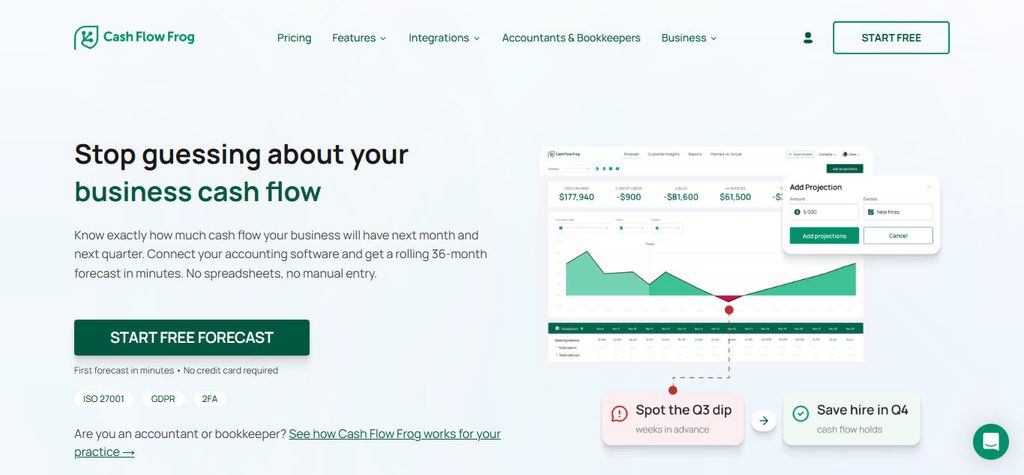
Businesses can use the tool to Track → Forecast → Explain → Stress‑Test → Act → Improve cash positions. Their platform catches potential cash shortage caused by late payments and increases in DSO and contains optimal AR forecasting.
Though advanced features may be expensive for small companies, they are great for small to medium businesses that need variance-driven forecasting.
CashFlow Frog Features:
- 1-3 year forecasting.
- QuickBooks, Xero, FreshBooks integrations.
- Visibility of AR/AP.
- Scenario planning.
- Variance reporting.
Pros:
- Low cost. ($19-39/month).
- Variance insights.
- Quick setup.
- Strong AR forecast.
Cons:
- Lacks features for larger clients.
- Weaker for multi-entity.
- Stress-testing is basic.
- Lacks depth for large firms.
6. Float
Float’s pricing starts at $59 per month, for 1-3 year forecasts. Integration with QuickBooks and Xero, and FreeAgent give AR and AP visibility and provide driver-based scenario planning. Float has multi-entity support and forecast accuracy is strong for rolling forecasts.
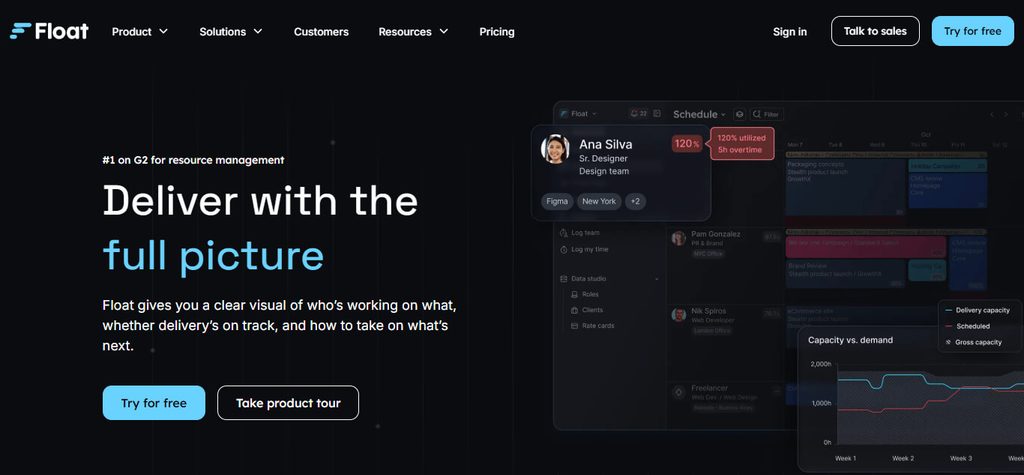
Businesses can Track → Forecast → Explain → Stress‑Test → Act → Improve cash positions. With Float, you can also pick up late payments and increases in DSO to help you avoid potential cash shortages.
Float is a solid option for smaller to medium business that needs rolling cash forecasting, but packaged deals may be costly to very small companies when compared to other accounting tools.
Float Features:
- 1-3 year rolling forecasts.
- Xero, QuickBooks, FreeAgent integrations.
- AR/AP visibility.
- Scenario planning.
- Multi-entity.
Pros:
- Excellent rolling forecasts.
- Easily understood.
- Strong for small to mid-sized business.
- Good short term liquidity.
Cons:
- More expensive. ($59/month).
- Lacks depth for larger firms.
- Basic stress testing.
- Costs too much for really small businesses.
7. Concourse
Concourse pricing is enterprise customized, and spans 5-10 year forecasting horizons. Integrations with ERP, BI, and finance systems allow for automation of AR/AP and AI-guided scenario planning.

Predictive AI improves the accuracy of forecasting for multi-entity consolidation. Users can Track, Forecast, Explain, Stress-Test, Act, and Improve cash position.
AR forecasting shows where there are potential liquidity risks by modeling any late payments and DSO increase risk. Ideal for AI-driven finance-forward B2B businesses, but most likely cost-prohibitive to SMBs with limited treasury management needs.
Concourse Features
- 5-10 year horizon forecasting.
- ERP and BI integrations.
- Automation of AR/AP with AI.
- Scenario planning.
- AI planning agents.
Pros:
- Leading AI automation.
- Easy multi-entity.
- Excellent stress testing.
- Predictive accuracy.
Cons:
- Enterprise level costs.
- Complicated to adopt.
- Requires treasury knowledge.
- Unnecessarily complex for small and mid-sized business.
8. Workday Adaptive Planning
Workday Adaptive Planning offers enterprise-level pricing, starting at around $15k per year, also spans 5-10 year forecasting horizons, and includes integrations with HR systems, along with integrations with ERP and finance systems for AR/AP automation and robust planning scenarios.
Predictive AI improves the accuracy of forecasting for multi-entity consolidation. Users can Track, Forecast, Explain, Stress-Test, Act, and Improve cash position.
AR forecasting shows where there are potential liquidity risks by modeling any late payments and DSO increase risk. Best for B2B businesses requiring integrated planning, but may be cost-prohibitive to SMBs when compared to other planning tools for SMBs.
Workday Adaptive Planning Features:
- 5 to 10 year planning.
- Integrations with ERP, HR, and finance.
- AR/AP workflows.
- Scenario planning.
- Enterprise consolidation.
Pros:
- Enterprise workflows.
- Excellent forecast accuracy.
- Excellent scenario planning.
- Treasury-grade.
Cons:
- Very expensive ($15
- Real-time liquidity tracking
9. Trovata
Trovata has enterprise‑level pricing that can be customized on a case‑by‑case basis and offers a forecasting horizon of 5–10 years. It integrates with multiple banks and ERPs, allowing for account receivable and payable (AR/AP) and treasury elevated scenario planning.
Forecasting is enhanced by real‑time tracking of liquidity. Businesses can Track → Forecast → Explain → Stress‑Test → Act → Revise cash improving measures. Liquidity risk is exposed through AR forecast modeling that captures losses and extended DSO.
This product is primarily used by large B2B businesses particularly in multi‑bank liquidity management; however, more premium pricing may put small businesses at a disadvantage relative to fewer, more straightforward accounting tools.
Trovata Features:
- Forecast horizons of 5–10 years.
- Multi‑bank integrations.
- AR/AP visibility.
- Treasury scenario planning.
- Real‑time liquidity tracking.
Pros:
- Excellent multi‑bank visibility.
- Strong treasury features.
- Accurate liquidity forecasting.
- Enterprise‑ready.
Cons:
- Enterprise pricing.
- Complex setup.
- Requires treasury staff.
- Unnecessary for SMBs.
10. HighRadius
HighRadius has enterprise pricing that begins around $20k per year, also with a forecasting horizon of 5–10 years. It integrates with treasury and finance systems along with core ERPs to automate AR/AP and provide advanced planning.
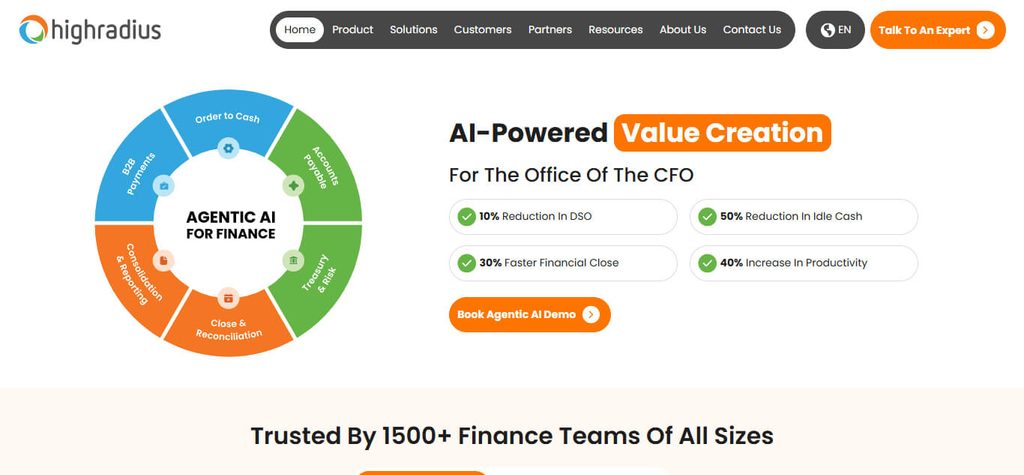
Forecasting accuracy for multi‑entity consolidation is enhanced with treasury automation. Businesses can Track → Forecast → Explain → Stress-Test → Act → Improve cash position measures.
Late payments and DSO increases; liquidity risk exposed by AR forecasting. This primarily serves B2B clients needing treasury automation; the price is most likely too high for smaller companies compared to tools focused on the SMB segment.
HighRadius Features
- 5 to 10 year forecast horizons
- ERP and treasury integrations
- Accounts Receivable (AR) and Accounts Payable (AP) automation
- Scenario planning
- Enterprise treasury workflows
Pros
- Strong treasury automation
- Precise forecasting
- Strong scenario planning
- Enterprise consolidation
Cons
- Very expensive ($20k/yr+)
- Complicated
- Requires treasury staff
- Unsuitable for SMBs
Cash‑Flow Management Platforms (2026)
| Platform | Forecast Horizon | Integrations | AR/AP Visibility | Scenario Planning | Multi‑Entity Support | Pricing Tier |
|---|---|---|---|---|---|---|
| LivePlan | 3–5 years | QuickBooks, Xero | Yes | Basic | Limited | $30–$40/month |
| Datarails | 5–10 years | Excel, ERP | Automated | Advanced | Strong | $10k+ annually |
| QuickBooks Online | 1–3 years | Native bank sync | Yes | Basic | Limited | $30–$90/month |
| Fathom | 3–5 years | Xero, QuickBooks, MYOB | Yes | Advanced | Strong | $50–$80/month |
| CashFlow Frog | 1–3 years | QuickBooks, Xero, FreshBooks | Yes | Basic | Moderate | $19–$39/month |
| Float | 1–3 years (rolling) | Xero, QuickBooks, FreeAgent | Yes | Driver‑based | Moderate | $59/month |
| Concourse | 5–10 years | ERP, BI | AI‑driven | Advanced | Strong | Enterprise pricing |
| Workday Adaptive Planning | 5–10 years | ERP, HR, Finance | Yes | Advanced | Strong | $15k+ annually |
| Trovata | 5–10 years | Multi‑bank, ERP | Yes | Treasury‑grade | Strong | Enterprise pricing |
| HighRadius | 5–10 years | ERP, Treasury | Automated | Advanced | Strong | $20k+ annually |
Conclusion
Based on the info available, the top 10 cash flow management platforms of 2026 are mid-markets, while SMBs are best served by platforms that are easy to use and cost less like LivePlan, QuickBooks Online, Float and CashFlow Frog.
Enterprise customers should look at Workday Adaptive Planning, Trovata, and HighRadius, which offer advanced treasury and consolidation solutions. The variance analysis and FP&A automation tools in Datarails and Fathom are predominantly used by finance teams.
The new kid on the block in AI-related finance tools is Concourse. In the end, the best platform for any business is a function fit, complexity, and price.
FAQ
What is a cash‑flow management platform?
A cash‑flow management platform helps businesses forecast, track, and analyze liquidity by integrating with accounting, ERP, and banking systems to manage AR/AP, scenario planning, and multi‑entity consolidation.
Which platforms are best for SMBs?
SMBs benefit most from LivePlan, QuickBooks Online, Float, and CashFlow Frog due to affordable pricing, ease of use, and short‑term forecasting capabilities.
Which platforms suit enterprises?
Enterprises prefer Workday Adaptive Planning, Trovata, and HighRadius for treasury automation, multi‑entity consolidation, and advanced scenario planning across global operations.
Which platform offers AI‑driven automation?
Concourse stands out with predictive AI agents, automating AR/AP workflows and enhancing forecast accuracy with machine learning.
How important is forecast horizon?
Forecast horizon determines planning depth: SMB tools cover 1–3 years, while enterprise platforms extend 5–10 years for long‑term liquidity strategies.