
As the use of cryptocurrency grows, companies must have tools that address the risks of doing business with cryptocurrency. These tools assist in the detection of criminal transactions, management of financial risks, and compliance with the Anti-Money Laundering (AML) laws.
In this article, I will examine the Best Crypto Transaction Monitoring APIs and how they assist companies in monitoring blockchain transactions, assessing the risk associated with a transaction, tracking wallets, detecting abnormal behavior, and automating compliance tasks. Finally, I will provide a feature-based, pricing, supported chains, and business use case comparison for each API.
Why It Is Crypto Transaction Monitoring APIs Matter
Anticipate Business Risk: Identify potentially high-risk blockchain transactions before they become issue or threat to business.
Better AML Processes: Help crypto businesses streamline Know Your Transaction (KYT), AML monitoring, and suspicious activity reporting processes.

Real-Time Risk Detection: Monitor transactions to identify risk and trigger alerts when business risk thresholds are breached.
Wallet Risk Assessment: Evaluate wallet addresses to identify connections with scams, sanctions, high-risk activities, and/or illicit activities.
Streamline Compliance: Automated compliance systems score transactions and prioritize high-risk transactions for manual review to reduce the time needed for review.
Blockchain Coverage: Crypto businesses encompassing several blockchains do not need multiple systems to monitor compliance since APIs support cross-blockchain monitoring.
Enhanced Fraud Detection: Identify risk activity signals including rapid fund transfers, transaction structuring, and abnormal patterns.
Transaction Traceability: Provide compliance teams with the means to trace transactions across wallets and follow the movement of funds.
Maintain Compliance Records: Ensure compliance records for transaction monitoring, alerts, and risk decisions and related investigations.
Growth and Business Scalability: Automated APIs offer direct integration of transaction monitoring to existing systems for exchanges, fintech providers, wallets, payment service providers, and other Web3 businesses.
Benefits Of Crypto Transaction Monitoring APIs
Real-Time Transaction Screening: The ability to evaluate transactions on the blockchain in real-time means you can detect suspicious behavior as it happens.
Automated Risk Detection: Evaluate transactions and wallets against configured risk factors and monitoring rules to determine risk levels.
Stronger AML Compliance: Continuous monitoring of crypto transactions helps strengthen AML and KYT compliance.
Wallet Risk Assessment: Identify the relationship between one or more wallet addresses and potentially risky entities, scams, sanctions, or illicit activities.
Multi-Chain Monitoring: Unified API based infrastructure to monitor blockchain networks for activity.
Customizable Alerts: Define risk thresholds and configure rules to generate alerts when transactions require additional analysis.
Transaction Traceability: Understand how funds move to and from wallets, including identifying potentially suspicious relationships.
Reduced Manual Work: Automate repetitive screening tasks and let compliance teams focus on higher risk cases.
Faster Fraud Response: Rapidly identify potentially fraudulent transactions to minimize losses.
Scalable Compliance Infrastructure: The infrastructure remains compliant as transaction volumes increase without requiring each transaction to be reviewed.
Easy System Integration: Facilitate the integration of monitoring API with exchanges, wallets, fintech, payment, and internal compliance systems.
Key Points
| Platform | Best For | Key Monitoring Capabilities | Key Strength |
|---|---|---|---|
| Scorechain | Crypto businesses & compliance teams | Transaction monitoring, AML risk scoring, wallet screening, alerts | Strong AML compliance and transaction-risk monitoring |
| CipherTrace (Mastercard) | Financial institutions & crypto businesses | Transaction tracing, AML analytics, wallet risk assessment, sanctions monitoring | Mastercard-backed blockchain intelligence |
| Crystal Blockchain | Exchanges, banks & compliance teams | Transaction monitoring, wallet screening, fund-flow analysis, risk detection | Strong visual transaction tracing and investigations |
| Coinfirm | Exchanges, fintechs & Web3 businesses | AML analytics, transaction monitoring, wallet screening, risk scoring | Broad AML/KYT compliance capabilities |
| Blockpass | Crypto platforms & Web3 businesses | Identity verification, transaction-related compliance, AML screening | Combines identity and compliance infrastructure |
| Didit | Fintech & Web3 businesses | Identity, fraud prevention, AML/KYC-related monitoring | Integrated compliance and identity-focused approach |
| Chainalysis KYT | Exchanges, institutions & regulators | Real-time transaction monitoring, risk alerts, wallet attribution, sanctions detection | Established blockchain intelligence and KYT capabilities |
| TRM Labs | Financial institutions & crypto companies | Transaction monitoring, wallet screening, risk scoring, sanctions and fraud detection | Strong cross-chain risk intelligence |
| Elliptic | Banks, exchanges & institutions | Transaction monitoring, wallet screening, AML analytics, risk detection | Advanced blockchain analytics and compliance intelligence |
| Merkle Science | Crypto businesses & investigators | Transaction monitoring, risk detection, investigations, wallet intelligence | Focus on crypto crime, fraud and investigative workflows |
1. Scorechain
Scorechain’s monitoring solution is ideal for companies in need of dedicated crypto transaction monitoring. Scorechain’s monitoring solution offers features like real-time and periodic monitoring, configurable Scenario-based rules, transaction risk analysis, alerts, and operational actions.
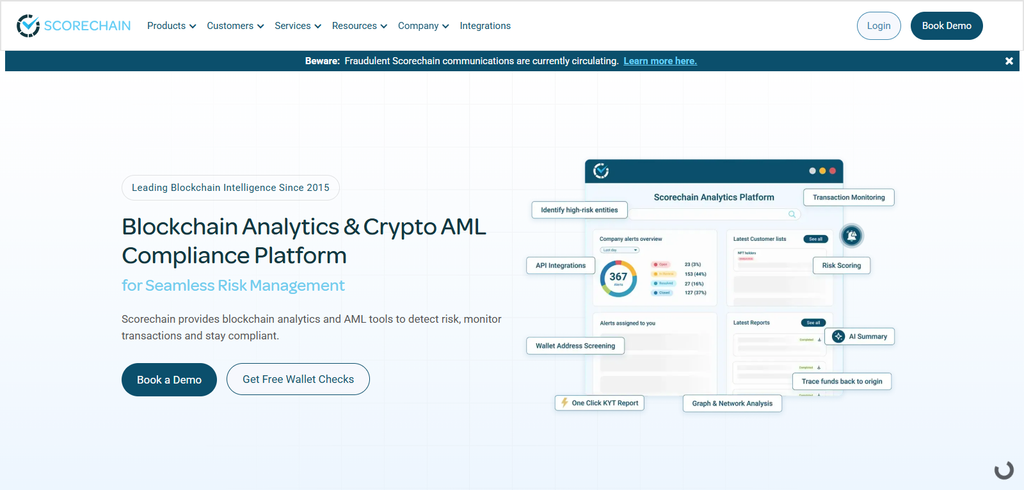
Scorechain boasts coverage for at least 23+ blockchains, supporting some of the largest and most popular blockchains like Bitcoin, Ethereum, Solana, Tron, Polygon, and BNB Smart Chain, etc. Scorechain’s solution uses risk scoring to assess direct and indirect exposures, including multi-hop exposure, and allows clients the ability to configure custom rules to assess the behavior of the opposing parties and the jurisdictions involved in the transaction.
Pricing is done on a quote-based system, so it is a good product for businesses looking for AML compliance and monitoring systems that grow with their business.
Scorechain Features, Pros & Cons
Features
- Tracking of transactions and analysis of AML risk in real time for crypto.
- Risk assessment for wallets and transactions.
- Analysis of multi-step transactions and the flow of funds.
- Custom compliance rules and automated notifications.
- Integration of APIs for crypto businesses and compliance.
Pros
- Thorough attention for crypto AML compliance.
- Meaningful risk scoring.
- Scalable monitoring of transactions.
- Well suited for exchanges and financial systems.
- Configurable monitoring workflows.
Cons
- Pricing is quote-based.
- Complex for smaller teams.
- Coverage of blockchain should be assessed for particular assets.
- Enterprise features may be excessive for small businesses.
- Needs compliance experience for effective configuration.
2. CipherTrace (Mastercard)
CipherTrace, now a Mastercard product, offers a solution for financial institutions and crypto businesses that need blockchain intelligence for AML and transaction investigations. CipherTrace focuses on the tracing of cryptocurrency flows, analysis of risky counter parties, and the supporting of compliance investigations.
Currently, their coverage and the assets within that coverage may vary depending on the CipherTrace product and the configuration of the service, making it important for a business to confirm if the networks supported check out prior to integrating with CipherTrace’s service.
Real-time screening can help support monitoring workflows, and transaction intelligence can help compliance teams investigate potentially illicit exposure and suspicious activity. CipherTrace’s pricing is more suited for enterprise-level contracts, making it appropriate for organizations that need advanced compliance systems.
CipherTrace (Mastercard) Features, Pros & Cons
Features
- Tracking and investigating blockchain transactions.
- Assessment for risk and exposure of crypto.
- AML and compliance toolkit.
- Address and entity attribution.
- Monitoring and investigations for crypto.
Pros
- Financial system coverage by Mastercard.
- Strong blockchain investigation.
- Useful for financial systems.
- Traces complex crypto fund flows.
- Useful for compliance teams.
Cons
- Positioning for enterprise.
- Pricing is not clear.
- Capabilities of product vary for solutions.
- Specialist compliance experience is needed.
- Could provide more compliance than a small enterprise needs.
3. Crystal Blockchain
Crystal Blockchain specializes in blockchain analytics, transaction monitoring, and compliance intelligence for cryptocurrency businesses, financial institutions, and investigative teams. Crystal’s offering enables organizations to do wallet-based analytics, track funds, and identify relationships and interconnections between addresses and entities.
For transaction monitoring, businesses get transaction risk data and can help support the AML functions by conducting preliminary analysis to determine if any activity is suspicious. Coverage of different blockchains varies by product offering, and said coverage is subject to change.
Risk analysis assesses transaction exposure and helps track and analyze funds movement across different wallets. Customized pricing makes Crystal more appropriate for professional compliance and investigation teams as opposed to small businesses or companies that consume API services.
Crystal Blockchain Features, Pros & Cons
Features
- Monitoring for transactions on blockchain and analytics.
- Visual cryptocurrency tracking.
- Wallet and entity analytics.
- Transaction risk assessment and investigation.
- Tools to investigate cryptocurrency transactions.
Pros
- Capable of strong visual analysis.
- Complex transaction tracking is possible.
- Built for corporate compliance use.
- Analyze wallet relationships.
- Useful for exchanges and financial services.
Cons
- More expensive for SMB customers.
- Investigation tools require some training.
- Blockchain coverage should be verified.
- Enterprise workflows can be complex.
- May be more sophisticated than needed.
4. Coinfirm
Coinfirm builds blockchain AML and compliance products and services designed specifically for cryptocurrency exchanges, finance technology businesses and payment services and businesses in the Web3 space. Coinfirm’s offering encompasses KYT-based transaction analysis, AML risk assessment, wallet screening, compliance monitoring, and risk management.
Businesses using Coinfirm’s solution can evaluate whether certain addresses or transactions pose a risk because of their relationship to high-risk activities. Coverage of different blockchains and tokens is subject to Coinfirm’s current assessment and coverage, so potential customers should ensure the relevant networks are included before working with Coinfirm.
Risk scoring allows compliance teams to triage suspicious transactions and assessments instead of continually evaluating current blockchain movements. Customized pricing versus a uniform public offering means Coinfirm can service businesses looking to implement comprehensive crypto compliance.
Coinfirm Features, Pros & Cons
Features
- Crypto AML and KYT transaction analysis.
- Wallet screening and risk assessment.
- Transaction risk scoring.
- Compliance monitoring and alerts.
- Blockchain intelligence for crypto businesses.
Pros
- Strong focus on crypto AML.
- Useful for exchanges and fintech companies.
- Combines wallet and transaction analysis.
- Supports automated compliance workflows.
- Suitable for Web3 businesses.
Cons
- Pricing can depend on selected services.
- Blockchain coverage should be checked before integration.
- Advanced compliance features may require configuration.
- Risk alerts can require manual review.
- Smaller businesses may not need the complete feature set.
5. Blockpass
Blockpass offers a broader take on compliance by combing identity verification and AML screening with services geared towards the needs of crypto. Companies operating in Web3 and crypto through exchanges or platforms would likely benefit from Blockpass’ offerings.
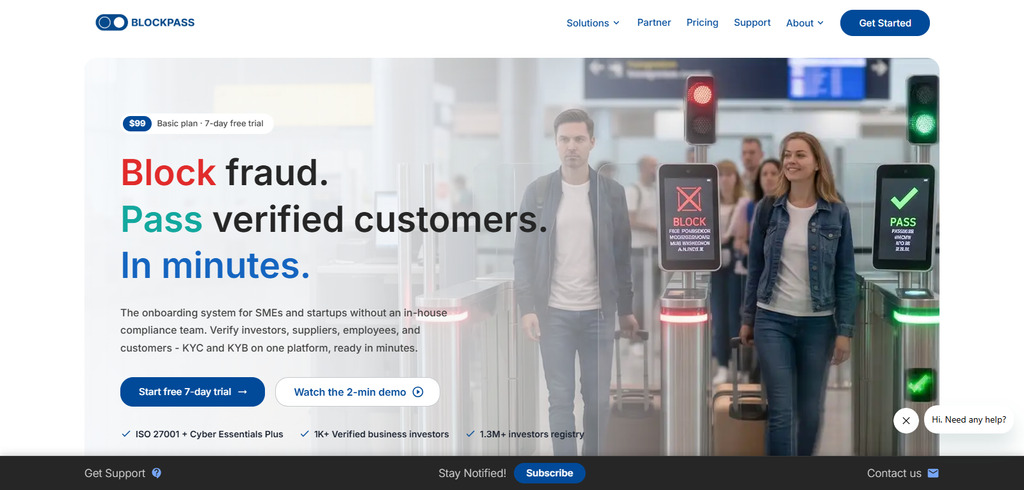
Blockpass’ Crypto AML solution ticks the box for services related to crypto screening, while On-Chain KYC and ongoing monitoring provide a solution for compliance beyond the initial user onboarding. Blockpass publishes pricing for Crypto AML in its plans.
Pricing is based on subscription tier, and Crypto AML is priced between $2.50 and $1 for each screening request. (blockpass.org) Support for crypto wallets and specific monitoring of transactions should be requested. Blockpass is a good choice for integrated KYC and crypto AML.
Blockpass Features, Pros & Cons
Features
- Crypto AML screening capabilities.
- Identity verification and KYC infrastructure.
- On-chain KYC and monitoring capabilities.
- Compliance screening workflows.
- Integration options for Web3 and crypto platforms.
Pros
- Combines identity and crypto compliance.
- Useful for Web3 businesses.
- Supports KYC and AML workflows together.
- Published pricing options are available for some services.
- Suitable for businesses seeking an integrated compliance stack.
Cons
- More identity-focused than pure transaction analytics platforms.
- Advanced blockchain investigation may be limited compared with specialist tools.
- Exact transaction-monitoring coverage should be verified.
- Some businesses may need additional blockchain analytics.
- Pricing varies by product and usage.
6. Didit
Didit merges transaction monitoring and AML and crypto wallet screening as part of a broader identity and fraud prevention infrastructure. Its real-time transaction monitoring engine is configured with over 150 pre-built rules spanning velocity, structuring, sanctions, high risk jurisdiction and crypto wallet risk.
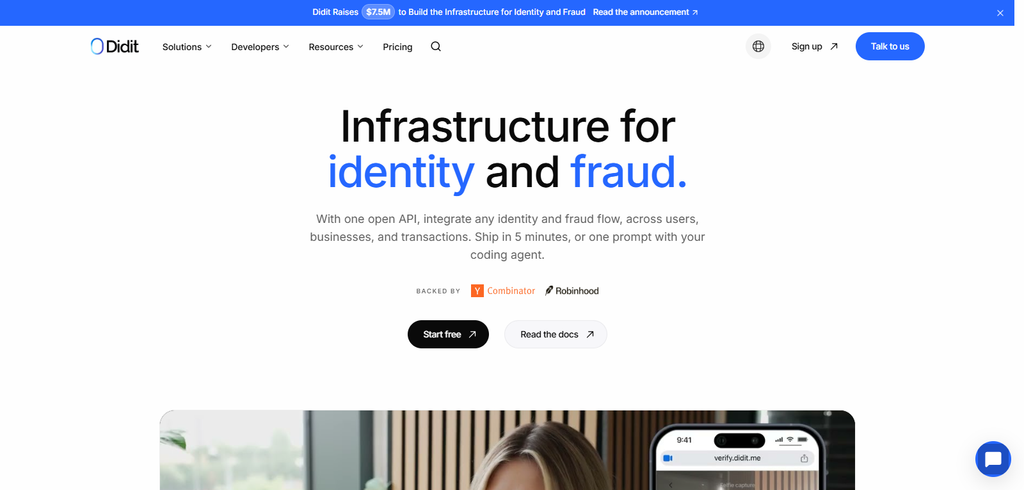
Clients receive risk scores, matched rules, alerts and case management workflows, and crypto transactions trigger wallet screening. Didit publishes pricing at $0.02 per monitored transaction, $0.20 for each AML screening request, and $0.15 for crypto wallet screening, and provides 500 free verifications and a pay-as-you-go pricing model with no minimums. (Didit) Its pricing is likely to appeal to businesses looking for a unified API and transaction monitoring.
Didit Features, Pros & Cons
Features
- Platform for real-time transaction monitoring.
- Crypto wallet screening.
- Automated AML risk scoring.
- Customizable transaction monitoring rules.
- Alerts and compliance case-management workflows.
Pros
- Options for usage-based pricing that are clear.
- Real-time monitoring.
- Integrates transaction, wallet and AML screening.
- Customizable with a large supply of pre-made rules.
- Ideal for early stage fintechs.
Cons
- Less developed compared to other blockchain analytics providers.
- Additional tools may be needed for some companies.
- Coverage for blockchain should be checked for specific cases.
- May cost more as volume of transactions increase.
- Pricing for more advanced functionality may be cost prohibitive.
7. Chainalysis KYT
Chainalysis KYT (Know Your Transaction) is a tool for digital asset service providers that need to monitor crypto transactions and detect suspicious activities. It integrates blockchain data with transaction monitoring, entity identification, and risk signals to help compliance teams trace and investigate suspicious transactions.
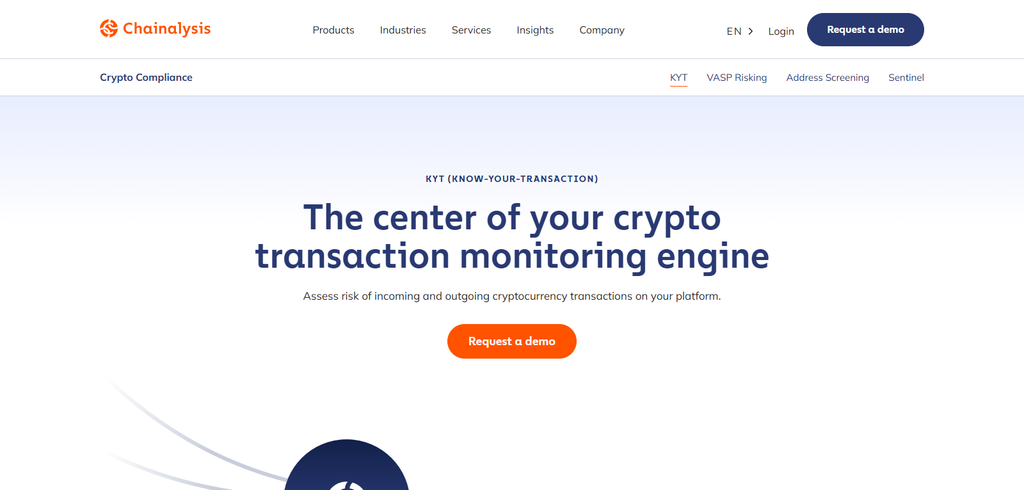
Chainalysis KYT offers customizable real-time monitoring and alerting to assist teams with ongoing KYT workflows, as well as risk signals to assist teams with prioritizing work. Chainalysis KYT has comprehensive chain and asset coverage that, by its nature, is subject to constant change, so businesses need to verify which networks are specifically relevant for their operations.
Chainalysis tends to sell its products in an enterprise manner with an emphasis on custom pricing, rather than providing a public pricing table. The most compelling use cases for Chainalysis KYT tend to be crypto exchanges, financial services organizations, and compliance teams with large volume transaction monitoring.
Chainalysis KYT Features, Pros & Cons
Features
- Transaction monitoring system (KYT).
- Real-time detection of transaction risk.
- Wallet identification and attribution.
- Alerts and determination of suspicious activities.
- Blockchain and transaction compliance investigation.
Pros
- Established transaction monitoring on blockchain.
- Extensive intelligence on blockchain and entities.
- Appropriate for financial institutions and exchanges.
- Capable of sophisticated transaction monitoring.
- Used for complex compliance investigations.
Cons
- May cost too much for some companies.
- Sophisticated functionality requires compliance teams.
- Pricing is not standardized.
- Integration and configuration requires technical teams.
8. TRM Labs
TRM Labs delivers blockchain intelligence and transaction monitoring to crypto businesses, financial services organizations, and compliance teams. TRM Labs’ monitoring tools enable clients to identify risk associated with cryptocurrency transactions and screen individual crypto wallets, assess associated risk, and trace funds across multiple blockchain networks.
TRM Labs reported risk screening coverage for approximately 100 blockchains, including 42 blockchains with enhanced tracing and investigative capabilities, with the potential for coverage to expand as blockchains are added .
TRM Labs’ risk signals can help compliance teams prioritize transactions based on the risk exposure associated with the transactions. For most clients, TRM Labs’ pricing is likely to be customized or enterprise-oriented based upon the use case and the selected product. TRM Labs is optimally positioned for organizations with broad multi-chain transaction monitoring and investigative capabilities.
TRM Labs Features, Pros & Cons
Features
- Crypto transaction monitoring and risk detection.
- Wallet screening and risk scoring.
- Cross-chain transaction intelligence.
- Sanctions and illicit-activity detection.
- Investigation and blockchain analytics tools.
Pros
- Broad multi-chain risk intelligence.
- Strong compliance and investigation capabilities.
- Useful for financial institutions and crypto businesses.
- Supports complex transaction analysis.
- Good fit for high-volume monitoring environments.
Cons
- Primarily designed for professional and enterprise users.
- Pricing is generally customized.
- Advanced functionality can have a learning curve.
- Blockchain coverage should be verified for required assets.
- May be more than smaller companies need.
9. Elliptic
Elliptic offers effective AML services for organizations needing to analyze risk associated with cryptocurrency transactions and wallets through its APIs. Asset, transaction, and blockchain-integrated risk processing flows can help corporations embed the APIs for blockchain intelligence into their compliance systems.
Elliptic developer support offers an API endpoint which, along with the associated documentation, provides a resource to inquire for supported assets, but the availability of assets within a given network should still be validated against the current API coverage offered by the business.
When analyzing risk, it is also possible to identify potentially suspicious exposure and help facilitate the investigation process. Pricing is usually more tailored to the business and the products selected rather than being published at a public price. Elliptic’s blockchain AML services most closely meet the needs of financial services and crypto-businesses that have regulatory obligations.
Elliptic Features, Pros & Cons
Features
- Analysis of crypto transactions and crypto wallets for risk
- Blockchain AML screening
- Transaction tracing and investigation
- Entity and address intelligence
- Blockchain risk data integration via API
Pros
- Strong reputation in blockchain compliance
- Appropriate for regulated financial institutions
- Appropriate for complex risk analysis
- Appropriate for crypto exchanges and fintechs
- API that supports automation of workflow
Cons
- Enterprise pricing may be relatively high
- Advanced Analytics may require specialized knowledge
- Coverage for supported assets needs to be confirmed
- Smaller companies may find the platform complex
- Full capabilities may need multiple services
10. Merkle Science
Merkle Science provides businesses, compliance teams, and law-enforcement designed services to perform cryptocurrency risk analysis and monitoring with their transactional and investigative services.
Their platform can help corporations identify and analyze blockchain activity, determine and analyze the behavior of wallets, and determine the flow of activity and possible exposure to criminal and illicit activity. Risk intelligence can be applied to prioritize transactions and addresses that should warrant additional scrutiny rather than addressing each transaction equally.
The blockchain networks and assets supported by Merkle Science are dependent on the current configuration of the product. Business validation of the required chains should be done prior to full integration.
Pricing is generally customized according to organizational requirements, transaction volume and selected capabilities. Merkle Science is optimally designed to meet the combined needs of ongoing transaction monitoring, evaluating risks associated with crypto activity, and advanced investigatory services.
Merkle Science Features, Pros & Cons
Features
- Cryptocurrency transaction monitoring
- Wallet risk intelligence
- Suspicious activity detection
- Blockchain transaction investigation
- Risk analysis for fraud, AML, and crypto-related threats
Pros
- High emphasis on cryptocurrency risk
- Powerful investigation capabilities
- Appropriate for enterprise use cases
- Detects suspicious activity on digital wallets.
- Ideal for compliance and security teams.
- Fits complex transaction risks presented in crypto business models.
Cons
- Complexities due to enterprise-oriented features.
- Pricing may warrant quote customization.
- Blockchain coverage may be a concern.
- Some advanced investigations require specialized analysts.
- More straight forward screening APIs, may be of greater interest for smaller businesses.
Conclusion
Decision-making for most businesses when selecting the best crypto transaction monitoring API in 2026 hinges on transaction volume, supported blockchain networks, compliance, risk detection needs, and available integrations. For businesses in need of Advanced Blockchain Risk Intelligence and AML monitoring solutions,
Scorechain, Chainalysis KYT, TRM Labs, Elliptic, Crystal Blockchain, Coinfirm and Merkle Science are some of the best available options. Businesses focused on broader transaction screening in conjunction with identity and compliance workflows may want to consider Blockpass and Didit.
Prior to selecting a service provider, a business needs to review several factors including pricing, risk scoring, KYT/AML features, real-time screening, supported chains, sanctions screening, wallet screening, alerts, API performance, integration tools, reporting features and scalability. Ultimately, the best solution is the one that serves the businesses transaction volume and compliance workflow best, even if that means it lacks some of the add on features.
FAQ
What is a crypto transaction monitoring API?
A crypto transaction monitoring API is a technology that allows businesses to automatically analyze blockchain transactions for suspicious activity, high-risk addresses, sanctions exposure, fraud indicators, and other AML-related risks.
Why do businesses need crypto transaction monitoring APIs?
Businesses use these APIs to automate transaction screening, identify suspicious activity, reduce manual compliance work, monitor wallet exposure, generate alerts, and support AML and KYT compliance processes.
What is KYT in crypto?
KYT (Know Your Transaction) is a compliance process that analyzes cryptocurrency transactions to identify potentially suspicious activity, risky counterparties, illicit fund exposure, sanctions-related risks, and unusual transaction patterns.
What features should a crypto transaction monitoring API have?
Important features include real-time screening, risk scoring, wallet screening, transaction tracing, sanctions screening, AML analytics, customizable rules, automated alerts, webhooks, API documentation, blockchain coverage, and investigation tools.
Can crypto monitoring APIs screen transactions in real time?
Yes. Many crypto monitoring platforms offer real-time or near-real-time transaction monitoring. However, the actual speed and available monitoring method can vary by provider, blockchain, API plan, and integration setup.