
In this article, we take a look at 2026’s best expense management business solutions. We cover solutions that facilitate financial workflow automation, automated expense tracking, and compliance across all sizes of business.
Solutions such as Airbase, Spendesk, and SAP Concur, or Coupa, are prime examples of the use of the most advanced solutions in the marketplace for efficient expense management and financial optimization.
Why Business Expense Management Platforms Matters
Financial Control – These products provide businesses with real-time information on spending, thereby eliminating overspending and increasing budget control.
Automation Efficiency – Capturing receipts, approvals, and reimbursements are all functions that these platforms can take care of, freeing employees from additional work.

Compliance Assurance – SAP Concur and BlueDot guarantee compliance with taxes, auditing, and policies within the organization.
Scalability – Both Airbase and Coupa can be used for a small to mid-sized company and be scaled to an enterprise level.
Integration Benefits – They can link with any other enterprise resource planning (ERP) system (QuickBooks, NetSuite), as well as accounting systems (SAP), to give complete financial system reporting and systems.
Benefits Of Business Expense Management Platforms
Cost Savings – Businesses save money by avoiding overspending. Tracking expenses in a managerial system decreases the chances for tracking mistakes, helping businesses attain better fiscal control.
Time Efficiency – Time spent on tracking expenses manually and approval processes is reduced by OCR receipt scan technology and automated approval functions, freeing staff from mundane tasks and allowing them to dedicate their time to tasks of greater value.
Compliance &Audit Readiness – SAP Concur and BlueDot systems deal with tax reporting and VAT recovery while also preparing audit reports.
Scalability – Airbase and Coupa are systems that can be used by small and medium enterprises and can easily adapt to the needs of corporate multinational businesses.
Integration Benefits – Integrating these systems with ERP and accounting systems (QuickBooks, NetSuite, SAP) makes it simple to report financially and eliminates reporting silos.
Fraud Prevention – AI systems, like those provided by Spendesk and Ramp, can detect possible fraudulent behavior.
Employee Satisfaction – Improving the experience of employees and decreasing frustration is achieved by faster reimbursements and more efficient processes.
Global Operations Support – Platforms such as Brex and Zoho Expense help manage teams that functions across borders and currencies.
Key Points
| Platform | Key Point |
|---|---|
| Airbase | Best for mid-market and enterprise businesses needing integrated spend management, approvals, corporate cards, reimbursements, and accounts payable workflows. |
| Spendesk | Best for businesses seeking centralized employee spending, smart corporate cards, approval controls, budgets, and real-time spend visibility. |
| Melio | Best for small businesses that want to manage vendor payments, bills, invoices, and business expenses from one platform. |
| BlueDot | Best for businesses focused on automated tax compliance, VAT/GST validation, and identifying tax-related issues within expense and invoice data. |
| Ramp | Best for companies wanting AI-powered expense management, corporate cards, automated reimbursements, procurement, and real-time spend controls. |
| Brex | Best for startups and growing companies needing corporate cards, expense management, travel, budgeting, and scalable spend controls. |
| Expensify | Best for businesses prioritizing simple receipt scanning, expense reporting, reimbursements, and automated expense tracking. |
| Zoho Expense | Best for small and mid-sized businesses looking for affordable expense tracking, receipt management, approvals, travel expenses, and accounting integrations. |
| SAP Concur | Best for large enterprises managing complex travel, expense reporting, compliance, approvals, and global finance processes. |
| Coupa | Best for enterprises seeking comprehensive spend management across expenses, procurement, invoicing, payments, and supplier management. |
1. Airbase
Founded in 2017, Airbase was one of the first providers of unified spend management. In 2024, Paylocity bought Airbase and has since incorporated expense management, automation of accounts payable, corporate transaction cards, and guided purchasing into a single AI-friendly platform.
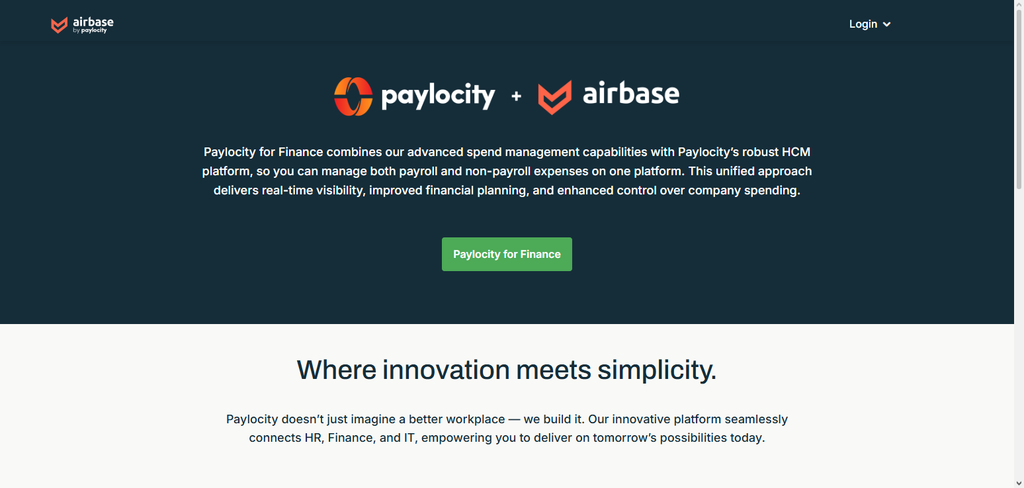
Airbase serves mid-market companies with 100 to 5,000 employees and processes billions of dollars in transactions each year. Pricing is quote-based and is offered alongside the Paylocity per-employee-per-month model starting at $15 to $50, depending on the modules.
Touchless Accounts Payable automation, AI for fraud detection, multi-entity support, and real time spending analysis are some of the services offered. They excel at consolidation, with the ability to minimize accounting by more than half. Airbase is best fit for the automation-heavy spend management space, where the competition focuses on card first, such as Ramp or Brex.
Airbase Features
- Integrated spend management (procurement, AP, expenses)
- Automation and fraud detection via AI
- Support for multi-entity and cross-border compliance
- Real time analytics and reporting
- Easy integrations with ERPs (NetSuite, QuickBooks, Xero)
| Pros | Cons |
|---|---|
| Unified spend management (AP, cards, procurement) | Pricing is quote-based, less transparent |
| AI-powered fraud detection | Best suited for mid-market, not freelancers |
| Multi-entity global compliance support | Higher learning curve for small teams |
| Real-time spend analytics | Requires ERP integration for full value |
| Strong automation reduces manual accounting | Limited free tier compared to Ramp |
| Consolidates fragmented workflows | May overlap with existing AP tools |
| Deep ERP integrations (NetSuite, QuickBooks) | Enterprise pricing can be expensive |
| Strong Paylocity ecosystem | Focused more on US market |
2. Spendesk
Spendesk was created in 2016 and is a leading spend management solution in Europe. It combines corporate cards, expense reports, invoicing, budgeting, and reporting in a single application. 2024 is forecasted to process €20B, and it has raised more than $304M. They have 5000+ customers and include SoundCloud and Doctolib.
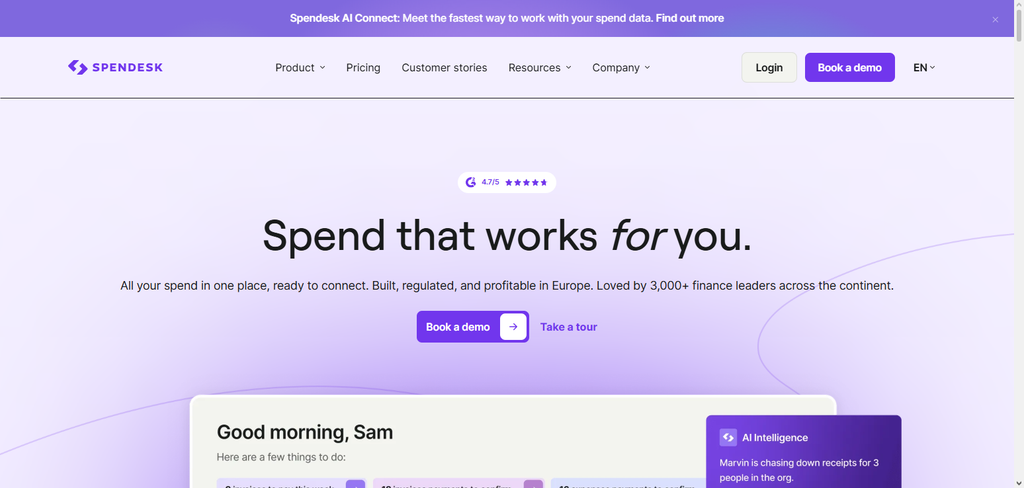
Pricing is tier-based and includes plans such as Starter (which is roughly $7,600 annually), Essentials, and Scale, with a quote estimate of $24,000 based on company size. Services includes unlimited virtual/physical cards, OCR receipt capture, invoice automation, and AI-based fraud detection.
Spendesk excels in European compliance and unlimited user pricing, making it prime for SMBs and mid-market companies scaling across multiple countries. There is good integration with NetSuite, Sage, Dynamics, and Xero and therefore a good amount of ERP connectivity.
Spendesk Features
- Unlimited virtual and physical cards
- Automated receipt capture and invoice processing with OCR
- Cooperate approved spending and budgets
- VAT and compliance in different countries in Europe
- Integrations with Sage, NetSuite, Dynamics, and Xero
| Pros | Cons |
|---|---|
| Unlimited virtual & physical cards | Annual pricing can be high for SMBs |
| OCR receipt capture & invoice automation | Limited presence outside Europe |
| Strong European compliance & VAT support | Requires ERP integrations for scale |
| Team budgets with approval workflows | Not ideal for freelancers |
| ERP integrations (Sage, NetSuite, Dynamics) | Quote-based pricing lacks transparency |
| Unlimited-user pricing model | Focused mainly on SMEs |
| Strong fraud detection | Limited advanced analytics vs Coupa |
| Easy-to-use interface | Less global reach compared to SAP Concur |
3. Melio
Founded in New York in 2018 by Matan Bar, Ilan Atias, and Ziv Paz, Melio has developed a focus on automating accounts payable and receivable processes aimed at SMBs. Xero purchased the company in 2025 for $2.5B. Melio now processes over $100B annually. Transparent pricing has four plans: free (5 ACH per month), Core ($25 per month),
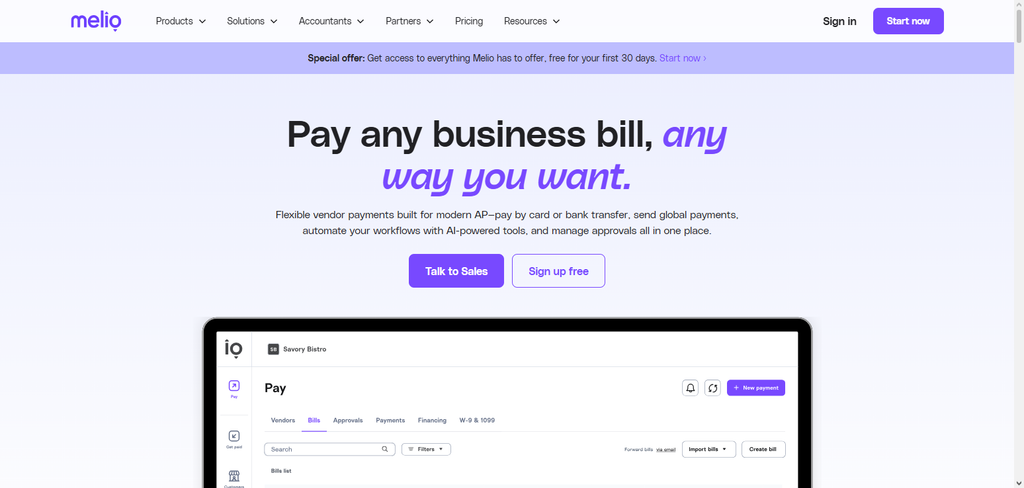
Boost ($55 per month), Unlimited ($80 per month), plus transaction fees (ACH $0.50, card payments 2.9%, checks $1.50). The services include bill pay, invoice management, AI-powered capture, approval workflows, and international payments to 80+ countries.
Melio has a unique feature which allows a business to pay its vendors by credit card even if the vendors do not accept credit cards payments making business cash flow flexibility better and more rewarding. Melio is best for SMBs looking for low-cost, QuickBooks and Xero integrations for AP/AR process automation.
Melio Features
- Vendor bill payment and management
- Payment to vendors, even without the option to accept cards, via virtual cards
- Pricing that is clear and transparent with ACH and card fees
- Cash flow management tools
- Integrations with QuickBooks and Xero
| Pros | Cons |
|---|---|
| Transparent pricing tiers | Limited enterprise features |
| Bill pay & vendor management | Transaction fees for cards/checks |
| Pay vendors via card even if they don’t accept | Focused mainly on US SMBs |
| Cash flow optimization tools | Limited global compliance |
| QuickBooks & Xero integrations | No advanced procurement features |
| Free ACH transactions | Limited automation compared to Airbase |
| Easy-to-use for SMBs | Not ideal for large enterprises |
| Strong AP/AR automation | Limited fraud detection |
4. BlueDot
BlueDot, founded in 2013 in Tel Aviv, is an AI-driven compliance solution for tax automation. BlueDot closed $82 million in funding and offers partnerships with SAP Concur and KPMG. The price is custom-tailored for enterprise clients and is quote-based.

Services consist of VAT recovery, compliance of taxable employee benefits, as well as fraud prevention with the use of AI. BlueDot’s products—VATBox, TEB, and Inspect—automate the detection of recoverable VAT, fringe benefits, and expense irregularities across all global operations.
BlueDot serves enterprise clients best as it provides audit-ready compliance and tax optimization. BlueDot stands out from its competitors for expanding beyond tax assurance into expense management to provide global compliance.
BlueDot Features
- AI for VAT and tax compliance
- Automation of compliance for fringe benefits
- Analytics for fraud detection
- Global reporting for audits
- Partnering with SAP Concur and KPMG
| Pros | Cons |
|---|---|
| AI-driven tax compliance | Pricing is enterprise-only |
| VAT recovery automation | Not suitable for SMBs |
| Fringe benefits compliance | Requires integration with SAP Concur |
| Fraud detection analytics | Limited standalone use |
| Global audit-ready reporting | Quote-based pricing |
| Strong enterprise partnerships | Focused mainly on compliance, not spend |
| Fortune 1000 client base | Complex setup process |
| Strong compliance assurance | Limited card/payment features |
5. Ramp
Ramp is a corporate card and spend management platform founded in 2019 by Eric Glyman and Karim Atiyeh in New York. Ramp offers products for card provisioning, bill payments, reimbursements, procure to pay, and treasury management. Ramp’s pricing is free with their Plus plan charging $15 per user per month and a further platform fee.
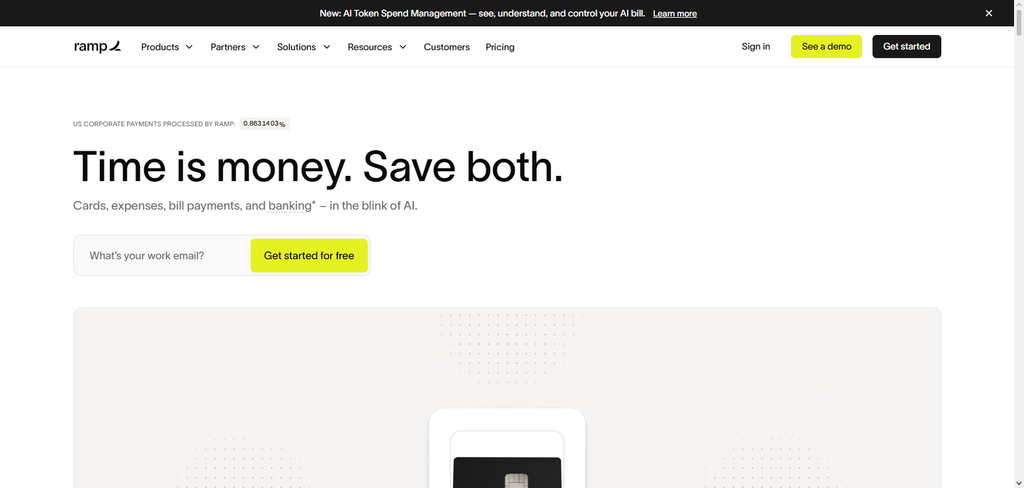
Ramp offers treasury services that provide competitive returns and procurement services that offer procurement agents. Ramp’s model incentivizes saving over spending, offering 1.5% cashback and controls spending.
Ramp is best for SMBs and startups in the United States, as it is the most polished free-tier automation platform to offer enterprise services. Ramp offers its services to 70,000+ clients including Shopify and Visa, processing $57B in 2024. Ramp’s services include AI-driven expense categorization and OCR invoice capture.
Ramp Features
- Automated procurement and corporate cash back card
- Capture and automation of invoices via OCR
- Procurement agent and integrated treasury services
- Real time spend management suite for startups
| Pros | Cons |
|---|---|
| Free tier with unlimited cards | Limited global reach |
| AI-driven expense categorization | Focused mainly on US startups |
| OCR invoice capture | Enterprise features require paid tier |
| Procurement agent & treasury services | Limited tax compliance tools |
| Cashback rewards | Not ideal for large enterprises |
| Real-time spend insights | Requires integrations for full automation |
| Easy onboarding for startups | Limited customization vs Coupa |
| Strong automation | No deep procurement suite |
6. Brex
Brex started in 2017 innovation-focused on building corporate credit cards for startups in San Francisco by founders Dubugras and Franceschi. Acquisition by Capital One in 2026 valued the company at $5.15B. It has since added expense management and bill payment with an integration for business accounts and employee travel booking.
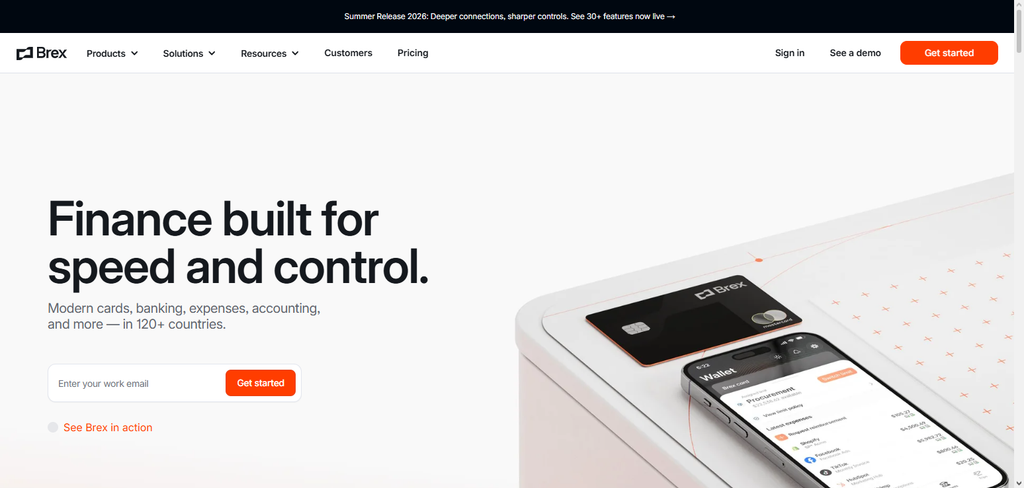
The company pricing model has a free plan for Essentials, Premium for $12 per user per month, and custom pricing for Enterprise. Brex has over 30,000 customers that include DoorDash and Robinhood with $700M annualized revenue in 2025. Some of the services include AI to automate receipt classification and GL coding, multi-entity, and in-application travel booking.
Brex shines for global multi-currency transaction and IRS compliant receipts. Best suited for Venture-capital-backed, technology focused startups, Brex offers an integrated experience with trip planning and payment automation.
Brex Features
- Corporate cards and multi currency travel spending
- Automated receipt capture and GL accounting
- Integrated travel booking browser
- IRS compliant expense management
| Pros | Cons |
|---|---|
| Multi-currency global support | Premium pricing for enterprise |
| Corporate cards with rewards | Focused mainly on tech/startups |
| Automated GL coding | Limited AP automation |
| Travel booking integration | Requires scale for full value |
| IRS-compliant workflows | Limited SMB affordability |
| Strong integrations | Quote-based enterprise pricing |
| Venture-backed ecosystem | Less procurement depth |
| Premium card benefits | Limited fraud detection vs Airbase |
7. Expensify
Founded in 2008 and based in San Francisco, Expensify is among the first expense management software. Expensify, which went public in 2021 (NASDAQ: EXFY), SmartScan OCR, receipt capture, reporting, reimbursement, and corporate cards, draws upon David Barrett’s early innovations.
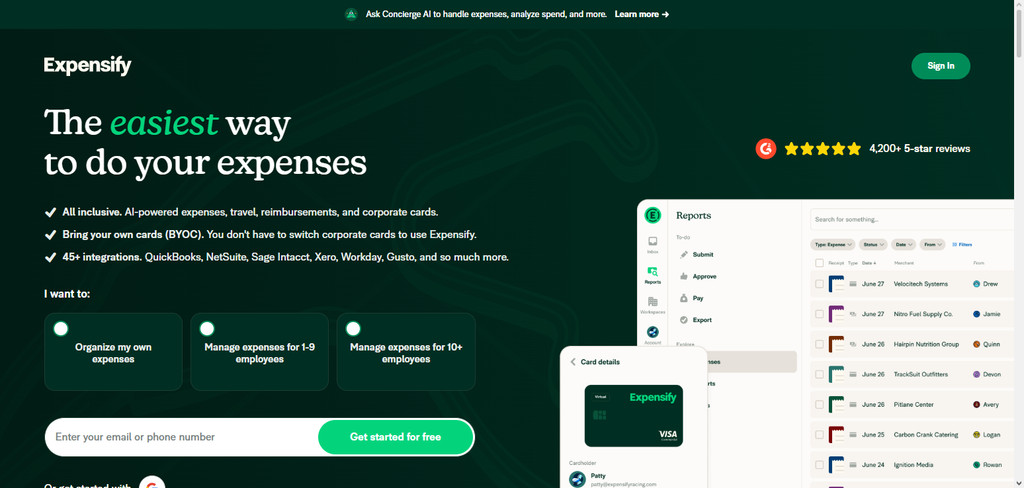
Expensify’s pricing is as follows: Expensify Card for $5/user/month, or $10 without; Control for $9/user/month, or $18 without. Expensify offers Bill Pay at $3/user/month and Payroll at $4–5/user/month. Expensify serves small and medium businesses (SMB) and freelancers with QuickBooks, Xero, NetSuite, and Sage intuit partner integrations.
Receipt scanning, workflow controls, reimbursement, and Expensify Card cashback at 1% of the purchase price are its services. It is highly recommended for small to medium businesses with accounting software where the number of active users is important for pricing.
Expensify Features
- OCR receipt capture and smart scan via Expensify
- Expense submissions and corporate cards
- Corporate cashback
- Pay, bill, and time management integrations
- Accounting integrations (QuickBooks, NetSuite, Sage)
| Pros | Cons |
|---|---|
| Affordable pricing ($5–$9/user) | Limited enterprise features |
| SmartScan OCR receipt capture | Add-ons increase cost |
| Expense reporting & reimbursements | Focused mainly on SMBs |
| Corporate card with cashback | Limited procurement tools |
| Payroll & bill pay add-ons | Less automation vs Airbase |
| Accounting integrations | Limited global compliance |
| Easy-to-use mobile app | Not ideal for large enterprises |
| Active-user pricing model | Limited fraud detection |
8. Zoho Expense
Zoho Corporation, founded 1996 in Chennai, India, has developed Zoho Expense, a low-cost travel and expense management tool. Pricing – Free (max 3 users), Standard $4/user/month, Premium $7/user/month. Features are OCR receipt scanning, GPS mileage tracking, corporate card reconciliation, automated per diem and multi level approvals.
Robustly connected with Zoho Books and Zoho Analytics, as well as QuickBooks, NetSuite, and Sage. Zoho Expense offers multi-currency support and Tax compliance making it a perfect solution for small to medium sized businesses internationally. It’s biggest competitor is Expensify. However Zoho Expense, undercuts Expensify and SAP Concur, offering solid automation and integration with its ecosystem for small to mid-sized businesses.
Zoho Expense Features
- Affordable pricing tiers ($4–$7/user)
- OCR receipt autoscan & mileage tracking
- Corporate card reconciliation
- Multi-level approval workflows
- Tight integration with Zoho ecosystem & QuickBooks
| Pros | Cons |
|---|---|
| Affordable pricing ($4–$7/user) | Limited enterprise-grade features |
| OCR receipt autoscan | Focused mainly on SMBs |
| Mileage tracking via GPS | Limited procurement depth |
| Corporate card reconciliation | Requires Zoho ecosystem for full value |
| Multi-level approval workflows | Limited fraud detection |
| Tight integration with Zoho Books | Less global compliance vs SAP Concur |
| Multi-currency support | Not ideal for large enterprises |
| Easy-to-use interface | Limited advanced analytics |
9. SAP Concur
SAP Concur was started in 1993 in Bellevue, Washington and is the leader in travel and expense management for enterprises worldwide. Acquired by SAP for $8.3B in 2014, SAP Concur has more than 92M users globally. Like most enterprise SaaS solutions, SAP Concur’s pricing is quote-based, but nonetheless, is more expensive than SMB solutions.
SAP Concur offers OCR receipt capture as a service, along with policy management, travel booking, and invoice automation. They also offer a multi-currency compliance service. SAP Concur integrates deeply with SAP ERP, Oracle, NetSuite, and Microsoft Dynamics. Best suited for multinational enterprises, SAP Concur provides duty of care and fraud services with a robust partner ecosystem. As the gold standard for global compliance and scalability in expense management, SAP Concur is preferred by enterprises.
SAP Concur Features
- Enterprise-grade travel + expense integration
- Global compliance & duty-of-care visibility
- OCR receipt capture & policy enforcement
- Invoice automation & fraud detection
- Deep ERP integrations (SAP, Oracle, Dynamics)
| Pros | Cons |
|---|---|
| Enterprise-grade travel + expense integration | Pricing is high, quote-based |
| Global compliance & duty-of-care | Complex setup process |
| OCR receipt capture | Not suitable for SMBs |
| Invoice automation | Requires ERP integration |
| Fraud detection | Higher learning curve |
| Deep ERP integrations | Limited affordability |
| Extensive partner ecosystem | Focused mainly on enterprises |
| Scalable for global firms | Less startup-friendly |
10. Coupa
Coupa was founded in California in 2006 by Dave Stephens and Noah Eisner, and is one of the most well known companies in the business spend management (BSM) market. Thoma Bravo purchased Coupa for $8 billion in 2023. Coupa supports over 3,200 customers worldwide, of which include a large portion of the Fortune 500.
Its product consolidates solutions for expense management, procure to pay, and supply chain collaboration in a unified AI driven model. Coupa’s pricing for the product is quote to quote, but typically starts around $499 per year for lower implementation instances, while custom enterprise level contracts are signed for larger implementations.
The platform offers AI for spending analysis, contract lifecycle management, supplier sourcing, invoice automation, and compliance. Coupa’s product also supports seamless integration with SAP, Oracle, and NetSuite. Coupa’s product is known for providing community intelligence, and tracks spending patterns across various industries to provide cost savings and compliance monitoring services.
Coupa Features
- AI-powered spend analysis & benchmarking
- Procurement & supplier collaboration tools
- Contract lifecycle management
- Invoice automation & compliance monitoring
- ERP integrations (SAP, Oracle, NetSuite)
| Pros | Cons |
|---|---|
| AI-powered spend analysis | Pricing is enterprise-only |
| Procurement & supplier collaboration | Not suitable for SMBs |
| Contract lifecycle management | Complex implementation |
| Invoice automation | Quote-based pricing |
| Compliance monitoring | Higher cost of ownership |
| ERP integrations | Requires large-scale deployment |
| Community intelligence benchmarking | Focused mainly on enterprises |
| Strong global presence | Limited free tier |
Conclusion
Automation, innovation and scalability will shape the business expense management systems market in 2026. Unified spend workflow solutions like Airbase and Spendesk target the mid-market and European regions, respectively. Meanwhile, Melio and Zoho Expense address the SME market with cost effective options.
Enterprise SaaS offerings like SAP Concur and Coupa dominate the marketplace with global compliance and integrated procure to pay offerings. Meanwhile, Ramp and Brex continue to use their card-centric automation offerings to disrupt the market, especially with their startup focused business models.
In addition, Expensify and BlueDot provide automation and compliance for freelancers, startup and small teams, respectively. The combination of companies provide efficient and modern financial management solutions.
FAQ
What is an expense management platform?
An expense management platform is software that automates tracking, approving, and reimbursing business expenses. It integrates with accounting systems, corporate cards, and compliance tools to reduce manual work and improve financial visibility.
Which platform is best for startups?
Ramp and Brex are ideal for startups due to free tiers, corporate cards, and AI-driven automation. They help fast-scaling teams manage spend without heavy upfront costs.
Which platform suits SMBs?
Expensify, Zoho Expense, and Melio are cost-effective, easy to use, and integrate with QuickBooks or Xero, making them perfect for small businesses.
Which platform is best for enterprises?
SAP Concur and Coupa dominate the enterprise segment with global compliance, procurement integration, and audit-ready workflows.
Which platform focuses on tax compliance?
BlueDot specializes in VAT recovery, taxable benefits compliance, and fraud detection, making it essential for multinational firms.