


When considering the future of decentralized automation, we must recognize Morpheus AI’s competitors. Unlike Morpheus AI, these frameworks provide a variety of features such as multi-chain support, compliance, and large-scale agent implementation. Some examples of these frameworks are ElizaOS and uAgents. These frameworks provide features such as improved governance and trading across Web3. Development teams and organizations can utilize these frameworks to implement improved decentralized and distributed applications.
What Makes a Good Morpheus AI Alternative?
Multi-chain support — Competitive products must, at a minimum, connect with Ethereum, Solana, Base, and EVM networks. This would let users work with different blockchains without breaking compatibility.
Agent orchestration — The best products enable multiple agents to collaborate. This makes more complex tasks, like creating a system to automate financial transactions, to be voted on and carry out governance actions, to buy and sell financial instruments, to transact and interact with the blockchain, to be done in an efficient and effective manner.
Security and compliance — In order to function in regulatory and licensed businesses, an automation framework must be reviewed by a third-party group, like a certification body under the International Organization for Standardization (ISO), for compliance and/or have contractual smart contracts.

Development — Providing detailed documentation and samples, like code or software development kits (SDKs), allows developers to rapidly create their own agents.
Functionality — Agents should be able to interact with blockchain networks to transact, vote, and carry out governance functions; interact with DeFi; and collect and interact with NFTs.
Other — The best products are able to address scalability and align incentives and ownership with decentralized ecosystems. Agents should be able to seamlessly interact with different blockchains to perform DeFi transactions, governance functions, and trading.
| Alternative | Key Point / Strength |
|---|---|
| ElizaOS | Most widely adopted open-source Web3 AI agent framework; supports ETH, Solana, EVM; 200+ plugins; best for social agents, trading bots, DAO governance. |
| Swarms Framework | Built by Coinbase; orchestration of multi-agent systems; wallet automation & stablecoin payments; highest developer experience score. |
| uAgents (Fetch.ai) | Enterprise-ready multi-agent framework; ISO 27001 + HIPAA certified; used in autonomous hedge funds; strong in finance automation. |
| Virtuals Protocol | AI agent launchpad + ownership layer on Base; integrates GAME framework; tokenized ownership for agent deployment. |
| GAME (Virtuals) | Modular perceive-plan-act framework; supports multimodal autonomous agents; ~20% market share in crypto AI frameworks. |
| Rig | Rust-based high-performance framework; strong for LLM-powered agents; ~15% market share; optimized for speed and reliability. |
| ZerePy | Python-native agent framework; focused on social media automation and creative outputs; smaller but growing adoption. |
| Griffain | Conversational AI agent for Solana; executes swaps, bridges, staking, and DeFi actions via natural language. |
| AIXBT | AI-powered crypto market intelligence agent; delivers real-time alpha signals via API and social sentiment analysis. |
| Cortex Agent (Synapse Protocol) | Cross-chain DeFi execution; supports perpetual futures trading, swaps, and bridging; integrates gas abstraction and portfolio tracking. |
1. ElizaOS
ElizaOS is an open-source Web3 AI agent framework. It is flexible and easy to use. It is compatible with Ethereum and Solana as well as other EVM compatible chains. It provides over 200 plugins. With ElizaOS, users can create trading bots and DAOs, and participate in social apps. It is a great option for creating decentralized, autonomous, and interactive apps.

ElizaOS contains hundreds of plugins. Security and governance plugins allow users to integrate their Web3 wallets to perform transactions. ElizaOS also provides plugins for automating DeFi transactions. Therefore, ElizaOS can be used in a variety of Web3 ecosystems.
ElizaOS Best Use Cases
- Automating DAO governance
- Building and deploying trading/investment bots for DeFi
- Automating social interactions and engagement with community members on social platforms
- Automating interactions and engagement with buyers/sellers on NFT marketplaces
- Automating interactions with and between users of multi-chain/assets wallets
Limitations
- Relatively less flexible and highly dependent on plugins
- Lacks in-built security and is subject to third-party security audits
- No enterprise level certifications
- Resource intensive for large/complex deployments
2. Swarms Framework
Swarms Framework, which is sponsored by Coinbase, is a multi-agent framework to reliably perform a variety of tasks within Web3. Swarms Framework helps automate payments using stablecoins. It allows agents to work together to complete a common goal. Swarms Framework is particularly strong in architecting agent communication to complete Web3 tasks.
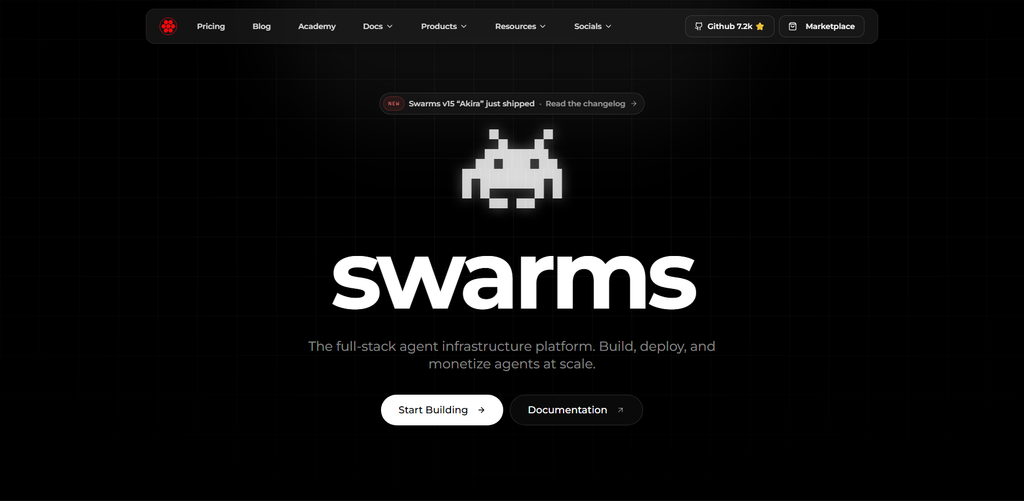
Swarms Framework, like ElizaOS, allows users to complete tasks using Web3 infrastructure, and helps automate payments. Swarms Framework also gives developers control over which agents can perform a given task. Because of this feature, Swarms Framework is ideal for banking and finance related Web3 applications.
The product features automated DeFi solutions, crypto-wallet integration, and cross-chain agent automation. The product focuses on security. Rigorous regulatory compliance increases the trust level of the product in regulated markets.
Swarms Framework Best Use Cases
- Financial workflow automation (payments, transfers, settlements, etc.)
- Automating interactions and engagement with/between users of multi-party/counterparty systems
- Automating interactions, engagement and management of DeFi treasuries
- Decentralized and collaborative agents
Limitations
- Suited for large/complex projects and requires in-depth software development knowledge and expertise
- Creative/Social agents are less developed
- Less flexible chain support
3. uAgents (Fetch.ai)
uAgents is an ISO 27001 and HIPAA certified multi-agent platform, used in various financial automations and in the development of hedge funds. It is used in other financial and regulated services. It has a communicate, coordinate and execute architecture which enables decentralized agents to execute financial transactions.

It provides strong and compliant SDKs to the development community, and ensures strong scalability. It provides automation, and interoperability across several blockchain networks. Compliance certificates attest to the fact that the service can be trusted in a regulated and controlled environment.
uAgents (Fetch.ai) Best Use Cases
- Autonomous management of Hedge funds
- Automating regulated/compliant activities in Finance
- Health related data and interaction automation (e.g. HIPAA)
- Cross-chain DeFi interactions and automation
- Other enterprise level use cases and deployments of AI
Limitations
- Over-compliance and high regulatory burden for basic/simple tasks
- Lacks creativity/interacts with NFTs in a limited manner
- More suited/aligned for large/complex enterprise projects and use cases
4. Virtuals Protocol
Virtuals Protocol helps in the creation and ownership of Artificial Intelligence agents. Similar to uAgents, it helps in the deployment of modular agents. It provides a means to govern and monetize agent services.

It provides various modules to assist in the development of Web3 applications. It helps in agent automation and governance. It integrates NFTs and provides a means to execute transactions in the Decentralized Finance Ecosystem.
Virtuals Protocol Best Use Cases
- Automating governance and agency
- Launchpad for next-gen multimodal agents
- Agency tokenization and ownership
- Community controlled agency
Limitations
- Ecosystem and EVM compatibility is relatively less
- Ownership model for agents may complicate scaling
- Enterprise level resources and compliance are still nascent
5. GAME Framework
GAME is a modular framework to develop web3 applications and integrate Artificial Intelligence in financial and decentralized services. It supports thousands of various financial and Decentralized applications.

It integrates Artificial Intelligence to provide governance and automation in agent services. It can validate and enforce governance rules, execute financial transactions, and integrate several blockchain networks.
Best Use Cases
- agent orchestration
- actions which need to perceive, plan and act
- incorporating NFTs with AI Agents
- automating governance within a DAO
- Designing modular DeFi solutions
Cons
- difficult to set up modular contracts
- lack of general UCs due to limited support across different blockchains except Virtuals
- smaller dev community when compared to ElizaOS
- how secure it is relies on the modular contracts
6. RIG
RIG is a Rust-based framework for building LLM-powered chatbots. It is one of the better frameworks for crypto AIs and has a market share of around 15%. Rust offers numerous advantages for web3 development including better concurrency and inter-process communication as compared to other languages.

A couple of the Rust dependencies in RIG offer features such as automation of Defi transactions, wallets, and governance. Therefore, RIG offers some features for Defi and governance out of the box.
Rig Best Use Cases
- Agents/Bots for DeFi Trade execution
- Agents for governance, Rust based reliability
- Financial Agent orchestration
Limitations
- having developers on your team that have Rust experience
- lack of agent implementation for social/creative activities
- not well suited for high load scenarios
- not well suited for DeFi [[cyber]] crimes
7. c
ZerePy is a Python-based framework for creating chatbots and other automation tasks. It is lightweight and simple. Because of these characteristics, it has gained traction among less complex projects.

Being a Python framework, it has all the advantages of that language including large standard library and a large ecosystem of packages. Due to this, it offers features for automating governance and NFT tasks. Because of the nature of the projects that use this framework, security is of less of a concern.
ZerePy Best Use Cases
- creative/social automated agents
- lightweight governance bots
- rapid application development for Web3
- basic NFT interactions
Limitations
- lack of general security model
- less popular when compared to ElizaOS
- not suited for high load applications
- lacking DeFi integration
8. Griffain
Griffain is a Solana-based chatbot that allows users to perform commands related to DeFi and other tasks using natural language. Using Griffain, users can perform tasks such as swaps, staking, bridging, and other similar tasks.

Due to its conversational nature, Griffain provides an easy-to-use and powerful SDK for building similar projects. Because of its nature, it provides security for transactions on Solana.
Griffain Best Use Cases:
- -agents/bots for Solana-centric DeFi
- -automated staking
- -conversational FinTech
- – agent-based orchestration for Solana
Limitations
- – Solana-centric solution
- – lacking enterprise-ready features
- -smaller developer community
- -security and trust rely on solana
9. AIXBT
AIXBT uses AI to create a competitive edge in the cryptocurrency market. Through social and financial data and predictive models, AIXBT generates real-time alpha. It’s design focuses on processing and analyzing large amounts of data in real-time.

Users can integrate AIXBT with a range of trading platforms to automate orders based on AI generated alphas. Real-time alphas and other Web3 services come at a cost which AIXBT controls through an integrated, secured API.
Best Use Cases
- -gaining edge/alpha in the DeFi space
- -sentiment/social trade execution/cancellation orders
- -trade signal generation
- -DeFi analytics
Limitations
- -Turing Complete?
- Strong suit is in trading intelligence
- Functionality in governance/NFTs is low
- Security is API dependent
- Ledger is primarily financial/trading
10. Cortex Agent (Synapse Protocol)
Cortex Agent is a component of Synapse Protocol focused on the intersection of cross-chain DeFi and offers services such as gas-enabled swap and bridge protocols and futures trading.
Cortex Agent offers a range of DeFi services and toolkits for developers to build Web3 applications. Services include swaps, futures trading, and bridging. Further security is offered through audit contracts.
Best Use Cases Cortex Agent (Synapse Protocol)
- Cross-chain swaps and bridge
- Automated trading of perpetual futures
- Track your miner claims and funds across multiple chains
- Gas optimizations for DeFi
- Participate in governance across multiple chains
Limitations
- Requal DeFi focus for other use cases
- Inadequate support for non-DeFi use cases
- Security relies on trust
- Steep learning curve
Morpheus AI vs Alternatives: Key Differences
| Framework | Introduction | Agent Capabilities | Web3-Specific Functionality | Supported Chains | Developer Experience | Security & Control |
|---|---|---|---|---|---|---|
| Morpheus AI | Original Web3 AI agent framework, focused on decentralized automation. | Basic agent orchestration, trading bots, governance. | Wallet automation, DAO integration, DeFi execution. | ETH, EVM chains. | Moderate documentation, plugin-based. | Relies on external audits, limited compliance. |
| ElizaOS | Widely adopted open-source framework with 200+ plugins. | Social agents, trading bots, DAO governance. | Wallets, governance automation, NFT marketplaces. | ETH, Solana, EVM. | Strong docs, large community. | Audited contracts, plugin-level controls. |
| Swarms Framework | Coinbase-backed orchestration layer. | Multi-agent collaboration, treasury automation. | Stablecoin payments, wallet automation. | ETH, EVM. | High developer experience, enterprise SDKs. | Permissioned orchestration, transaction-level security. |
| uAgents (Fetch.ai) | Enterprise-ready, ISO + HIPAA certified. | Autonomous hedge funds, regulated workflows. | Cross-chain DeFi, compliance-driven automation. | ETH, Cosmos, multi-chain. | Enterprise SDKs, compliance modules. | Strong compliance, certified security. |
| Virtuals Protocol | Agent launchpad with ownership layer. | Tokenized agent deployment, monetization. | Governance via ownership tokens. | Base chain. | Streamlined deployment tools. | Ownership validation, audits. |
| GAME Framework | Modular perceive-plan-act system. | Multimodal agents, complex workflows. | NFT integration, governance automation. | Base chain. | Modular APIs, flexible setup. | Validation layers, chain compatibility. |
| Rig | Rust-based high-performance framework. | LLM-powered agents, low-latency bots. | DeFi automation, governance execution. | ETH, Solana. | Rust concurrency, reliable SDKs. | Rust memory safety, audits. |
| ZerePy | Python-native lightweight framework. | Social media automation, creative agents. | NFT automation, governance bots. | ETH, EVM. | Easy prototyping, Python libraries. | Basic security, smaller scale. |
| Griffain | Conversational AI agent for Solana. | Natural language DeFi execution. | Swaps, staking, bridges via chat. | Solana. | Conversational APIs, Solana SDKs. | Chain-level validation, transaction controls. |
| AIXBT | Market intelligence agent. | Real-time alpha signals, sentiment analysis. | Trading automation, DeFi signals. | ETH, EVM. | API-first design, analytics modules. | Data validation, controlled APIs. |
| Cortex Agent | Synapse Protocol’s cross-chain agent. | Portfolio tracking, futures trading. | Cross-chain swaps, gas abstraction. | ETH, multi-chain. | Cross-chain SDKs, DeFi integrations. | Audited contracts, transaction controls. |
Conclusion
Finally, we have Morpheus AI. As noted, the framework is primarily for the development of Web3 agents. However, ElizaOS, Swarms and uAgents, for example, are scalable in a wide variety of use cases, and compliant across multiple blockchains. Virtuals Protocol and GAME provide users with control over their digital assets and agent services, respectively. Rig and ZerePy are fast and efficient.
Griffain, AIXBT and Cortex Agent, are useful when Warp-speed conversation and intelligence across multiple blockchains are required. Overall, the agents and services outlined above are superior to Morpheus AI in numerous ways including composition of an ecosystem, tools and services provided to developers, and the overall safety and security of the services provided.
FAQ
What is Morpheus AI?
Morpheus AI is a foundational Web3 agent framework designed for decentralized automation, enabling trading bots, DAO governance, and wallet orchestration across Ethereum and EVM-compatible chains.
Why consider alternatives to Morpheus AI?
Alternatives like ElizaOS and uAgents offer broader scalability, compliance certifications, multi-chain support, and richer developer ecosystems, surpassing Morpheus AI’s baseline capabilities.
Why consider alternatives to Morpheus AI?
Alternatives like ElizaOS and uAgents offer broader scalability, compliance certifications, multi-chain support, and richer developer ecosystems, surpassing Morpheus AI’s baseline capabilities.
Which alternative is best for enterprise use?
uAgents excels in enterprise environments with ISO + HIPAA compliance, while Swarms provides robust orchestration for financial institutions.
Which alternative is best for startups?
ZerePy and Griffain are lightweight, accessible, and ideal for rapid prototyping or Solana-native conversational DeFi agents.


