

When a blockchain app requires consistent performance, reliable connectivity, and dedicated resources, selecting the right RPC provider can make a big difference. Triton One is popular for its infrastructure on Solana, but developers might want to explore other options based on pricing, scalability, multi-chain support, latency, or streaming features.
This guide will introduce the Best Triton One Competitors for Dedicated RPCs, and compare what each vendor offers. You have these different options, from the Solana-only platforms to the larger blockchain infrastructure providers, with different technical and production needs.
What Is a Dedicated RPC?
A Dedicated RPC (Remote Procedure Call) is a blockchain access point that is assigned to a specific application or customer, rather than being shared across multiple users. It generally runs on dedicated or isolated node infrastructure, giving you more control over capacity, traffic and configuration.
Dedicated RPCs are useful for high-volume applications like DeFi platforms, trading systems, wallets, analytics and Blockchain indexers. They offer more predictable latency, higher throughput, improved reliability, and dedicated resources than standard shared RPC endpoints.

Key Points
| Triton One Competitor | Key Point |
|---|---|
| Helius | Solana-native infrastructure with dedicated nodes, staked transaction paths, and real-time streaming. |
| QuickNode | Multi-chain RPC infrastructure with dedicated clusters, Solana gRPC, transaction tooling, and enterprise capabilities. |
| Chainstack | Dedicated Nodes and Solana Trader Nodes combine isolated infrastructure with enterprise RPC, streaming, and multi-chain access. |
| OnFinality | Managed dedicated nodes, archive RPC, and infrastructure suitable for teams requiring dedicated capacity and predictable performance. |
| NOWNodes | Multi-chain hosted node infrastructure supporting Solana alongside major blockchain networks, suitable for managed RPC workloads. |
| Alchemy | Multi-chain developer platform offering Solana RPC, streaming, archive capabilities, and consumption-based infrastructure. |
| dRPC | Decentralized RPC aggregation with latency-aware routing, multi-region infrastructure, and redundancy rather than isolated dedicated nodes. |
| Shyft | Provides Solana RPC, indexed APIs, and real-time Yellowstone/RabbitStream infrastructure for data-intensive applications. |
| RPC Fast | Targets HFT, MEV, arbitrage, and execution-sensitive workloads with low-latency data and transaction infrastructure. |
| eRPC | Focuses on physical placement, direct shred access, SWQoS, and colocated infrastructure for latency-sensitive workloads. |
1. Helios
Founded in 2022, Helius is exclusively focused on Solana infrastructure and is a Solana-native alternative for high-performance RPC workloads. It has dedicated Solana nodes from $2,900/month, real-time gRPC streaming, Jito bundle simulation, and colocation options.
Its LaserStream service offers accounts, programs, blocks and transactions as low-latency gRPC and WebSocket streams. Helius charges for standard services by credit, while enterprise customers receive custom infrastructure, rate limits, geographic coverage, and SLAs.
Applications
- Solana Trading and High Frequency Trading Apps
- MEV and arbitrage mechanisms
- DeFi protocols & dApps
- Live indexation of Solana data
- Wallets and transaction apps
Main Differences Between
- Solana Built-in Infrastructure
- Dedicated Solana RPC nodes.
- gRPC in Real-Time with LaserStream
- Specialized APIs for Solana developers
- Infrastructure for low-latency workloads
2. QuickNode
QuickNode provides multi-chain RPC infrastructure to 80+ chains founded in 2017. Its Dedicated Clusters run on private single tenant nodes with no shared rate limits, providing predictable latency and burst capacity up to 50,000 RPS. QuickNode for Solana provides Yellowstone gRPC, validator-data streaming, Jito, and dedicated infrastructure for trading workloads.
Standard RPC is usage-based and dedicated infrastructure is for higher-volume production needs. Its multi-chain coverage and isolated infrastructure make it relevant for applications that want Solana with other networks.
Applications
- Multi-chain dApps
- Solana Exchange
- DApps and DEX (Decentralized Exchanges)
- Wallet and payment apps
- Blockchain indexing and analysis
KEY DIFFERENCES
- Broad coverage of multiple chains
- RPC-specific infrastructure
- Solana Yellowstone gRPC support
- Options for enterprise-grade scaling
- Global routing and infrastructure
3. Chainstack
We started Chainstack in 2018 and we now provide managed blockchain infrastructure for 70+ networks. Its dedicated-node option provides you with isolated infrastructure and gives you control over configuration, network access, and data privacy.
Chainstack also supports Yellowstone Geyser gRPC for low latency streaming of blockchain data. The pricing model is a combination of subscription plans and node and usage costs, with published plans starting at $49/month and dedicated-node compute starting at $0.50 per hour.
Chainstack is built for Solana and other production networks for apps that need dedicated capacity, predictable performance, analytics and enterprise-grade infrastructure.
Areas of application
- DeFi Apps
- Trading Infrastructure of Solana
- Indexing The Blockchain
- Enterprise dApps.
- Real time blockchain analysis
Key Discriminators
1.Dedicated Server
2. Solana Trading Nodes
3. grpc support in Yellowstone
4. Infrastructure for multiple chains
5. Managed nodes actions
4. OnFinality
OnFinality offers managed and self-service dedicated blockchain nodes and shared RPC APIs. Pricing is in RPC Response Units and there is a free Developer tier, a Growth tier at $49/month and an Accelerate tier at $249/month.
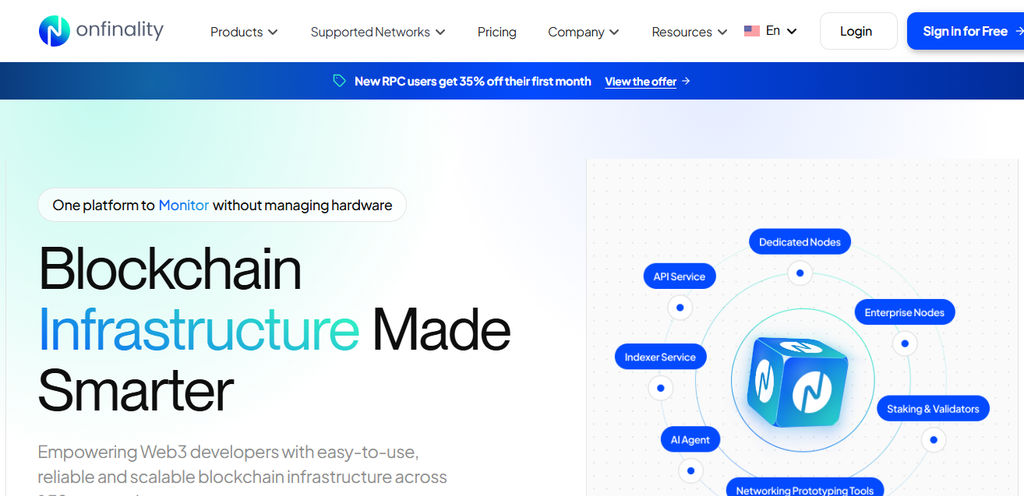
Dedicated nodes are paid for separately on a pay-as-you-go basis. Dedicated infrastructure can be full or archive nodes, monitoring, upgrades, support, node clusters, higher support SLAs, RPC fallback etc.
It is built for production applications that need isolated node capacity, predictable access, and managed operations without having to maintain their own blockchain servers.
Use Cases
- Production dApps
- Indexing on blockchain
- Applications of archive data
- Web3 applications with high throughput
- Services for real-time data on blockchains
Key Differentiators
- Dedicated Node Management
- Infrastructure options on their own
- Availability of archive-nodes
- WebSocket and RPC access
- Gestion de la santé des nœuds
5. NOWNodes
NOWNodes is a multi-chain Blockchain-as-a-Service provider with 120+ networks supported including Solana, Bitcoin, Ethereum, Polygon and other major chains. It provides shared and dedicated nodes and its Solana dedicated infrastructure is priced at €4,200/month after its pricing revision in 2026.
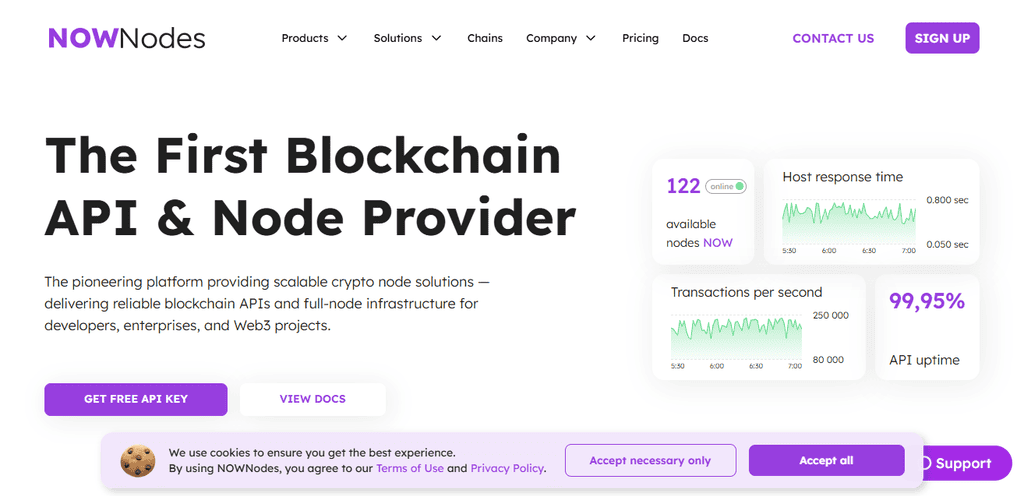
The dedicated nodes have no fixed RPS limit and the throughput is determined by the allocated hardware. Its Solana service supports JSON-RPC and WebSocket access. The broader platform offers APIs, archive nodes, trace/debug services and gRPC. Dedicated nodes are separately priced, standard plans are priced on request.
Application Cases
- Wallets for crypto
- Infrastructure for Exchange
- Blockchain explorers
- Multi-chain dApps
- Blockchain analytics instruments
Major Differentiators
- 100+ blockchain networks
- Dedicated node selection
- API access to multiple chains
- Availability of archive-nodes
- Operated blockchain infrastructure
6. The Alchemy
Alchemy gives you multi-chain RPC infrastructure for networks like Ethereum, Solana, BNB Smart Chain, Polygon, Arbitrum, Optimism, Base, Avalanche, Starknet, and more. Pricing is based on Compute Units. There’s a free tier of 30 million CU/month and Pay-as-You-Go pricing of $0.525 per million CUs.
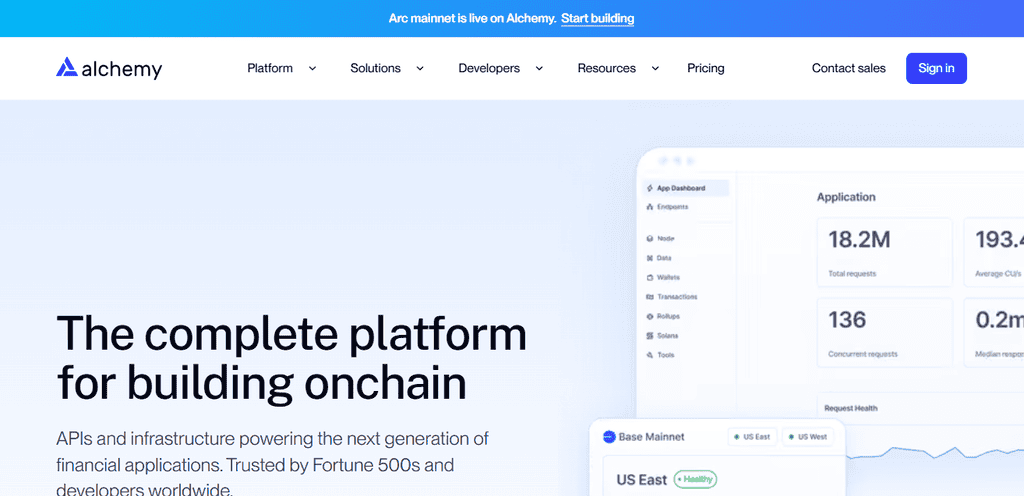
Enterprise customers can get custom capacity, support and SLAs; Solana gRPC starts at $75/TB. Alchemy also offers premium endpoints, throughput scaling, archive access and application APIs, making it a fit for teams already using its broader Web3 developer stack.
Use case
- dApps of Web3
- DeFi Apps
- Wallet infrastructure
- Indexing Blockchain
- Trading and transaction apps
Things That Set Us Apart
- Multi-chain developer platform
- gRPC interface and Solana RPC
- High throughput infrastructure.
- Access to archived data
- Integrated developer tooling and Web3 APIs
7. dRPC
Instead of mainly depending on traditional dedicated nodes for single providers, dRPC employs a decentralized RPC aggregation and routing model. The cost is calculated using Compute Units, where the usual charge for supported RPC methods is 20 CU, and rates are shown as $0.30 for each million CU.
It now supports Ethereum, Polygon , Optimism, Base, BNB Smart Chain, Arbitrum and Bitcoin , and Solana too. Paid access includes provider connectivity, load-balancing fallback and verification features. This model is particularly relevant when the importance of redundancy, routing and multi-provider availability outweighs the benefits of owning isolated hardware.
Use Cases
- Cross-chain dApps
- Applications of DeFi
- Wallets in Web3
- Redundancy of RPC
- Provider Fail Over Applications
Distinctive Factors
- Distributed RPC network
- Multiple provider routing
- Infrastructure redundancy, automatically.
- Delay-aware routing
- Multi-chain RPC aggregation.
8. Shyft
Shyft is a Solana focused infra provider. We provide RPC, gRPC, APIs and dedicated nodes for latency sensitive workloads. Its shared Solana plans start at free and go up to $649/month.
Its dedicated Solana RPC nodes start at $1,800/month. Dedicated infrastructure includes isolated nodes, multiple shred stream acceleration sources, automated failover, unlimited streaming, monitoring, and direct support for developers.
Shyft supports Yellowstone gRPC and RabbitStream and has infrastructure dedicated to trading, bots, indexers, DeFi apps and high-throughput Solana workloads that require lower latency than shared infrastructure.
Use Cases
- Trading applications for Solana
- Arbitrage and HFT systems
- MEV infrastructure
- Indexing the block chain
- Solana applications in real time
KEY DIFFERENCES
- Infrastructure around Solana
- Dedicated RPC nodes for Solana
- gRPC support for Yellowstone
- Live streaming infrastructure
- Low-latency services for trading
9. Speedy RPC
RPC Fast is focused on Solana infrastructure for HFT, DeFi, MEV, trading bots and latency sensitive applications. Its shared plans are free to $499/month. Dedicated Solana nodes start at $2,200/month and provide bare-metal infrastructure without any shared SaaS rate limits.
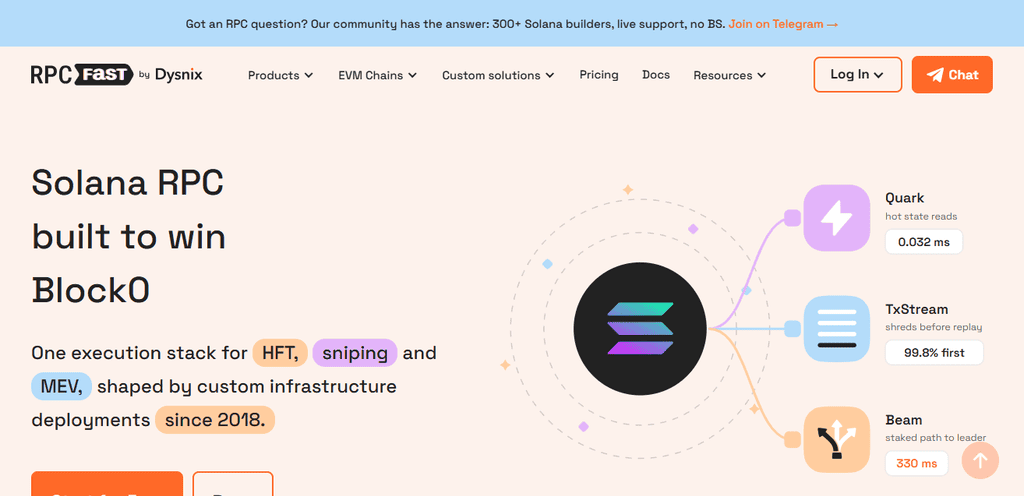
Custom indexing, geographic deployments (EU, US, Asia) and dedicated configurations for Yellowstone gRPC, Shredstream, Aperture TxStream, SWQoS integrations. Dedicated-node pricing includes server, setup and maintenance. Higher tiers add more RAM and more support for RPC-methods.
Use Cases
- HFT (high frequency trading)
- MEV and arbitrage
- Trading bots for Solana
- DeFi Apps
- Real time processing of Blockchain data
Things That Set Them Apart
- Low latency Solana infrastructure.
- bare-metal node reservation
- gRPC for Yellowstone
- Access to Shredstream
- HFT workloads infrastructure
10. eRPC (Enhanced Remote Procedure Call)
eRPC operates on low-latency Solana infrastructure for applications that need quick access to validator and transaction data. Its infrastructure strategy is about direct data delivery, physical placement and execution sensitive connectivity, not just traditional shared JSON-RPC access. It can be evaluated together with Triton One when considering Solana infrastructure for trading, MEV, and real-time data workloads.
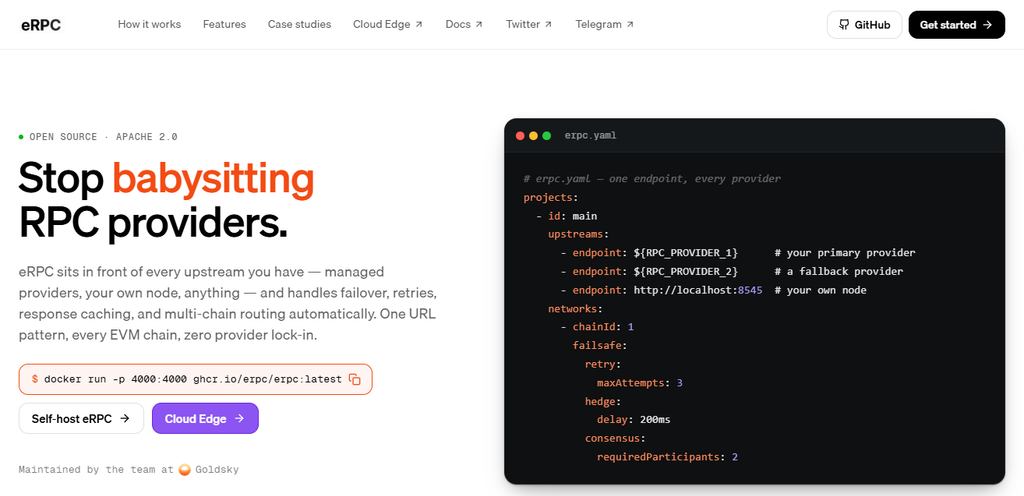
For this comparison, however, publicly documented pricing and dedicated-node specs are less comprehensive than those published by Helius, QuickNode, Chainstack, Shyft, or RPC Fast, so buyers should request current configuration, availability, and pricing directly before treating eRPC as a like-for-like dedicated-node option.
Applications
- Solana HFT apps
- MEV and arbitrage
- Infrastructure for trading
- Blockchain Data in Real Time
- Latency-sensitive applications on Solana
Key Differentiators
- Approach to Low-Latency Infrastructure
- Direct access to the Blockchain data
- Placement of physical infrastructure
- Performance optimization for Solana
- Infrastructure for execution-sensitive workloads
Why Look for Triton One Competitors?
Flexible Pricing: Competitors offer multiple pricing models such as pay-as-you-go, subscription, and dedicated-node pricing, so developers are able to choose infrastructure that suits their RPC traffic, app size, and budget.
Multi-Chain Support: Triton One is very much about Solana infrastructure, whereas other options can provide RPC access to Ethereum, Polygon, Arbitrum, Base, BNB Chain, and more from a single platform.
Dedicated Infrastructure Certain competitors offer dedicated nodes, private clusters or isolated infrastructure, offering applications greater control over resources, capacity, configuration and performance for demanding production workloads.
Lower Latency: Infrastructure, geographic location, specialized networking, and streaming services may be needed by trading platforms, MEV systems, and other real-time applications to reduce latency for time-sensitive blockchain operations.
Streaming Support: Alternatives may offer Yellowstone gRPC, WebSocket, Shredstream, or other real-time data services to applications requiring ongoing transaction, account, block, or validator information.
Scalability: Developers are able to build for growing RPC traffic without needing to rebuild their backend architecture. Different providers have different throughput limits, dedicated resources, automatic scaling, regional deployment, and enterprise infrastructure.
Developer Tools Competitors might offer RPC endpoints along with APIs, monitoring, analytics, indexing, debugging, documentation, SDKs and enterprise support, to reduce the number of infrastructure services developers need to consume.
How to Choose a Triton One Competitor?
Availability of Specialist RPCs: Find a provider that offers Dedicated Nodes, Private Endpoints, or isolated infrastructure, which can manage your application’s expected traffic without competing for shared resources.
Solana Support: Look for Solana compatibility, including supported RPC methods, node versions, transaction capabilities, and infrastructure tailored for applications needing reliable Solana connectivity.
Performance: Compare latency, throughput, response consistency, geographic infrastructure, and capacity limits to confirm the provider can support high-volume applications and latency-sensitive blockchain workloads.
Streaming Support: If your application needs continuous transaction, account, block or validator information, look for Yellowstone gRPC, WebSocket, Shredstream or similar real-time services.
Pricing: Compare subscription, on-demand, compute unit and dedicated node pricing, including included capacity, overage charges, scaling costs and potential enterprise fees .
Reliability: Prioritize uptime guaranties, redundancy, failover mechanisms, monitoring, infrastructure segregation, and service-level agreements to reduce downtime for production applications and critical blockchain activities.
Developer Support: This includes documentation, SDKs, technical support, API tooling, dashboards, monitoring, and integration resources that are especially important when your team needs help deploying and maintaining dedicated RPC infrastructure.
Scalability: Choose infrastructure that can handle increased RPC traffic by adding throughput, adding nodes, regional deployments, dedicated resources, or enterprise capacity, without requiring major architectural changes.
Conclusion
Triton One’s competitors are taking a variety of approaches to purpose-built RPC infrastructure, giving developers more options for Solana and multi-chain workloads. Helius and Shyft are focusing on Solana-specific infrastructure. The others offer more general blockchain coverage and RPC services – QuickNode, Chainstack, OnFinality, NOWNodes and Alchemy.
RPC Fast and eRPC are tuned toward latency sensitive workloads while dRPC is tuned for decentralized RPC routing and redundancy. When evaluating these providers, consider dedicated-node availability, supported chains, latency, throughput, gRPC and streaming features, pricing, reliability, scalability, and developer support.
Ultimately, the best provider will be determined by the application’s blockchain needs, traffic volume, performance expectations, technical requirements, and infrastructure budget.
FAQ
What is Triton One?
Triton One is a blockchain infrastructure provider focused heavily on Solana RPC infrastructure, including high-performance connectivity and real-time data services for demanding applications.
What are the best Triton One competitors?
Notable alternatives include Helius, QuickNode, Chainstack, OnFinality, NOWNodes, Alchemy, dRPC, Shyft, RPC Fast, and eRPC, with different infrastructure, pricing, and performance models.
Which Triton One competitors offer dedicated RPCs?
Helius, QuickNode, Chainstack, OnFinality, NOWNodes, Shyft, and RPC Fast offer dedicated or isolated infrastructure options. Availability and configurations can vary by blockchain and plan.
Which alternatives support Solana?
All ten providers discussed support or target Solana infrastructure, although their Solana capabilities differ. Some are Solana-focused, while others provide Solana alongside broader multi-chain RPC services.
Which providers support gRPC or real-time streaming?
Providers including Helius, QuickNode, Chainstack, Shyft, RPC Fast, and Alchemy offer Solana-related gRPC or streaming capabilities. Specific protocols and services vary between providers.