

In this article, I will cover the Top Bitquery Competitors for Blockchain GraphQL and compare the key features developers should consider when selecting a platform. All projects need real-time and historical data in different on-chain data, but blockchain applications require reliable access to data that is structured.
These alternatives provide different approaches to building scalable applications and data-driven products in Web3, including GraphQL indexing, multichain APIs, custom data pipelines and analytics.
Why Look for Bitquery Competitors?
More Blockchain Support: Some have support for more blockchain networks, giving developers access to data from multiple chains across multiple ecosystems without the need for separate infrastructure or multiple data providers.
Various API Options: Developers might prefer platforms that offer GraphQL, REST APIs, SDKs, RPC, or streaming interfaces if they find these options better align with their application architecture, workflow, and technical needs.

Real-Time Data Needs: Apps requiring low-latency blockchain data may look for competition providing real-time indexing, event streaming, webhooks, or always-up-to-date data sets for reactive apps and analytics.
Custom Indexing: Some platforms offer more flexibility for building custom indexes, event handlers, subgraphs or data pipelines, allowing developers to tailor blockchain data to the needs of their specific applications.
Specialized Data: Competitors may provide specialized data sets such as wallet intelligence, DeFi activity, market metrics, derivatives, NFTs or token analytics that deliver additional value for specialized Web3 applications.
Pricing Flexibility: Development teams can select the infrastructure that corresponds to their anticipated data usage, as providers offer diverse pricing structures, including free tiers, credits, and usage constraints.
Developer Experience: The documentation, SDKs, query tools, dashboards, APIs, deployment workflows and integration options differ from one platform to another, making developer experience a significant reason to look at alternatives.
Scalability Requirements As Web3 applications scale, they may require infrastructure capable of supporting increased query volume, greater blockchain coverage, real-time workloads, and production data pipelines without requiring extensive infrastructure management.
How to Choose a Bitquery Competitor?
Blockchain Support: Verify that the platform supports the blockchains your application needs, such as major EVM networks and new ecosystems, so you don’t need to use multiple providers for different chains.
GraphQL & API Support: Check the availability of GraphQL vs REST APIs, RPC endpoints, SDKs, and query flexibility to make sure the provider will fit well with your existing app architecture and development workflow.
Data Coverage: Review the presence of datasets like transactions, tokens, wallets, intelligent contracts, NFTs, DEX trades, DeFi activity, balances and any other on-chain data you need for your application.
Real-Time Performance: Confirm the provider supports real-time indexing, streaming, subscriptions, or webhooks with appropriate latency for use cases requiring real-time blockchain events and market data.
Historical Data: For use cases like backtesting, long-term analytics, wallet research, or historical blockchain analysis, evaluate historical data depth, availability, query limits, and supported networks.
Scalability: Understand API limits, query performance, indexing capacity, infrastructure reliability and production scalability to ensure the provider can handle more users, requests, datasets and blockchain activity as you grow.
Developer Experience: Examine the documentation, SDKs, sample code, query tools, authentication, dashboards, debugging resources, and deployment workflows to evaluate how easy it is for developers to create and maintain integrations.
Pricing & Limits: Look at free tiers, credits, API requests, data limits, subscription costs, enterprise pricing, and overage policies to find infrastructure that fits your expected usage and budget.
Key Points
| Competitor | Key Point |
|---|---|
| The Graph | Decentralized blockchain indexing protocol that enables developers to query blockchain data using GraphQL through custom subgraphs |
| Covalent | Provides unified multichain APIs and structured on-chain data across 100+ blockchains for developers and enterprises. |
| Dune Analytics | SQL-based blockchain analytics platform offering customizable dashboards and community-driven on-chain datasets. |
| Amberdata | Enterprise-grade digital asset infrastructure delivering blockchain, DeFi, market, and derivatives data APIs. |
| Nansen | Blockchain analytics platform known for wallet labeling, smart money tracking, and real-time on-chain intelligence. |
| Glassnode | Provides institutional-grade on-chain metrics, market intelligence, and API access for crypto research and investment analysis. |
| SQD (Subsquid) | Open and self-hostable blockchain data infrastructure with GraphQL support and coverage across 225+ chains. |
| Goldsky | Managed indexer platform that helps developers build real-time GraphQL APIs and blockchain data pipelines. |
| Envio | High-performance blockchain indexing solution that generates GraphQL APIs for Web3 applications with low-latency querying. |
| Moralis | Web3 development platform offering blockchain APIs, wallet APIs, NFT APIs, and indexed blockchain data services. |
1. The Graph
The Graph is a decentralized indexing protocol for querying data from networks like Ethereum and IPFS. Supports 60+ networks including Ethereum, Arbitrum, Base, Polygon, Optimism, BNB Chain, Solana, Bitcoin and more. It is useful for dApps, DeFi dashboards, analytics platforms, and Web3 applications.
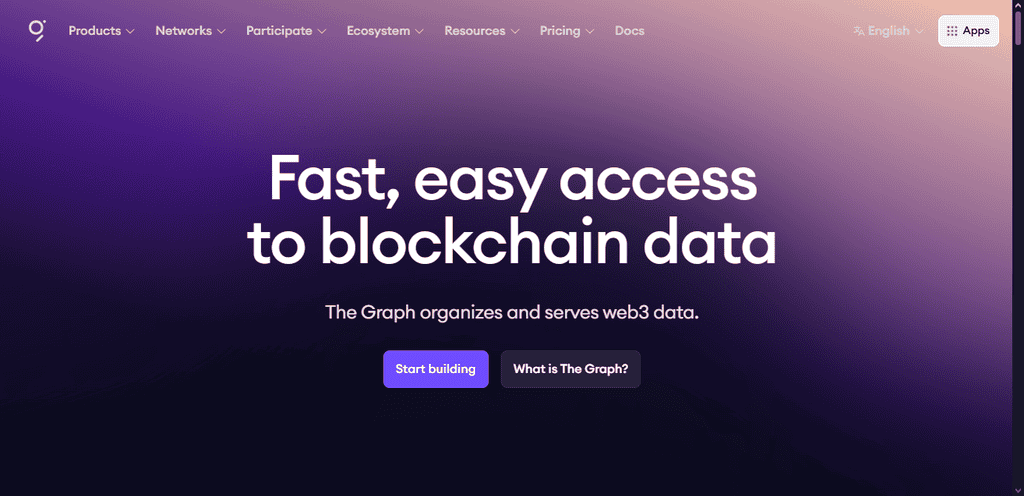
Developers are able to create or use subgraphs and query indexed entities via GraphQL. The platform supports structured smart-contract data and real-time streaming with technologies such as Substreams.
Subgraph Studio grants you 100,000 free queries per month followed by usage-based pricing. Developers have Graph CLI, API keys, GraphQL endpoints and indexing tools for application integration.
key differences
- Blockchains Decentralized Index Infrastructure
- Subgraph-based GraphQL-first querying
- Ecosystem and network support for big multichains
- Community and application built data indexes
- Subgraphs and Substreams for structured data in blockchains.
Best-Fit Users
- Blockchain developers
- Indexed smart-contract data is a must for DeFi protocols
- Web3 analytics teams’ custom dashboards
- Blockchain queries for developers in GraphQL
2. GoldRush
Covalent, now rebranded as GoldRush, offers unified multichain blockchain data APIs for developers building wallets, explorers, analytics applications and Web3 products. Support for 100+ blockchains including Ethereum, Solana, Bitcoin, Base, Polygon, BNB Chain, Arbitrum and Optimism.
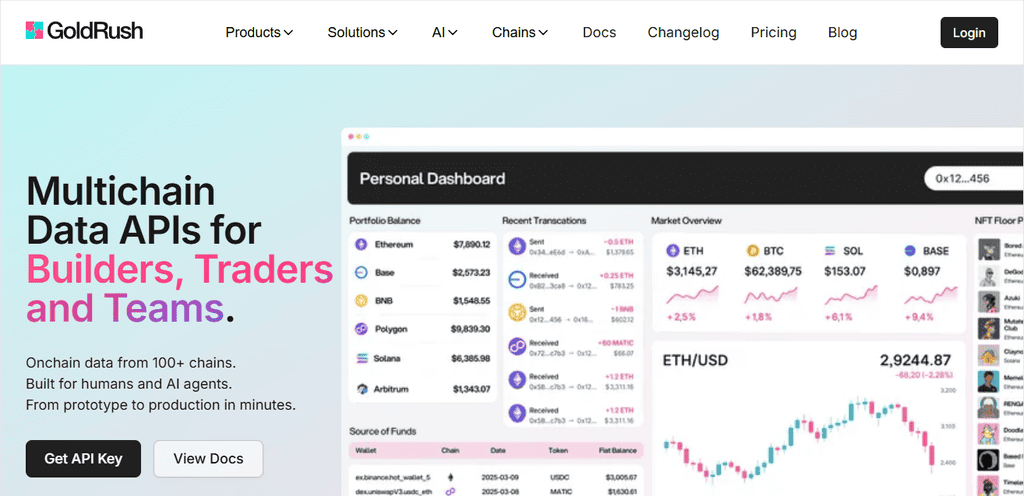
Its APIs include wallet balances, transaction history, token information, NFT data, prices, DEX analytics, approvals, and JSON-RPC access. Bitquery-style GraphQL is not the main interface, but developers mainly connect via REST APIs, SDKs, CLI tools, and WebSocket capabilities.
GoldRush has a free trial for 14 days with 25,000 API credits, and the paid plans start at $10/month. Its wide chain coverage and decoded data makes it relevant for multi chain applications.
ways to tell them apart
- Unified APIs for a wide range of blockchains
- Preprocessed normalized blockchain datasets
- Robust Wallet & Portfolio Data Coverage
- Token, NFT, transaction and DeFi endpoints
- APIs for developers that reduce the complexity of indexing
Best Fit Customers
- Developers of multichain wallets
- Portfolio & Asset Tracking Applications
- Web3 tools for analytics
- Developers need normalized cross-chain data
3. Dune Analytics
Dune Analytics is an on-chain analytics and data platform that aims to make blockchain datasets queryable via SQL, dashboards, APIs and data connectors. Today, it powers 100+ chains and provides access to over 1 PB of indexed multichain data that is essential to protocol analytics, token research, DeFi analysis, dashboards, and community-driven research.
The core Dune developer workflow is centered around DuneSQL and APIs, and it’s not a GraphQL provider at its heart. Developers are able to convert queries into API endpoints and integrate Dune with BI tools, dbt workflows and automation systems. Dune is also a free experience, although higher usage and API capabilities require subscription plans and credits.
Critical Differentiators**
- SQL-based analysis of blockchain data
- Community-built dashboards and queries
- Comprehensive analytics and visualization capabilities
- High support for customized blockchain research
- API access to convert queries to apps
Best Fit Users
- Blockchain data analysis
- Cryptocurrency Researchers and Traders
- On-chain activity tracking by protocol teams.
- Analytics dashboard makers
4. Amberdata
Amberdata is a digital-asset data infrastructure platform for blockchain, crypto market and DeFi data for developers, institutions, traders, researchers and financial teams. Its coverage blends blockchain fundamentals with market and derivatives data, enabling users to work with real-time and historical datasets.
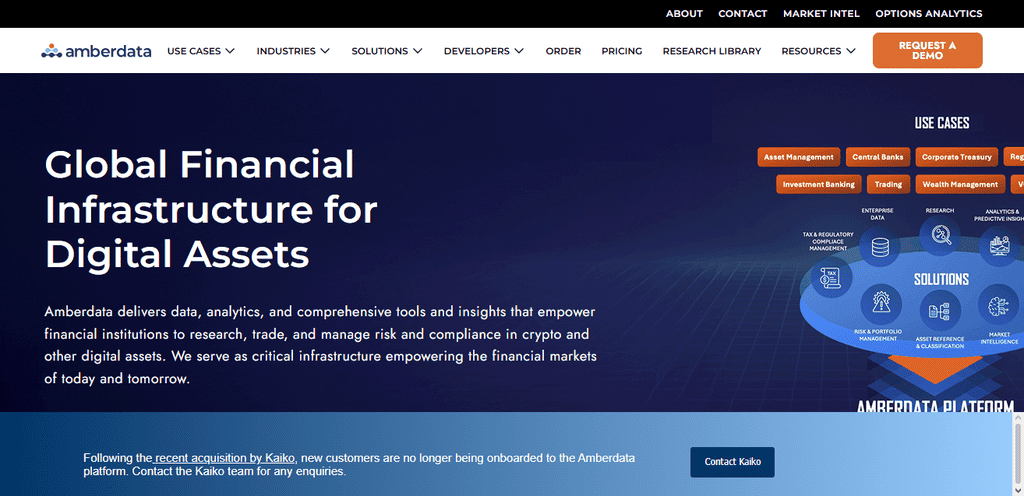
Amberdata offers APIs and data access infrastructure for blockchain transactions, addresses, tokens, DeFi activity, market prices, derivatives and other financial datasets. Its offering is more focused on institutional-grade data than just a GraphQL-first developer experience.
The pricing is largely startup and enterprise focused with startup access and enterprise licenses discounted rather than a prominently advertized permanent free tier. API subscriptions have usage limits including 250,000 requests per day and access to WebSockets.
Things That Make Us Different
- Blockchain and market data combined
- Strong institutional and financial data orientation
- Digital asset data in historical and real time
- Market Analytics, DeFi and Derivatives
- APIs for quantitative and institutional workflows
Top Users
- Corporate crypto teams
- Quantitative researchers
- Trading platforms and market research
- Teams for financial data and risk management;
5. Nansen
Nansen employs a combination of blockchain data, wallet labels and on-chain intelligence and is particularly geared toward smart money activity, token movements, wallet behavior and market signals identification.
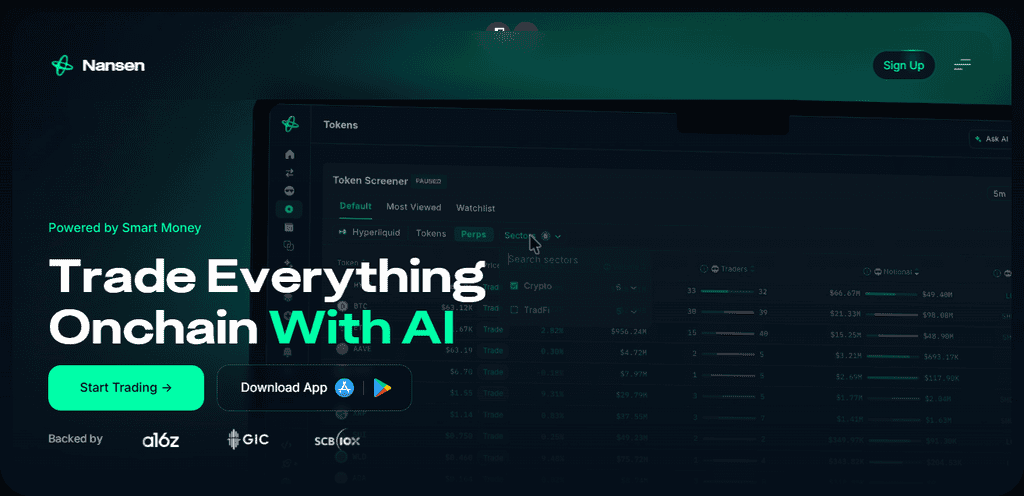
The API currently has data available on 25+ chains and over 500 million labeled addresses. It provides endpoints for wallet profiling, token analytics, smart-money netflows, token screening, and trading-related data. Nansen’s API is geared toward developers and institutional users, and is REST-based instead of GraphQL-based primarily.
The API offers a free tier with 100 initial credits and a daily refill of 10 credits, while Pro has 2,000 monthly credits. API credits are sold in blocks of 10,000 for $10. Developers are able to integrate through API keys, documented endpoints and MCP for AI-powered workflows.
Key Differentiators
- Enhanced entity intelligence and wallet labeling
- Tracking Smart Money Activity
- Token & Wallet Flow Analytics
- Market insights + on-chain intelligence
- API access to programmatically analyze wallets and tokens
Best Fit Users
- Research teams for cryptos
- Securities, commodities and financial services sales agents
- Web3 protocol-based wallet behavior tracking
- Developers of wallet intelligence applications
6. Glassnode
Glassnode is a blockchain analytics firm that specializes in on-chain data, with a heavy emphasis on blockchain metrics, market intelligence and historical digital-asset analytics, rather than general-purpose application indexing.
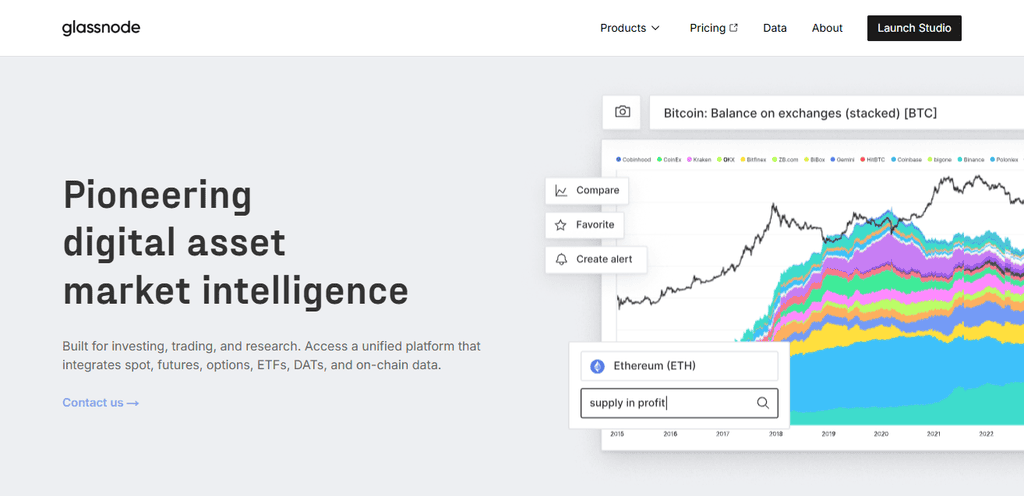
It has data for more than 1,500 assets and has covered 11 blockchains so far, including Bitcoin, Ethereum, Solana, Tron, BNB Chain, Dogecoin, Arbitrum, TON and XRP. Its datasets include on-chain metrics, market metrics, derivatives, macro indicators, ETF-related information and other financial analytics. API access available. Availability of API depends on the plan.
The advanced plan is **$49/month (billed annually). Professional provides richer historical and higher resolution access with API/data credits. Hence it is particularly relevant for quantitative research, trading analytics and investment data applications.
Big Differences
- Full On-Chain Financial Analysis
- Full Bitcoin and Ethereum metrics coverage
- Historical blockchain and market data sets
- Advanced indicators for investors & traders
- Aggregation of on-chain, market & derivatives data
Best Fit Users
- Cryptocurrency investment analysis
- Quantitative research practitioners
- Institutional trading desks
- Digital asset platforms Research
7. SQD (Subsquid)
SQD, ex-Subsquid, is a blockchain data infrastructure platform focusing on extracting, processing, and serving large quantities of indexed blockchain data. It is aimed at developers who want flexible access to historical on-chain data instead of using predefined datasets.
Its architecture allows for flexible indexing pipelines and data processing under the control of the developer, which is useful for analytics platforms, explorers, protocol apps, and specialized Web3 datasets. Developers are able to query the data from the blockchain and expose application specific datasets through APIs and query layers.
In particular, SQD takes the lead with its decentralized data-access infrastructure and native SQD token ecosystem. Pricing is based on the amount of network and infrastructure used. Developers should refer to the latest SQD Network and cloud documentation for relevant limits, credits and production costs.
Key Discriminators
- Blockchain data extraction infrastructure agile
- Indexing pipelines controlled by the developer
- Applicable to processing of large scale historical data
- Transforming & Indexing data as you want
- Assists in creating specialized blockchain datasets
Best Fit Users
- Web3 Data Engineer
- Blockchain analytics developers
- dApp teams that need custom indexing
- Teams dealing with large historical data sets
8. Goldsky
Goldsky is a real-time indexing, GraphQL subgraph, streaming pipeline and RPC access platform for production apps. It supports 150+ chains and offers products like Subgraphs, Turbo Pipelines, and Edge RPC.
Its Subgraphs product creates custom GraphQL APIs from blockchain data and Turbo Pipelines can stream events to Postgres, ClickHouse, Kafka and S3. Goldsky emphasizes live access, historic data, custom schemas and automatic reorganization handling.
$100 in free credits for new users (no credit card required) . Scale plan has usage-based pricing. Developers are able to deploy subgraphs, set up pipelines, leverage TypeScript transformations, and integrate blockchain data directly into application backends.
Things that set us apart
- Infrastructure for real-time blockchain indexing
- Subgraphs based on GraphQL
- Blockchain streaming data pipelines
- Native database and data warehouse integrations
- Production-grade application data out of the box
Best Fit Users
- Development of real-time dApps
- Teams for DeFi applications
- Blockchain analysis tools
- Developers needing GraphQL + streaming data
9. Envio
Envio offers blockchain indexing infrastructure via its HyperIndex, HyperSync and HyperRPC products. Developers are able to use HyperIndex to write event handlers in TypeScript to convert live and historical blockchain events into production-ready GraphQL APIs.
It supports a broad spectrum of networks including Ethereum, Base, Polygon, Optimism, Scroll, Fuel, Hyperliquid and other EVM and non-EVM ecosystems. HyperSync is the high-speed data retrieval layer. HyperRPC is read-only RPC access.
Envio offers a free tier for development and testing and production usage-based pricing through Envio Cloud. The real-time indexing architecture is built to deliver sub-second latency, automatic reorg handling, and multichain indexing.
Developers are able to generate configurations from contracts or ABIs and deploy indexed APIs, thus minimizing the infrastructure management.
Unique Selling Points
- Rapid blockchain synchronization
- HyperIndex for GraphQL APIs
- Indexation: Real-time and historical
- Creating event handlers in TypeScript
- HyperSync and HyperRPC for flexible blockchain access
Best-Fit Users
- EVM applicative developers
- DeFi Protocol Creators
- Teams that are building real-time dashboards
- Developers who want to have their own indexing infrastructure
10. Morale
Moralis is a Web3 API platform that helps developers access ready-to-use blockchain, wallet, token, NFT, price, DeFi, RPC and streaming data without building their own indexing infrastructure. It supports 50+ chains including Ethereum, Solana, Base, Polygon, BNB Chain, Arbitrum, Avalanche, Optimism and other major networks.
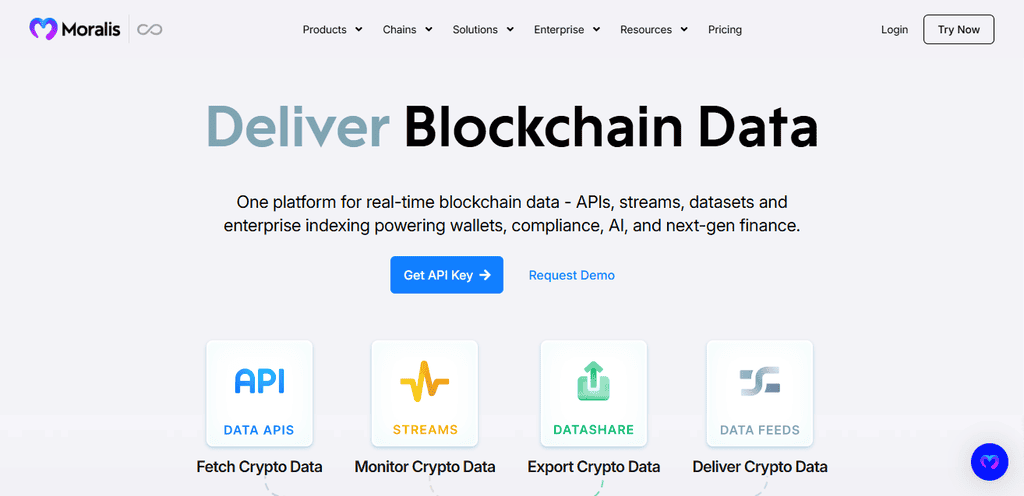
Its APIs offer balances, transfers, ownership, token information, NFT metadata, prices, DeFi data, wallet activity and historical information. Moralis Streams adds real-time webhook-based blockchain monitoring and RPC nodes are lower level access.
Official developer pricing has also included free access depending on the offering. Current pricing includes paid Starter, Pro and Business plans. Connect with developers through REST APIs, SDKs, RPC and Streams.
Key Differentiators
- Massive library of pre-built Web3 APIs
- Wallet, token, NFT and DeFi data in one platform
- Real-time Streams with support for webhooks
- RPC access and higher level APIs
- Developer-friendly SDK & API ecosystem
Users with Best Fit
- Developers in Web3
- Wallet & portfolio platforms
- Applications of NFT and token
- Developers looking for plug-and-play blockchain APIs
Conclusion
Choosing from the best Bitquery alternatives based on the blockchain data needs, API preferences, and application use case. GraphQL-based indexing is exemplified by The Graph and Goldsky, while Covalent/GoldRush and Moralis offer easy-to-use multichain APIs.
Dune is more focused on blockchain analytics, while Nansen and Glassnode are more focused on on-chain intelligence and market data. Amberdata combines blockchain and financial datasets, SQD and Envio have custom indexing infrastructure.
Before choosing a platform, compare what blockchains are covered, what data they offer, whether they support real-time data, historical data, developer tools, scalability, pricing, and more. That will enable developers to discover infrastructure that matches their Web3 data needs.
FAQ
What is Bitquery?
Bitquery is a blockchain data platform that provides structured on-chain information through APIs and GraphQL. Developers can use it to access blockchain transactions, tokens, wallets, smart contracts, DeFi activity, and other Web3 datasets.
What are the top Bitquery competitors?
Major Bitquery alternatives include The Graph, Covalent/GoldRush, Dune Analytics, Amberdata, Nansen, Glassnode, SQD (Subsquid), Goldsky, Envio, and Moralis. Each platform differs in blockchain coverage, APIs, indexing, data types, pricing, and developer tools.
Which Bitquery competitor supports GraphQL?
The Graph, Goldsky, and Envio provide strong GraphQL-based data access. The Graph uses subgraphs, Goldsky provides GraphQL Subgraphs, and Envio’s HyperIndex can expose indexed blockchain data through GraphQL APIs.
Which alternative is suitable for multichain blockchain data?
Covalent/GoldRush and Moralis are focused on providing unified access to data across many blockchain networks. Their APIs can simplify access to wallet, token, transaction, NFT, and other blockchain datasets.
Which Bitquery alternative is focused on blockchain analytics?
Dune Analytics is primarily designed for blockchain analytics, SQL queries, dashboards, and data visualization. Nansen and Glassnode also focus heavily on on-chain intelligence, but with different datasets and analytical approaches.