

A good on-chain data platform can make or break a Web3 application, especially when developers need blockchain activity delivered fast and reliably. Goldsky is known for real-time indexing, streaming, and data pipelines, but it’s not the only game in town.
In this guide, I will cover the best Goldsky alternatives for real-time on-chain data, comparing pricing, blockchain coverage, indexing capabilities, APIs, developer tools, and practical use cases so that you can find the right fit for your project.
Why Look for Goldsky Alternatives?
Wider Blockchain Coverage: For specialized multichain applications, there may be a need for support for specific EVM and non-EVM networks not supported by Goldsky, in which case other options may be better suited.
Multiple Pricing Models Goldsky may not have the right price tag for every project. The alternatives have different free tiers, usage-based pricing or enterprise plans for varying data needs.

Special Indexing Requirements: Some teams require more control over indexing logic, transformations, and data pipelines. “Developers may gain more control with platforms like Subsquid and Envio.
Historical Data Needs: If your projects need a lot of historical blockchain data, you should probably look at providers that can give you deeper datasets, faster backfills, or specialized extraction tools for analytics and research workloads.
Solana-Centric Infrastructure: Solely on Solana developers could benefit from dedicated platforms like Helius providing Solana-specific APIs, RPC infrastructure, webhooks, and real-time data.
Analytics Capabilities: If your team is primarily focused on blockchain analytics, you might prefer Dune. Dune provides SQL querying, dashboards, datasets, and community-made analytics, versus application-specific indexing infrastructure.
Self-Hosting Options: For organizations that want more control over their infrastructure, open-source options like Blockscout or Envio can be deployed, allowing for greater customization and control over deployment and operational architecture.
Specialized developer tools: Different types of applications require different APIs, SDKs, GraphQL interfaces, webhooks, or data-access methods. Alternatives can provide specialized tooling that fits the specific development workflows better.
Key Points
| Competitor | Key Point |
|---|---|
| Subsquid | High-performance blockchain indexing with customizable ETL pipelines and multichain support. Frequently viewed as a direct alternative to The Graph. |
| Covalent | Provides structured on-chain data across 100+ blockchains through a unified API. |
| Goldsky | Real-time blockchain data infrastructure focused on indexing, data streaming, and on-chain automation. |
| Helius | Specialized indexing and data services for the Solana ecosystem, including APIs and webhooks. |
| GhostGraph | Blockchain indexing platform that enables developers to create custom index transformations and query via GraphQL. |
| Alchemy Subgraphs | Managed indexing solution that simplifies querying blockchain data and building decentralized applications. |
| Chainbase | Unified Web3 data infrastructure offering indexed blockchain data and developer APIs across multiple chains. |
| Envio | Modern indexing framework designed for fast data synchronization and near real-time blockchain analytics. |
| Blockscout | Open-source blockchain explorer and indexing platform that enables access to indexed on-chain data. |
| Dune Analytics | Allows users to query, index, and analyze blockchain datasets through SQL-based dashboards and analytics tools. |
1. Subsquid
Subsquid was founded in 2021 and is focused on decentralized blockchain data extraction and indexing. Pricing/free tier: Developer-accessible resources and usage-based pricing are available, with availability varying by service. Core data offering Subsquid offers indexed datasets, historical blockchain data and data-processing infrastructure you can tailor to your needs.
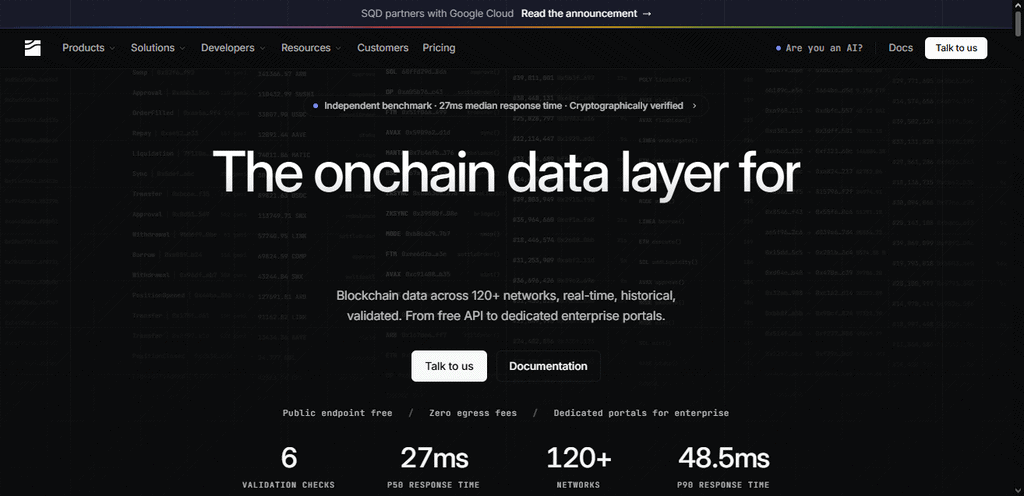
It supports many EVM and non EVM chains. Real-time capability: Its ingestion architecture is able to continuously process blockchain data for applications demanding fresh updates.
Developers are able to build analytics, DeFi and Web3 applications using Squid SDK, TypeScript-based indexing, APIs and customizable data pipelines.
Top Use Cases for
- Custom Blockchain Indexing – Perfect for developers who want custom indexing logic, transformations and control over how raw blockchain data is processed.
- Historical Data Processing – Ideal for applications with large historical datasets, backfills and analytics-heavy blockchain workloads.
- Multichain Applications – Good for projects that pull data from multiple EVM and non-EVM networks into one data infrastructure.
- DeFi Analytics – Great for detailed protocol events, transactions, token activity, and historical DeFi data.
- Custom Data Pipelines – A powerful alternative for teams that are building their own data lakes, APIs or analytics infrastructure, rather than relying on static datasets.
Differences From Goldsky
- More Control – Subsquid provides developers with greater control over their indexing and data-processing logic, while Goldsky focuses on managed infrastructure and quicker deployment.
- Historical Processing – Subsquid is built for complex historical extraction and backfills, while Goldsky is more production-ready for real-time pipelines.
- Developer Control – Subsquid is for teams who want more control over their indexing architecture, instead of using managed services.
- Real-Time Focus – Goldsky centers on managed real-time streams, subgraphs, and webhooks, while Subsquid offers more flexibility for custom data workflows.
2. Coordinate
Founded in 2017, Covalent was known for providing unified blockchain data via developer-friendly APIs. Pricing/free tier: It provides API access with usage limits and paid tiers for higher-volume needs. Free access may vary by product. Core data offering: The infrastructure is built around wallet balances, transactions, token activity, NFT data and historical blockchain information.
Covalent supports a wide array of EVM-compatible and other blockchain networks. Live capability: Developers are able to access frequently updated blockchain data for applications that need up-to-date information.
Its Unified API, documentation, SDK-oriented integrations, and structured endpoints make it easy to build wallets, analytics platforms, portfolio trackers, and Web3 applications.
Best Practices
- Wallet Data – Useful for balances, transactions, token holdings, and wallet activity history.
- Portfolio Applications – Ideal for wallets and portfolio trackers that require structured blockchain info across multiple networks.
- Multichain APIs – Perfect for apps that want standardized blockchain data without having to create separate indexers for each supported chain.
- Token & NFT Applications – Useful for retrieving token transfers, NFT info, owner info and other blockchain activity.
- Blockchain Analytics – Allows developers to create dashboards and data products from ready-to-consume blockchain datasets without building indexing infrastructure from scratch.
4 Differences From Goldsky
- API-First Approach – Covalent is more about ready-made unified blockchain data APIs, while Goldsky is more about custom indexing and real-time data pipelines.
- Less Custom Indexing – Covalent makes standardized data more available, but it doesn’t offer as much flexibility in custom indexing as Goldsky.
- Wide Data Access – Covalent works well for developers who want standardized wallet, token, and transaction data from many chains.
- Pipeline vs API – Goldsky is more suited for teams building custom streaming and indexing pipelines, Covalent is often easier for consuming existing structured datasets.
3. Goldsky
Year Founded: Founded in 2022, Goldsky is building blockchain data infrastructure for developers and data-intensive Web3 applications. Pricing/free tier: Goldsky provides a range of usage-based and enterprise-oriented options, with access based on indexing and streaming needs. Basic data offering: Real-time indexing of blockchains, replication of data, and streaming pipelines are the core of its product.
Blockchain support: Goldsky supports a number of major EVM networks and is continuing to expand the networks supported. Real-time capability: A key strength is the ability to stream in real-time, allowing applications to receive blockchain events with low latency. API/Developer Tools. Developers are able to use Goldsky Mirror, Goldsky Streams, SQL-based workflows, APIs and indexing tools for dashboards, DeFi protocols, analytics and operational applications.
Best Use Cases
- Real-Time Blockchain Apps – Best for apps that need to have on-chain data updated all the time and have a low indexing latency.
- Production Subgraphs – For teams who want managed GraphQL APIs without the overhead of maintaining their own indexing infrastructure.
- Event Driven Applications – Webhooks can be used to achieve bots, alerts, notifications and automated database synchronization.
- DeFi Applications – Great for products needing live swaps, liquidity, protocol events, balances and other structured blockchain data.
- Data Pipelines – Useful for getting blockchain data into databases and analytics systems via managed indexing and streaming infrastructure.
Key Differences to Other Alternatives
- Managed Infrastructure – Goldsky reduces operational work by managing indexing infrastructure, instead of teams managing their own stack.
- Real-Time Performance – Its most compelling advantage is fast, continuously updated blockchain data for production applications.
- Graph-Compatible – Goldsky enables the migration of existing Graph subgraphs, so teams don’t need to start from scratch.
- Streaming + Indexing – Goldsky is wider than an indexing-only solution by combining subgraphs, APIs and real-time webhooks.
4 Helius
Founded year: Founded in 2022, Helius primarily provides infrastructure and data tools for Solana developers. Pricing/free tier: Helius offers a free developer tier with usage limits, as well as paid plans for apps that require more API capacity. Core data offering: Services include advanced transaction data, blockchain APIs, RPC infrastructure, webhooks and real-time Solana data.
Blockchain coverage: Helius is highly specialized around Solana, as opposed to large multi-chain providers Real-time: With a streaming-first infrastructure and webhooks, developers are able to get blockchain activity as it occurs.
API/developer tools: Better APIs, DAS API, RPC endpoints, webhooks and developer tooling make Helius a useful tool for wallets, NFT platforms, trading applications, analytics and Solana dApps.
Best Use Cases of
- Solana Applications – Best suited for developers building specifically on Solana who need dedicated blockchain infrastructure.
- Real-Time Notifications – Webhooks allow you to track transactions, accounts, programs, NFT activity, swaps and transfers.
- Trading Applications – Great for applications requiring rapid Solana transaction and market data.
- Wallets & Portfolio Trackers – Excellent for real time balances, transaction histories, token activity and user notifications.
- NFT Platforms – Handy for tracking NFT listings, bids, sales, transfers and other Solana activity.
4 Differences From Goldsky
- Solana Specialization – Helius is very Solana-centric while Goldsky is more of a general blockchain data infrastructure platform.
- Unique APIs for Solana – Helius offers specific APIs for Solana and parsed transaction data rather than primarily focusing on generic indexing.
- Real-Time Streaming – Helius provides webhooks and LaserStream for lightning-fast delivery of Solana events.
- Developer Infrastructure – Helius is Solana RPC, APIs, webhooks, and streaming. Goldsky is subgraphs, indexing, and data pipelines.
5. Ghost Graph
GhostGraph is a newer blockchain data infrastructure platform aiming to make indexed blockchain data more accessible for developers. Pricing/free tier: Pricing and access differ according to the current service structure of the platform, so developers should check what limits are available before selecting it for production workloads.
It is based on structured on-chain datasets and blockchain indexing, reducing the need for developers to process raw blockchain data themselves. Blockchain coverage: Indexing infrastructure support for networks is a factor in coverage.
GhostGraph is designed for applications that require fresh blockchain data. API/developer tools: Developers are able to build analytics, dashboards, DeFi applications and other on-chain products using its indexing and data-access infrastructure.
Top Use Cases for
- Custom On-Chain Data – Ideal for projects that require structured data on the blockchain for their application.
- Blockchain Analytics – Great for dashboards and analytics products built on indexed blockchain events.
- DeFi Data Apps – May power apps that need data on protocols, transactions, tokens and smart contract technology.
- Developer Data APIs – Best suited for teams that want blockchain data exposed through application friendly data interfaces.
- On-Chain Monitoring — Good for products that need to monitor the blockchain and convert raw events into data for your application.
Goldsky has a few big differences
- Product Focus – GhostGraph is more focused on blockchain data access and indexing, while Goldsky has a more powerful managed real-time pipeline and subgraph ecosystem.
- Real-time infrastructure – Goldsky is very focused on low-latency streams and webhooks.
- Managed Deployment – Goldsky is built to reduce infrastructure management for production index workloads.
- Ecosystem Maturity – Goldsky offers mature migration and compatibility options for Graph-style subgraphs so existing indexing projects can transition more easily
6. Alchemy Subgraphs
Alchemy was founded in 2017 and its Subgraphs offering extends its broader blockchain infrastructure into indexed application data. Pricing/free tier: Alchemy offers both free and paid usage tiers for developers, with higher limits for production workloads.
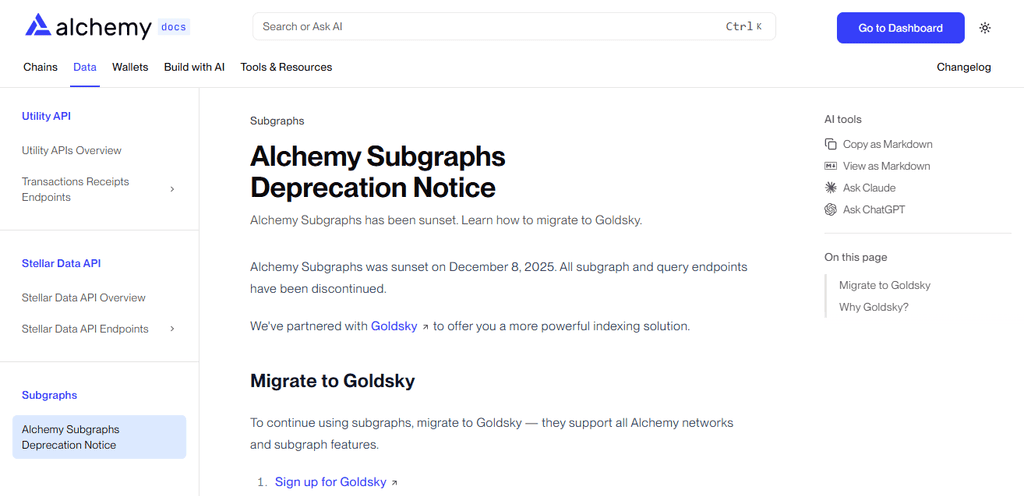
Alchemy Subgraphs allows developers to query structured blockchain data without the need to build indexing infrastructure from scratch. Blockchain support: We cover a number of major blockchains available across the Alchemy infrastructure.
Subgraph indexing allows applications to access updated smart-contract and on-chain data as new blocks are mined. API/developer tools: Developers are able to build DeFi, NFT, gaming, and analytics applications using GraphQL queries, APIs, SDKs, dashboards, documentation, and Alchemy’s broader RPC ecosystem.
Top Use Cases
- DeFi Frontends – useful for getting structured data about the protocol, swaps, liquidity pools, token balances, transactions etc.
- NFT Use Cases – Ideal for marketplaces and apps that query NFT ownership and contract activity.
- GraphQL Apps – Perfect for developers who wish to query indexed blockchain data using GraphQL.
- Alchemy Ecosystem Projects – Great for teams already working with Alchemy RPCs and APIs.
- Protocol Analytics – Can power dashboards and applications that require structured smart contract event data.
Differences from Goldsky
- Broader Alchemy Stack – Alchemy Subgraphs is part of a larger RPC and developer infrastructure ecosystem, whereas Goldsky is more focused on data indexing and pipelines.
- GraphQL Focus – Both are capable of Graph-style queries, but Alchemy does it as part of its broader developer platform.
- Ecosystem Integration – Alchemy customers already using the infrastructure and data services will find integration easier as it is all in one platform.
- Pipeline Flexibility – Goldsky focuses on streaming data pipelines and webhooks in addition to subgraphs
7. Chainbase
Year founded: Chainbase was founded in 2021 and aims to provide single, unified access to blockchain data for developers and AI-oriented applications. Pricing/free tier: Chainbase offers a developer plan with usage limits and paid plans for apps with more data volume. Core data provision: Its infrastructure covers structured blockchain data, APIs, indexing and datasets that are designed to make consuming multi-chain data easier.
Chainbase offers support for a wide range of blockchain networks, with a focus on the main EVM chains. Real-time ability: Infrastructure is designed to continuously update on-chain data for data-driven applications. API/developer tools: APIs, data services, query tools and developer infrastructure to enable analytics, AI agents, wallets, DeFi apps and other Web3 products
Top Use Cases
- Multichain Data APIs – Great for apps that need structured blockchain data across multiple chains.
- AI and Web3 Agents – Useful for AI applications that require blockchain data as an input for analysis or decision-making.
- Blockchain Analytics – Gives teams access to structured on-chain datasets for dashboards and analytical products.
- Wallet Applications – Useful for querying wallet, transaction, token and activity information across supported chains.
- Data-Driven dApps – Great for developers that want to easily access data from the blockchain without having to build the whole indexing stack. ([Startupik][6])
Ways Goldsky is Different
- Unified Data Access – Chainbase focuses on standardized, broad access to blockchain data, while Goldsky is more about custom indexing and streaming.
- API Focus – Developers who just want APIs and datasets, not custom indexing pipelines, will find Chainbase appealing.
- AI Compatibility – Chainbase is more centered on blockchain data for AI and data applications.
- Customization – Goldsky usually provides more direct control over application-specific subgraphs, streams and event-driven pipelines
8. Envio
Founded in 2023, Envio is focused on high-performance blockchain indexing for developers building data-intensive applications. Pricing/free tier: Envio offers developer tooling at an accessible price point, and infrastructure options based on usage, which are great for both experimentation and production.
Its HyperIndex infrastructure helps developers build custom indexes from blockchain events, turning raw on-chain activity into application-ready data. Coverage of the blockchain: Envio supports multi-chain indexing and multiple EVM-compatible networks.
Fast event processing and indexing speeds make it ideal for applications that require fresh blockchain data. API/developer tools: TypeScript based configuration, GraphQL APIs, custom handlers, and indexing tools for DeFi, gaming, analytics and dashboards.
Best Applications
- High-Speed Indexing – Ideal for teams that need high-performance blockchain indexing and fast historical sync.
- Multi-chain dApps – Great for applications that index contracts on multiple EVM networks and supported non-EVM ecosystems.
- DeFi Analytics – Ideal for real-time protocol analytics, liquidity tracking, trading data and financial dashboards.
- Block Explorers – Can power structured transaction, contract and event data for block chain explorers.
- Real-time monitoring – Great for applications monitoring stablecoins, liquidations, wallets or protocol events in real-time. ([GitHub][7])
Differences from Goldsky
- Performance Focus – Envio offers fast indexing and historical backfills powered by HyperSync.
- Developer Control – Developers are able to write the indexing logic using TypeScript-based handlers, enabling a code-first workflow.
- Self-Hosting Choice – Envio provides self-hosting, providing teams greater control over their infrastructure than a fully managed model.
- Multichain Indexing – Envios can index multiple chains from a single framework, and Goldsky focuses on managed subgraphs and real-time data pipelines
9. Blockscout
Blockscout was founded in 2018 as an open-source blockchain explorer and infrastructure. Pricing/free layer: Blockscout is open source and is deployable by developers and networks. Hosted and enterprise-oriented services may have different commercial arrangements.
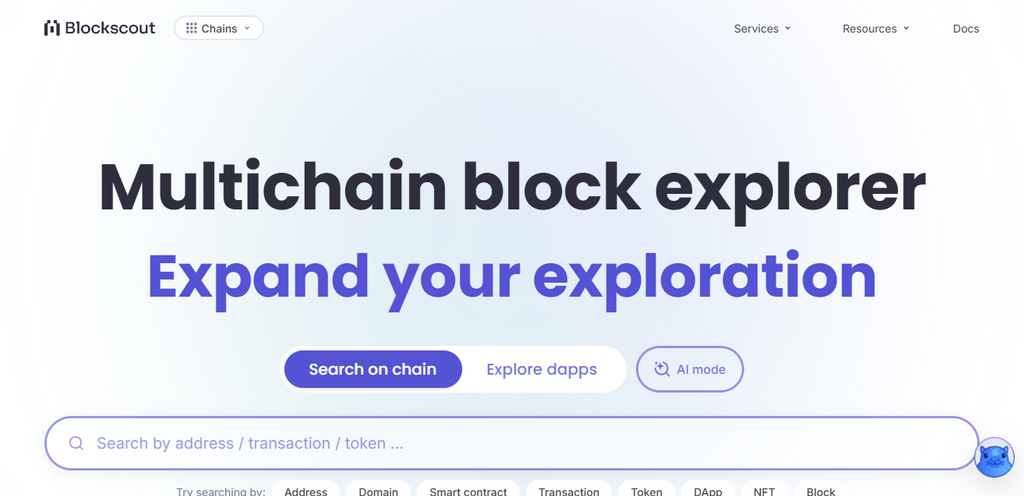
Blockscout offers explorers, transaction data, contract verification, tokens data, addresses, blocks, and blockchain activity. Blockchain support: It supports a wide range of EVM-compatible networks and is used by many individual chains. ** Real time capability:** Explorer data is updated as blocks and transactions are processed, making it useful for monitoring live network activity.
APIs, verified contract interfaces, explorer infrastructure, and open-source components that enable developers to build blockchain explorers, tools for analytics, and network-specific applications.
Best Use Cases
- Blockchain Explorers – Its most potent use case is building explorers for EVM-compatible networks.
- Transaction Tracking – Follow transactions, blocks, addresses, tokens, and smart-contract activity.
- Contract Verification – For applications and networks that need verified smart-contract source code and readable contract information.
- Network Infrastructure – Blockchain teams can use Blockscout as an explorer and data-access layer for their own networks.
- Open Source Development – Good for teams who want more control over explorer infrastructure and to be able to modify the software.
Main Differences To Goldsky
- Explorer First – Blockscout is primarily a blockchain explorer, open source, while Goldsky is focused on indexing and data pipelines for applications.
- Open Source Model – Blockscout’s open-source architecture allows for more control.
- Developer Data Layer – Goldsky is better for custom application backends that need subgraphs and streaming data.
- Network Visibility – Blockscout is excellent for human-readable transaction & contract exploration, Goldsky is more geared toward machine-consumable application data.
10. Dune Analytics
Dune Analytics was founded in 2018 and is a blockchain analytics and community-driven onchain data analysis company. Pricing/free tier: Dune has a free tier for many public dashboards and queries, while paid plans unlock additional capabilities, performance and collaboration features.
Core data offering: Decoded blockchain datasets, SQL-based querying, dashboards and analytics around transactions, tokens, DeFi, NFTs and protocols through its platform. Blockchain coverage: Dune supports many of the largest blockchain networks and is rapidly growing its data coverage.
Data is updated as new activity is processed on the supported networks, enabling near-current analytics. API/Developer tools: SQL queries, dashboards, APIs, datasets and embedded analytics make Dune a go-to for researchers, analysts, protocols, investors and Web3 data teams.
Best Application
- Blockchain Analytics – Dune is a great tool for analyzing transactions, protocols, tokens, DeFi activity, and broader on-chain trends.
- SQL Research – Analysts can query blockchain datasets using SQL, without having to build their own full indexing infrastructure.
- Dashboards – useful for creating public or private dashboards displaying protocol metrics and market activity.
- Protocol Research – Ability to monitor user activity, trading volume, liquidity, token movements, and protocol growth.
- Crypto Data Reporting – For researchers, investors, analysts, and Web3 teams that want visualized blockchain intelligence instead of an application backend.
Differences From Goldsky
- Analytics versus Infrastructure – Dune is a research and analytics platform, Goldsky is a production blockchain data infrastructure.
- SQL-Based Workflow – Dune prefers SQL queries and dashboards to custom indexing pipelines.
- Not Great For App Backends – Dune is typically not the first choice when an application needs low-latency transactional data delivery.
- Research Strength – Dune is better suited for exploratory analytics, public dashboards, and market research. Goldsky is better suited for live application data, indexing, and streaming
Who Should Choose These Goldsky Alternatives?
Multichain Developers: Teams building applications on multiple blockchains should consider alternatives that offer wider chain coverage, unified APIs and flexible indexing infrastructure to efficiently handle diverse on-chain datasets.
DeFi Protocols: DeFi teams who need transactions, swaps, liquidity, token moves and protocol events can pick platforms that have fast indexing, reliable APIs and real-time data from the blockchain.
Solana Developers: If you are building on Solana, you should look at specialized providers like Helius, which provides Solana-specific APIs, RPC infrastructure, webhooks, enhanced transactions and streaming.
Data-Heavy Applications: For projects working with large historical datasets, complex blockchain events, or continuous data streams, other solutions provide scalable indexing, quicker backfills, and customizable data pipelines.
Blockchain Analyst: However, for flexible blockchain research and reporting, Dune Analytics and other platforms that offer SQL queries, dashboards, decoded datasets and visualized on-chain activity may be preferable to researchers and analysts.
Custom indexing teams: If you want full control over your indexing logic, data transformations, schema, and processing workflows, consider alternatives like Subsquid or Envio for more customization.
Open Source Projects: Teams that want their own infrastructure, transparency, customization, or self-hosting should consider open-source solutions such as Blockscout or Envio, rather than managed services.
Enterprise Web3 Teams: If you are a business that requires scalable infrastructure, reliable data delivery, multiple APIs, advanced integrations, and production-grade performance, then compare enterprise-focused alternatives based on usage, support, security, and scalability.
Conclusion
Goldsky remains a good option for real-time on-chain indexing, streaming, and blockchain data pipelines, but some projects might need specialized alternatives. Subsquid and Envio provide custom indexing while Covalent and Chainbase offer easy multichain data access. Helius is a better fit for Solana developers while Dune Analytics is more powerful for blockchain analytics and SQL-based research.
Blockscout is an open-sourced solution. Alchemy Subgraphs are indexed data in a larger developer ecosystem. In the end, the best Goldsky alternative will depend on the chains it supports, data freshness, indexing flexibility, API capabilities, historical data requirements, pricing, scalability, and the specific needs of each Web3 application.
FAQ
What is the best Goldsky alternative?
There is no single best option for every project. Subsquid and Envio are strong for customizable indexing, Helius suits Solana applications, while Dune is better for blockchain analytics.
Which Goldsky alternative is best for real-time blockchain data?
Goldsky, Envio, Helius, and Subsquid are strong choices for real-time or continuously updated blockchain data. The right option depends on supported networks, latency requirements, and indexing flexibility.
Is Subsquid better than Goldsky?
Subsquid can be better for teams needing customizable indexing, historical data extraction, and greater control over data pipelines. Goldsky is generally stronger for managed real-time streaming and indexing workflows.
Which Goldsky alternative is best for Solana?
Helius is a strong choice for Solana developers because it provides Solana-focused APIs, RPC infrastructure, webhooks, enhanced transaction data, and real-time streaming capabilities.