


Finance teams can spend valuable time managing invoices, tracking payments, and following up with customers. That’s where AI accounts receivable automation tools come into play. Such solutions help businesses automate repetitive tasks, reduce billing errors, track outstanding payments and improve cash flow management.
But with so many platforms out there, picking the right one can be tough. In this guide, we will go over the best AI accounts receivable automation tools, their key features, pros and cons to help you pick the right solution for your business.
Key Features of AI Accounts Receivable Automation Tools
Automatic Invoicing: AI programs can generate and dispatch invoices automatically, using customer and transaction data. This reduces the need for manual data entry, minimizes billing errors, and helps businesses keep to regular invoicing schedules.
AI-Driven Cash Application: Intelligent algorithms within these platforms match incoming payments against open invoices, minimizing manual reconciliation, enhancing payment accuracy, and enabling finance teams to process transactions more efficiently.

Automated Payment Reminders: Automated reminders are pre-scheduled communications that notify customers of upcoming and overdue payments, helping businesses reduce late payments, ensure consistent follow-ups and improve collection efficiency.
Predictive Analytics: AI analyzes past payment patterns and customer behavior to predict when payments are likely to be made, where delays may occur, how to prioritize collection efforts and help the finance team make informed decisions.
Credit Risk Assessment: AI examines customer payment histories and financial information to detect possible credit risks. This assists businesses in establishing suitable credit limits, reducing exposure, and making well-informed credit choices.
Dispute and Deduction Management: These tools assist in identifying invoice discrepancies, handling customer disputes, and monitoring deductions, enabling finance teams to address payment issues more quickly, reduce delays, and maintain accurate receivables records.
Real-Time Reporting and Cash Flow Visibility: AI-powered dashboards monitor outstanding invoices, overdue balances, collection performance, and payment trends to give finance teams real-time information to plan cash flow and make financial decisions.
Accounting and ERP Integrations: Integration with accounting software, ERP systems, and payment gateways allows for the synchronization of financial data, reduces duplicate entries, streamlines workflows, and improves accuracy across accounts receivable operations.
How to Choose the Right AI Accounts Receivable Automation Tool
Determine Your Business Needs: Determine your business needs, volume of invoices, problems in collecting payments and existing workflows. Seek a tool that meets these priorities without adding complexity or cost you don’t need.
Check for Automation Features: See if it has automated invoicing, payment reminders, cash application, reconciliation and collections management. Choose features that eliminate repetitive tasks and increase your finance team’s productivity.
Look for Integration Options Ensure that the platform integrates smoothly with existing accounting software, ERP systems, CRM tools, and payment gateways to maintain accurate financial records and prevent data duplication.
Compare Pricing and Costs: Consider subscription fees, implementation costs, integration fees and any additional service costs. Pick a solution that is within your budget and yields measurable gains in collection efficiency.
Evaluate AI Capabilities: Review predictive analytics, prediction of payment behavior, automated customer prioritization, and risk assessment. Trusted AI capabilities help finance teams make informed decisions and improve collection strategies.
Data Security First. Pick a platform that provides encryption, access control, secure data handling and the right compliance support. Keeping sensitive financial information safe reduces security risks and fosters trust with customers.
Consider scalability and user-friendliness: Select software that’s easy to use and can scale to manage larger numbers of invoices, more customers, and evolving workflows without requiring extensive technical knowledge or frequent platform changes.
Customer Service Assessment: Review onboarding help, staff training, technical support, and troubleshooting tools. Responsive customer service addresses implementation challenges, minimizes disruptions and keeps accounts receivable operations running efficiently.
Key Points
| AI AR Automation Tool | Key Point |
|---|---|
| HighRadius | Enterprise-grade AI accounts receivable platform with automated cash application, collections, credit management, and predictive analytics for reducing DSO. |
| Billtrust | Comprehensive invoice-to-cash automation solution combining AI-powered invoicing, payment processing, cash application, and collections management. |
| Versapay | Collaborative AR platform that uses AI to streamline invoice management, customer payments, dispute resolution, and cash application workflows. |
| Esker | AI-driven order-to-cash automation platform offering intelligent invoice delivery, collections management, payment matching, and customer communication tools. |
| Quadient AR (YayPay) | Predictive accounts receivable software leveraging machine learning for collections prioritization, payment forecasting, and customer risk analysis. |
| Sidetrade | AI-powered order-to-cash platform featuring predictive payment behavior analysis, automated collections, and cash flow optimization capabilities. |
| Tesorio | Specialized AI receivables platform focused on collections automation, payment prediction, cash forecasting, and AR performance insights. |
| Invoiced | Cloud-based AR automation software with intelligent invoicing, payment reminders, customer portals, and automated cash collection workflows. |
| Upflow | Modern AI-enabled receivables management platform that automates invoice follow-ups, payment tracking, and customer communication processes. |
| Gaviti | AI-driven collections automation solution providing smart dunning workflows, customer segmentation, payment predictions, and AR analytics. |
1. HighRadius
HighRadius is an enterprise accounts receivable automation platform designed to streamline invoice-to-cash operations. The software leverages AI to automate invoice generation, cash application, collections and dispute management, freeing up finance teams from manual work.
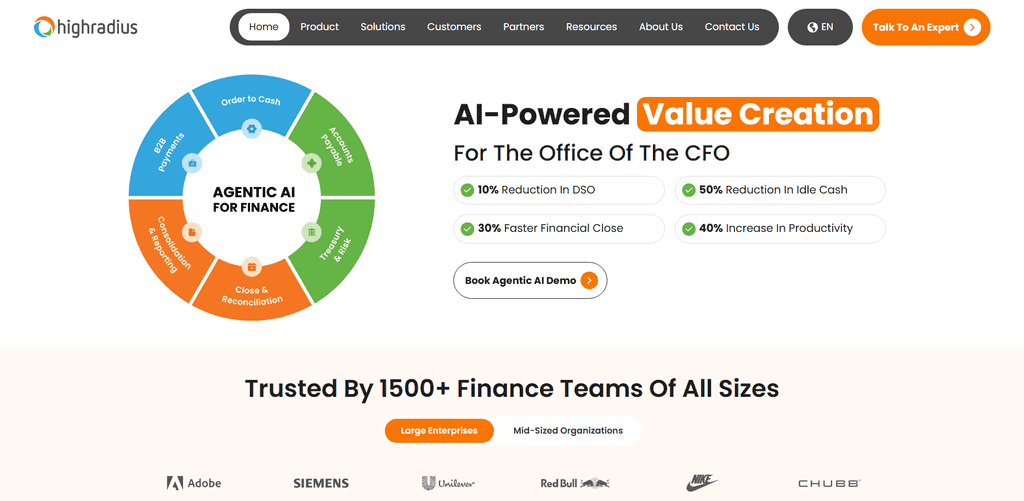
Payment tracking capabilities provide real-time visibility into outstanding invoices and customer payment behavior. Automated payment reminders and collection workflows can help improve on-time payments and decrease Days Sales Outstanding (DSO).
HighRadius also provides cash flow forecasting & analytics that supplements financial planning. It’s best for mid-sized to large businesses that process a high volume of invoices and have more complex receivables operations.
Benefits
- Provides AI-driven cash application and payment reconciliation.
- Automates collections and follows up on payments.
- Credit risk and deduction management support.
- Provides wide ERP integration capabilities.
Cons
- Might be complicated for smaller businesses.
- It can be time-consuming to implement.
- Smaller teams may find the pricing to be expensive.
- Requires training to effectively use advanced features
2. Billtrust
Billtrust offers a complete invoice-to-cash automation platform to help businesses transform their accounts receivable processes. The platform automates invoice delivery via digital and paper channels and offers centralized tracking of payments across multiple payment methods.
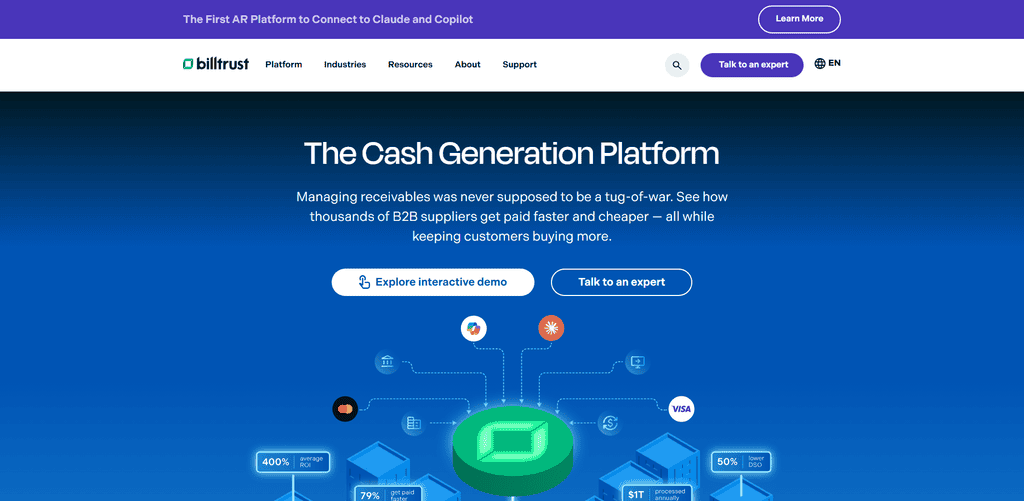
Automated payment reminders and customer communication tools enhance collections efficiency and reduce overdue balance . Billtrust also provides cash flow visibility via reporting dashboards and receivable analytics.
It connects with ERP systems to help financial operations run smoothly. The platform is aimed primarily at B2B companies, mid-market organizations and enterprises looking for end-to-end AR automation and payment management capabilities.
Pros:
- Automates B2B Invoice & Payment Processing.
- Supports digital delivery of invoices.
- Simplifies cash application and reconciliation workflow.
- Provides customer payment portals and payment choices.
Negatives
- May take a lot of setup for complex workflows.
- Price may not be suitable for smaller businesses.
- Advanced features may need additional configuration.
- Broader finance automation may require complementary solution
3. Versapay
Versapay is a collaborative accounts receivable platform that integrates invoice automation with customer interaction tools. Businesses can automate invoice delivery, payment collection and reconciliation and provide customers with a self-service payment portal.
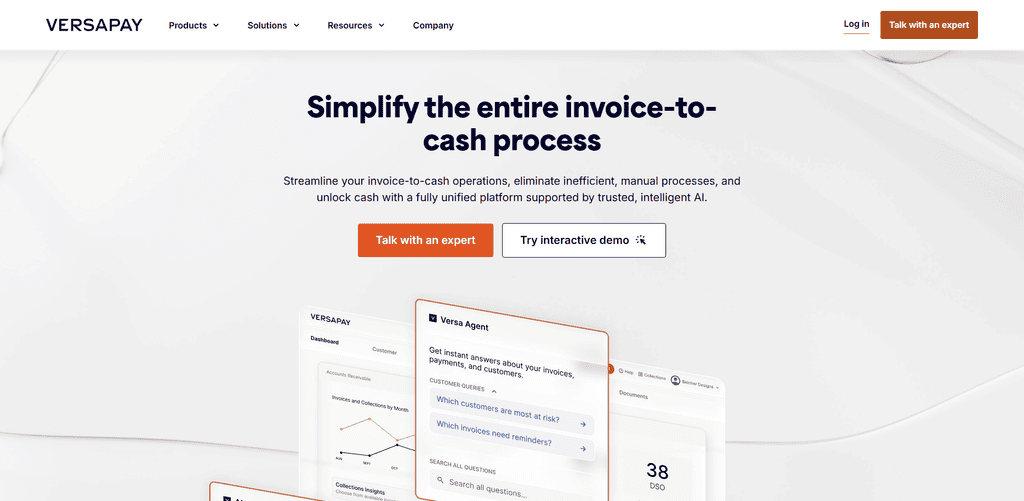
The platform’s payment tracking capabilities allow finance teams to track outstanding invoices and customer interactions in real-time. Automated reminder workflows make sure follow-ups are timely and require minimal manual effort.
Versapay assists with cash flow management with reporting and forecasting tools that increase visibility into incoming payments. B2B companies looking to improve customer relationships and streamline receivables processes particularly favor it.
Advantages
- Collaborative accounts receivable workflows.
- Streamlines payment reminders and collections.
- Provides customer portals for invoice visibility and payment.
- Streamlines communication and dispute resolution.
Cons
- Benefits hinge on customer portal adoption.
- Additional integration work may be required for complex ERP environments.
- Advanced workflows may require setup.
- May not be suitable for businesses needing heavy finance automation beyond Accounts Receivable
4. Esker
Esker’s AI-powered invoice-to-cash automation enables organizations to digitize and streamline their accounts receivable processes. The platform automates the creation, distribution and payment processing of invoices and reduces reliance on manual data entry.
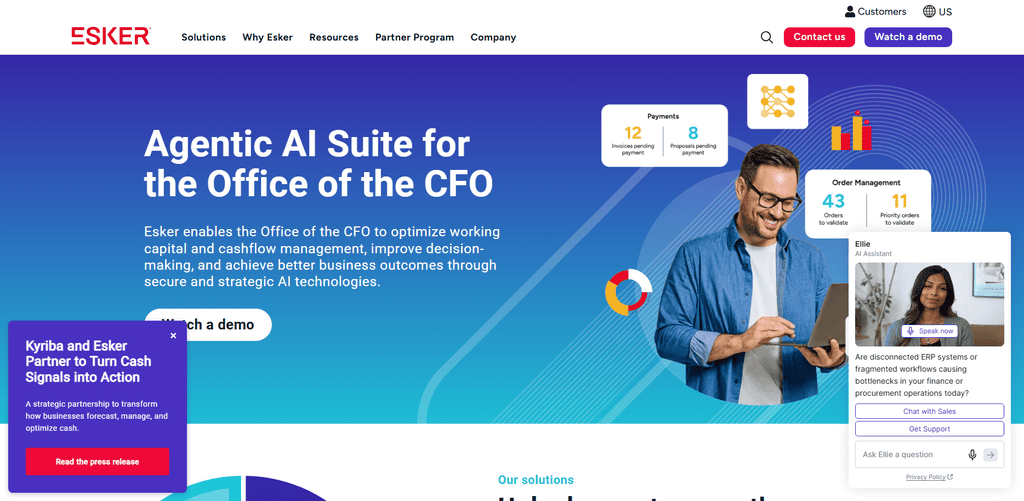
Payment tracking tools give you accurate insight into collections and the status of customer accounts. Esker’s automated reminder and collection workflows help organizations accelerate payment cycles and lower overdue invoices.
The advanced reporting features enable to manage cash flow by getting insights into the performance of receivables and collection trends. The solution is built for global businesses, enterprises and organizations that need to scale their automation across many regions and departments.
Advantages
- Automates invoice to cash workflow.
- Supports electronic invoice and document workflow.
- Provides collections management features.
- Provides integration options with enterprise finance systems.
Cons.
- It can be complicated to implement in large organizations.
- Pricing may be less affordable for small businesses.
- Custom workflows may require technical assistance.
- Users may require training to handle the advanced features
5. Quadient’s YayPay
YayPay’s Quadient AR is an accounts receivable automation solution in the cloud that is designed to enhance collections and payment visibility. The platform automates invoice delivery, payment tracking and customer communication to reduce admin tasks.
Its AI-powered payment tracking identifies collection priorities and identifies accounts at risk of delayed payment. Automated reminders and follow-up sequences help you collect more efficiently while maintaining relationships with your customers.
Features for cash flow management, including forecasting tools, receivables analytics and real-time financial dashboards. YayPay is especially well-suited for small and mid-sized companies that want a modern AR platform that offers predictive insights and streamlined workflows.
Advantages
- Automates customer payment reminders and collections.
- Offers dashboards for tracking outstanding invoices.
- Provides predictive insight to help prioritize collections.
- Helps teams systematically manage customer communications.
Cons
- Implementation may be complex due to integration requirements.
- More work to customize.
- Small teams could have a price concern.
- Some complex disputes might still require manual intervention
6. Sidetrade
Sidetrade is an AI-powered order-to-cash platform that helps businesses improve their accounts receivable performance. The solution automates invoice processing, collection activities, dispute resolution and customer payment management. Its predictive AI analyzes payment behavior to help finance teams determine the best collection strategies and prioritize accounts.

Automated payment reminders reduce the manual effort involved and increase the recovery rate. Sidetrade’s cash flow management tools provide forecasts, risk assessments and collection metrics for performance to help make informed financial decisions. This platform is targeted mainly at large enterprises and multinational organizations looking for advanced AI capabilities within their receivables operations.
Pros
- Uses AI for collection prioritization.
- Helps to predict customer payment behavior.
- Automates receivables workflows and follow ups.
- Visibility of credit risk and cash flow.
Cons
- It could be more complicated than necessary for small businesses.
- Implementation may require changes to processes.
- Needs careful planning for integration with existing systems.
- Teams may need training in the use of advanced analytics.
7. Tesorio
Tesorio is a finance-oriented platform that blends accounts receivable automation with cash flow forecasting. The software makes invoice tracking and collections management easier, while providing insight into payment trends and customer behaviors. Finance teams can track outstanding invoices and collection efforts on one dashboard with its payment tracking system.
Automated reminder workflows keep you on schedule with customer follow-up and minimize delays in collections. Tesorio has particularly strong cash flow management capabilities, with predictive forecasting and receivables analysis to support financial planning. This platform is a great fit for SaaS companies, technology companies and finance teams that are focused on forecast accuracy.
Benefits
- Automates collections processes and follow-up.
- Offers cash flow forecasting functionality.
- Helps prioritize late invoices.
- Increases visibility into receivables performance.
Cons
- Could be overkill for businesses with simple AR needs.
- Data quality matters for forecasting accuracy.
- Different monetary systems have different integration needs.
- Advanced capabilities may require additional configuration
8. Invoiced
Invoiced is a cloud-based accounts receivable platform that simplifies invoicing, payment collection and customer communications. Businesses can automate invoice generation and distribution and offer customers multiple payment options through a self-service portal. Payment tracking tools provide a window into invoice status, outstanding balances and payment histories.
Automated reminder workflows help cut late payments and improve collection efficiency, without creating administrative work. Receivables reporting and collection performance information to manage cash flow. Invoiced is mainly targeted at small and medium businesses that need simple and scalable AR automation features.
Advantages
- It sends out invoices and payment reminders automatically.
- Facilitates online payment collection.
- Streamlines customer billing processes.
- Provides tools for monitoring open receivables.
Cons:
- Customization of complex enterprise workflows.
- Advanced reporting needs may need further configuration.
- Whether it fits with existing business systems.
- Specialized dispute management requirements may require additional processes
9. Upflow
Upflow is a modern accounts receivable management platform that helps businesses accelerate collections and improve cash flow. You can do everything from one system, from following up on invoices and communicating with customers to tracking payments. Practical insights allow finance teams to track payments in real time and prioritize collection efforts.
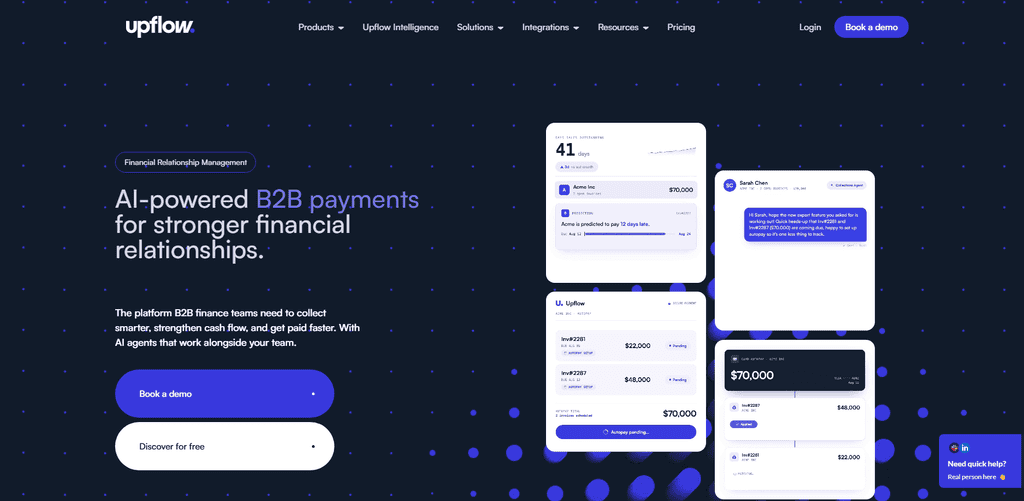
Automated payment reminders are personalized to maximize response rates and maintain good customer relations. Upflow also gives you cash flow visibility with dashboards, analytics, and forecasting tools. The platform is particularly popular with B2B companies, SaaS providers and fast-growing companies that need efficient AR management solutions.
Benefits
- Automates the payment reminders and collections processes.
- Provides dashboards to view receivables.
- Helps teams prioritize customer accounts that are overdue.
- Provides support for integration with accounting and billing systems.
Cons
- May be not suitable for highly complex enterprise processes .
- Features differ by plan selected.
- Check compatibility of integration before implementation.
- Cash application requirements may require higher tier capability
10. Gaviti
Gaviti is an AI-powered platform for collections automation that streamlines the management of receivables and improves payment performance for organizations. The software automates the chasing of invoices, customer contact and collection processes, reducing the need for manual intervention. Its payment tracking features give finance teams visibility into overdue accounts and collection efforts.
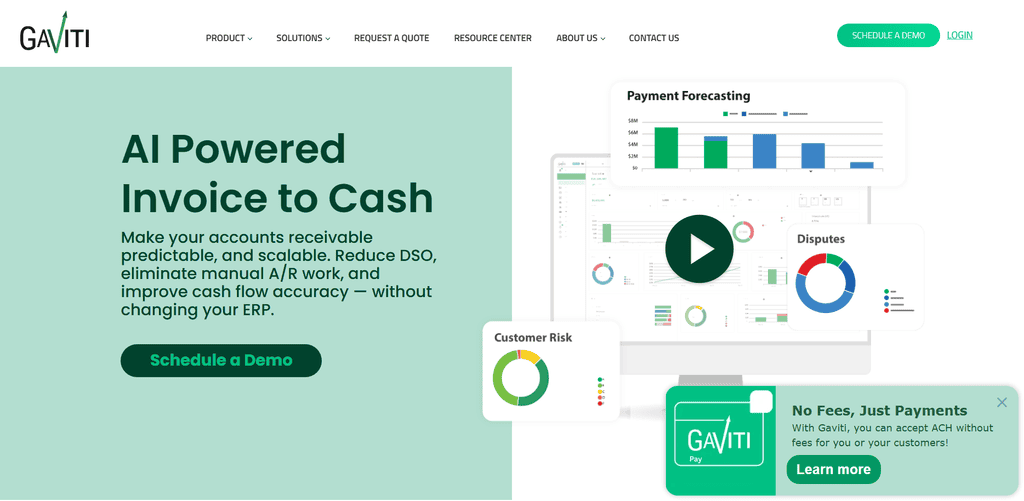
Payment reminders can be automated and customized based on customer segments and payment behavior. Cash flow management includes collection analytics, aging reports and performance dashboards to help businesses optimize working capital . Gaviti is ideal for credit, collections and finance teams managing large customer portfolios.
Advantages
- Automates collections workflow and payment follow-ups.
- Helps to prioritize the overdue invoices.
- Gives visibility into collection team activities.
- Gives structured communication with customers.
Disadvantages
- Additional configuration might be needed for more complex workflows.
- Verify that the integration is compatible.
- The pricing may depend on the business requirements and usage.
- Manual review may still be necessary for some exceptions.
Conclusion
AI-based accounts receivable automation tools can help companies streamline their invoicing process, speed up payment collection, reduce manual errors, and enhance their cash flow management. Tools like HighRadius, Billtrust, Versapay, Esker and Tesorio offer features to streamline receivables processes and provide a deeper view into finances.
But your business size, automation needs, integration capabilities, pricing, data security, and other factors will determine the right solution for you. Businesses should look at the features, scalability and ease of use of each platform before making a decision. Choosing the right AI-powered software can help finance teams improve productivity, manage outstanding payments more effectively, improve customer relationships and drive long-term business growth.
FAQ
What is AI accounts receivable automation?
AI accounts receivable automation uses artificial intelligence to streamline invoicing, payment tracking, cash application, payment reminders, and collections, helping businesses reduce manual work and improve financial efficiency.
What are the best AI accounts receivable automation tools?
Some popular options include HighRadius, Billtrust, Versapay, Esker, Quadient AR (YayPay), Sidetrade, Tesorio, Invoiced, Upflow, and Gaviti. The best choice depends on business requirements and budget.
How does AI improve accounts receivable management?
AI analyzes payment patterns, automates repetitive tasks, identifies overdue invoices, prioritizes collection activities, and provides predictive insights, helping finance teams improve collection efficiency and cash flow visibility.
Can AI accounts receivable tools reduce late payments?
Yes, these tools can schedule payment reminders, identify customers likely to pay late, and prioritize follow-ups. These capabilities encourage timely payments, although results depend on customer behavior and business processes.