


Crypto investing has become a much more complicated affair for U.S. investors and traders, especially when transactions are spread across exchanges, wallets, DeFi platforms, staking rewards and NFTs. Any sale, trade, payment or disposal can create a taxable event and recordkeeping can be slow and error prone.
The Best Crypto Accounting Software for US Investors and Traders can help you import transactions, reconcile balances, calculate cost basis and gains, and prepare IRS-ready reports like Form 8949 and Schedule D. This guide compares the leading platforms to help you pick the best one for your trading activity, budget and tax-filing needs.
What Is Crypto Accounting Software?
Crypto accounting software is a specialized tool for automating the recording, classification, reconciliation, and reporting of cryptocurrency and digital asset transactions. Connects to exchanges, wallets, blockchains, and custodians to track trades, transfers, payments, staking, DeFi activity, fees, and asset balances.
It calculates fiat values, cost basis, and realized or unrealized gains and losses and generates audit-ready journal entries for accounting systems such as QuickBooks, Xero or NetSuite. It’s not just a tax calculator, but it helps with ongoing bookkeeping, GAAP or IFRS reporting, compliance, and financial controls.

How to Choose the Best Crypto Accounting Software in the USA?
Identify your needs: Before comparing platforms, identify your transaction volume, asset types, DeFi activity, entities, and whether you need bookkeeping, tax reporting, or enterprise-grade accounting.
U.S.-specific availability: Make sure the software is available to U.S. users, shows prices in USD, has North American support hours, and can accommodate U.S. reporting requirements such as Form 8949 and 1099-DA workflows.
Check integrations: See that it integrates natively with your exchanges, wallets, custodians, blockchains and accounting systems such as QuickBooks, Xero or NetSuite.
Test reconciliation: Use software that can reconcile blockchain data, the crypto subledger and your general ledger, to automatically detect missing transactions or balance mismatches.
Tax reporting review: Ensure it calculates cost basis, gains, losses and income, and produces IRS-ready reports or integrates with TurboTax, TaxAct, or your CPA’s software
Evaluate audit trails: Look for records that can be traced back to the journal entries, including transaction hashes, wallet addresses, pricing sources, classifications, and manual adjustments for auditor review.
Assess Security & Controls: Insist on encryption, role-based access, approval workflows, audit logs, SOC reports, and explicit data-residency options before sharing treasury or financial data.
Compare pricing and support: Compare subscription cost, transaction limits, onboarding, quality of customer support, scalability, and free trials. Test drive two finalists with your real data.
10 Best Crypto Accounting Software for US Investors and Traders
1. Koinly
Koinly is a popular crypto tax and portfolio platform used by individuals in 100+ countries. The free plan includes tracking and a gains preview, and paid reports start at $49 for 100 transactions, $99 for 1,000, and $199+ for 3,000+ per tax year. It supports thousands of cryptocurrencies and integrates with 800+ exchanges, wallets, blockchains and Defi protocols via API or CSV imports.
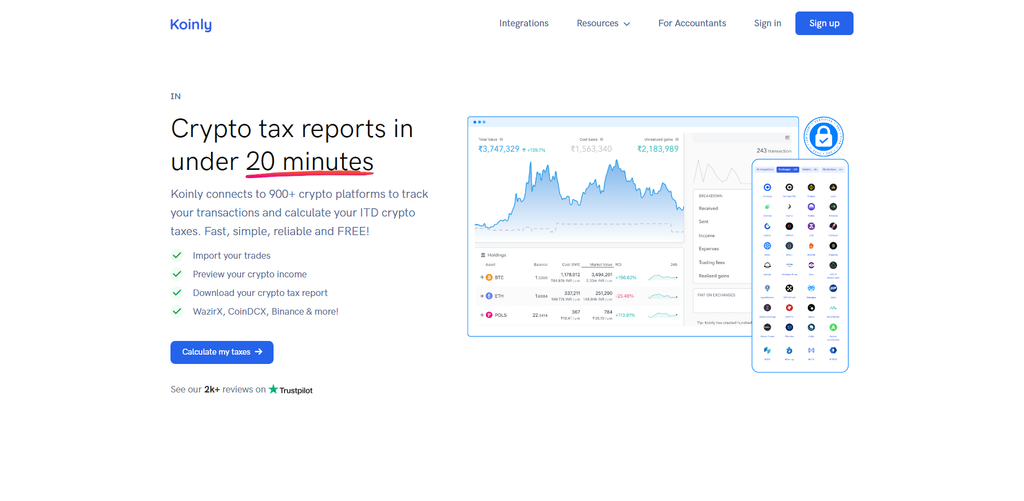
Koinly tracks trades, transfers, staking, lending, NFTs and unreaized gains, with tax-loss-harvesting insights. Generates Form 8949, Schedule D, income reports and TurboTax/TaxACT-compatible exports. Tax professionals may get it via a professional portal, but Koinly’s support team doesn’t provide tax advice or filing services.
Main Features
- Import transactions from multiple cryptocurrency exchanges, wallets and blockchain networks.
- Automatically tracks cryptocurrency trades, transfers, staking rewards, mining income and DeFi activities.
- Computes capital gains, capital losses and cost basis using FIFO, LIFO and HIFO methods.
• Produces U.S. tax reports such as IRS Form 8949 and Schedule D. - Portfolio tracking, missing transaction detection and automatic transfer matching.
Limitations
- Some complex DeFi transactions may need to be manually classified and fixed.
- Tax reports can be downloaded with a paid subscription.
- The price rises with the volume of the transaction and reporting requirements.
- Limited historical data may be available for some exchange and blockchain integrations.
2. CoinTracker
CoinTracker is a crypto tax reporting tool that has portfolio tracking features and is popular with Coinbase users. Pricing starts at $59 for 100 transactions and can rise to about $599-$1,999 for higher volume plans. A Full Service option is listed at $3,499 annually. It supports major cryptocurrencies, DeFi protocols and NFTs with 500+ integrations across exchanges, wallets and blockchains.

The platform automatically imports transactions, categorizes income and disposals, matches transfers, and tracks portfolio performance and tax-loss harvesting. CoinTracker generates capital gains and income reports, Form 8949, Schedule D data, and integrations with TurboTax and H&R Block. Users can invite their own tax professional and the Full Service plan includes expert reconciliation support.
Main Features
- Compatible with leading cryptocurrency exchanges, wallets and blockchains.
- Automatically tracks transactions and monitors portfolio balance.
- Calculates crypto tax liabilities, capital gains and capital losses.
- Supports US tax reporting and integration with TurboTax and other tax filing services.
- Portfolio performance analysis, transaction history and tax-loss harvesting insights.
Study limitations
- Subscription costs may increase significantly for high volume traders.
- Advanced tax reporting features are available in paid plans.
- Some DeFi and complex blockchain transactions require manual review.
- Tax calculations rely on complete and accurate exchange and wallet records.
3. Coin Ledger
CoinLedger is a crypto tax platform that is friendly for beginners and offers free portfolio tracking and pay-per-report tax filing. Reports cost $49 for 100 transactions, $99 for 1,000 and $199+ for 3,000+. Optional expert tax-return preparation is billed hourly starting at $200. Supports a host of assets including DeFi, NFTs, staking, and airdrops with 1,000+ exchange, wallet, and blockchain integrations.
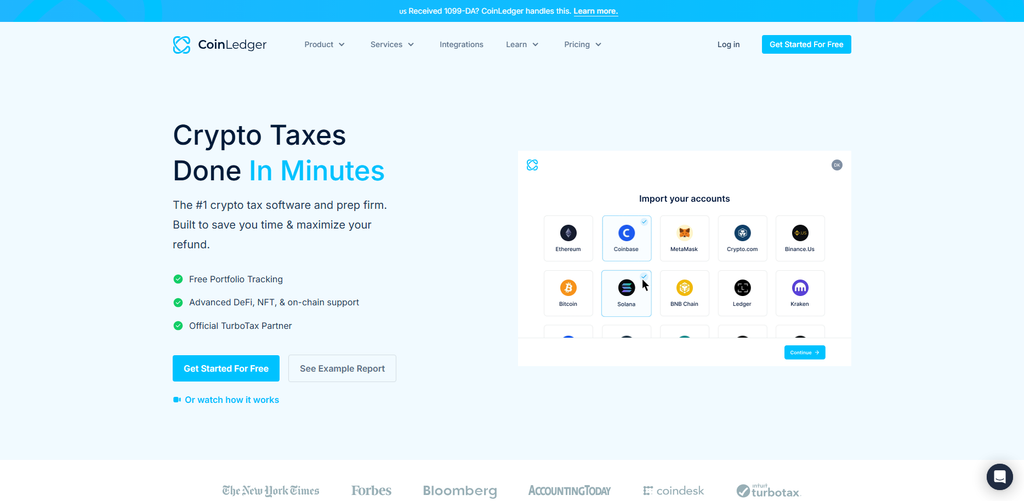
Transactions imported via API or CSV are automatically categorized into trades, income, fees and transfers, with gas-fee capture and reconciliation tools. CoinLedger prepares IRS Form 8949, income statements, audit trails and provides import options to TurboTax Online/Desktop, TaxACT and H&R Block. You can also pay for an expert review or hourly tax prep help.
Main Features
- US tax reporting: Calculates capital gains, capital losses and cost basis.
- Tracks buying, selling, swapping, staking, mining, and NFT transactions.
- Generates reports for IRS Form 8949 and Schedule D, including tax software export options.
- Import cryptocurrency transactions from exchanges, wallets and blockchain networks.
- Transaction reconciliation, portfolio tracking and comparison tools for Form 1099-DA.
Constraints
- You can download tax reports for a fee.
- Increased transaction volumes may lead to greater reporting costs.
- Might need manual transaction imports for unsupported protocols.
- Complex DeFi activities may require further reconciliation
4. ZenLedger
ZenLedger is a U.S.-focused crypto tax platform for investors who require detailed reporting and access to tax professionals. Silver starts at $49 for 100 transactions, Gold is $199 for 5,000, and Platinum is $399 for 15,000 transactions. It supports major cryptocurrencies, 400+ exchanges and wallets, 100+ DeFi protocols and 10+ NFT platforms.

ZenLedger tracks transactions across exchanges, wallets, and DeFi. It supports FIFO, LIFO, and HIFO accounting methods and has tax-loss-harvesting and audit-report features. It generates Form 8949, Schedule D, Income reports, FBAR/FinCEN alerts, and TurboTax/TaxAct integrations. Tax Pro Access and partner CPA filing services provide support from tax professionals during filing season.
Key Features
- Bridges crypto exchanges, wallets, and blockchains to import transactions.
- Tracks crypto trades, staking rewards, mining income, NFTs and DeFi transactions.
Calculates capital gains, losses and cost basis using supported accounting methods. - Produces US tax reports like Form 8949 and Schedule D.
- Provides tax-loss harvesting tips and expert tax preparation guidance.
Limitations
- Advanced reporting and DeFi features might require higher-tier subscriptions.
- The price may vary depending on the volume of transactions and other services.
- Some complex blockchain transactions need manual tweaking.
- Transactions import may contain gaps if unsupported exchanges and protocols are used
5. TokenTax
TokenTax is crypto tax software and a full-service accounting firm, ideal for investors with complex portfolios or those who want a professional filing. Pricing starts at $65 for 100 transactions, Premium is around $199 for 5,000 transactions and VIP is $3,499 for advanced reconciliation and full-service preparation.
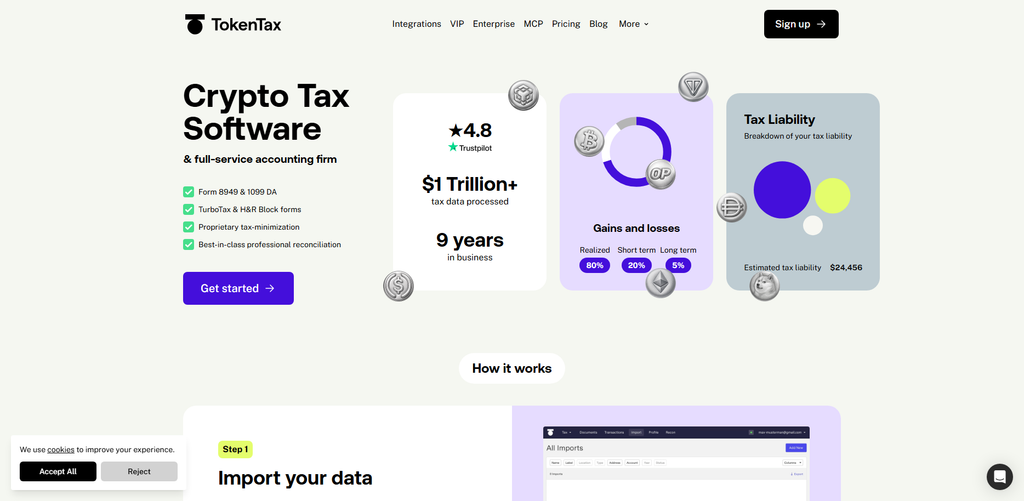
It supports major centralized exchanges, wallets, DeFi platforms, and NFT marketplaces through API and CSV imports. TokenTax tracks trades, transfers, staking, DeFi, NFTs, and cost basis by FIFO, LIFO, and specific-identification methods.
It generates Form 8949, income reports, audit trail reports and TurboTax compatible exports. Its biggest plus is having in-house CPAs and enrolled agents who can prepare, review and file returns, especially on its higher tiers.
Main Features
- Extracts crypto currency transaction data from exchanges, wallets and trading platforms.
- Computes capital gains, capital losses and crypto-related taxable income.
- Produces tax forms and US tax reporting (Form 8949)
- Reconciliation of NFT and DeFi, margin trading and staking transactions.
- Supports CPA and tax professionals on complex crypto tax returns.
Limitations:
- Professional tax preparation services can be costly.
- Pricing can jump up significantly for high-volume trading accounts.
- Some transactions require manual reconciliation and documentation.
- No depth with exchange integrations & automated imports vs some competitor
6. CoinTracking
CoinTracking is a proven crypto portfolio and tax platform that’s a great fit for active, high-volume traders. It features a free plan for up to 200 transactions, Starter at $49/year, Pro at $169/year for 3,500 transactions, Expert from $259/year for 20,000-100,000 transactions and Unlimited at $899/year. Supports 5000+ cryptocurrencies and 400+ exchanges, wallets and blockchains with API, CSV, blockchain and manual imports.
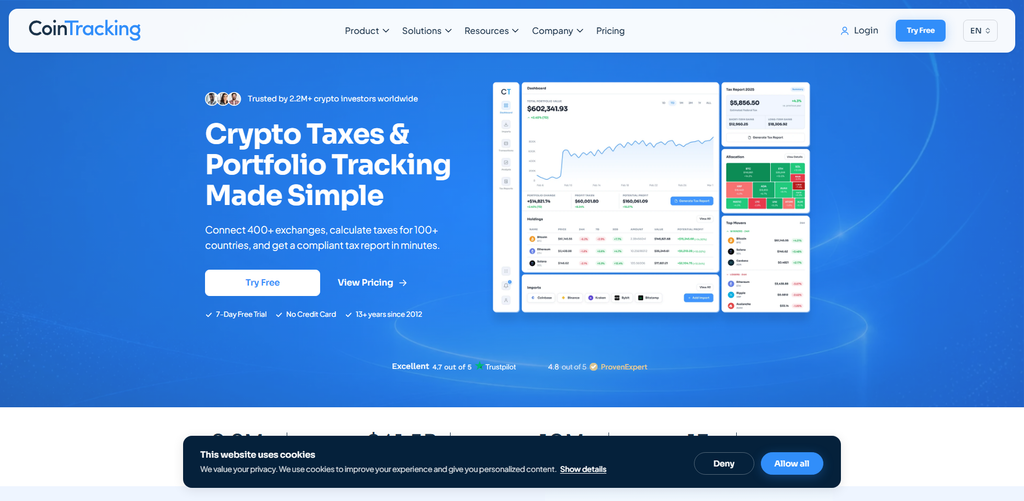
CoinTracking tracks balances, realized and unrealized gains, DeFi, NFTs, and transaction history. Paid tiers offer daily auto-sync for up to 100 accounts. It has 25+ reports, Form 8949, Schedule D, FBAR/FATCA information, and TurboTax exports. Corporate plans are CPA-oriented and tax-data preparation via CPA partners is available for professional use
Main Features
- Gives detailed portfolio tracking, trading history and asset performance reports.
- Import cryptocurrency transactions from multiple exchanges and wallets is supported.
- Computes capital gains, losses and cost basis using FIFO, LIFO, HIFO and other methods.
- Generates US tax forms such as Schedule D and Form 8949
- It offers transaction analysis, reconciliation tools and comprehensive portfolio reporting.
Limitations
- Beginners might find the interface challenging to use.
- Access to more sophisticated reporting features requires a paid subscription.
- Wrong imports can lead to duplicate transactions and cost-basis mismatches.
- Some DeFi transactions are complex and may need manual adjustments
7. TaxBit
TaxBit is primarily a crypto tax-compliance platform for enterprises and institutions, rather than a mass-market consumer filing tool. It pulled its individual product in January 2023, and now serves exchanges, brokers, DeFi platforms, enterprises and government agencies, with institutional pricing widely reported in the thousands of dollars per month.

Its API-first system supports digital currencies across major blockchains and integrates with exchanges, wallets, accounting systems and reporting infrastructure. TaxBit tracks transactions, normalizes data, calculates cost basis, and reconciles 1099s with actual activity.
It generates IRS-ready Form 8949 and Schedule D outputs, as well as income reporting for staking, rewards, and airdrops. Higher tier enterprise offerings include CPA review and real-time reporting. Professional support is available.
Main Features
- Provides enterprise-grade crypto tax compliance and accounting infrastructure.
- Automates the acquisition and reconciliation of digital asset transaction data.
- Allows digital asset tax calculations and cost-basis tracking.
- Enterprise reporting, audit trails, compliance data management.
- Provides API-based integration capabilities for exchanges, financial institutions and enterprises.
Restrictions
- It stopped its former consumer tax product.
- Primarily aimed at enterprises, exchanges and institutional clients.
- Prices and service packages typically tailored for corporate customers.
- It may not be suitable for individual investors’ personal tax filing needs
8. Cryptocurrency Tax Calculator
“Crypto Tax Calculator” can refer to a general class of tools, or to CryptoTaxCalculator – a platform to calculate your crypto gains and losses. Generally, top calculators offer free imports and previews, then charge about $49–$499+ annually depending on transaction volume and features. They support thousands of cryptocurrencies, major exchanges, wallets, DeFi protocols and CSV imports for less common platforms.
Transaction tracking generally covers trade matching, transfer detection, income classification, staking rewards, airdrops, and gas-fee treatment. Most calculators export to TurboTax, H&R Block or TaxAct and produce Form 8949 and Schedule D summaries and income reports. Provider professional support varies, with some providing CPA directories, expert review or accountant portals, and others providing only customer support.
Main Features
- Imports crypto transaction histories from exchanges, wallets and blockchain networks.
- Monitors DeFi transactions, NFTs, staking rewards, and other digital asset activities.
- Calculates capital gains, losses and taxable income for cryptocurrency.
- Prepares US investor tax reports such as Form 8949 and Schedule D.
- Offers crypto tax professionals transaction classification, reconciliation and accounting tools.
Limitations
- Tax reports are downloadable with a paid plan.
- Complex transactions may require manual classification.
- Pricing depends on the number of transactions and the requirement for advanced reporting.
- Certain blockchain protocols and exchange integrations might have limited support
9. Ledgible
Ledgible is a crypto tax platform with separate consumer and professional products, and is especially good for CPAs and accounting firms. Consumer tracking is free all year long; reports start at $49 per tax year. Professional pricing is $49 per client per tax year + transaction-based increments. It supports natively connected exchanges and wallets, as well as file imports and manual entry for other sources.
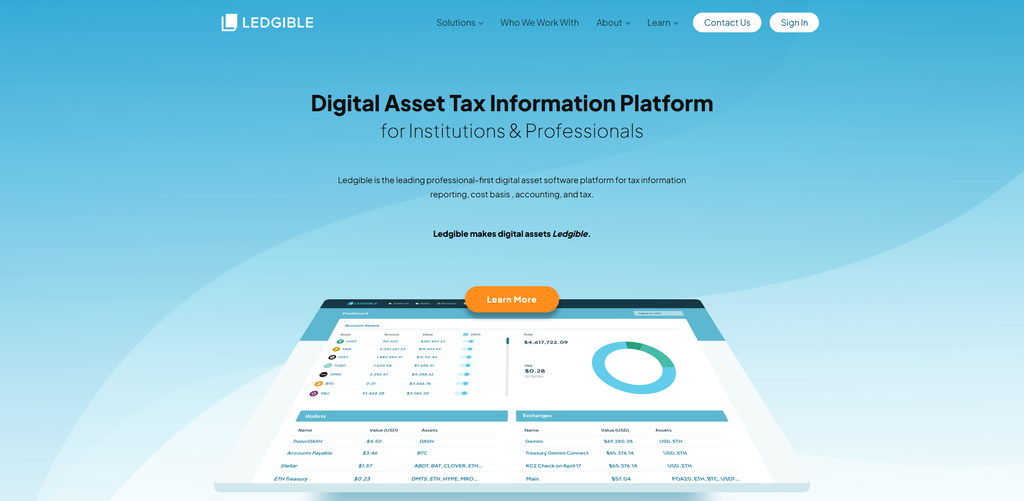
Ledgible tracks transaction history, cost basis, fees, gains and losses, and estimated tax exposure across your connected accounts. It produces IRS Form 8949, TurboTax and TaxAct imports and reports compatible with professional systems such as UltraTax CS, GoSystem Tax RS and CCH Axcess. Tax pros get client-management tools, flexible client-pay or preparer-pay billing and 24/7 support.
Main features
- Provides tax reporting and accounting solutions for electronic assets to financial institutions and businesses.
- Tracks cryptocurrency transactions and calculates cost basis.
- Provides tax reporting and compliance workflows for digital asset activity.
- Combines financial reporting and accounting data.
- Supports institutional workflows, audit documentation and requirements for professional tax preparation.
Limitations
- Generally targeted at institutions and the professional user, not the casual investor.
- The pricing is usually adapted to the needs of business.
- Implementation may require additional technical and accounting support.
Individual investors may not require its enterprise-level features.
10. Accointing.
Accointing is a crypto portfolio tracker and tax reporting tool for retail investors in multiple jurisdictions. It offers a free tier with basic tracking and limited reporting, and paid plans are usually $79-$299 per year for higher transaction volume, analytics and advanced reports. It supports most major cryptocurrencies and connects with exchanges such as Coinbase, Binance, Kraken and hardware wallets via API and CSV imports.

The platform has a single dashboard to track holdings, transactions, performance, income, airdrops, staking and DeFi yields. Accointing generates country-specific tax reports like IRS Form 8949 for U.S. users, UK HMRC capital-gains summaries, and TurboTax-compatible exports. It also has CPAs that help keep its tax logic up-to-date, so there is some professional tax oversight.
Key Features
- Historically offered tools to track your cryptocurrency portfolio and calculate taxes.
- Added support for importing exchange and wallet transactions.
- Crypto trades, transfers & portfolio performance tracking.
- Provided capital gains calculations and tax reporting capabilities.
- Conducted portfolio analysis and historical transaction classification.
Limitations
- Its standalone consumer product has been trimmed or de-prioritized.
- New tax reporting features are in limited supply.
- Current users might have to migrate their transaction history.
- Not a good option for new US investors needing current tax filing support.
Comparison Table of the Best Crypto Accounting Software
| Software | Best for | Starting price | Crypto coverage | Ledger / ERP integration | Tax & compliance support |
|---|---|---|---|---|---|
| Ledgible | CPA firms, mid-market businesses, tax-ready accounting | $49/month for 200 transactions; $100 per additional 2,500 transactions; enterprise custom | 20+ blockchains; exchanges, wallets, custodians | QuickBooks Online, Xero, NetSuite, Advent Geneva; UltraTax CS, CCH Axcess, Lacerte, DrakeTax spark+1 | U.S. GAAP support, Form 8949, TurboTax/TaxAct, professional tax workflows |
| Cryptio | Enterprises, asset managers, regulated institutions | $449/month Basic; $899/month Pro; Enterprise quote-based | 150+ blockchains, exchanges, custodians, DeFi protocols; 60,000+ smart contracts labeled breezing+1 | Native NetSuite, QuickBooks, Xero; SAP, Oracle Fusion, Dynamics 365, Sage, Workday milkroad+1 | GAAP/IFRS workflows, audit trails, SOC 1 and SOC 2 Type 1/2 breezing+1 |
| Bitwave | Enterprise digital-asset accounting and tax | Quote-based | 80+ blockchains; deep block-level DeFi support techdogs+1 | QuickBooks, Xero, NetSuite, Sage Intacct, Oracle, Workday coinledger+1 | GAAP/IFRS, impairment, mark-to-market, audit trails, SOC 1 Type 2 and SOC 2 Type 2 coinledger+1 |
| Cryptoworth | Growing crypto finance teams and multi-chain operations | Free up to 100 transactions; $285–$910/month tiers; enterprise quote-based | 800+ DeFi protocols claimed; broad exchange and chain coverage breezing+1 | QuickBooks, Xero; NetSuite in enterprise tier milkroad+1 | Cost basis, gain/loss tracking, reconciliation, SOC 2 Type 1 and 2 breezing+1 |
| TRES Finance | Complex multi-chain, DeFi, and Web3 accounting | Demo/quote-based | 250+ blockchains; strong automated DeFi detection | NetSuite, QuickBooks, SAP, Xero | GAAP/IFRS, SOC 1/SOC 2, PCAOB-related compliance positioning |
| SoftLedger | Businesses wanting crypto and traditional accounting in one ledger | $1,125/month billed annually; $13,500/year for 3 users with unlimited entities fitsmallbusiness+1 | Digital-asset add-on with cost basis and gain/loss tracking | It replaces the general ledger rather than syncing to QuickBooks/Xero coinledger+1 | Multi-entity accounting, SOC 1 Type II, crypto asset tracking fitsmallbusiness+1 |
| Breezing | SMBs and accounting firms using QuickBooks or Xero | $29–$2,917/month | 80+ chains and exchanges | QuickBooks Online, Xero, Bexio | Double-sided journal entries, crypto invoice closure, SOC 2 audit completed |
| QuickBooks Online | Small businesses with occasional crypto transactions | $38/month | No native crypto accounting; requires a crypto subledger | Native accounting ledger; receives entries from Ledgible, Bitwave, Cryptio, etc. coinledger+1 | Standard accounting and tax workflows; crypto tax forms require an integrated tool coinledger+1 |
Conclusion
The best crypto accounting software will depend on the size of your business, the number of transactions you make, how active you are in DeFi, and what reporting you need to do. There’s no one-size-fits-all winner: Cryptio is best for regulated, multi-entity businesses; Bitwave is a fit for crypto-native teams that need broad ERP and treasury workflows
Ledgible is powerful for CPA-led tax compliance, Cryptoworth and Breezing are better suited for smaller teams, and SoftLedger works best when businesses want both crypto and traditional accounting in one ledger. The practical solution in most cases is a crypto subledger that reconciles wallets and exchanges and then posts audit-ready journal entries into QuickBooks or Xero.
FAQ
What is crypto accounting software?
It automates tracking, pricing, reconciliation, and reporting of crypto transactions. It connects to exchanges, wallets, blockchains, and custodians, calculates cost basis and gains, and posts journal entries to QuickBooks, Xero, or NetSuite
Do I need it if I already use QuickBooks?
Yes, if you hold or transact crypto regularly. QuickBooks is not crypto-native, so a crypto subledger is needed to track wallets, token transfers, fees, and lot-level cost basis before syncing entries into QuickBooks
What is a crypto subledger?
A crypto subledger is a specialized record that tracks digital-asset activity in detail, then rolls it into clean journal entries for your general ledger. It acts as the source of truth for blockchain and exchange balances.
Can it calculate crypto taxes?
Many platforms calculate realized and unrealized gains, losses, and cost basis. They can generate Form 8949 data for Schedule D, although businesses should have a CPA review complex transactions and tax positions