
You don’t have to buy the entire property or deal with tenants yourself when investing in real estate. As online investment opportunities have increased, real estate crowdfunding platforms have made it easier to invest in residential, commercial and rental property with smaller amounts of capital.
In this article I will explain the Best Real Estate Crowdfunding Platforms. I will compare minimum investment amounts, property options, fees, investor eligibility, key features, and limitations so you can decide which platform is best for your investment goals.
What Are Real Estate Crowdfunding Platforms?
Definition: Real estate crowdfunding platforms are online investment services that allow multiple investors to pool their funds to invest in real estate-related opportunities.
Fractional Ownership: These platforms let investors purchase shares or fractional interests in properties without needing to buy an entire residential or commercial building.

Investment Opportunities: Investors have the opportunity to invest in different types of properties including rental homes, apartments, office buildings, industrial properties and development projects.
Low Investment Requirements: Many platforms have lower entry requirements than traditional property purchase, making real estate investing accessible to investors with smaller budgets.
Income Generation: Investors can earn returns from rental income, interest payments, property appreciation, or profits from the sale of investment projects.
Investment Structures: Platforms offer various investment models, such as debt investments, equity investments, real estate funds, REITs, and tokenized property interests.
Property Management: Many platforms partner with professional property managers and real estate sponsors to manage property operations, maintenance, financing, and project execution.
Risk and liquidity: Real estate crowdfunding is subject to market risks, potential capital loss and limited withdrawal options. Research and evaluation of the investment holding period are key.
How to Choose the Best Real Estate Crowdfunding Platform?
Minimum Investment Look at the minimum investment rules of different platforms to find opportunities that fit your capital and target investment budget.
Investment Types: Verify whether the platforms provide residential properties, commercial buildings, rental houses, real estate debt, equity investments or diversified property funds.
Who Can Invest: Check whether the platform is open to accredited investors, non-accredited investors, or both — and what the accreditation requirements are.
Fees and Charges: Look at management fees, servicing fees, transaction fees, and any other costs that could eat into your overall investment returns.
Expected Returns: Evaluate historical performance, expected returns, rental income potential and investment risks. Do not assume that any returns advertized are guaranteed.
Liquidity Options Before parking your money into long-term property investments, know the policies for withdrawal, redemption schedule, availability in the secondary market and holding period.
Platform Transparency: Evaluate the credibility of the platform by reviewing property information, sponsor experience, financial documents, investment strategy, and reporting practices.
Risk and Diversification Compare property locations, investment structures, reliability of sponsors, and diversification options to avoid putting all your capital into one real estate project.
Key Comparison Table
| Platform | Main Investment Focus | Investment Type | Minimum Investment* | Best For |
|---|---|---|---|---|
| 1. Fundrise | Residential and commercial real estate | Diversified real estate funds | $10 | Beginner investors and portfolio diversification |
| 2. Groundfloor | Residential property development | Real estate loans and debt investments | $10 | Short-term real estate lending |
| 3. Arrived | Rental and vacation homes | Fractional property ownership | $100 | Investing in individual rental properties |
| 4. Ark7 | Single-family rental properties | Fractional property shares | $20 | Fractional rental property investing |
| 5. Concreit | Income-producing real estate | Pooled real estate investments | $1 | Low-cost entry into real estate investing |
| 6. Lofty | Residential rental properties | Tokenized property ownership | $50 | Blockchain-based fractional property investing |
| 7. EquityMultiple | Commercial real estate | Debt, preferred equity, and equity | $5,000 | Accredited investors seeking commercial deals |
| 8. CrowdStreet | Commercial and institutional real estate | Private real estate offerings and funds | Varies by offering | Accredited real estate investors |
| 9. Willow Wealth | Real estate and alternative assets | Private market investments and funds | Varies by offering | Alternative investment diversification |
| 10. Relli | Sponsor-led real estate opportunities | Individual sponsor offerings | Varies by offering | Comparing independent real estate sponsors |
1. Fundrise
Fundrise is a US-based platform for investing in real estate and private credit. It was created in 2012 to make private market investing more diversified and accessible to regular investors. It provides pooled funds in residential and commercial property, credit and private companies, where investors choose a goal-based plan rather than individual properties.
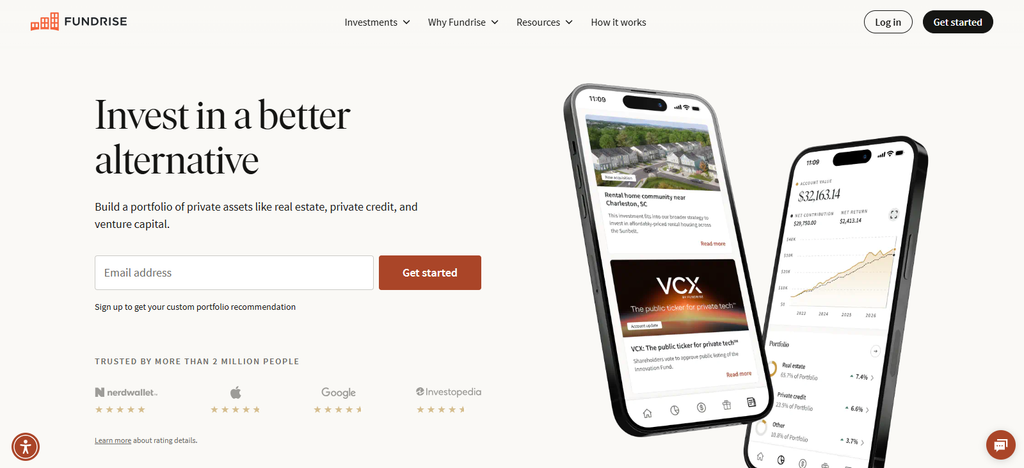
The minimum is $1,000 for IRAs and $10 for taxable accounts. Most offerings are available to non-accredited U.S. investors. Some Regulation D funds are accredited-only. The property does not directly own the property but uses funds managed by Fundrise. Investors pay 0.15% advisory plus 0.85% management fees annually plus underlying fund costs.
Main Features
- Provides a range of real estate investment funds for residential and commercial property exposure.
- Low initial investment, making it a great entry point for beginners in real estate investment.
- Enables you to make automated, recurring investments to grow your portfolio over time.
- Offers multiple income and long term growth investment strategies.
- Offers online portfolio tracking and investment performance monitoring.
Major Limitations
- Investors in pooled funds have little say over which individual properties are chosen on their behalf.
- Redemptions are subject to fund conditions and quarterly redemption limits.
- Annual advisory and management fees that eat into overall investment returns.
- Certain investment options have long holding periods and poor liquidity. ## 2. Groundfloor
2. Groundfloor
Groundfloor is a private-markets platform based in Atlanta, focused on short-term, real-estate-backed loans to residential developers and fix-and-flip borrowers. The company was founded in 2013. Investors may invest in individual loans or Notes generally secured by first or second lien with loan terms of around 6 to 12 months. Minimum is $10 for individual Loans and $100-$1,000 for Notes.
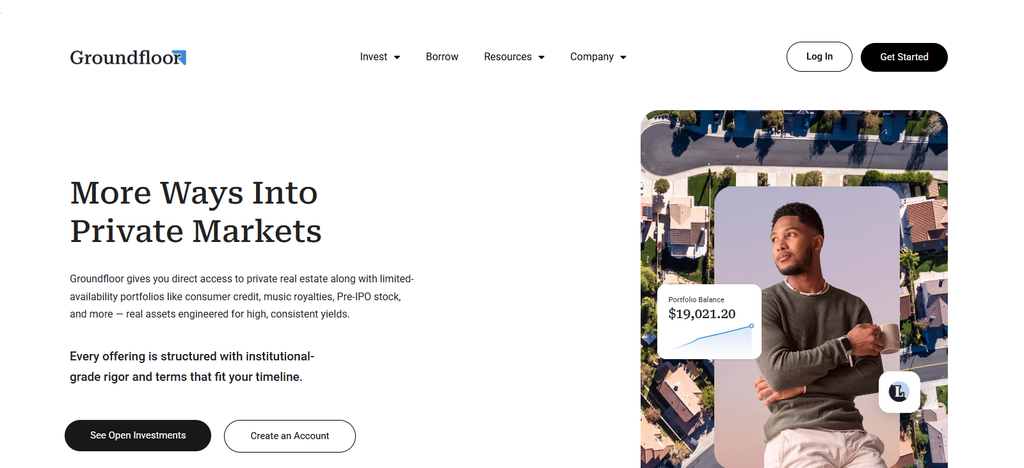
Which U.S. investors can participate will be determined by the rules for each product, but they can be accredited and non-accredited. The investment is debt-based, so investors receive contractual interest payments instead of equity in the property. Groundfloor says there are no investor fees for Notes or Loans, but its Flywheel portfolio has a 1.0% management fee that is deducted from distributions. Origination-related fees are usually paid by borrowers.
Specifications
- Fractional ownership opportunities in residential mortgage loans.
- Allows you to invest in individual property-backed loans with low minimum investments.
- Supports the short-term real estate debt investment opportunities.
- Enables investors to choose specific loan investments based on project information.
- Investment options available to many non-accredited investors in the US.
Key limitations
- Returns depend on borrowers repaying their loans in accordance with agreed terms.
- Borrower defaults could delay payments or cause losses on your investment.
- Loans are generally held to maturity by investors.
- Investment opportunities are dictated by the loan inventory and borrower appetite.
3. Arrived
Arrived, which launched in Seattle in 2019, allows investors to buy fractional shares of individual U.S. single-family rental and vacation homes, as well as diversified real-estate funds. The platform’s emphasis is on accessible, homeownership style investing without the need for investors to manage properties. The minimum investment is $100. . It is generally available for U.S. citizens and green-card holders 18 and over, without accreditation for regular offerings.
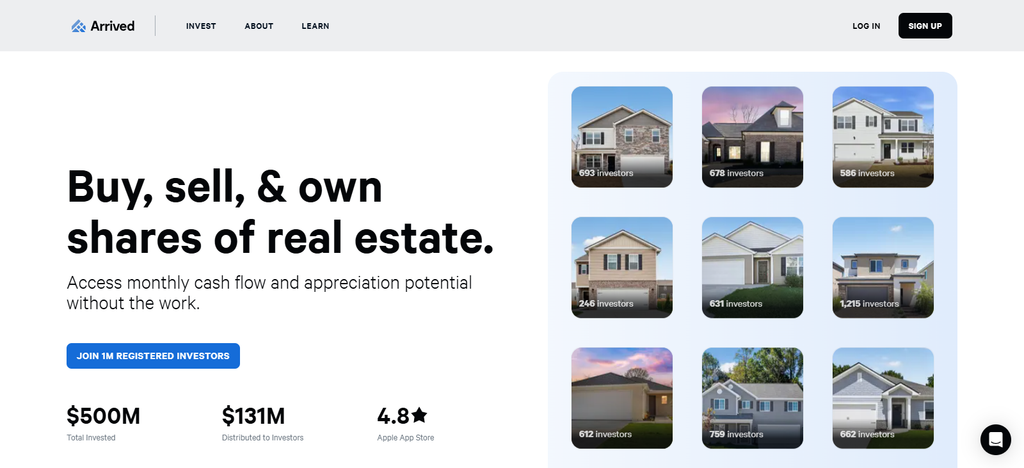
Each property is owned in a separate Series LLC, which isolates that property’s income, liabilities and assets. Fund investments are made using shares in the relevant fund. Fees are product-dependent and include approximately 0.1% to 0.30% per quarter in asset management fees, property management and disposition-related costs. The liquidity is not unlimited and depends on holding periods and availability.
Main features
- Sells fractional ownership in single family rental properties.
- Provides exposure to vacation rentals and long-term rental homes.
- Allows investors to select properties based on location and investment information.
- Access to diversified real estate funds.
- Provides options for recurring investment for eligible funds.
Primary Limitations
- Property investments can take years to achieve the planned exit.
- There are limited secondary market sales and redemption opportunities.
- Overall investment performance is influenced by property management and sourcing fees.
- Rental income and property appreciation are subject to market conditions and occupancy.
4. Ark 7
Based in San Francisco, Ark7 was founded in 2018 and publicly launched in 2022, providing a platform for fractional ownership of individual U.S. rental properties. Investors buy shares in individual homes. They earn a percentage of the rental income and property appreciation. The minimum is $20 a share. Standard Regulation A offerings are available to U.S. residents age 18 and older, and non-accredited investors.
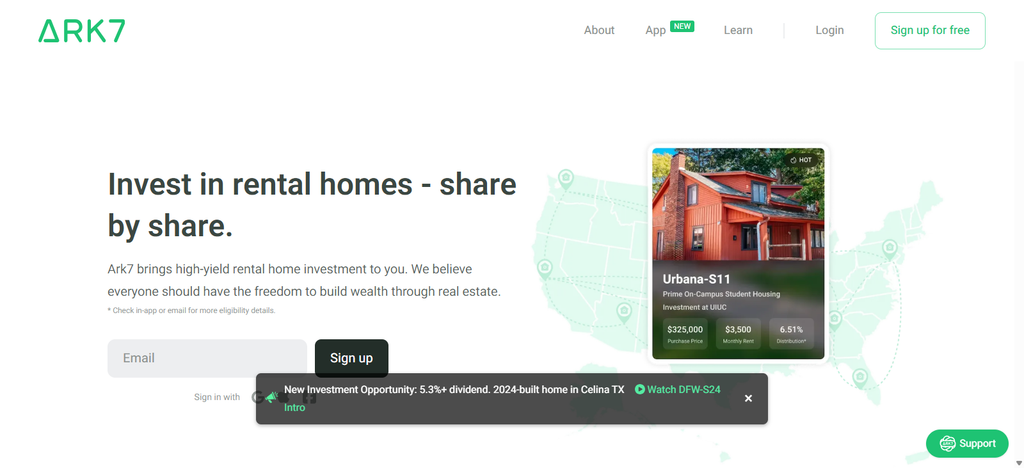
Some Ark7+ products may be accredited-only. Generally each property is set up in its own series LLC . That means investors are exposed to one particular property , not a wide pooled fund . There’s also a one-time 3% sourcing/acquisition fee, property-management fees of 8%-15% of rental income and a 15% asset-management fee on distributable free cash flow. The shares are not liquid and there is no guaranty that the shares will be able to be resold.
Main Features
- Provides fractional shares in single-family rental homes.
- Investors are able to pick properties instead of just investing in pooled funds.
- Relatively low initial investment requirements.
- Provides property information and tracks investment performance.
- Enables income from rental properties through fractional investments.
Principal Constraints
- Investment opportunities are restricted to the properties listed on the platform.
- Ability to sell fractional shares depends on market demand and availability of buyers.
- Property management and sourcing costs can erode returns to investors.
- Lack of control over property operations and management for the investor.
5. Concreit
Concreit is a mobile-first real estate investing app based in Seattle and was founded in 2018. Its main product, Concreit Fund I LLC, pools investor capital into a Regulation A+ fund that holds mostly short-term, first-lien private real-estate loans instead of owning homes outright. It’s one of the lowest entry options, with the minimum effectively $1, or one Investor Share. Investors can also set up recurring deposits.
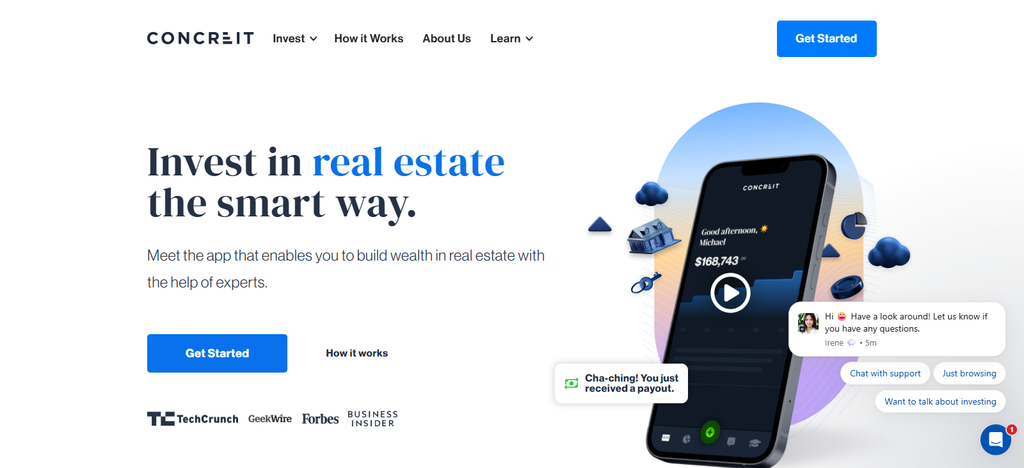
It is available to U.S. residents who are 18 years or older and does not require you to be an accredited investor. It is a diversified private real-estate debt fund, with dividends that can be paid weekly, with optional reinvestment. The manager charges around 1% a year on net asset value, plus certain financing and property related fees. Investors have reported a $5 monthly fee for balances under $5000, but should check current terms.
Main Features
- Access to pooled real estate investment opportunities.
- Provides an affordable entry point for investors with limited funds.
- Focuses on income producing real estate investment opportunities.
- Offers automated investment options for eligible accounts.
- Offers digital portfolio tracking and investment management tools.
Key Limitations
- Investors don’t get to choose the properties they invest in.
- Fund performance is driven by income and valuations of the underlying property.
- Withdrawal requests have processing times and fund restrictions.
- Net returns can be eaten away by management fees and other fund expenses.
6. Lofty
Lofty, which launched in 2018, is a blockchain-based platform that tokenizes ownership of U.S. rental properties, enabling investors to buy fractional stakes called tokens. It’s trying to make it feel more like buying stocks or crypto and investing in property, with the ability to choose properties and get distributions from rental income.

The minimum is $50, which is equal to one token. The platform is generally open to the average investor, but investors should confirm the jurisdiction, KYC and offering specific requirements before putting money into an account. Instead of a traditional REIT or private fund, Lofty’s structure employs tokenized fractional property ownership.
It charges a 2.5% fee on every buy and sell made through its marketplace. Investors should also factor in the operating costs of the property, the risk of vacancy and limited liquidity since the resale of tokens is subject to demand in the marketplace.
Main Features
- Provides tokenized fractional ownership opportunities in rental properties.
- Utilizes blockchain technology to indicate property investment interests.
- Investors can choose individual properties.
- Offers an in-app marketplace for trading eligible property tokens.
- Allows for digital tracking of property ownership and rental distributions.
Limitations
- Liquidity of token depends on available buyers and activity in marketplace.
- Technical and operational risks may arise in relation to blockchain transactions.
- The availability of listings creates opportunities for property investment.
- Direct control over property management is not given by token ownership.
7. EquityMultiple
EquityMultiple, founded in 2015, is a private real estate investing platform that provides accredited investors with direct access to commercial real estate deals, funds and structured notes. Invests in equity, preferred equity and debt for property types such as multifamily, industrial, office and development projects.

The minimum for Alpine Notes is $5,000 and for regular offerings it is $25,000. Accredited investors are eligible, self-certifying on onboarding, typically without the need for upfront documentary proof. Investments are generally private placements that are illiquid and not publicly traded and held for several years.
Products have different fee structures. Notes may not carry any platform fee for investors. Older direct deals often charge 1%-2% per annum plus flat fees and some funds charge around 2% of NAV per annum.
Feature Highlights
- Offers investment opportunities in commercial real estate.
- Offers investment vehicles of debt, preferred equity and common equity.
- Access to professionally managed real estate projects.
- Provides short-term note investment opportunities via its Alpine Notes offering.
- Provides detailed investment documentation and project level information.
Key Limitations
- Targets accredited investors, restricting entry for beginners.
- Standard investment opportunities usually need a higher minimum amount.
- Most investments are illiquid until they exit as planned.
- Returns are a function of asset performance, borrower repayment and sponsor execution.
8. Crowd Street
CrowdStreet is a marketplace for accredited investors in private commercial real estate sponsors and funds, founded in 2013. The company offers individual property transactions, portfolios and funds in sectors including multifamily, industrial, hospitality and development.
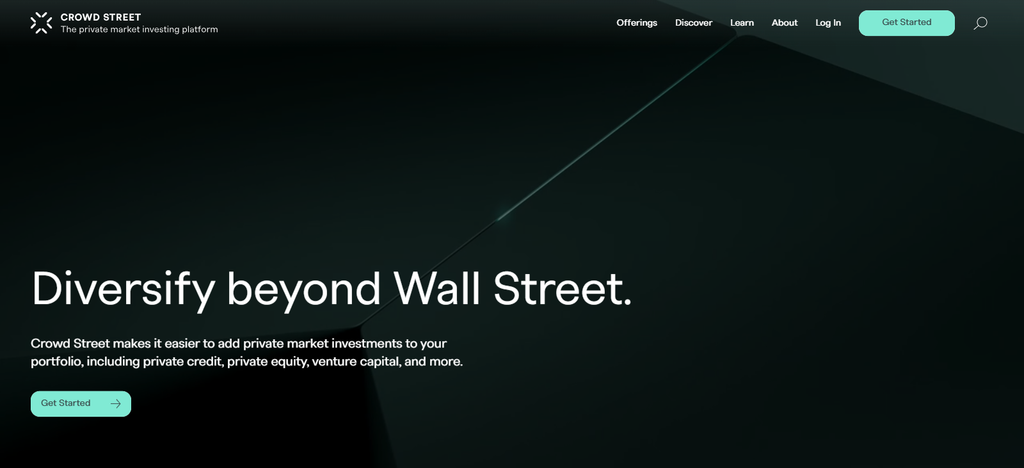
The minimum is typically $5,000, but many individual products and funds require more. Only U.S. citizens or residents of the U.S. or Washington, D.C. who are accredited investors and meet the citizenship, residency or visa requirements are eligible.
Typically, the investment structure is a direct participation in a sponsor’s private offering or a CrowdStreet-managed fund, rather than a publicly traded REIT. CrowdStreet doesn’t charge account maintenance fees, but registered offerings can carry upfront sales loads of about 1.5%–3.5% plus ongoing servicing and fund-level fees. Investments are illiquid and long term.
Important Features
- Gives access to commercial real estate investment opportunities.
- Access to independent real estate sponsors and investment managers.
- covers opportunities in the multifamily, industrial, office and other commercial property.
- Enables qualified investors to assess specific investment opportunities.
- Furnishes project documentation and sponsor information to investment research.
Main Limitations
- Private placement opportunities are usually only available to accredited investors.
- Minimum investment amounts are typically higher than on platforms targeted to beginners.
- Many investments need long holding periods.
- Investment results very much dependent on sponsor experience and project execution.
9. Willow Wealth
Founded in 2015, Willow Wealth (formerly Yieldstreet) is a private-markets platform that offers investments in real estate, private credit, private equity and other alternatives. It also curates its own deals, as well as those from outside managers, providing investors with broader alternative-asset exposure than a real-estate-only platform.
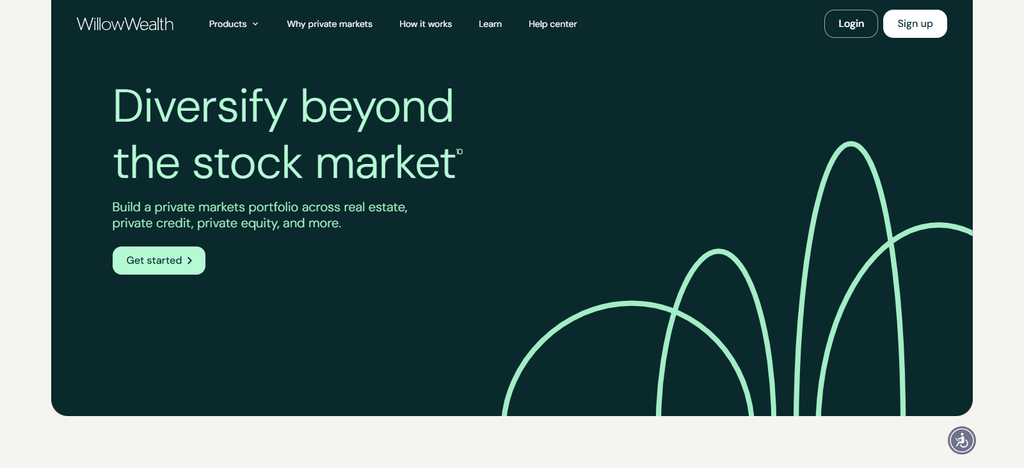
Generally, minimums start at $5,000, selected private-credit funds require $10,000 and Willow 360 managed portfolios require $25,000. Most primary offerings are available only to accredited investors.
Some products, such as certain income funds, may be available to non-accredited investors. The structure is dictated by the investment type – direct private deals, funds, notes or managed portfolios. Fees are deal-specific and often hidden in the offering; managed portfolios charge a 1.25% advisory fee plus about 0.175% expenses.
Key Features
- Offers access to alternative assets and private real estate investment opportunities.
- Provides investment funds managed by third party investment managers.
- Includes professionally vetted private market investment opportunities.
- Offers managed portfolio solutions through its Willow 360 offering.
5.Diversifies a portfolio across a range of private investment strategies.
Major Limitations
- Usually, only accredited investors can be involved in primary private-market offerings.
- Higher investment minimums compared to platforms geared toward beginners.
- Many investments require investors to tie up their capital for long times.
- Management, placement and underlying fund fees can add to the total costs of investing.
10. Relli
Relli, which launched in 2023, is a newer private real-estate marketplace that mainly lists deals from independent real-estate sponsors, rather than managing all of the investments itself. It creates a platform for investors looking to gain access to individual private market opportunities, often with longer holding periods and no short-term notes.
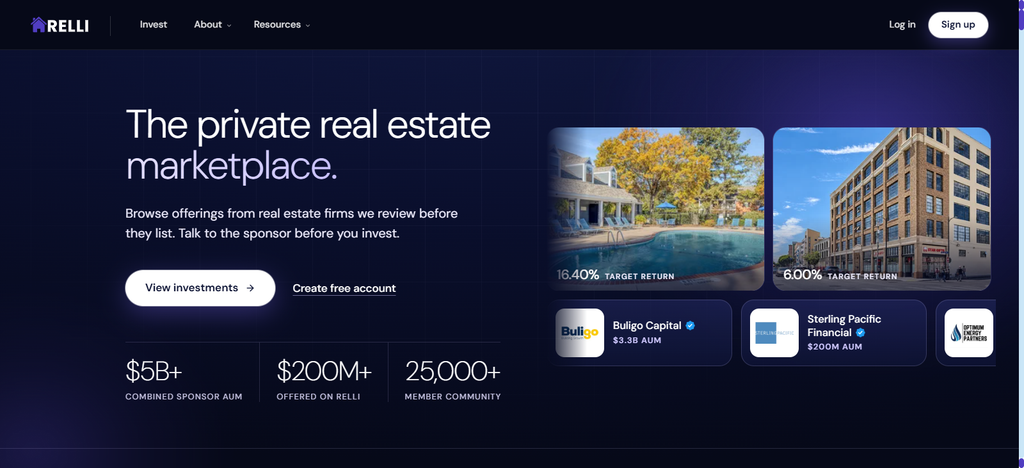
Each sponsor typically sets a minimum investment, which usually starts at around $25,000. Most deals are only available to accredited investors and the sponsor will verify whether you qualify, so this is not the best option for newbies looking for small-dollar, diversified exposure.
The structure of the investment is typically a direct private placement into a Sponsor’s real estate project or fund that may have equity, debt or hybrid terms. Relli does not charge investors a platform fee, however, underlying sponsors and investments may charge acquisition, management, performance or disposition fees.
Key Features
- Access to real estate investment offerings from independent sponsors.
- Enables investors to compare different sponsors and property investment opportunities.
- Offers direct communication channels with investment sponsors.
- Provides access to individual real estate deals, not just a single managed fund.
- Allows investors to see information about the sponsor and offering details before investing.
Base Limitations
- Most investment opportunities are only available to accredited investors.
- Usually, they require higher minimum investments than those platforms that are geared toward beginners.
- Limited investment liquidity, with many offerings requiring investors to hold to maturity.
- Returns based on underlying property performance and performance by individual sponsor.
Conclusion
Real estate crowdfunding platforms make it easy to invest in residential, commercial and rental property without having to buy a property outright. Fundrise, Groundfloor, Arrived, Ark7, and EquityMultiple are all platforms that have different types of investment structures, minimums, and income opportunities.
But picking the right platform means carefully assessing fees, investor eligibility, expected returns, liquidity and property risks. Investors should also consider sponsor experience, investment tenure and diversification options before committing capital. Ultimately, the best platform will depend on your own financial objectives, budgets and risk tolerance. Investors can make better choices about real estate investments through thorough research.
FAQ
What are real estate crowdfunding platforms?
Real estate crowdfunding platforms are online services that allow multiple investors to pool funds and invest in residential, commercial, and rental properties.
Which are the best real estate crowdfunding platforms in 2026?
Some popular platforms include Fundrise, Groundfloor, Arrived, Ark7, Concreit, Lofty, EquityMultiple, CrowdStreet, Willow Wealth, and Relli.
Can beginners invest in real estate crowdfunding?
Yes, several platforms offer beginner-friendly investment options with relatively low minimum requirements, although eligibility and investment conditions vary.
What is the minimum investment required?
Minimum investments vary by platform and offering. Some provide entry points as low as $10, while private commercial real estate deals may require thousands of dollars.
How do real estate crowdfunding investors earn money?
Investors may earn through rental income, interest payments, property appreciation, or profits generated from successful real estate projects.