The top AI data governance solutions that assist businesses in managing, keeping an eye on, and safeguarding their data in contemporary digital settings will be covered in this article.
These solutions employ AI to enable responsible AI development, guarantee regulatory compliance, enhance data quality, and automate data categorization. Selecting the appropriate platform may lower risks, increase data trust, and facilitate more intelligent data-driven decision-making.
Key Point & Best AI Data Governance Platforms
| Platform | Key Points |
|---|---|
| Collibra Data Intelligence Cloud | Enterprise data governance platform that helps organizations catalog, manage, and govern data assets. It provides data lineage, policy management, compliance tools, and collaboration features to ensure trusted and regulated data across business teams. |
| Informatica CLAIRE AI | AI-powered metadata intelligence engine that automates data discovery, classification, and governance. It uses machine learning to recommend data quality improvements, detect anomalies, and improve enterprise data management efficiency. |
| IBM OpenPages with Watson | AI-driven governance, risk, and compliance (GRC) platform. It integrates cognitive insights from Watson to automate risk identification, regulatory compliance management, and enterprise risk monitoring. |
| Microsoft Purview | Unified data governance and compliance platform that provides data discovery, classification, and lifecycle management across hybrid and multi-cloud environments. It helps organizations maintain regulatory compliance and data security. |
| SAP Data Intelligence | Enterprise data orchestration and governance platform that enables data integration, metadata management, and AI data pipeline orchestration across SAP and non-SAP systems. |
| Oracle Data Governance Cloud | Cloud-based governance solution that provides data cataloging, quality monitoring, lineage tracking, and compliance management to ensure reliable enterprise data assets. |
| Atlan AI Governance | Modern data workspace with built-in AI governance capabilities. It enables collaborative data cataloging, metadata management, and policy enforcement across data teams and analytics tools. |
| DataRobot AI Governance | Platform designed to manage and monitor AI models across their lifecycle. It provides model transparency, risk monitoring, regulatory compliance support, and automated governance workflows. |
| Arthur AI | AI monitoring and governance platform that tracks model performance, bias, drift, and reliability. It helps organizations maintain responsible AI practices and compliance. |
| Palantir Foundry | Advanced data integration and analytics platform that supports AI governance, risk analysis, and operational intelligence across complex enterprise data environments. |
1. Collibra Data Intelligence Cloud
Collibra Data Intelligence Cloud is an analytics solution that offers an enterprise platform to provide data management, data governance, and data understanding.
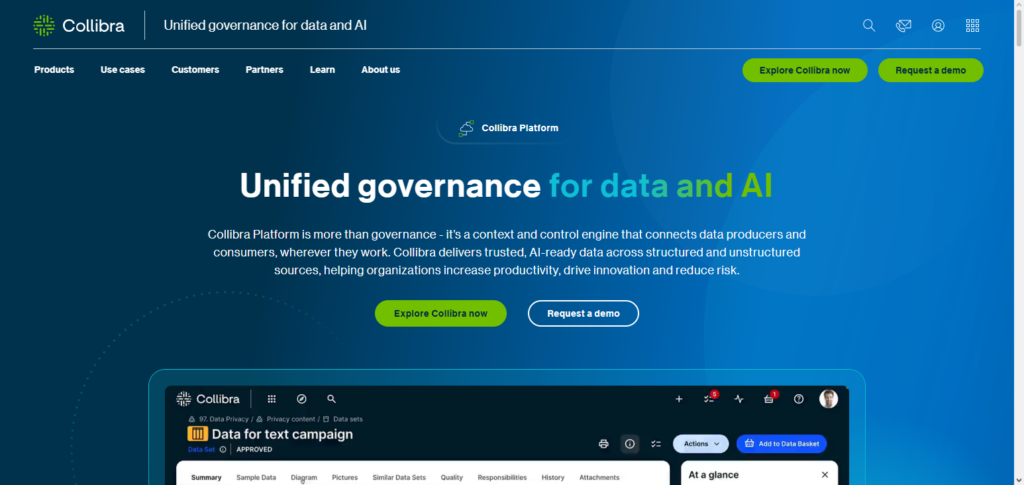
Data intelligence Cloud provides data cataloguing, data governance automation, lineage tracking, enforcement policies, and unified views. Data intelligence Collibra Cloud is used as a data visibility and compliance solution used by many enterprises to help identify and improve AI automation of
data. Data automation provides contextual descriptions of datasets and improves data accessibility and collaboration. Best AI Data Governance Platforms like Collibra Data Intelligence Cloud** provide a data governance foundation for analytics, AI capabilities, and compliance for enterprises.
Collibra Data Intelligence Cloud Features, Pros & Cons
Features
- Organizes data assets and allows users to discover them through an enterprise data catalog.
- Data lineage tracking from analytics to the data source.
- Compliance and governance management through policies.
- Metadata automation and data recommendations powered by AI.
- Governance processes through automation workflows.
Pros
- Excellent governance for enterprises.
- Advanced management of metadata, as well as tracking of data lineages.
- Supports hybrid and multi-cloud environments
- Assists in the preparedness for audits and the compliance of enterprises to regulations.
- Scale large organizations easily.
Cons
- Implementation and setup of the system is complicated.
- Great expense for small businesses.
- Governance teams are needed.
- Users will have to learn the system.
- Further development is needed for customization.
2. Informatica CLAIRE AI
CLAIRE AI is a component of Informatica´s Intelligent Data Management Cloud with AI capabilities for metadata processes.
CLAIRE uses AI on data discovery, classification, data quality, and data governance; these processes are automated for all enterprise systems. The AI engine is able to process large volumes of metadata and capture the relational data and present autonomous analysis to the data operational teams.
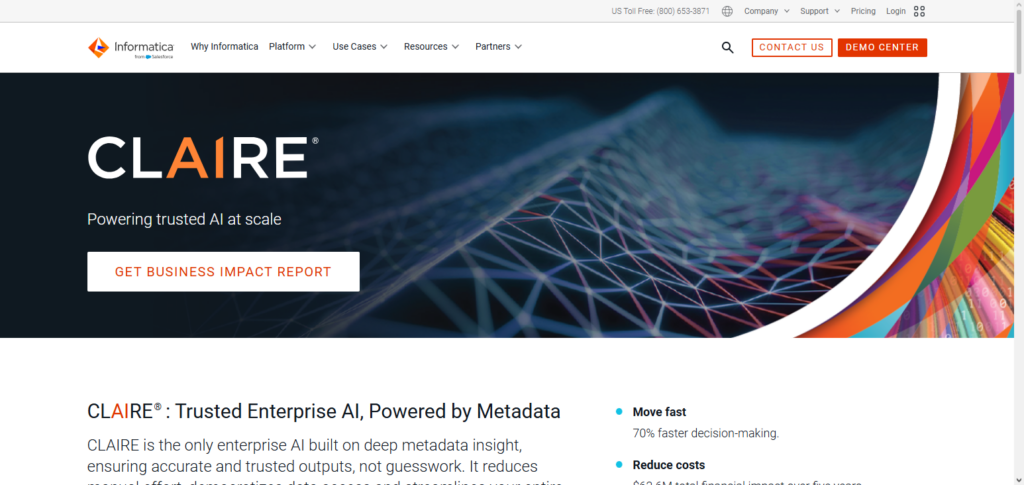
CLAIRE AI incorporates generative Artificial Intelligence functions, including CLAIRE GPT and AI copilots, which help manage data workflow and governance policies.
As businesses start to implement data-centric operational strategies, Best AI Data Governance Platforms like Informatica CLAIRE AI facilitate the automation of intricate data governance tasks, helping to lower the volume of work to be done and increase the speed of analytics with data that is both reliable and of excellent quality.
Informatica CLAIRE AI Features, Pros & Cons
Features
- An engine for AI powered metadata intelligence.
- Classification and discovery of data is automated.
- Agents of AI monitor the quality of the data.
- Intelligent integration of data across the cloud.
- For automating workflows in data management, an AI copilot is used.
Pros
- Governance automated by AI is highly.
- Classification and discovery of data is rapid.
- Data and process integration in the Informatica ecosystem.
- Profound enhancement in work productivity owing to the automation of AI.
- Enterprise data environments that are large in size are supported.
Cons
- Most of the advantages work only within the Informatica ecosystem.
- Enterprise pricing can be steep.
- Beginners may find the setup difficult.
- Some of the additional features require considerable effort to set up.
- It may be overkill for smaller teams.
3. IBM OpenPages + Watson
IBM OpenPages with Watson is a sophisticated governance, risk, and compliance (GRC) solution that incorporates analytics, automation, and Artificial Intelligence.
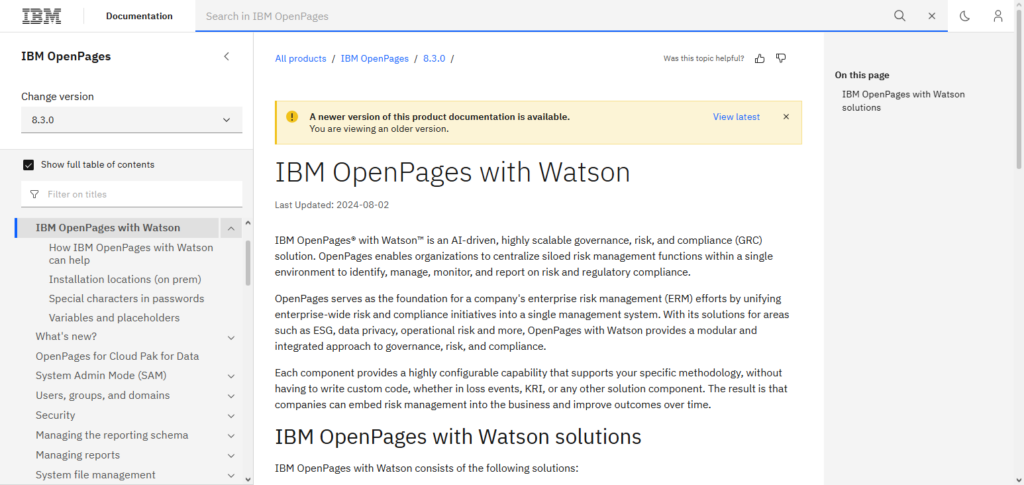
It supports organizations in risk monitoring, regulatory compliance, and improved corporate governance through integrated workflow solutions. The Watson AI component examines operational and compliance data and identifies risk exposure and the corresponding measures for risk mitigation.
The platform is used by businesses in various sectors, including finance, healthcare, and government, to improve compliance and operational oversight. IBM OpenPages with Watson is recognized among the Best AI Data Governance Platforms, and it enables organizations to embed governance and risk intelligence into their enterprise data ecosystems.
IBM OpenPages with Watson Features, Pros & Cons
Features
- Integrated platform for governance, risk, and compliance (GRC).
- AI assisted risk evaluation and foresight.
- Policy management and compliance workflow automation.
- Reporting and dashboards that are customizable.
- API integration with enterprise solutions.
Pros
- Excellent risk and compliance management.
- AI offers insight to assist in decision making.
- GRC modules are customizable.
- Enterprise solutions integrate well.
- Works for large enterprises with multiple global sites.
Cons
- Can be tricky to implement.
- Management may require a high level of technical skill.
- Licensing can be incredibly expensive.
- New entrants might find the system a bit overwhelming.
- More focused on risk management and catalogs less data.
4. Microsoft Purview
Microsoft Purview is a platform used for data compliance and governance, helping businesses find, identify, and manage data in multi cloud and hybrid environments.
Its integration with Microsoft 365 and Azure cloud services offers organizations data asset visibility. Purview automatically scans data and identifies sensitive information, while applying compliance policies to a country’s regulations.
Additionally, the platform’s built in AI detects risks and automates data protection workflows. Best AI Data Governance Platforms, like Microsoft Purview, help enterprise environments manage large amounts of information by ensuring data governance, privacy protection, and responsible data usage.
Microsoft Purview Features, Pros & Cons
Features
- Unified governance and compliance platform for data.
- Discovery and classification of data is automated.
- Protection and enforcement of policy via sensitivity labels.
- Comes integrated with Azure and Microsoft ecosystem.
- Global compliance regulations in alignment with automated assessments.
Pros
- Excellent integration with Microsoft cloud.
- Excellent automation of compliance and protection of data.* Flexibility in hybrid and multi-cloud environments.
- Easy to use interface with Microsoft integration.
- AI, along with data governance, is supported.
Cons
- Functionality is limited to the Microsoft ecosystem.
- The Azure environment has limited cloud governance.
- Pricing is scaled in complex and unconventional ways.
- Features and governance are limited to low-cost cloud services.
- Large enterprises can expect a prolonged setup.
5. SAP Data Intelligence
SAP Data Intelligence is a leading data orchestration and governance solution focused on connecting, managing, and processing data throughout distributed enterprise systems. It assists organizations in building data pipelines, incorporating different data sources, and overseeing AI models once they are deployed.
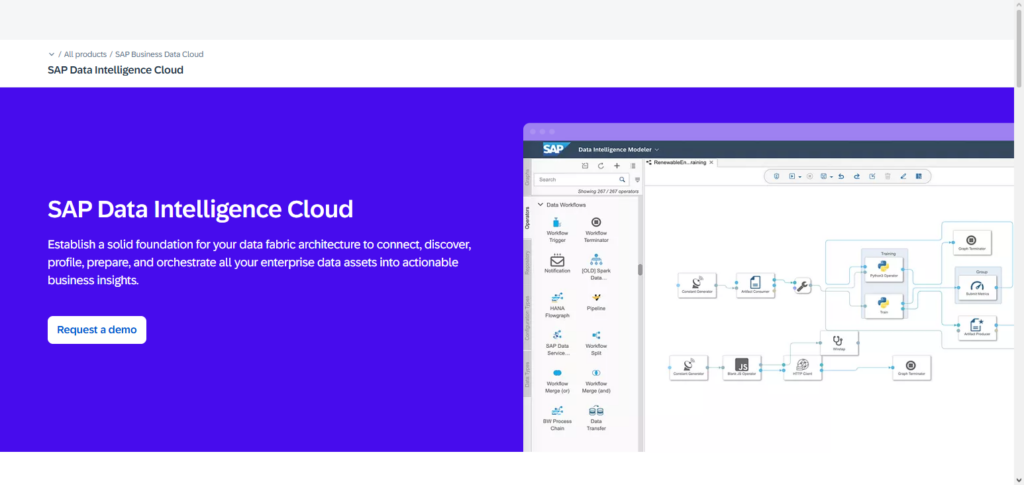
Governance elements are also a strong feature of this platform and include metadata management, data lineage, and enforcement of governance policies.
SAP ecosystem clients utilize this solution to unify data from cloud, on-premise, and hybrid data environments. SAP Data Intelligence is recognized as one of the Best AI Data Governance Platforms, and is distinguished for seamlessly integrating data, machine learning, and governance into one comprehensive enterprise solution.
SAP Data Intelligence Features, Pros & Cons
Features
- Managing data orchestration across the enterprise.
- Machine learning and AI pipeline infrastructure.
- Tracking data lineage and managing metadata.
- Data integration from SAP and non-SAP sources.
- Managing the data lifecycle and governance.
Pros
- Benefits SAP-centric businesses.
- Good enterprise system integration.
- AI and machine learning support.
- Good for enterprise data environments.
- The data pipeline can be monitored in real-time.
Cons
- Skins to AI and machine learning integration.
- Integration improves enterprise system integration.
- Additional costs in the required technology.
- Provisioning has a vast and complex setup.
- New users need support to reduce the learning curve.
6. Oracle Data Governance Cloud
The Oracle Data Governance Cloud is a leading-edge solution that allows businesses to keep data proofed and reliable, as well as compliant with enterprise systems. Data cataloging, metadata automation, and data quality monitoring are just a few of many available options.
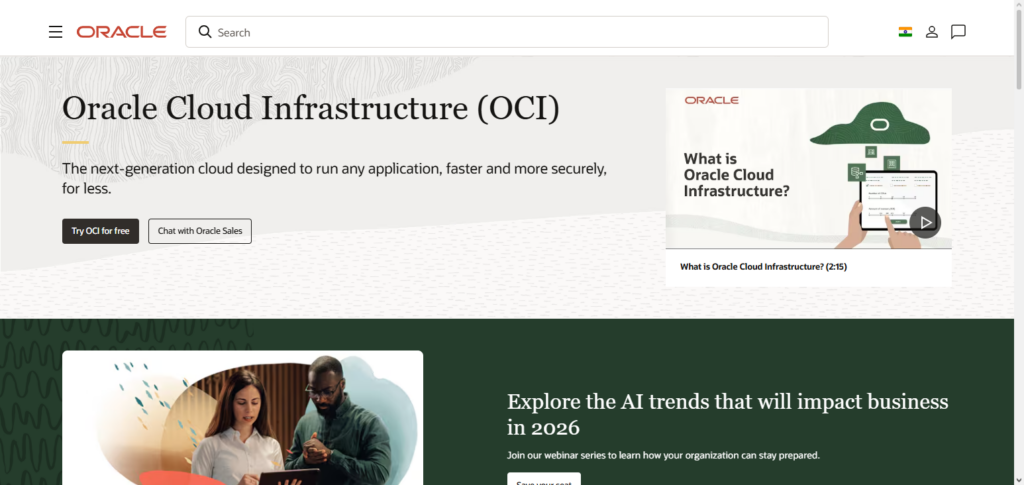
This platform allows businesses to locate data owners, track data lineages, and establish policies for data governance. Oracle also offers AI-based analytics to help automate and improve operational efficiency. Because of the rapid expansion of data in modern enterprise architecture, Best AI Data Governance Platforms like Oracle Cloud Data Governance are critical for managing complex data ecosystems.
Oracle Data Governance Cloud Features, Pros & Cons
Features
- Data catalogs and manage metadata.
- Tools for the monitoring and validation of data quality.
- Tracking the lineage of data across systems.
- Compliance and governance of the policy.
- Using the Oracle Cloud for integrated infrastructure
.Pros
- Extensive integration with Oracle enterprise systems.
- Ensures data quality management is effective.
- Ideal for large scalable enterprises.
- Provides effective compliance and security controls.
- Ideal for data governance on the cloud.
Cons
- Little to no advantages when used outside the Oracle ecosystem.
- Licensing for enterprises is expensive.
- Requires specific knowledge of Oracle to manage.
- Small teams face difficult deployment challenges.
- Development may be required for customization.
7. Atlan AI Governance
Atlan AI Governance is a collaborative governance platform that helps data teams, data analysts, and data engineers. It is an active metadata management system and works with data tools like Snowflake, BigQuery, and Tableau.
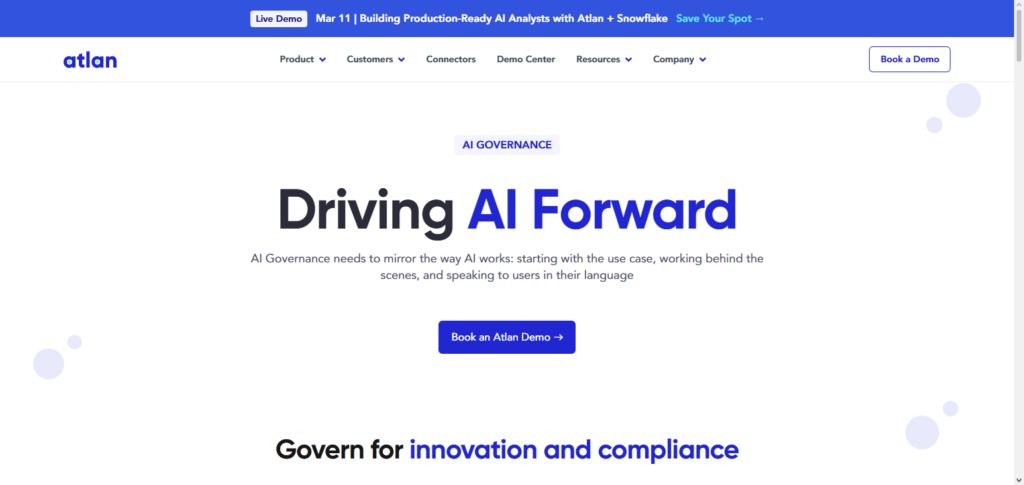
Atlan is a transparent data usage platform that offers automatic data cataloging, data lineage, and policy management. The platform’s AI features recommend certain standards, making governance workflows, and metadata classification easier, enabling teams to maintain consistency.
Atlan AI Governance is frequently mentioned when discussing the Best AI Data Governance Platforms for their workspaces that help collaborative practices to establish an organizational understanding of data.
Atlan (Atlan AI Governance) Features, Pros & Cons
Features
- Data governance workspaces created for collaboration.
- Automation for data cataloging and management of data.
- Data lineage tracking within analytic tools.
- AI-based data discovery recommendations.
- Bridges with Snowflake, Tableau, BigQuery, and other tools.
Pros
- User-friendly and agreeable to modern styles.
- Data teams enjoy stronger collaboration.
- Offers good integration with modern data stacks.
- Active management of metadata is desirable.
- Offers rapid deployment in contrast to traditional tools.
Cons
- The tools are primarily newer than older, legacy platforms.
- Many advanced features are still in development.
- Enterprise pricing may be significantly elevated.
- A complete data stack is required.
- The ecosystem is smaller than older vendors.
8. DataRobot AI Governance
DataRobot AI Governance aids in the monitoring, management, and governance of machine learning models during the model lifecycle. After model deployment, systems should be kept transparent, compliant, and trustworthy.
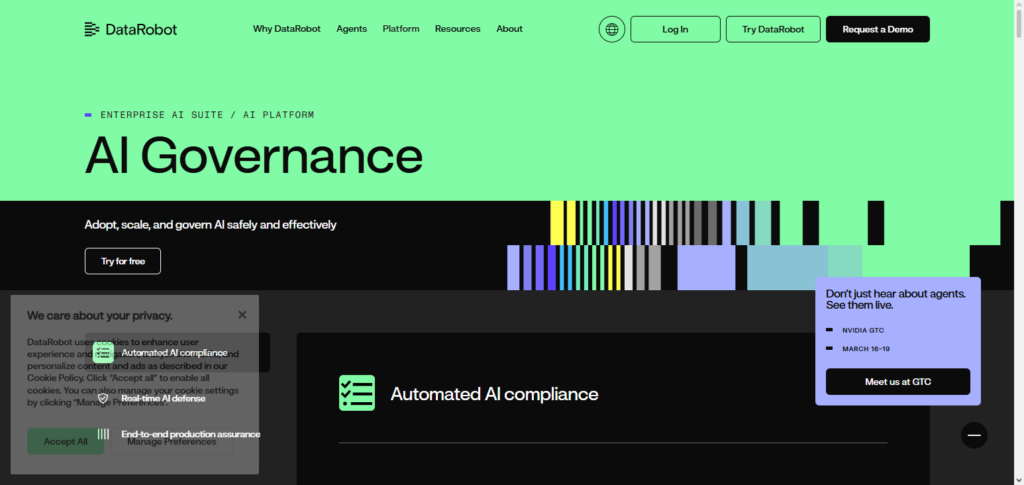
The platform aids in model monitoring, drift detection, bias identification, and documentation of reasoning for compliance. DataRobot also has automated audit trails and reports for responsible AI. With the increase of ML models in production, Best AI Data Governance Platforms like DataRobot AI Governance aids in the ethical governance of models.
DataRobot AI Governance Features, Pros & Cons
Features
- Governance of the AI model lifecycle.
- Monitoring of model performance and detection of drift.
- Documentation and audit trails automation.
- Tools for bias detection and explainability.
- AI model compliance monitoring.
Pros
- Protection of responsible AI is a top priority.
- Exceptional monitoring of AI models.
- Helps with staying continually legally compliant.
- Reporting and documentation is automated.
- Incorporation into machine learning workflows is seamless.
Cons
- Greater focus on AI models and less on data governance.
- May need supplemental data catalog tools.
- Cost of enterprise licensing.
- Management is only beneficial with expertise in ML.
- Non-AI workloads see minimal benefits.
9. Arthur AI
Arthur AI is an AI governance platform specializing in tracking the fairness and reliability of machine learning models. Arthur AI promotes transparency through real-time tracking of model performance, biases, data drifts, and predictive performance.
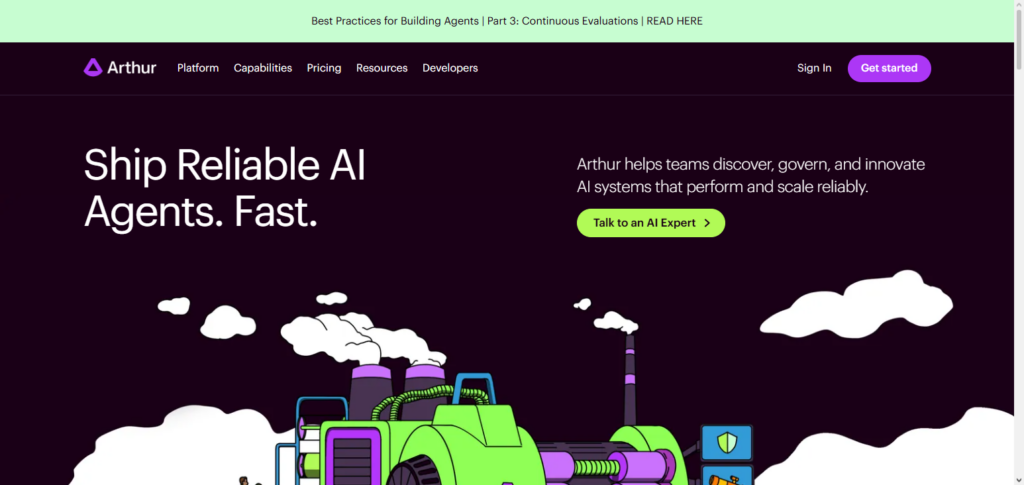
Arthur AI allows organizations to keep trust in the AI decision-making systems, and to detect and diagnose issues early. Arthur AI is used to explain, and in an evolving landscape of responsible AI, Best AI Data Governance Platforms such as Arthur AI provides model explainability, ensuring AI models perform reliably and responsibly in the real world.
Arthur AI Features, Pros & Cons
Features
- Monitoring of AI models in real-time.
- Detection of bias and analysis of fairness
- Performance and data drift monitoring
- Tools to explain AI decisions
- Machine learning platform and tools.
Pros
- Capabilities of AI monitoring are strong.
- ML systems are kept reliable.
- Insight into explainable AI is given.
- Responsible governance of AI is supported.
- Dashboards for monitoring in real-time are available.
Cons
- Limited to governance of AI models.
- Data governance features of a traditional sense are lacking.
- Required knowledge of ML for effective use is rather high.
- Other tools may be necessary for integration.
- Pricing is enterprise based.
10. Palantir Foundry Risk AI
Palantir Foundry is a data integration and analytics system that assists companies in unified data ingestion, application creation, and management of operational workflow. The platform also possesses strong governance capabilities, including data lineage, access governance, and audit tracking.
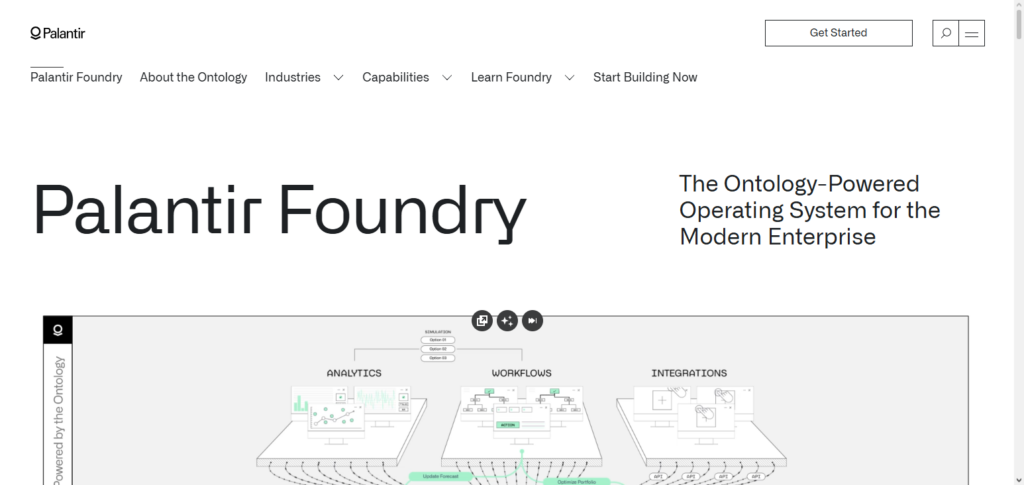
Foundry additionally enables analytics and AI modell deployment, assisting companies in the conversion of their raw data to insights. The platform is used in government, finance, and healthcare. Among the Best AI Data Governance Platforms, Palantir Foundry Risk AI is recognized for the unique capability to integrate data governance, risk intelligence, and advanced analytics in one operational data ecosystem.
Palantir Foundry (Risk AI / Data Governance) Features, Pros & Cons
Features
- Data integration and analytic system that is unified.
- Data lineage end-to-end and controls for governance.
- AI and machine learning models can be deployed.
- Control of access based on roles and security of data.
- Tools for Operational Decision Intelligence
Pros
- Strong analytical, AI, and governance capabilities.
- Top tier security and access control.
- Handles complex data environments.
- Used by large enterprises and government.
Cons
- Imposes high licensing and deployment costs.
- Technical know-how required.
- Takes time to deploy.
- Small and mid-size enterprises should avoid.
- Pricing lacks transparency.
Conclusion
Organizations that wish to scale analytics and artificial intelligence projects while managing data ethically must select the finest AI data governance systems. Compliance management, automated data discovery, and data cataloging are all made possible by platforms like Microsoft Purview, Informatica CLAIRE AI, and Collibra Data Intelligence Cloud. In the meanwhile, systems like Arthur AI and DataRobot AI Governance place a strong emphasis on responsible AI practices, transparency, and AI model monitoring.
To assist businesses in maintaining safe and reliable data environments, enterprise platforms like IBM OpenPages with Watson, SAP Data Intelligence, and Oracle Data Governance Cloud integrate governance, risk management, and compliance. Large, complex ecosystems can benefit from collaborative, data-driven governance frameworks provided by contemporary tools like Atlan and Palantir Foundry.
In the end, an organization’s data infrastructure, legal needs, and level of AI development determine which platform is best. Businesses may guarantee data quality, uphold compliance, lower risk, and create reliable AI systems that foster long-term innovation and expansion by implementing one of the top AI data governance platforms.
FAQ
What are AI data governance platforms?
AI data governance platforms are software solutions that help organizations manage, monitor, and control how data and AI models are used across an enterprise. These platforms provide features such as data cataloging, metadata management, policy enforcement, access control, and compliance monitoring. Their main goal is to ensure that data used in analytics and AI systems is accurate, secure, and compliant with regulations.
Why are AI data governance platforms important?
AI data governance platforms are important because they ensure responsible and secure use of data in AI systems. Without proper governance, organizations risk data misuse, biased AI outcomes, regulatory penalties, and security breaches. Governance frameworks also help maintain transparency, accountability, and trust in AI-driven decision-making across businesses.
What features should you look for in an AI data governance platform?
The best AI data governance platforms typically include features such as automated data cataloging, metadata management, data lineage tracking, access control, compliance monitoring, and AI model governance. Many modern tools also use machine learning to detect anomalies, classify data automatically, and improve data quality management.
How is AI governance different from traditional data governance?
Traditional data governance focuses on managing data quality, access permissions, and compliance policies. AI governance goes further by overseeing machine learning models, algorithms, and automated decision-making systems. It includes monitoring model performance, detecting bias, ensuring explainability, and managing the lifecycle of AI models.
Which companies offer the best AI data governance platforms?
Several enterprise technology companies provide leading AI data governance solutions. Popular examples include Collibra Data Intelligence Cloud, Informatica CLAIRE AI, Microsoft Purview, IBM OpenPages with Watson, and Palantir Foundry. These platforms help organizations manage data assets, ensure compliance, and support responsible AI adoption.