


The Best Crypto APIs that help developers, businesses and Web3 platforms access reliable cryptocurrency data, blockchain data, trading tools and digital assets will be discussed. Crypto
APIs break the barriers when developing a crypto application by offering real time data of the market, tracking transactions, managing portfolios, and numerous advanced features when it comes to blockchain. I will talk about the features and the advantages these APIs offer and some use case scenarios.
What Are Crypto APIs?
Crypto APIs are a type of software interface that connects applications with cryptocurrency exchanges, blockchain networks, and digital asset platforms. APIs give developers access to real-time prices and data; transactional and wallet data; trading and blockchain analytics; and more.
Businesses employ APIs to create trading platforms, portfolio trackers, payment APIs, and even Web3 application APIs and financial tools. Crypto APIs make implementing blockchain technology much easier compared to building the full cryptocurrency infrastructure from the ground up.

Why Businesses Need Crypto APIs in 2026
Real-Time Cryptocurrency Price Tracking: Live tracking of dynamic cryptocurrency price and market fluctuations.
Automated Trading and Portfolio Management: Cut down time managing crypto trades and tracking portfolio assets.
Blockchain Transaction Monitoring: Access to transaction and wallet activity on the blockchain.
Building Web3 Applications and Decentralized Platforms: Create cutting edge dApps and DeFi services.
Improving Financial Analytics and Decision Making: Crypto market insights provide better investment decisions.
Key Points & Best crypto APIs In 2026
| API | Brief Detailed Explanation |
|---|---|
| CoinMarketCap API | Provides global crypto prices, market metrics, exchange data, and reliable industry insights. |
| CoinGecko API | Offers token discovery, extensive altcoin coverage, and decentralized exchange data. |
| CoinStats API | Supports multi-chain portfolios with data from numerous blockchains and exchanges. |
| CoinAPI | Delivers institutional-grade historical data, tick records, and exchange tracking solutions. |
| Binance API | Enables trading integration with deep liquidity from leading cryptocurrency exchange. |
| ChangeNOW API | Allows easy in-app cryptocurrency swaps supporting thousands of digital assets. |
| Alchemy API | Provides powerful Web3 infrastructure with reliable blockchain data access. |
| Tatum API | Simplifies cross-chain development, smart contracts, and blockchain transactions efficiently. |
| Bitquery API | Enables advanced blockchain analytics, wallet tracking, and DeFi data extraction. |
| OpenSea API | Fetches NFT metadata, images, and marketplace sales history across blockchains. |
10 Best crypto APIs In 2026
1. CoinMarketCap API
The CoinMarketCap API has the most accurate cryptocurrency market data. It delivers all the critical data that financial applications need, including real-time pricing, trading volume, exchange listings, the global market cap, historical market data, and detailed cryptocurrency rankings.
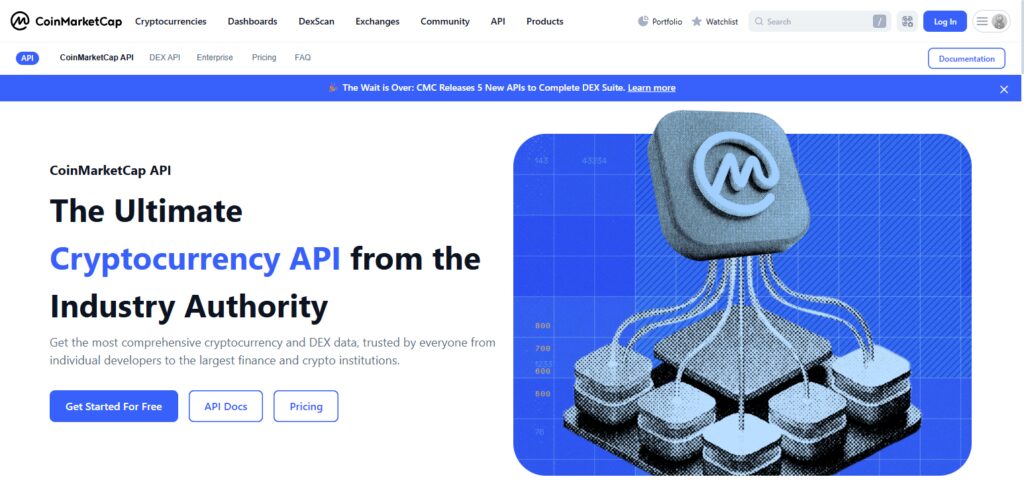
It is the preferred API for the portfolio, trading, and research tools that product teams build. It offers extensive data of thousands of digital assets, making it suitable for enterprise-level applications.
Add reliable data, multiple API plans, and developer-friendly documentation, and you have a winning API. The CoinMarketCap API is the most advanced API for professional cryptocurrency projects.
CoinMarketCap API – Features
- Real-Time Data: Access to live price data, rankings, volume data, and market cap data.
- Asset Data: Thousands of cryptocurrencies offered with market data and analytics.
- Historical Data: Historical price data, trends, and analytics.
- Market Data: Listings and trading pairs with global market data.
- Developer Support: Documentation, flexible API pricing, and enterprise solutions readily available.
| Pros | Cons |
|---|---|
| Provides highly accurate real-time cryptocurrency market data. | Advanced features require expensive premium API plans. |
| Covers thousands of cryptocurrencies and exchanges globally. | Free tier has limited API request capacity. |
| Offers detailed historical market data for analysis. | Some smaller tokens may have limited information. |
| Includes reliable documentation for developers. | Data access can become costly for large enterprises. |
| Suitable for professional trading and research platforms. | Requires API key authentication for usage. |
2. CoinGecko API
The CoinGecko API is another excellent option for developers needing market data for a broader scope of cryptocurrencies. It is extremely popular among Web3 developers focused on new tokens and decentralized finance (DeFi), NFTs, and decentralized exchanges (DEXs).
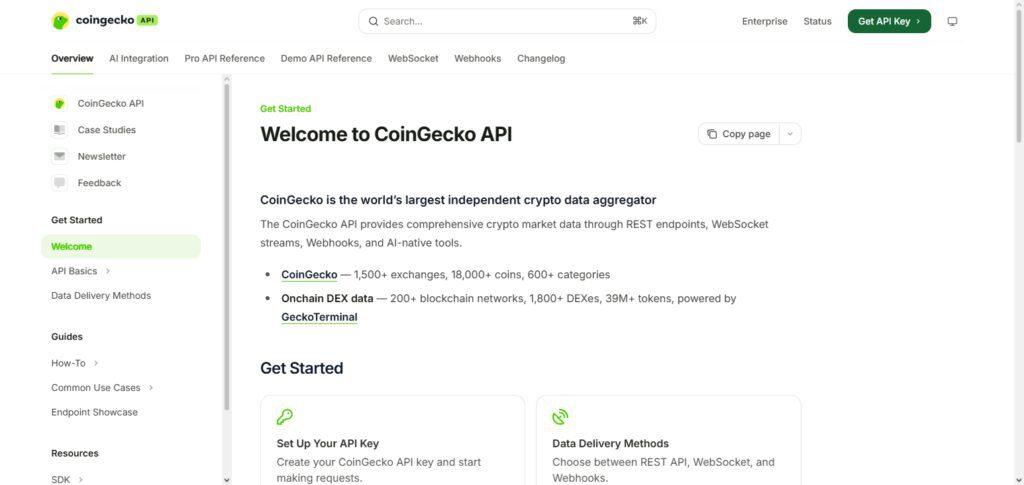
The API supplies real-time data, drawn historical charts, market data, exchange data, and provides developer-friendly endpoints.
Due to its transparency and extensive coverage of altcoins, the CoinGecko API is an excellent resource for new blockchain-based applications and an excellent cryptocurrency research API.
CoinGecko API – Features
- Large Coverage: Coins data includes emergent tokens, altcoins, and DeFi assets.
- Web3 & DEX Data: Data for DEXs, tokens, and the blockchain ecosystem.
- Historical Data: Charts with market data and historical performance of cryptocurrencies.
- Market Data: Open data with community-driven market analyses.
- Simple Integration: Simple endpoints and documentation for ease of integration.
| Pros | Cons |
|---|---|
| Provides extensive coverage of cryptocurrencies and altcoins. | Free API has limited request speed and capacity. |
| Excellent support for DeFi, NFTs, and Web3 data. | Some market data updates may experience delays. |
| Offers transparent and publicly accessible crypto information. | Advanced features require paid subscription plans. |
| Easy integration with developer-friendly endpoints. | Less suitable for high-frequency trading applications. |
| Strong choice for crypto research applications. | Historical data depth varies between assets. |
3. Fireblocks API
The Fireblocks API provides a sophisticated infrastructure tool for developers to create DApps with protection for digital assets. A developer can integrate automated transaction features or customize wallet management.
Fireblocks also provides an entire suite for cross blockchain infrastructure for governed crypto operations. The API is embraced by financial institutions, exchanges and enterprises for integration of secured, scalable and dependable crypto wallet for Web3.
Fireblocks API – Features
- MPC-Based Security: Multi-Party Computation (MPC) technology is utilized to fortify the protection of private keys and prevent major risks.
- Multi-Blockchain Support: Provides the ability to manage digital assets on multiple blockchains from one place.
- Wallet Management: Makes the creation, control and monitoring of scalable Crypto Wallets really easy.
- Automated Transactions: Automation of crypto transfers and approvals/management of workflows is built within.
- Governance Tools: Custom transaction rules, permissions, and approval workflows are available.
- APIs & SDKs: Provides developer-friendly MPC-based APIs and software development kits to integrate protections easily.
- Transaction Visibility: Monitors blockchain transactions and provides instant visibility on the movement of assets.
Pros & Cons of Fireblocks API
| Pros | Cons |
|---|---|
| Advanced MPC security provides strong protection for digital assets | Pricing can be expensive for small developers and startups |
| Supports multiple blockchain networks and digital assets | May require technical expertise for full integration |
| Enterprise-grade wallet infrastructure for institutions | Better suited for businesses than individual developers |
| Provides secure transaction approval workflows | Setup and configuration can be complex |
| Offers powerful APIs and SDKs for developers | Limited usefulness for simple wallet projects |
| Strong compliance and governance features | Enterprise features may increase operational costs |
4. CoinAPI
For institutional grade crypto market data, CoinAPI is an excellent option. This API is especially useful for quants and algo-trading platforms as it focuses on structured tick data and streaming trades, order books, and exchange rates.
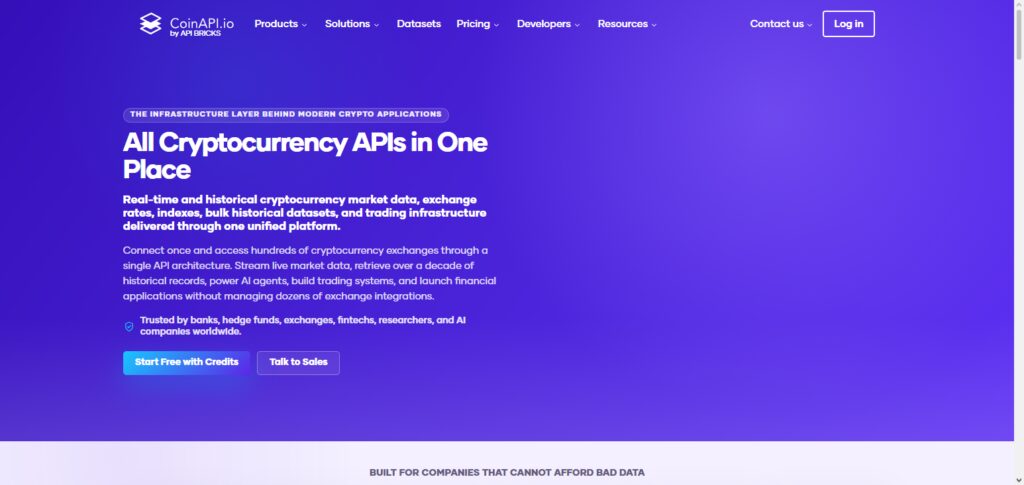
Developers interested in market analysis and building advanced trading platforms and algorithms will find the level of detail provided by CoinAPI excellent for their needs.
CoinAPI is an excellent solution for crypto research and the development of advanced, institutional grade quantitative strategies as its historical datasets are exceptionally detailed and complemented by its coverage of all exchanges.
CoinAPI – Features
- High-Frequency Trading Data provides order book and tick data with online trading data and an online trading service.
- Advanced Historical Data provides quantitative and modeling data with an extensive history of data.
- Global Exchange Market Coverage provides worldwide data coverage from many cryptocurrency exchanges.
- Algorithmic Trading Systems provides trading and research systems that are highly advanced.
| Pros | Cons |
|---|---|
| Provides institutional-grade cryptocurrency market data. | Pricing is expensive for small developers. |
| Offers high-frequency trading and tick-level information. | Complex data structure requires technical knowledge. |
| Includes extensive historical market datasets. | Not ideal for beginner-level crypto projects. |
| Supports multiple global cryptocurrency exchanges. | Requires higher resources for data processing. |
| Excellent for quantitative trading research. | Free access options are limited. |
5. Binance API
One of the largest digital asset exchanges globally makes Binance API one of the biggest competitor market trading APIs. Developers can build automated trading, market analysis, and portfolio applications, as well as price monitoring tools.
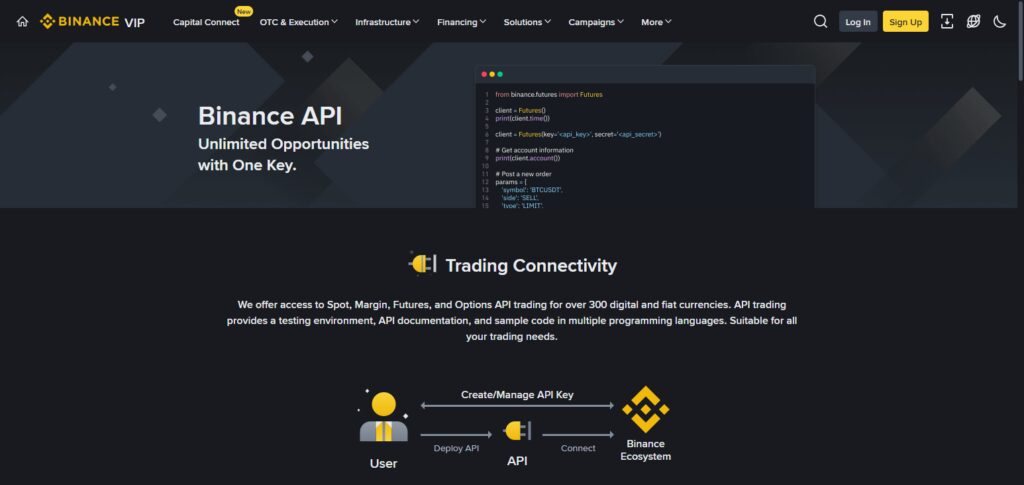
APIs provide tools to access deep liquidity, order books, trades and executions, account and book management, and market stats. Extensive trade documentation and a strong development ecosystem enhance the API’s appeal to professional trading and crypto platforms.
Continuous support of complex trading strategies, advanced API execution, and extensive trading platform support keeps Binance APIs in the game.
Binance API – Key Features
- Automated Trading Allows developers to design trading bots and build automated cryptocurrency platforms.
- Deep Market Liquidity Allows Access to One of the Largest Cryptocurrency Trading Ecosystems.
- Real-Time Market Data provides price data, order book data, trade data, and market data.
- Account Management Allows balance and trading management with order placement.
- Professional Trading Systems provides advanced and scalable systems to build advanced cryptocurrency systems and platforms.
| Pros | Cons |
|---|---|
| Provides access to deep cryptocurrency market liquidity. | Mainly dependent on Binance exchange ecosystem. |
| Supports automated trading and advanced strategies. | Regulatory restrictions affect availability in regions. |
| Offers real-time market and trading information. | API changes may require application updates. |
| Includes powerful account and order management tools. | Security risks require careful API key management. |
| Suitable for professional trading applications. | Not designed for multi-exchange data aggregation. |
6. ChangeNOW API
ChangeNOW APIs allow developers to build applications that exchange and/or swap tokens seamlessly. The API needs little to no trading infrastructure and swaps for a multitude of digital assets.
ChangeNOW APIs allows the development of wallet based applications, fin-tech applications, payment solutions, Web3 applications, and more that offer instant swaps. The API provides the rates, tracks the transactions, and manages the swaps automatically.
Its much easier trading infrastructure allows developers a much faster method to implement trading solutions on their platform while increasing user experience on a blockchain based application.
ChangeNOW API – Key Features
- Instant Cryptocurrency Exchange gives the ability to instantly swap cryptocurrency in-app.
- Large Asset Base trading swaps can consist of thousands of different digital assets.
- Automatic Processing ChangeNOW swaps automatically execute, track, and complete.
- In-App Wallets allow the swapping of cryptographic assets.
- Simple API keeps complexity to a minimum.
| Pros | Cons |
|---|---|
| Enables simple cryptocurrency swap integration. | Limited advanced trading features available. |
| Supports a wide range of digital assets. | Swap fees can vary based on market conditions. |
| Reduces need for building exchange infrastructure. | Dependent on third-party liquidity providers. |
| Provides automated transaction processing features. | Less suitable for professional trading platforms. |
| Easy integration for wallets and Web3 apps. | Requires monitoring transaction performance. |
7. Alchemy API
The Alchemy API is a premier infrastructure provider for developers building on Web3 and is used to easily develop scalable blockchain applications.
With complete RPC nodes, blockchain data solutions, wallets, and a suite of development tools across various networks, Alchemy harnesses the capability to read and write blockchain data, deploy dApps, and perform contract management.
Alchemy API is focused on high-performance infrastructure and is used across the developing Web3 space due to its speed, reliability, and advanced debugging capabilities.
The API is used to develop everything from NFT dApps to DeFi dApps, and pushes the limits of Web3 development by allowing developers to focus on building and not on the complexities of blockchain networks.
Alchemy API – Key Features
- Web3 Blockchain Built has many tools to build on the blockchain.
- Fast RPC Calls make reading and writing to the blockchain and sending transactions quick.
- Multi-Chain Support can accommodate large web3 apps covering multiple blockchains.
- Developer Tools offer monitoring and more advanced features.
- NFT and DeFi Support: This provides the tools for the building of complex applications built on the decentralized financial services offered via the blockchain.
| Pros | Cons |
|---|---|
| Provides powerful Web3 infrastructure and blockchain tools. | Advanced usage can become expensive at scale. |
| Offers fast and reliable RPC services. | Mainly focused on developers, not end users. |
| Supports multiple blockchain networks efficiently. | Requires blockchain development knowledge. |
| Includes advanced debugging and monitoring features. | Some features depend on supported networks. |
| Excellent for NFT and DeFi applications. | Beginners may find setup challenging. |
8. Tatum API
The Tatum API is one of the easiest APIs for developing on the blockchain. It allows developers to easily build applications on multiple blockchain networks through a unified interface. Developers using Tatum can easily create wallets, send and receive transactions, create and manage tokens, smart contracts, and other assets without having to learn different blockchain protocols.
Tatum supports many different networks and decreases development time by offering ready-to-use blockchain features in API calls. Tatum is a great API for blockchain application developers and is used by many startups, Web3 developers, and Fintech companies, because of its cross-chain capabilities.
Tatum API – Key Features
- Cross-Chain Blockchain Support: Multiple blockchain networks can be accessed through a single interface.
- Simplified Blockchain Development: Simplifies the development process by pre-structuring blockchain API functions.
- Smart Contracts: Offers the ability to create and interact with smart contracts on the blockchains.
- Token Development: Supports the creation and management of tokens.
- Rapid Development: Allows limited coding for the building of blockchain services.
| Pros | Cons |
|---|---|
| Simplifies blockchain development across multiple networks. | Advanced features require paid plans. |
| Supports wallets, tokens, and smart contracts. | Less suitable for highly customized blockchain solutions. |
| Reduces coding complexity for developers. | Limited control compared to direct blockchain development. |
| Provides cross-chain application development capabilities. | Documentation may require deeper technical understanding. |
| Useful for startups building Web3 applications. | Performance depends on supported blockchain networks. |
9. Bitquery API
Bitquery API provides a way to access sophisticated analytical capabilities for on-chain data. They provide data for each transaction on the blockchain and provide the ability to track all types of transactions. They have data for all on-chain DeFi activities and provide real-time data on blockchain networks.
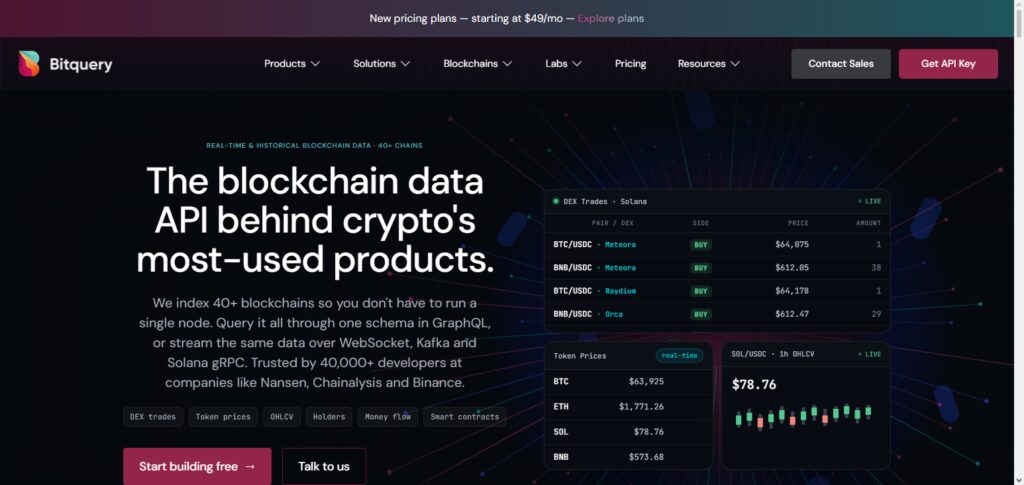
Their SQL-like queries help developers customize their searches on the blockchain for data that will help build research and compliance applications, as well as financial applications. Companies looking for deep analysis and intelligence on the blockchain
As well as advanced analysis on market transactions will find Bitquery a powerhouse of data and analytics that will help them build and monitor complex digital solutions across all blockchain networks.
Bitquery API – Key Features
- On-Chain Analysis: Offers a deep view of activities and transactions on the chain.
- Wallet Monitoring: Monitors the movement of a wallet’s digital assets and transfers.
- DeFi Activity Tracking: Monitors activities on decentralized finance across the different chains.
- Blockchain Analysis: Offers easy and fast blockchain data analysis through a SQL-enabled structure.
- Research and Compliance: Assists in the analysis of blockchain activities and market operations
| Pros | Cons |
|---|---|
| Provides advanced blockchain analytics capabilities. | Requires technical knowledge for complex queries. |
| Enables detailed wallet and transaction tracking. | Pricing can be high for large-scale usage. |
| Supports DeFi monitoring and research applications. | Not designed for basic crypto price tracking. |
| Offers customizable SQL-like blockchain queries. | Data interpretation requires analytical expertise. |
| Useful for compliance and investigation platforms. | Learning curve is higher for beginners. |
10. OpenSea API
The OpenSea API is a ubiquitous option for all developers building applications around NFTs and digital collectibles. OpenSea is the largest NFT marketplace and helps other developers build their own NFT galleries, trackers, gaming applications, and Web3-based NFT marketplaces.
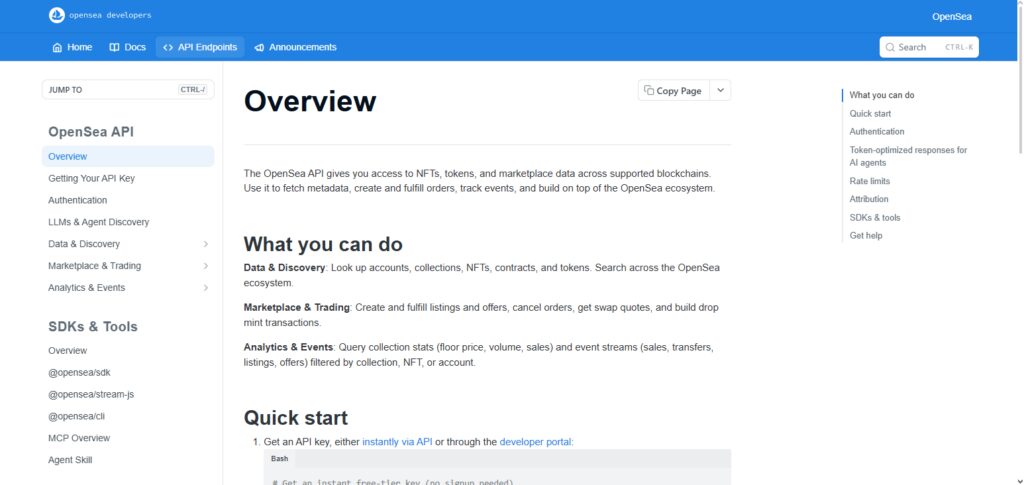
OpenSea also provides users the ability to view the metadata of NFTs and learn the sales history of NFTs and their respective collections across multiple blockchains. With the size and extensiveness of the NFT ecosystem, OpenSea provides useful data for applications that help ease the trading of digital collectibles.
OpenSea API – Key Features
- NFTs in the Marketplace: Access to the backgrounds, assets, and listings in a marketplace.
- NFT Metadata: Fetch images, descriptions, ownership info, and collection data.
- Cross-Chain NFTs: Supports NFTs on multiple blockchains.
- NFT Sales History: Access to trading and transaction history of collectibles.
- Web3 Development: Assists the creation of NFT marketplaces, galleries, and games.
| Pros | Cons |
|---|---|
| Provides extensive NFT marketplace data access. | Mainly focused on NFT-related applications. |
| Offers NFT metadata and collection information. | Dependent on OpenSea marketplace ecosystem. |
| Supports multiple blockchain NFT ecosystems. | API availability may change with platform updates. |
| Helps build NFT galleries and marketplaces. | Limited support for non-NFT blockchain data. |
| Provides useful sales and ownership tracking. | High-volume applications may require additional infrastructure. |
How We Selected The Best Crypto APIs
- Data Accuracy and Reliability: Selected those APIs delivering reliable data and making timely updates possible.
- Supported Cryptocurrencies and Blockchain Networks: Selected APIs that cover many Cryptocurrencies, Blockchain and all Digital Assets.
- API Speed and Performance: Focused on APIs that respond quickly and are reliable.
- Security Standards and Documentation Quality: APIs that provide a good level of security and documentation for developers are preferred.
- Pricing Flexibility and Scalability: APIs that offer flexible pricing and scalable services are preferred.
- Developer Community Support: APIs that offer a good developer community, helpful documentation and reliable support are preferred.
Challenges and Risks of Crypto APIs
- Inaccurate or Delayed Data: Users making investment decisions with unclear or incorrect data may be negatively affected.
- App Performance Deteriorates: When APIs are interrupted, applications may also be interrupted, so the reliability of the API is diminished.
- API Security Gaps: Poor API security can be a risk for cyber security and can expose sensitive data.
- Blockchain Regulation Changes: The availability of certain APIs may be impacted by changing laws.
- Reliance on External APIs: Using external APIs may be limited and come with additional risks.
Conclusion
In Conclusion Best Crypto APIs in 2026: Top Solutions for Developers The top crypto APIs in 2026 allow for easier development of blockchain applications with secure APIs, rapid scaling, and adaptivity to new and exciting capabilities.
With fast changing market resources and easy automated trade options, many of the APIs offer simplistic solutions to the ever changing world of cryptocurrency.
With the growing and changing needs of trade, establishing the correct API is pertinent to the needs of the project at hand. The future of innovation design with digital assets will depend on the trustworthy development of APIs.
FAQ
Are Crypto APIs free to use?
Many Crypto APIs offer free plans with limited requests and features.
Why do businesses use Crypto APIs?
Businesses use them for market data, trading, payments, and Web3 development.
Which Crypto API is best for trading?
Binance API is popular for automated trading and exchange integration.
Can Crypto APIs track wallet transactions?
Yes, APIs like Bitquery and CoinStats support wallet tracking features.