

I will be covering the Best DeFi Yield Aggregators in 2026 in the following article. Yield farming can be made much simpler through the use of these platforms.
They can also automate strategies for yield farming. These platforms can improve the yield of crypto across even more chains. These features effectively bring better accessibility and value to DeFi for beginner and advanced users.
What Are DeFi Yield Aggregators?
DeFi yield aggregators are platforms that simplify investing and managing returns in crypto for users through automation and smart contracts. Rather than forcing users to manually move their crypto through various lending and liquidity protocols, a yield aggregator will constantly monitor the best opportunities to maximize yield.
This is a great time saver and simplifier for users interested in yield farming and maximizing their passive income.

Many popular yield aggregators are multi-chain, supporting many blockchains and assets, and provide features like auto-compounding and risk management. DeFi yield aggregators and their features simplify investement for both DeFi newcomers and veterans.
How DeFi Yield Aggregators Work
Crypto Deposit: Users can deposit popular cryptocurrencies like ETH, USDC, DAI, etc., to DeFi yield aggregators using the smart contract feature for protection and security. The platform holds funds only under the custody rules stated in the smart contract.
Allocation via Smart Contracts: DeFi yield aggregators use smart contracts to automatically allocate the crypto assets in lending protocols, liquidity pools, and staking services to help users achieve the best potential returns.
Yield Optimization: DeFi yield aggregators eliminate the need for users to analyze the market. Instead, the aggregator will search the many different protocols and identify the best yield farming option with the highest APY and will allocate funds to that protocol.
Auto Compensation: DeFi yield aggregators reinvest rewards passively via yield farming and staking to help users achieve greater returns over time via the compounding effect.
Portfolio Balance: The aggregators are designed to rebalance funds automatically per the incentives, risks, and liquidity to ensure optimal returns.
Gas Fee Optimization: DeFi aggregators will use gas fees to yield farm. Frequent updates to strategies will incur costs, so aggregators use batching and optimization techniques combined with gas fee analysis to yield farm efficiently.
Risk Control: Diversification, auditing, and security are all part of top yield aggregator protocols to balance market risks.
Passive Income Earning: The aggregator uses optimization techniques to ensure that funds are actively generating rewards via staking and liquidity farming.
Benefits of Using DeFi Yield Aggregators
Maximized Profits: For people who don’t want to be always closing out DeFi yield strategy positions or don’t have the time to constantly manage their positions, DeFi yield aggregators automatically position users’ funds into lending, staking, or liquidity farming options to maximize yield.
Compounding Yield: By aggregating yield, DeFi yield strategies automatically reinvest their rewards. This ensures users will see their yield grow over time via the benefits of compounding.
Convenience: When using a yield aggregator, users no longer have to switch between the many different DeFi protocols to optimize yield.
Improved Resilience: Many yield aggregator platforms use multiple DeFi protocols and vaults to diversify yield and reduce reliance on one single DeFi protocol.
Reduced Gas Fees: Yield aggregators use advanced strategy optimization and batching to minimize the costs of gas fees to use DeFi.
Cross-Chain Capability: Many aggregators are cross-chain and users can use DeFi protocols on Ethereum, BNB Chain, Polygon, Arbitrum, Avalanche, Solana and more to find the best yield.
Simple Design: Most DeFi yield aggregators use a simple dashboard to design their aggregator while users can deposit assets, view their performance, and withdraw their assets without complicated procedures.
Decentralization / Transparency: With all transactions on the blockchain, users can see exactly where their funds are going, the rewards they have been given, and how the vaults are performing.
Earn While You Sleep: Users can earn rewards from staking, lending, and liquidity mining while the platform manages the underlying strategies.
Enhanced Security: Established DeFi yield aggregators strengthen the security and reliability of users’ funds by utilizing smart contracts that undergo audits, decentralized systems, and risk management.
Key Point & Best DeFi Yield Aggregators
- Yearn Finance – Automates yield farming strategies to optimize returns across multiple DeFi protocols.
- Beefy Finance – Multi‑chain yield optimizer offering auto‑compounding vaults for higher efficiency.
- Harvest Finance – Aggregates farming rewards and redistributes profits to liquidity providers.
- Idle Finance – Smart rebalancing tool that allocates assets between risk‑adjusted yield strategies.
- Autofarm – Cross‑chain aggregator with auto‑compounding vaults and integrated DEX services.
- Zerion – Portfolio management platform enabling yield tracking and DeFi investment aggregation.
- Instadapp – Smart wallet layer that unifies DeFi protocols for advanced yield optimization.
- Ape Board – Dashboard aggregator simplifying yield tracking across multiple DeFi platforms.
- Pendle Finance – Tokenizes future yield, allowing users to trade and maximize yield exposure.
- Stader Labs – Focused on liquid staking solutions, enabling yield aggregation for staked assets.
10 Best DeFi Yield Aggregators
1. Yearn Finance
Founded by Andre Cronje in July 2020, Yearn Finance is one of the original, most prominent DeFi yield aggregators. It automated yield farming by routing assets (ETH, DAI, USDC, and other stablecoins) through multiple protocols (Aave, Compound, Curve, etc.).

Yearn Finance made gas cost socialization easy and pooled deposits into yVaults. Yearn Finance is community-driven since the governance of Yearn Finance is through the YFI token DAO. Yearn Finance also pioneered fair launch governance. It is one of the Best DeFi Yield Aggregators, and it is evolving through multi-chain support (Ethereum, Arbitrum, etc.).
Yearn Finance Details
- Based on the idea of Andre Cronje after 2020.
- Use of yVaults for automated yield farming.
- Compatible with ETH, DAI, USDC, USDT.
- YFI token DAO manages governance.
- Ethereum and Arbitrum are examples of supported chains.
| Pros | Cons |
|---|---|
| Automated yield farming strategies | Complex strategies may confuse beginners |
| Strong community governance via YFI | High gas fees on Ethereum |
| Multi‑chain support (Ethereum, Arbitrum) | Risk of smart contract exploits |
| Transparent vault strategies | Limited support for newer chains |
| Long track record since 2020 | Competitive APYs may fluctuate |
2. Beefy Finance
Beefy Finance is a cross-chain yield optimizer that was launched in September 2020 by a team of pseudonymous developers from Argentina. Beefy Finance has 21 supported blockchains, with some of the most popular being Ethereum, Polygon, BNB Chain, Avalanche, and Fantom.

Beefy uses a vault system that collects liquidity pool rewards and reinvests them through Beefy to compound and maximize the APY. Beefy uses BIFI token to give Beefy Governance and Profit Share functions.
Beefy is focused on the safety of its users by having their smart contracts be open source and be audited. Beefy Finance is one of the Best DeFi Yield Aggregators for a reason; their services provide a simplified and diverse yield farming experience across multiple chains.
Beefy Finance Details
- Established by a team from Argentina in 2020.
- Optimizes over 21+ chains.
- Provides auto-compounding vaults for increased APY.
- Revenue sharing governance token is BIFI.
- Contracts are audited and open-source.
| Pros | Cons |
|---|---|
| Supports 21+ blockchains | Vault strategies can be risky |
| Auto‑compounding vaults boost APY | Requires trust in audits |
| Governance token BIFI with revenue sharing | Smaller liquidity pools on some chains |
| Open‑source contracts | Complex UI for new users |
| Strong multi‑chain presence | APY volatility across chains |
3. Harvest Finance
Harvest Finance automates yield farming via smart contracts vaults. Founded on September 1, 2020, it allows ETH, WBTC, USDC, USDT across networks like Polygon, Arbitrum, Base, and zkSync. FARM token holders can vote and earn fees from treasury problems.
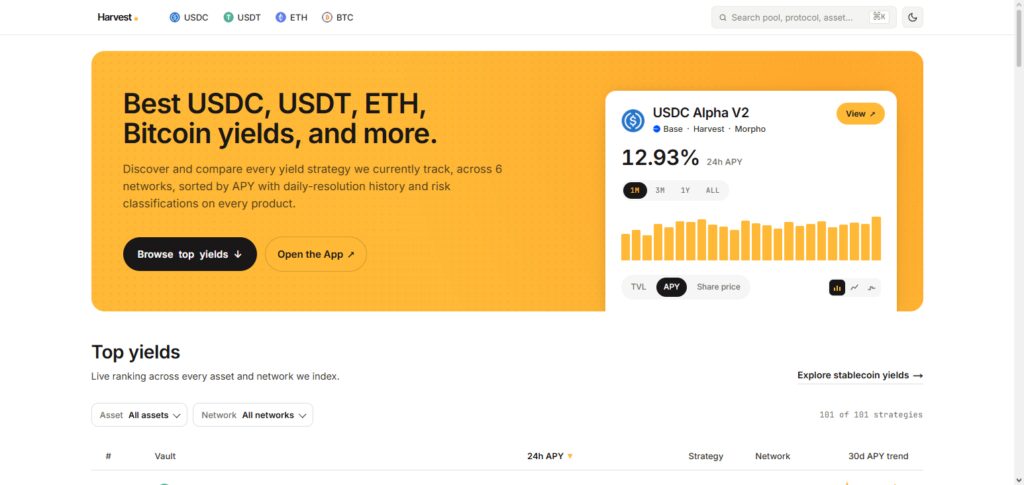
Harvest pipelines rewards from Aave, Compound, Curve, and Uniswap to depositors. Harvest Finance operates after initial exploits for 2000+ days. Transparency for users is noted with continuous yield data and multi-chain results, which led to pointing Harvest as on of the Best DeFi Yield Aggregators.
Harvest Finance Details
- Established in 2020 on Ethereum.
- Uses Aave, Curve, and Uniswap for reward aggregation.
- Compatible with ETH, WBTC, USDC, USDT.
- Governance is exercised via the FARM token.
- Multi‑chain vaults on Polygon, Arbitrum, and zkSync.
| Pros | Cons |
|---|---|
| Multi‑chain vaults (Polygon, Arbitrum, zkSync) | History of exploits (2020) |
| FARM token governance | Lower liquidity compared to rivals |
| Supports ETH, WBTC, USDC, USDT | APY depends on external protocols |
| Transparent yield reporting | Complex strategies for beginners |
| Long‑standing DeFi project | Limited innovation vs newer platforms |
4. Idle Finance
Idle Finance, a yield optimization protocol based in New York, reallocated assets among lending protocols like Aave, Compound, Morpho, Lido, and Clearpool, and was launched in 2019. Best Yield vaults (stablecoins like DAI, USDC, and USDT, which are auto-rebalancing) and Yield Tranches (which are deposits split into Senior and Junior risk classes) are the two products on offer.
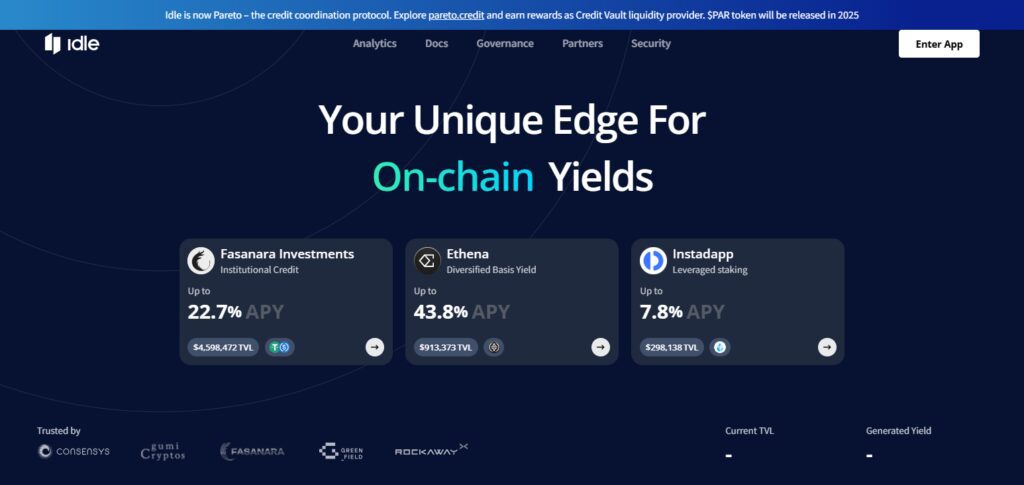
Idle Finance charges a performance fee, but no deposit or withdrawal fees are taken. It is operated by the IDLE token DAO. Due to its ability to balance risk-adjusted returns, Idle Finance has been recognized as one of the Best DeFi Yield Aggregators. It is also moving into Pareto, which is a credit coordination protocol.
Idle Finance Details
- Established in 2019 in New York.
- Has the first Best Yield vaults and Yield Tranches.
- Includes stablecoins like DAI, USDC, USDT.
- IDLE token DAO provides governance.
- Is becoming the Pareto credit protocol.
| Pros | Cons |
|---|---|
| Founded in 2019, strong track record | Smaller user base vs Yearn/Beefy |
| Best Yield vaults auto‑rebalance | Performance fees apply |
| Yield tranches balance risk/reward | Limited asset diversity |
| Governance via IDLE token DAO | Transitioning to Pareto may cause uncertainty |
| Supports stablecoins (DAI, USDC, USDT) | Less focus on multi‑chain expansion |
5. Autofarm
Founded in 2020, Autofarm is a cross-chain yield aggregator and auto-compounding vault and DEX aggregator. Autofarm supports users holding assets on BNB Chain, Polygon, Avalanche, Fantom, and Ethereum to farm yield with no manual effort required to maximize their APY.

Autofarm’s smart contracts automatically harvest, swap and reinvest reward tokens. Its governance token AUTO incentivizes community governance and participation. As one of the Best DeFi Yield Aggregators, Autofarm provides multi-chain strategies to streamline and simplify the yield farming process on their intuitive interface.
Autofarm Details
- Established in 2020 with a cross‑chain aggregator.
- Provides DEX assistance for auto-compounding vaults.
- Supports yields from chains like BNB, Polygon, Avalanche, Fantom, Ethereum.
- Governance token is AUTO.
- Provides a simplified multi‑chain yield farming tactic.
| Pros | Cons |
|---|---|
| Cross‑chain aggregator | Smaller community vs Yearn/Beefy |
| Auto‑compounding vaults | Governance token AUTO less adopted |
| Supports BNB, Polygon, Avalanche, Fantom | APY volatility |
| Integrated DEX services | UI less polished than Zerion |
| Simplifies yield farming | Limited institutional adoption |
6. Zerion
Founded in 2016 in San Francisco, Zerion is a Web3 wallet and DeFi aggregator. It supports BTC, ETH, ERC-20 tokens, NFTs, and staked assets across the Ethereum, Solana, and other chains.

Zerion offers users a dashboard to track their portfolio, and trade and perform yield farming via DEX aggregation. Zerion raised $24M and has more than 300,000 monthly active users. As one of the Best DeFi Yield Aggregators, Zerion is a great example of being able to non-custodially manage your assets.
Zerion Details
- Established in 2016 in San Francisco.
- A DeFi aggregator and web3 wallet.
- Supports assets including BTC, ETH, all ERC‑20, NFTs.
- Provides DEX assistance and portfolio aids.
| Pros | Cons |
|---|---|
| Founded in 2016, strong credibility | Focused more on tracking than farming |
| Web3 wallet + aggregator | Limited yield optimization tools |
| Supports BTC, ETH, ERC‑20, NFTs | Relies on external protocols for yield |
| 300K+ monthly active users | Not purely a yield aggregator |
| User‑friendly dashboard | Fees may apply for swaps |
7. Instadapp
Instadapp launched in 2018 in Hyderabad by Samyak and Sowmay Jain. It is a smart DeFi middleware and wallet. Instadapp combines multiple protocols. These include MakerDAO, Compound, Uniswap and Aave.
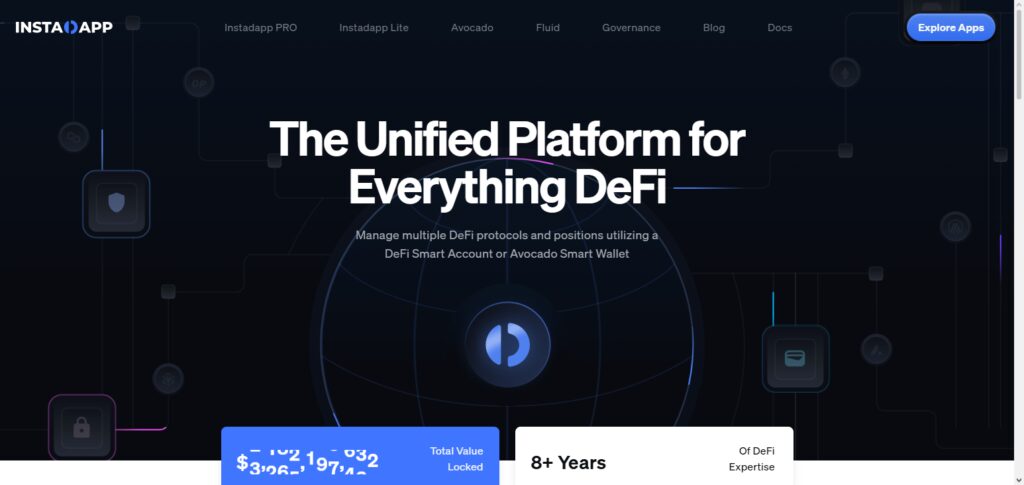
Users can borrow, leverage, refine and automate their actions. Its DeFi smart layer combines multiple protocols in one interface. Instadapp has processed over 5 billion dollars of total value locked and has received extra funding of 12.4 million dollars. Instadapp is among the best DeFi Yield Aggregators. For both retail and institutional use, it turns multiple DeFi actions in single transaction.
Instadapp Details
- Founded in 2018, Hyderabad.
- Smart wallet layer integrating MakerDAO, Aave, Uniswap.
- Supports ETH, stablecoins, DeFi assets.
- Governance via INST token.
- Managed over $5B in TVL.
| Pros | Cons |
|---|---|
| Founded in 2018, long track record | Complex for beginners |
| Smart wallet layer integrates MakerDAO, Aave, Uniswap | Requires advanced DeFi knowledge |
| Supports ETH, stablecoins, DeFi assets | Governance token INST less liquid |
| Managed $5B+ TVL | High gas fees on Ethereum |
| Advanced automation tools | Limited retail adoption |
8. Ape Board
Founded in 2021 in Singapore by Mike Phulsuksombati, Ape Board is a cross-chain portfolio dashboard. Ape Board is designed to allow users to manage yields across multiple platforms in a single place. It launched to support assets across Ethereum, BNB Chain, Polygon, Solana, and Terra. Along with multiple financial chains, Ape Board also supports users on the self-governing and decentralized exchange platforms.
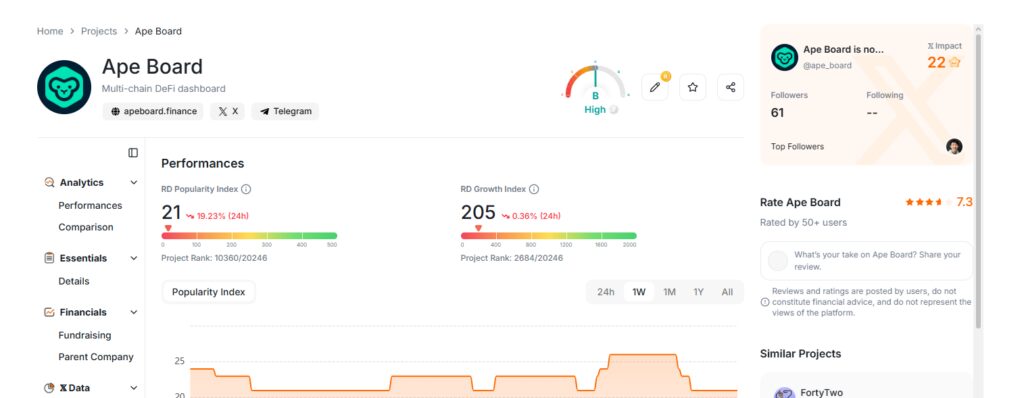
It also was awarded 1.2 million in funding from investors, including DeFiance Capital and SCB 10X. Among the best DeFi Yield Aggregators, Ape Board sees direct farming less important to the goal of the company than reducing the hassle of managing a portfolio or tracking individual yields
Ape Board Details
- Founded in 2021, Singapore.
- Cross‑chain portfolio dashboard.
- Supports Ethereum, BNB Chain, Polygon, Solana, Terra.
- Raised $1.2M from DeFiance Capital.
- Simplifies yield tracking across platforms.
| Pros | Cons |
|---|---|
| Founded in 2021, Singapore | Focused on tracking, not farming |
| Cross‑chain portfolio dashboard | Limited yield optimization |
| Supports Ethereum, BNB, Polygon, Solana, Terra | Smaller funding compared to rivals |
| Raised $1.2M from DeFiance Capital | Dependent on external protocols |
| Simplifies yield tracking | Not a direct yield aggregator |
9. Pendle Finance
Pendle Finance was started in 2021 by TN Lee and Vu Nguyen to tokenize and trade future yields. Pendle Finance incorporates yield-bearing tokens from stETH, aUSDC, cDAI, and others. Pendle Finance uses Ethereum, Arbitrum, Optimism, and BNB Chain in its framework.
Pendle segregates the principal and yield into tradeable tokens (which are PT and YT). This creates the arenas of speculation and fixed yield along with hedging. Pendle is named among the Best DeFi Yield Aggregators, and is the largest platform for yield trading, combining the DeFi ecosystem with the derivatives of trade in finance.
Pendle Finance Details
- Founded in 2021, Singapore.
- Tokenizes & trades future yield.
- Supports stETH, aUSDC, cDAI, yield tokens.
- Operates on Ethereum, Arbitrum, Optimism, BNB Chain.
- Largest yield trading platform in DeFi.
| Pros | Cons |
|---|---|
| Founded in 2021, Singapore | Complex yield tokenization model |
| Tokenizes & trades future yield | Requires advanced DeFi knowledge |
| Supports stETH, aUSDC, cDAI | Smaller user base vs Yearn/Beefy |
| Operates on Ethereum, Arbitrum, Optimism, BNB | Volatility in yield tokens |
| Largest yield trading platform | Liquidity risk in YT/PT markets |
10. Stader Labs
Established in Singapore in April 2021, Stader Labs is a multi-chain liquid staking platform. It offers liquid staking tokens for ETH, MATIC, BNB, HBAR, NEAR, and Fantom (ETHx, MaticX, BNBx, HBARX, NearX, sFTMX, LunaX).
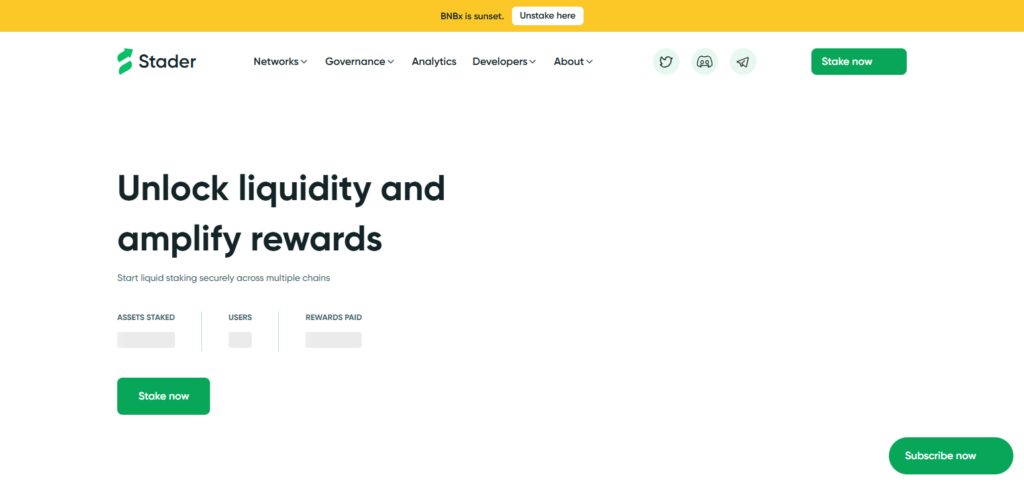
With investment from Pantera Capital and Coinbase Ventures, Stader has received a total funding of 16.5M USD. Their offerings include staking pools and DeFi for lending and liquidity. Stader is one of the Best DeFi Yield Aggregators.
Stader Labs Details
- Founded in 2021, Singapore.
- Multi‑chain liquid staking platform.
- Supports ETH, MATIC, BNB, HBAR, NEAR, Fantom.
- Issues liquid staking tokens (ETHx, MaticX, BNBx).
- Backed by Pantera Capital & Coinbase Ventures.
| Pros | Cons |
|---|---|
| Founded in 2021, Singapore | Focused mainly on staking |
| Multi‑chain liquid staking | Limited farming strategies |
| Supports ETH, MATIC, BNB, HBAR, NEAR, Fantom | Dependence on validator performance |
| Issues liquid staking tokens (ETHx, MaticX, BNBx) | Smart contract risks |
| Backed by Pantera & Coinbase Ventures | Competition from Lido & Rocket Pool |
Conclusion
The DeFi ecosystem is home to a variety of yield optimization platforms. Beefy Finance and Yearn Finance pioneered automated vault strategies. Other platforms include risk-adjusted lending and farming, like Idle Finance and Harvest Finance.
Users can take advantage of the work of cross-chain innovators, like Autofarm, as well as portfolio dashboards like Zerion and Ape Board. Users are encouraged to take advantage of the advanced strategies of Instadapp, the yield tokenization of Pendle Finance, and the liquid staking of Stader Labs.
These platforms are collectively the Best DeFi Yield Aggregators in 2026. The services they provide yield strategies, utilizing, and diversifying automation. They take DeFi services further by providing an offering for institutional and retail participants, while making their services more user-friendly and improved yield strategies.
FAQ
What is a DeFi yield aggregator?
A DeFi yield aggregator is a platform that automates yield farming strategies, reallocating assets across multiple protocols to maximize returns.
Which are the top yield aggregators in 2026?
The leading platforms include Yearn Finance, Beefy Finance, Harvest Finance, Idle Finance, Autofarm, Zerion, Instadapp, Ape Board, Pendle Finance, and Stader Labs.
How do yield aggregators maximize returns?
They pool user deposits, auto-compound rewards, and rebalance assets across lending, staking, and liquidity pools to optimize APY.
Are DeFi yield aggregators safe to use?
Safety depends on audits, smart contract security, and governance. Platforms like Yearn and Beefy undergo regular audits, but risks such as exploits remain.
Which assets are supported by yield aggregators?
Most support stablecoins (DAI, USDC, USDT), ETH, BTC, and yield-bearing tokens like stETH, MaticX, and BNBx. Multi-chain aggregators expand support across Ethereum, BNB Chain, Polygon, Avalanche, and more.