Best Stablecoin APIs for Fintech Applications in 2026 is the trend in payments and treasury management and allied areas. The role of stablecoin APIs grows with the support for multiple chains, adoption of compliance-ready custody, and easy integration of fiat.
By focusing on APIs from Eco Routes, Stripe Bridge, Circle CCTP, LI.FI, BVNK, Alchemy, Lightspark, Fireblocks, MoonPay, and Stripe, we will analyze features, supported chains, pricing, and their place in the ecosystem for choice of stablecoin API to support fintech’s growing and safe API integrations.
How To Choose Stablecoin APIs for Fintech Applications
Supported Stablecoins
Check for API support of USDC, USDT, DAI, and PYUSD or similar services. From a compliance perspective, it is ideal to use USDC, but the liquidity offered by USDT is hard to beat.
- Network Coverage
Evaluate how many chains are supported (ethereum, solana, polygon, avalanche, L2s). APIs Alchemy and Eco Routes have the best multi-chain coverage.

Pricing Model
Compare subscription-based models (BVNK, Fireblocks), transaction-based models (Circle, MoonPay), and hybrid models (Eco Routes, Alchemy).
Compliance & Regulation
Check for GENIUS Act compliance built in with KYC/AML modules. Of the mentioned services, Circle and Fireblocks fall under this category.
Custody Options
API services that include custody and insurance for institutional fintech services are preferred (Fireblocks, Circle).
Fiat On/Off Ramps
For consumer applications, services such as Stripe Stablecoin Beta and MoonPay provide seamless fiat conversion.
Treasury Management
Enterprise services that require treasury management will find the services offered by BVNK and Eco Routes appropriate.
Developer Experience
Consider the completeness of SDKs, documentation, APIs, and monitoring services (Alchemy, Eco Routes)
Use Case Alignment
API services should be aligned to payments, remittance, treasury, custody, and developer services based upon the fintech offering.
Benefits Of Stablecoin APIs for Fintech Applications
Conflict-Free Payments
Through stablecoin payments, your customers can clear obligations immediately with low costs regardless of geographic location, without the involvement of conventional banking networks.
Expansive Chain Support
Integration with Alchemy and Eco Routes provides the flexibility of cross-network operations in the range of 10-20 networks.
Fiat On/Off Ramps
The Stablecoin Beta from Stripe and MoonPay slash the conversion from and to stablecoins, making these technologies accessible to non-technical user sets.
Treasury Management
Eco Routes and BVNK offer enterprise-level treasury management, settlement, and reporting tools.
Compliance and Regulation
Circle and Fireblocks implement KYC/AML. Consequently, stablecoin APIs adhere to the GENIUS Act and other regulatory frameworks.
Developer Support
Integration with Alchemy and Eco Routes provide developer support via SDKs, integration, and analytics.
Custodial Services
For enterprises, institutional-grade protection is provided by Fireblocks’ secure custody.
Key Points
| Provider | Chains Supported | Stablecoins | Key Features | Best For |
|---|---|---|---|---|
| Eco Routes API | 15 | 7 | Atomic transfers, gas abstraction, idempotency | Multi-chain orchestration |
| Circle CCTP & Programmable Wallets | 13+ | USDC | Fiat ramps, custody, compliance | Regulated fintechs |
| Bridge.xyz / Stripe Bridge | 8+ | 4 | Cross-chain routing, Stripe integration | Payment orchestration |
| Lightspark | Bitcoin + stablecoin rails | USDC, Lightning | Instant settlement, low fees | Global remittances |
| LI.FI | 10+ | Multiple | Bridge aggregation, routing | DeFi + fintech bridges |
| Stripe Stablecoin Beta | Stripe ecosystem | USDC | Merchant APIs, fiat on/off ramps | SaaS & e-commerce |
| BVNK | 12+ | USDC, USDT | Treasury + settlement | Enterprise treasury |
| Alchemy Stablecoin APIs | 20+ | USDC, USDT, DAI | Developer-first infra, analytics | Fintech developers |
| MoonPay API Tier | 10+ | USDC, USDT | Fiat on/off ramps, KYC | Consumer fintech apps |
| Fireblocks APIs | 15+ | USDC, USDT | Custody, transfers, compliance | Institutional fintechs |
1. Eco Routes API
Eco Routes API is a multi-chain transaction orchestration platform that integrates with 15 networks and 7 stablecoins, including USDC, USDT, DAI, and GUSD. It offers atomic swaps, gas optimizer, and idempotent transaction handler, and is therefore well suited for treasury and settlement flows.
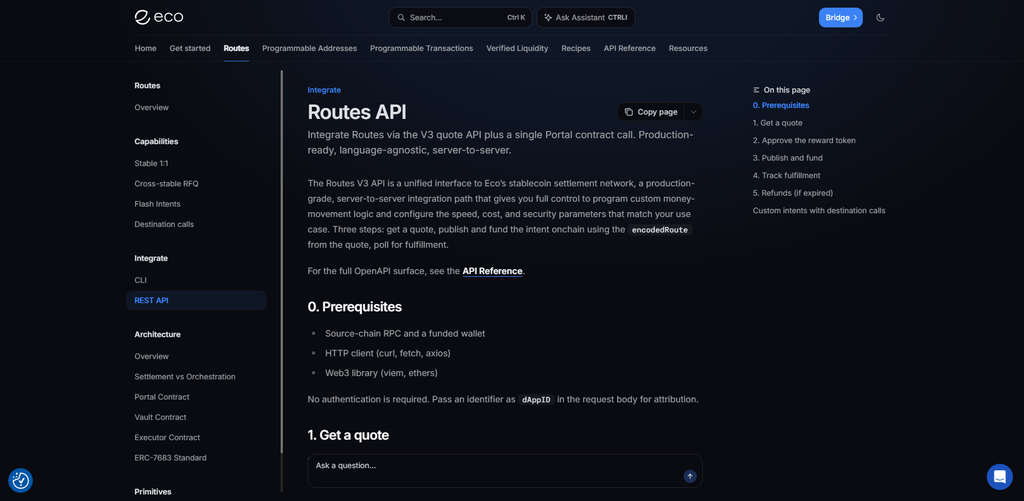
Eco Routes API uses a tiered pricing model, wherein enterprise packages would offer SLA-backed uptime. Networks covered are Ethereum, Solana, Polygon, Avalanche, and some of the more advanced L2s. Eco Routes API’s developer first approach is designed to make integration into Fintech Stack a breeze.
It offers compliance modules that fulfill the EU and US GENIUS Act obligations. Eco Routes API is very popular with Fintechs that provide reliable multi-chain orchestration for payments and treasury management.
| Feature | Pros | Cons |
|---|---|---|
| Multi-chain orchestration (15 networks) | Broad coverage across Ethereum, Solana, Polygon, Avalanche, L2s | Complexity in integration |
| Supports 7 stablecoins (USDC, USDT, DAI, GUSD, etc.) | Flexibility for treasury & payments | Limited fiat ramps |
| Atomic transfers | Prevents double-spending | Higher dev learning curve |
| Gas abstraction | Simplifies UX | May add overhead |
| Idempotent transactions | Reliable settlement | Requires strict API handling |
| Compliance modules | GENIUS Act ready | Regulatory overhead |
| Tiered pricing | Scales with usage | Enterprise costs rise |
| SLA-backed uptime | Enterprise reliability | Costly premium tiers |
| Developer-first SDK | Easy integration | Still evolving documentation |
2. Circle CCTP & Programmable Wallets
Circle’s Programmable Wallets API and Cross-Chain Transfer Protocol, CCTP, support USDC on 13+ networks including Ethereum, Solana, Avalanche, Base and Arbitrum. It provides fiat on/off ramps along with custody and compliance, and is thus preferred by regulated Fintechs. Circle offers a transaction-based pricing model, and enterprise packages include compliance reporting and fraud control.
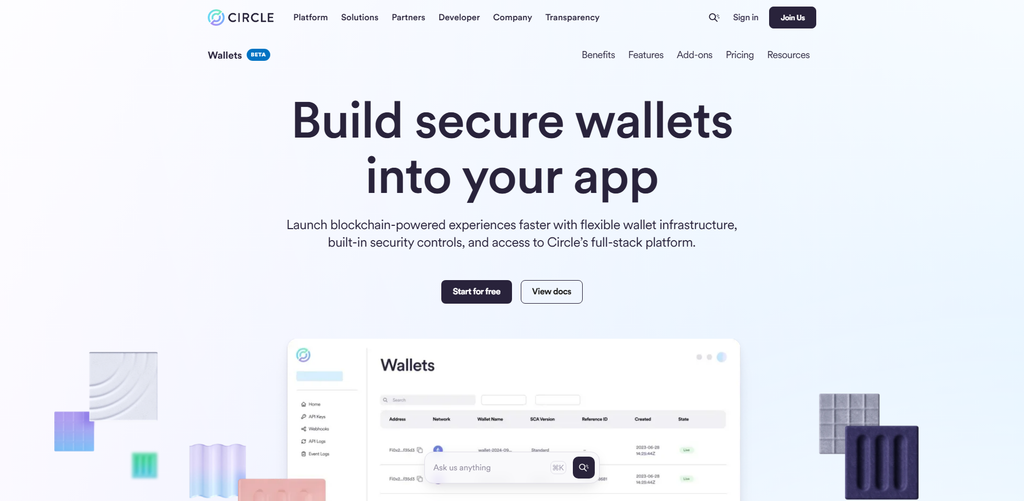
Programmable Wallets give Fintechs the ability to embed USDC within their applications, while CCTP provides native USDC transfer across multiple chains with no need for wrapped tokens. Given Circle’s strong regulatory position, it is the best choice for Fintechs that need custody, compliance, and fiat integration.
| Feature | Pros | Cons |
|---|---|---|
| USDC-only support | Strong regulatory compliance | No multi-stablecoin support |
| 13+ networks | Wide chain coverage | Limited compared to Alchemy |
| Fiat ramps | Seamless fiat integration | Higher fees |
| Custody services | Institutional-grade | Centralized custody risk |
| Compliance reporting | GENIUS Act aligned | Adds overhead |
| Fraud monitoring | Safer transactions | May slow settlement |
| Programmable wallets | Embedded USDC transfers | Limited customization |
| Transaction-based pricing | Pay-as-you-go | Expensive at scale |
| Strong brand trust | Widely adopted | Single issuer dependency |
3. Bridge.xyz / Stripe Bridge
Bridge.xyz builds upon Stripe Bridge to offer integration with 8+ networks and 4 stablecoins, USDC, USDT, and DAI. Specializing in cross-chain routing and payment orchestration, it supports fintechs in moving stablecoins across ecosystems.
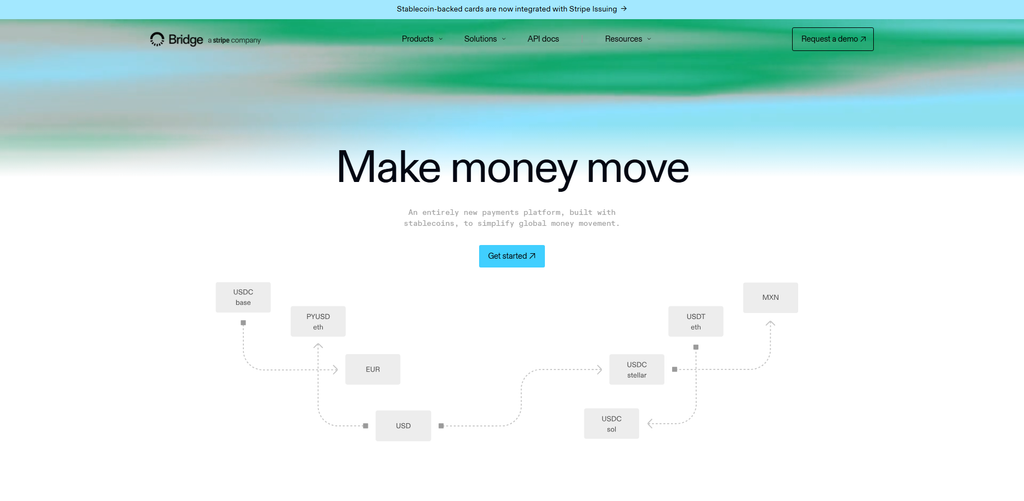
Networks included are Ethereum, Polygon, Solana, and Avalanche. Bridge.xyz charges fees related to the volume and the speed of the settlement in a pay-as-you-go model.
Stripe Bridge enables merchants to accept stablecoin payments and bridge fiat currency to crypto with seamless integration. Bridge.xyz is most effective for fintechs developing payment orchestration layers who value efficiency in cross-chain liquidity and routing.
| Feature | Pros | Cons |
|---|---|---|
| Cross-chain routing | Efficient liquidity movement | Latency risk |
| Supports 8+ networks | Good coverage | Less than Eco/Alchemy |
| 4 stablecoins | Flexible payments | Limited compared to LI.FI |
| Stripe integration | Merchant-ready | Stripe ecosystem lock-in |
| Usage-based pricing | Scales with volume | Costs rise with traffic |
| Settlement speed | Fast orchestration | Dependent on routing |
| Payment orchestration | Ideal for SaaS | Complex compliance |
| Developer SDK | Easy integration | Limited analytics |
| Fiat bridging | Smooth fiat-crypto | Stripe dependency |
4. Lightspark
Lightspark extends the Bitcoin Lightning Network by incorporating stablecoin rails with USDC along with BTC. It offers instant settlement for low fees, making it optimal for global remittances and other cross-border applications within the fintech space.
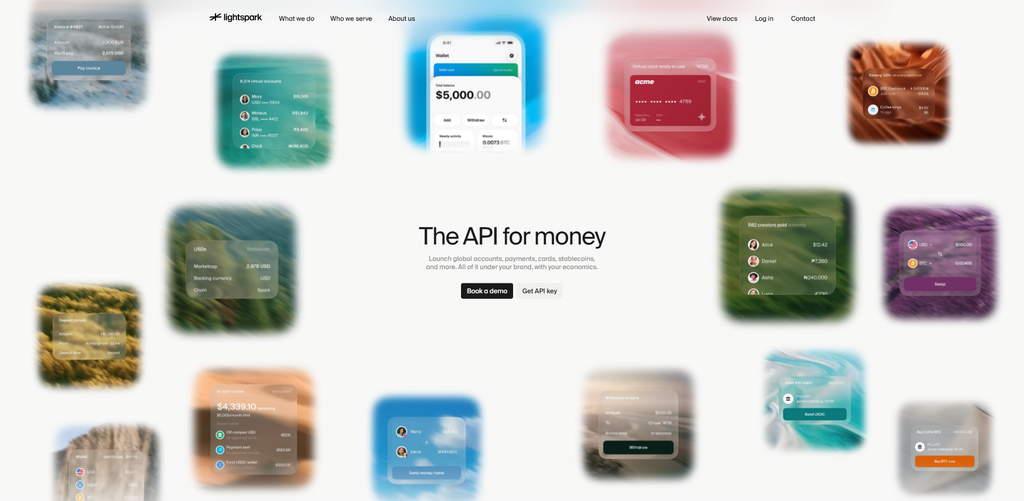
Networks include Bitcoin and Ethereum for USDC issuance. Lightspark charges fees in a pay-as-you-go model based on transaction volume with optimized micro fees designed for high-volume transfers.
Lightspark abstracts complex Lightning Network APIs to enable stablecoins payments offered with almost zero-latency to fintechs. Of the solutions for international transfers, Lightspark offers one of the few solutions with low cost and high speed.
| Feature | Pros | Cons |
|---|---|---|
| Bitcoin Lightning + USDC | Unique hybrid rails | Limited stablecoin choice |
| Instant settlement | Near-zero latency | Network dependency |
| Micro-fee pricing | Cost-efficient | Volume scaling issues |
| Cross-border focus | Ideal for remittances | Limited treasury tools |
| API abstraction | Simplifies Lightning | Learning curve |
| Ethereum USDC support | Expands utility | Limited chain coverage |
| Compliance modules | Safer transfers | Regulatory overhead |
| Developer SDK | Easy integration | Still maturing |
| Low-cost transfers | Attractive for fintechs | Limited enterprise features |
5. LI.FI
LI.FI offers a bridge aggregation API that supports 10+ networks and multiple stablecoins like USDC, USDT, DAI, and FRAX. Routing solutions for liquidity aggregation and cross-chain swaps are included. Networks supported are Ethereum, Polygon, Solana, Arbitrum, and Avalanche. Fees are charged based on volume with a more complex pricing structure related to the routing and liquidity used.
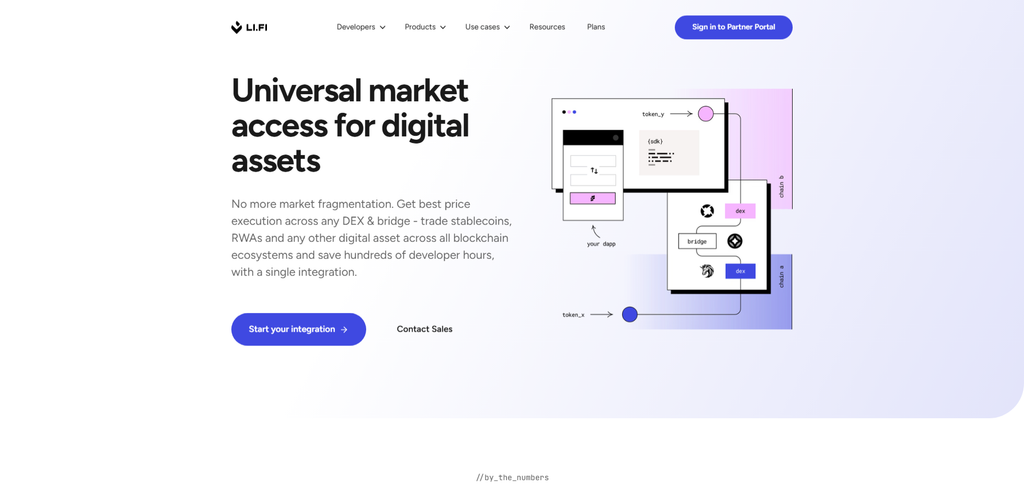
Property of Lukka Innovations, Inc. Reproduction or distribution prohibited without permission. LI.FI is commonly used across DeFi and fintech applications that require cross-chain liquidity management. The SDKs make integration easy, while compliance modules allow for safe routing for regulated fintechs. LI.FI is well-suited for fintechs in need of multi-chain bridge aggregation with support for stablecoins.
| Feature | Pros | Cons |
|---|---|---|
| Bridge aggregation | Liquidity optimization | Latency in routing |
| Supports 10+ networks | Broad coverage | Less than Alchemy |
| Multiple stablecoins | Flexible integration | Complexity in swaps |
| Routing intelligence | Efficient transfers | Higher dev overhead |
| Liquidity aggregation | Better pricing | Dependent on liquidity pools |
| SDKs for developers | Easy integration | Documentation gaps |
| Compliance modules | Safer routing | Adds cost |
| Volume-based pricing | Scales with usage | Expensive at scale |
| DeFi + fintech use | Versatile | Regulatory uncertainty |
6. Stripe Stablecoin Beta
Stripe’s Stablecoin Beta API integrates USDC into Stripe’s merchant ecosystem for use with fintechs and SaaS to accept stablecoins. Supported networks are Ethereum and Solana. Fees follow Stripe’s merchant fee model which is typically 2.9% + fixed cents per transaction, however stablecoin settlement is designed to be lower cost.
Stripe provides ramps to and from fiat currency, compliance, and fraud prevention. As a result, it is ideal for use with e-commerce and SaaS fintechs. The Stablecoin API integrates seamlessly with a Stripe account, reducing the friction businesses feel from adopting a stable coin payment method.
| Feature | Pros | Cons |
|---|---|---|
| USDC support | Stable & regulated | No multi-stablecoin |
| Ethereum + Solana | Reliable networks | Limited coverage |
| Merchant integration | Seamless for SaaS | Stripe lock-in |
| Fiat ramps | Easy conversion | Higher fees |
| Fraud detection | Safer payments | May slow UX |
| Standard merchant pricing | Familiar model | Expensive for micro-payments |
| API simplicity | Easy adoption | Limited customization |
| Compliance-ready | GENIUS Act aligned | Centralized |
| SaaS focus | Ideal for e-commerce | Not treasury-oriented |
7. BVNK
BVNK has a treasury and settlement API that supports 12+ networks and stablecoins like USDC and USDT. It focuses on enterprise treasury management and gives fintechs the ability to hold, transfer, and settle stablecoins across different blockchains. Supported networks are Ethereum, Solana, Polygon, and Avalanche.
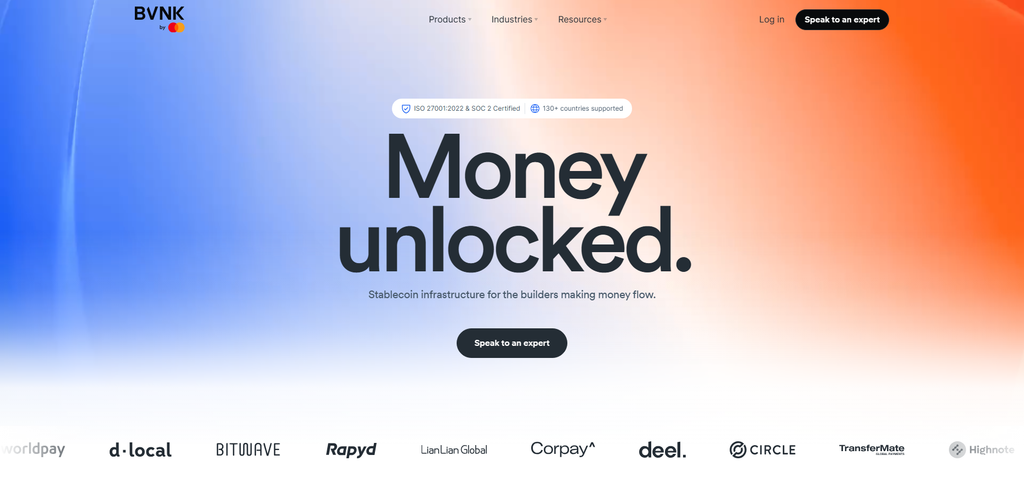
Pricing is subscription-based and the enterprise tier offers advanced reporting and compliance. BVNK’s APIs are designed for enterprise-grade treasury orchestration, making it a great choice for fintechs with large volume stablecoin transactions.
| Feature | Pros | Cons |
|---|---|---|
| Treasury orchestration | Enterprise-grade | Not consumer-focused |
| Supports 12+ networks | Broad coverage | Less than Alchemy |
| USDC & USDT | Widely used | Limited diversity |
| Settlement APIs | Reliable | Latency risk |
| Subscription pricing | Predictable costs | Expensive for startups |
| Compliance modules | Safer treasury | Adds overhead |
| Reporting tools | Enterprise analytics | Complex setup |
| SLA-backed uptime | Reliable | Costly premium tiers |
| Developer SDK | Easy integration | Limited flexibility |
8. Alchemy Stablecoin APIs
Alchemy provides developer friendly stablecoin APIs designed to work with 20+ networks and stablecoins like USDC, USDT, and DAI. It provides users with analytics, monitoring, and developer tools. Supported networks are Ethereum, Solana, Polygon, Avalanche, Arbitrum, and Base.
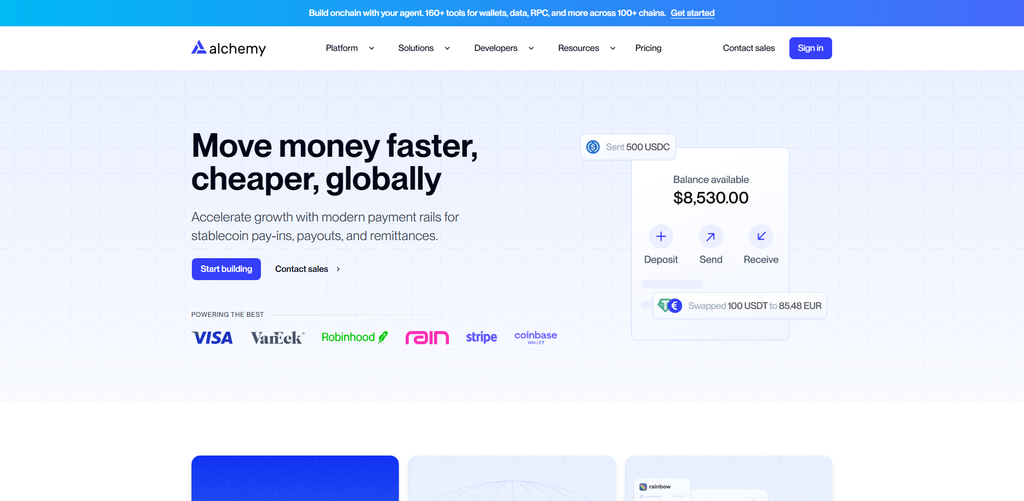
We have free developer tiers and enterprise packages that offer advanced analytics and SLA-backed uptime. Alchemy is a great choice for fintech developers who need scalable infrastructure and analytics for stablecoin integrations.
| Feature | Pros | Cons |
|---|---|---|
| 20+ networks | Largest coverage | Complexity in orchestration |
| USDC, USDT, DAI | Multi-stablecoin | No fiat ramps |
| Developer-first infra | Strong tooling | Learning curve |
| Analytics & monitoring | Deep insights | Adds overhead |
| Free developer tier | Accessible | Limited enterprise features |
| SLA-backed uptime | Reliable | Costly premium tiers |
| SDKs & docs | Easy integration | Still evolving |
| Compliance-ready | Safer integration | Adds cost |
| Scalable infra | Ideal for fintech devs | Not treasury-focused |
9. MoonPay API
MoonPay’s API supports over 10 networks as well as popular stablecoins such as USDT and USDC with a focus on fiat on/off ramps. It helps fintechs give their users the ability to purchase and withdraw stablecoins all within the integrated KYC process. Supported networks include Ethereum, Solana and Polygon.
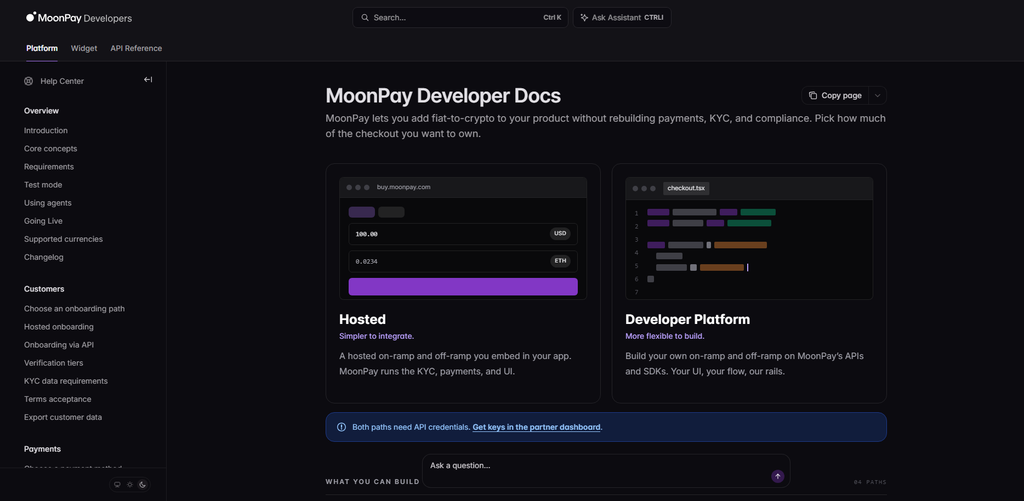
Pricing is based on the volume of fiat conversions, and therefore is transaction-based. MoonPay is well suited for fintech apps that need compliance-ready integrations and access to stablecoins.
| Feature | Pros | Cons |
|---|---|---|
| Fiat on/off ramps | Easy user access | Higher fees |
| Supports 10+ networks | Broad coverage | Less than Alchemy |
| USDC & USDT | Widely used | Limited diversity |
| Integrated KYC | Compliance-ready | Adds friction |
| Transaction-based pricing | Pay-as-you-go | Expensive at scale |
| Consumer fintech focus | Ideal for apps | Not enterprise-grade |
| Developer SDK | Easy integration | Limited analytics |
| Fraud monitoring | Safer transfers | Slower UX |
| Fiat withdrawals | User-friendly | Limited treasury tools |
10. Fireblocks APIs
Fireblocks has custody and transfer APIs for over 15 networks and stablecoins such as USDC and USDT. Focus is on institutional fintechs that need secure custody and settlement combined with compliance. Supported networks include Ethereum, Solana, Polygon, Avalanche and Arbitrum.
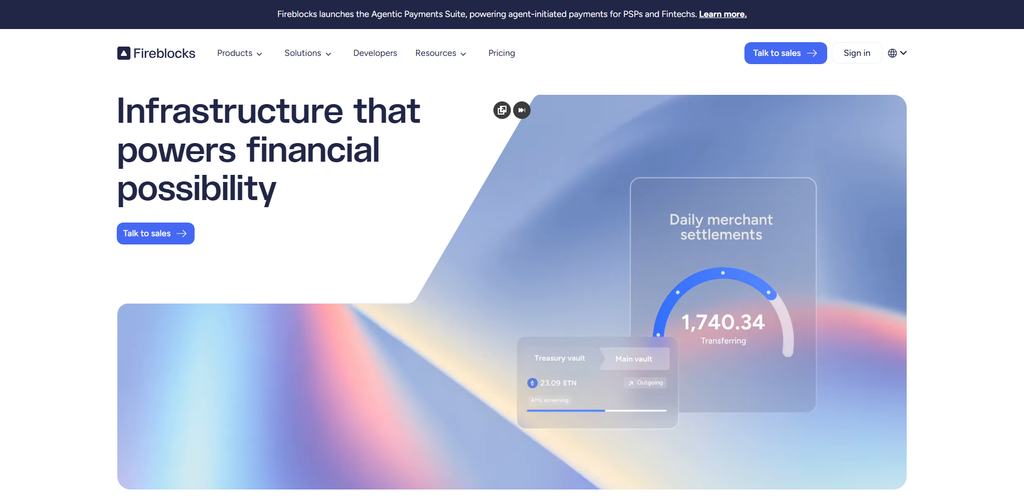
Pricing is enterprise subscription-based, with packages that include compliance, insurance, and SLA-backed uptime. Fireblocks has a lot of demand from institutional fintechs for secure custodial services and regulated stablecoin transactions.
| Feature | Pros | Cons |
|---|---|---|
| Custody APIs | Institutional-grade | Centralized custody risk |
| Supports 15+ networks | Broad coverage | Less than Alchemy |
| USDC & USDT | Widely used | Limited diversity |
| Compliance modules | GENIUS Act aligned | Adds overhead |
| Insurance-backed | Safer custody | Higher costs |
| SLA-backed uptime | Reliable | Costly premium tiers |
| Enterprise subscription | Predictable pricing | Expensive for startups |
| Secure transfers | Strong security | Complex setup |
| Institutional adoption | Widely trusted | Not consumer-focused |
Conclusion
In 2026, stablecoin APIs dominate fintech innovation with solutions for cross-chain payments, management and custody of treasuries, and integration with fiat at scale. Each stablecoin API service provider has specific strengths. Eco Routes API dominates multi-chain orchestration, Circle CCTP has custody of USDC in regulated environments, and Bridge.xyz and LI.FI are best for cross-chain routing.
For merchant adoption, fiat on-ramps are offered by the Stripe Stablecoin Beta and MoonPay, and BVNK and Alchemy offer treasury and developer infra respectively. For global remittances and custody for institutions, Lightspark and Fireblocks are the top providers.
Depending on the primary use case for your fintech (payments, treasury, compliance or developer tooling) you should select the corresponding API. By appropriately selecting the stablecoins and networks in combination with the pricing model, your fintech can achieve scalable, compliant and cost-efficient stablecoin integrations.
FAQ
What is a Stablecoin API?
A Stablecoin API is a developer interface that allows fintechs to integrate stablecoin payments, transfers, custody, and treasury functions into their applications. It abstracts blockchain complexity, enabling seamless cross-chain settlement, fiat ramps, and compliance
Which stablecoins are most supported?
The most widely supported stablecoins are USDC, USDT, and DAI, with some APIs also supporting GUSD and FRAX. Circle CCTP focuses exclusively on USDC, while Eco Routes, Alchemy, and LI.FI support multiple stablecoins across 10–20 networks.
Which networks do these APIs cover?
Coverage varies:
Eco Routes API → 15 networks (Ethereum, Solana, Polygon, Avalanche, L2s)
Alchemy → 20+ networks
Circle CCTP → 13+ networks
LI.FI → 10+ networks Others like Stripe Stablecoin Beta focus on Ethereum and Solana.
What pricing models are used?
Transaction-based fees → Circle, Lightspark, MoonPay
Subscription tiers → BVNK, Fireblocks
Hybrid models → Eco Routes, Alchemy (volume + enterprise SLA packages) Stripe follows its merchant fee model (2.9% + fixed cents).