

Prediction markets are an interesting part of the Web3 ecosystem, where people can predict real-world events and trade on possible outcomes with blockchain technology. Polymarket has garnered a lot of attention, but there are a number of other platforms that offer different features, trading mechanisms and market opportunities.
Whether it’s sports, cryptocurrency, politics or global events, these platforms provide a range of ways to get involved in decentralized forecasting. In this guide, I’ll look at the Best Web3 Prediction Markets like Polymarket and compare their main features, supported networks, fees, liquidity, and limitations.
What Are Web3 Prediction Markets?
Web3 prediction markets are blockchain-based platforms that enable users to predict the outcomes of real-world events by trading on the possible outcomes. These markets cover a range of categories including politics, sports, cryptocurrency, economics, elections and world events. Users usually buy YES or NO outcome positions using crypto or stablecoins.
And decentralized oracles help verify settlements and actual event results. Intelligent contracts handle transactions. Web3 prediction markets are not like traditional centralized platforms. Instead, they run on transparency, decentralized infrastructure, peer-to-peer participation and automated execution. This allows users to take part in collective forecasting.

How to Choose the Best Web3 Prediction Market?
Blockchain Compatibility: Opt for platforms that use reliable blockchain networks, have low transaction fees, offer fast processing, and are compatible with popular cryptocurrency wallets to make it easy to participate in prediction markets.
Prediction Market Types: Check the types of prediction markets that are on offer – politics, sports, crypto, economics, elections, world events, etc. to see if there are enough markets to meet your prediction needs.
Trading Fees and Costs: Look at maker and taker fees, gas fees, deposit fees and withdrawal fees to get a sense of how much it costs to play in prediction markets.
Liquidity and Trading Volume: Look at daily trading volume, market depth, liquidity available and order execution to avoid issues entering or exiting prediction positions.
Accepted Tokens and Payments: Check the list of accepted cryptocurrencies, stablecoins, collateral requirements and deposit options to ensure easy funding and smooth trading across various markets.
Security and Market Resolution: Review smart contract audit, decentralized oracle, dispute mechanism, wallet security and settlement procedures to reduce potential trading and platform risks.
Trading Mechanism and User Experience – Assess the ease of platform navigation, market data, and wallet connectivity, comparing automated market makers, order books, and peer-to-peer trading.
Regulatory Compliance and Accessibility: Identify the geographic availability, regional restrictions, eligibility criteria and relevant regulations to ensure allowed and responsible engagement when choosing a platform.
10 Best Web3 Prediction Markets Like Polymarket
| Platform | Key Point |
|---|---|
| Augur | One of the oldest decentralized prediction market protocols, allowing anyone to create and trade markets with community-driven dispute resolution. |
| Azuro | Open prediction market infrastructure powering multiple sports and event forecasting applications across EVM-compatible blockchains. |
| SX Bet | Peer-to-peer on-chain sports prediction exchange where users set odds and trade directly against each other. |
| Zeitgeist | Polkadot-based prediction market platform focused on permissionless market creation and decentralized governance |
| Gnosis (Omen) | Prediction market ecosystem built on Gnosis infrastructure, offering flexible market creation and decentralized settlement. |
| Manifold Markets | Community-driven prediction platform where users create and trade forecasts on virtually any topic through an open marketplace. |
| Predict.fun | BNB Chain-based prediction platform combining event forecasting with DeFi yield opportunities for participants. |
| Limitless Exchange | Base network prediction market allowing users to trade binary outcomes across crypto, sports, politics, and esports events. |
| Myriad Markets | Multichain Web3 prediction marketplace covering categories such as crypto, sports, politics, economy, gaming, and culture. |
| Opinion | BNB Chain prediction market focused on macroeconomic events, including inflation reports, interest-rate decisions, and employment data |
1. Augur (n.)
Augur is one of the first decentralized prediction market protocols in the Web3 ecosystem. It’s built to allow for permissionless forecasting with the ability to create and trade markets on almost any future event. The platform is built on Ethereum infrastructure and uses smart contract technology to manage and settle the market.

Augur relies on community reporting and dispute mechanisms for outcomes and supports participation using cryptocurrencies. People can buy and sell shares in the probability of an event happening .
The fees are determined by the market creators and network fees . Users who prefer a fully decentralized prediction market experience, with open participation and transparent governance, will prefer Augur.
Key Features
- Ethereum intelligent contracts for decentralized prediction markets.
- permissionless creation of markets for predictions of real-world events.
- Decentralized reporting and outcome resolution through the REP token.
- A mechanism for dispute resolution, where participants can challenge incorrect market results.
- Automated trading, settlement and distribution of payouts via intelligent contracts.
Primary Limitations
- Less trading activity and low liquidity than major prediction platforms.
- Ethereum gas fees can add to transaction costs.
- Hard interface and interaction with the blockchain that makes learning hard.
- Disputes on market resolution may delay final settlements
2. Azuro
Azuro is a decentralized prediction market and betting infrastructure protocol designed to power apps across multiple blockchain networks. Azuro isn’t a single prediction platform, instead it’s a liquidity, oracle and market infrastructure for developers. The protocol is EVM-compatible chains, with a heavy focus on sports and event prediction markets.
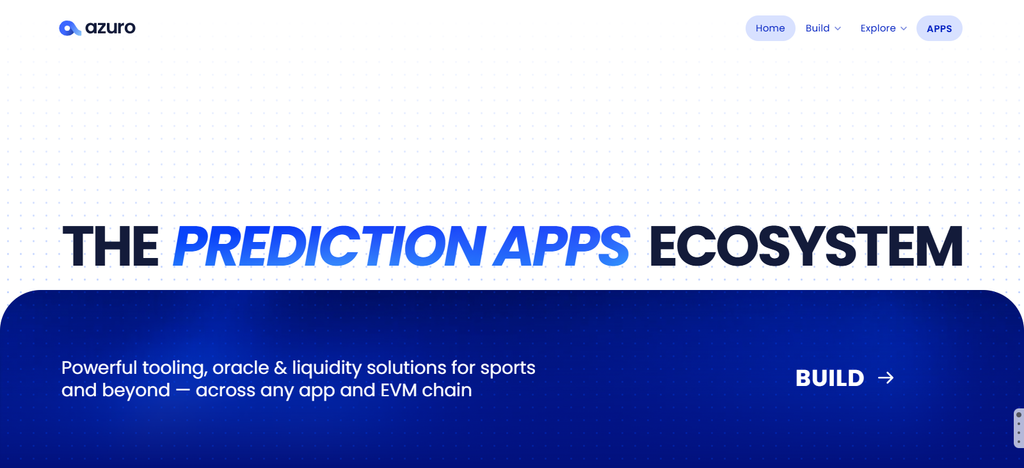
Users usually engage via applications built on top of Azuro’s infrastructure, paying in cryptocurrency and executing on-chain transactions. Trading costs depend on the application used for the protocol.
Smart-contract automation, decentralized liquidity and transparent settlement mechanisms help secure the ecosystem while cross-application liquidity sharing aims at boosting market efficiency and trading activity.
Key Features
- Decentralized infrastructure for prediction markets based on smart contract technology.
- A pool of shared liquidity that powers multiple connected apps.
- Dynamic odds with AMM-based trading mechanism.
- Strong emphasis on sports prediction and live betting markets.
- Multi-chain infrastructure for networks like Polygon, Gnosis, Arbitrum.
Main Limitations
- Specializes in sports and gaming-related markets.
- No one official consumer-facing interface.
- Trading costs are embedded in odds and spreads.
- User experience and available markets depend on the connected applications.
3. SXBet
SX Bet is a blockchain-based peer-to-peer sports prediction and forecasting exchange. This allows users to bet against each other instead of a traditional bookmaker, creating a decentralized marketplace for sports-related predictions.
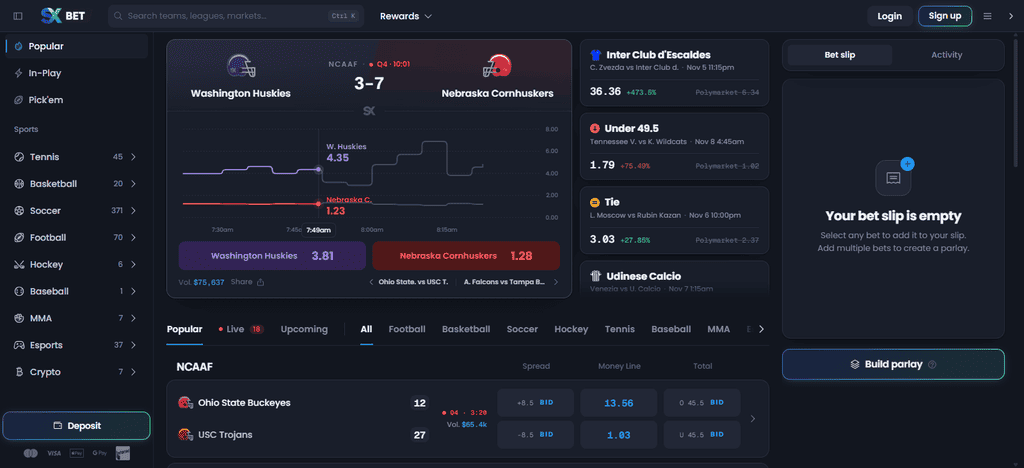
The platform is built on the SX Network ecosystem, it supports cryptocurrency deposits and withdrawals, and offers a wide variety of sporting events. Depending on their forecasts, market participants may place back or lay positions.
As a rule, trading fees are charged on the winning positions which helps to keep the liquidity of the platform. Settlement intelligent contracts, transparent transaction records, and decentralized infrastructure add integrity and security to trading for participants across the world.
Features Highlights
- Sports betting exchange and peer-to-peer prediction.
- Trading on-chain and non-custodial fund management.
- Matching betting positions based on order book trading.
- Supports sports markets and selected event based predictions.
- USDC based transactions & blockchain based settlement.
Main Limitations
- Heavy focus on sports markets.
- Individual events may vary greatly in liquidity.
- There could be extra network costs for blockchain transactions.
- Market availability and user access can differ by jurisdiction
4. Zeitgeist
Zeitgeist is a decentralized prediction market platform built on the Polkadot ecosystem. It’s built on community governance and permissionless market creation. Users can create prediction markets on politics, finance, sports, cryptocurrency and social events.
The platform combines the automated market making technology with decentralized forecasting mechanisms to enable trading. Users participate via blockchain-based assets and interact with on-chain liquidity pools.
Transaction costs vary with network activity and market conditions. Decentralized governance, blockchain consensus, and transparent settlement mechanisms provide security. Zeitgeist caters to users who wish to participate in community driven forecasting and cross-chain interoperability within the broader Web3 ecosystem.
Main Features
- Initially developed as a decentralized prediction market protocol on Polkadot.
- Supports scalar, binary, and categorical prediction markets.
- Employed automated market maker and order book trading strategies.
- ZTG token based governance and dispute resolution.
- Funded futarchy experiments for decentralized decision making.
Main Limitations
- The platform has allegedly stopped serving on August 2, 2026.
- Liquidity is limited and participation in the market is relatively low.
- Adding Polkadot wallet and token requirements added complexity to the onboarding.
- User access was hampered by geographical and regulatory limitations
5. Gnosis (Omen)
Gnosis is bringing decentralized prediction markets to life with its Omen application, built on oracle technology and blockchain infrastructure. The platform lets users buy and sell event outcomes without any centralized intermediaries.
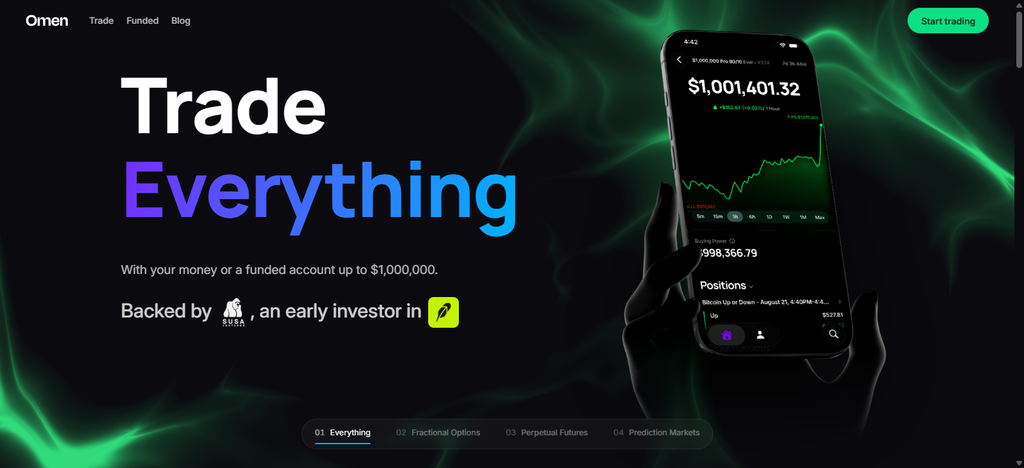
Omen is built on the Gnosis ecosystem and enables trading with automated market makers and crypto-based transactions. Markets can be created for categories like finance, politics, sports and cryptocurrency events.
Trading costs typically include costs of liquidity and transaction fees on the blockchain. The platform is further secured with audited intelligent contracts and decentralized oracle services, and the intent is for outcome resolutions to be transparent and verifiable on-chain.
Main Features
- Powered by Gnosis Conditional Tokens infrastructure.
- enables creation of prediction markets without permission.
- Outcome-tokens are traded by automated market makers.
- Integrates Reality.eth to resolve markets in a decentralized fashion.
- Supports customizable markets and conditional outcome tokens.
Major Constraints
- Liquidity is spread across separate markets.
- Trading volume is lower than major prediction markets
- Users require compatible crypto wallets and knowledge of blockchains.
- Settlements could be disputed and take time to be resolved by Oracle
6. Manifold Markets
Manifold Markets is a prediction market that is focused on crowd forecasting and community engagement. Unlike many blockchain-native platforms, it focuses on accessibility and lets users create markets covering technology, politics, economics, sports, entertainment and current events.
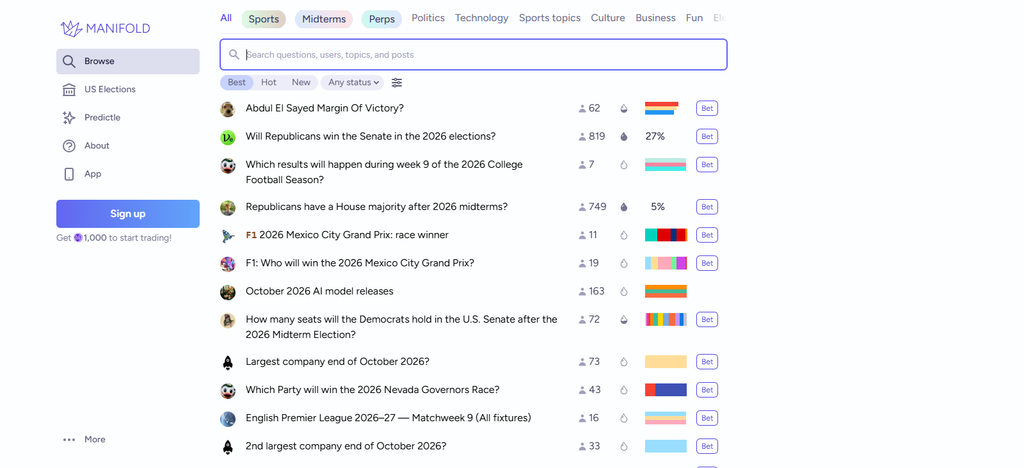
The platform is recognized for fostering user-generated markets and active discussion on event probabilities. In a market based trading system participants buy and sell shares which represent outcomes .
Platform mechanisms exist to keep the market trading and that provides liquidity. Clear market rules, community moderation and transparent resolution procedures build trust in outcomes and encourage engagement amongst forecasters.
Main Features
- Users can create markets on virtually any topic.
- Allows you to make predictions in politics, sports, technology, economics and entertainment.
- Employs Mana (M) as its virtual currency for trade.
- Automated market makers + limit order.
- Includes community forecasts, leaderboards and social interaction.
Main Limitations
- No converting Mana into real money.
- no traditional cash out from prediction balances.
- The outcome is usually decided by the market makers.
- Liquidity and accuracy of prediction may differ between markets.
7. Predict.fun
Predict.fun is a Web3 prediction market platform that merges decentralized finance with event forecasting. Built on BNB Chain infrastructure, it lets users participate in prediction markets around cryptocurrency trends, politics, sports and other real-world events.
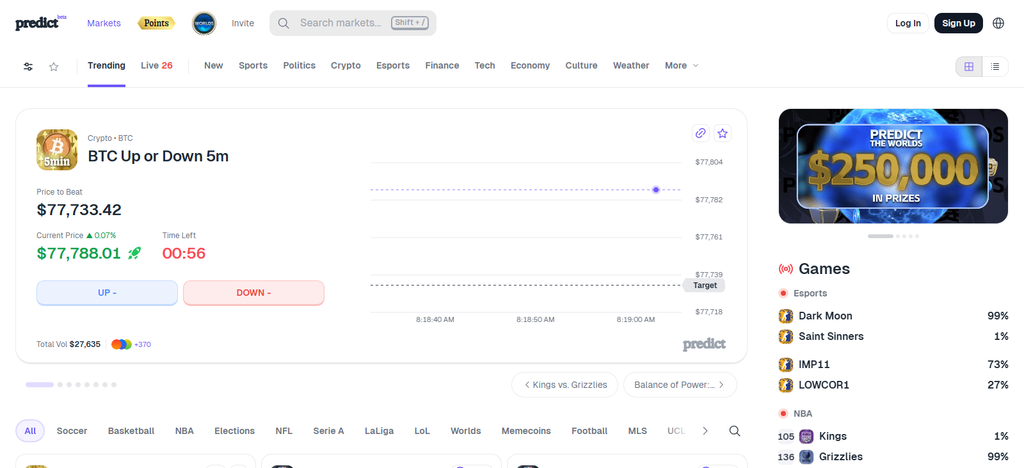
The platform wants to incentivize participation by combining predictions with yield-generating possibilities. Users trade positions with supported digital resources and communicate directly via intelligent contracts on the blockchain.
Network fees and platform mechanics determine trading costs. Security is based on decentralized contract execution with automated settlement and transparent market records in place to help support fair outcome resolution and user trust.
Main Features
- On-chain prediction trading based on BNB Smart Chain.
- supports sports, politics, crypto and economic event markets.
- Orders are executed on a central limit book order.
Uses the UMA Optimistic Oracle to settle markets in a decentralized way. - Integrates with Venus Protocol for yield generating positions.
Major limitations
- Requires BNB Smart Chain infrastructure and network compatibility.
- Access may be limited in certain jurisdictions for geographical reasons.
- Yield-bearing positions are subject to additional DeFi and smart contract risk.
- A disputed market outcome can delay settlement of a fund.
8. Limitless Exchange
Limitless Exchange is a blockchain prediction trading platform that enables users to trade on the outcomes of real-world events. The exchange features markets on sports, politics, cryptocurrency developments, esports and other trending topics. It is based on a blockchain infrastructure and uses binary market structures in which market participants buy shares in outcomes according to the probability of events.
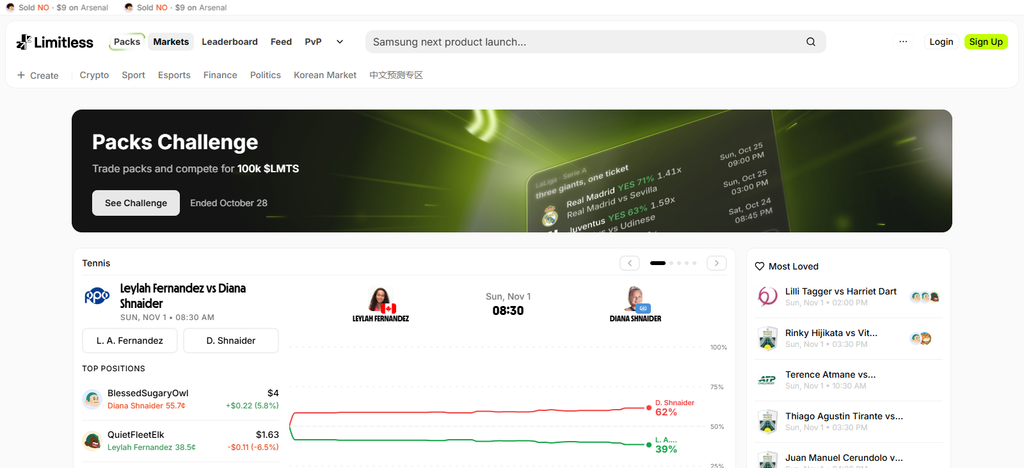
The primary payment method is cryptocurrency, allowing for seamless on-chain settlements. Network transaction fees and market expenses are typically included in trading costs. Transparent smart-contract execution, blockchain verification, and automated market settlement help secure the platform and enable efficient, accessible event forecasting.
Main Features
- On-chain prediction trading on Base blockchain.
- Supports cryptocurrency and prediction markets on real world events.
- Enables order-book trading and automated market making.
- YES and NO outcome positions collateralized in USDC.
- Enables wallet integration and permissionless market creation.
Major Limitations
- Country restrictions limit access in some countries.
- Trading fees may differ depending on the order type and market price.
- Liquidity in markets can vary quite a lot from market to market.
- The risks of smart contract and oracle are still valid.
9. Myriad Markets
Myriad Markets is a multi-chain prediction market platform that helps validate predictions across a range of categories, such as crypto assets, sports competitions, economic developments, culture, and gaming. It also has built-in mechanisms to create and trade markets in a decentralized way to encourage user participation.
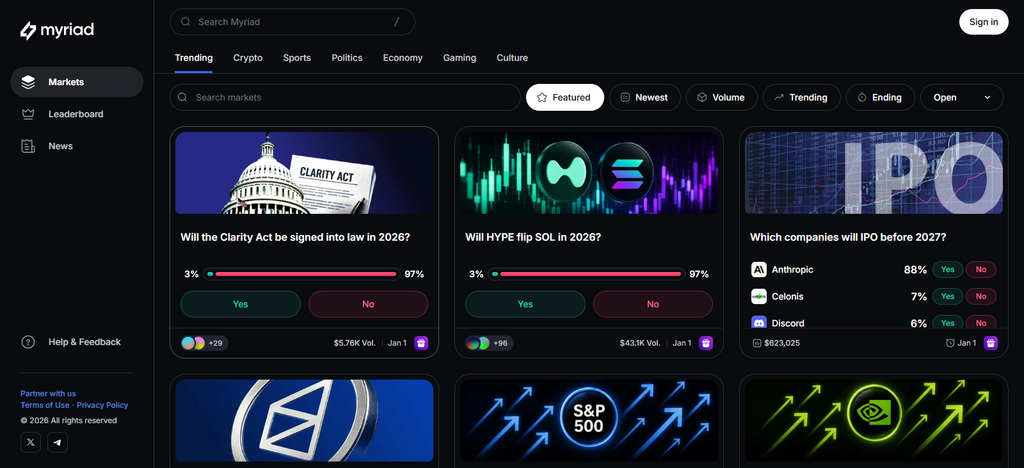
Participants buy and sell positions on digital resources representing expected outcomes. Myriad Markets aims to support multiple blockchain ecosystems for better accessibility and liquidity options.
The market costs depend on the activity of the blockchain network and the transaction requirements. Security measures include transparent on-chain settlements, smart-contract automation, and verifiable event resolution systems to guaranty integrity throughout the forecasting process.
Main Features
- Allows prediction markets on chain, across multiple blockchain networks.
- Embeds prediction markets into content and digital media platforms.
- Gives cryptocurrency, news and predictions on real world events.
- Supports outcome based market positions and stablecoin trading.
- Integrated applications provide an interactive forecasting experience.
Limitations
- Liquidity may differ depending on the supported network and market.
- Availability in Marketplace varies by supported applications and integrations.
- Cross-chain participation could add extra transaction complexity.
- Oracle and market resolution mechanisms may create settlement risks.
10. Opinion
Opinion is a prediction market platform mainly used for forecasting macroeconomic and financial events. Traders can place bets on the outcomes of inflation reports, jobs data, interest-rate decisions and other economic data. The platform is built on blockchain infrastructure and allows transparent and decentralized trading through cryptocurrency-based transactions.
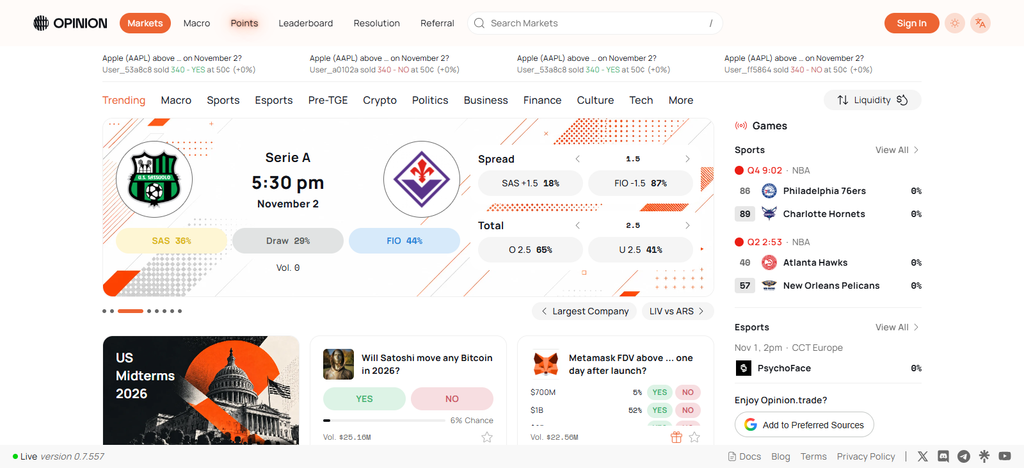
Participants buy outcome shares, which represent the market’s expectations of future events. Trading costs generally include network fees and market execution fees. Smart agreements automate trade settlement.
Market operations and transparent resolution procedures allow outcome verification. Opinion is especially appealing to users interested in forecasting economic trends and policy developments.
Main Features
- Decentralized prediction exchange of outcomes of real world events.
- Supports news, sports, financial and macro-economic markets.
- Trades via a central limit order book.
- Uses Opinion AI to resolve markets in a decentralized way.
- unified liquidity infrastructure and OPN token-based governance.
Major Limitations
- Must have knowledge of cryptocurrency and blockchain trading.
- The liquidity of the market may vary depending on the type of event.
- Oracle-related risks arise with AI-based resolution and dispute mechanisms.
- Access and eligibility for regulatory purposes can differ across jurisdictions.
Conclusion
Web3 prediction markets are transforming the way users predict real world events using blockchain technology, smart contract technology, and decentralized trading. Other examples of event-based forecasting are Augur, Azuro, SX Bet, Zeitgeist, Gnosis (Omen), Manifold Markets, Predict.fun, Limitless Exchange, Myriad Markets and Opinion.
But the choice of the right platform is a matter of balancing blockchain compatibility, prediction categories, trading fees, supported cryptocurrencies, liquidity, and security standards.
Users should also take into account market settlement methods and regional availability before participating. Ultimately, the best platform depends on what type of trader you are, what you need to be able to access and how much risk you’re willing to take.
FAQ
What are the best Web3 prediction markets like Polymarket?
Some popular alternatives include Augur, Azuro, SX Bet, Zeitgeist, Gnosis (Omen), Manifold Markets, Predict.fun, Limitless Exchange, Myriad Markets, and Opinion.
How do Web3 prediction markets work?
Web3 prediction markets allow users to trade on possible event outcomes using cryptocurrencies. Smart contracts manage transactions, while oracle systems help verify results and process settlements.
Which blockchains support Web3 prediction markets?
Popular networks include Ethereum, Polygon, Base, Arbitrum, BNB Smart Chain, and Gnosis Chain. Blockchain support varies depending on the platform.
What types of events can users predict?
Users can explore prediction markets covering politics, sports, cryptocurrency prices, elections, economics, entertainment, technology, and major global developments.
What cryptocurrencies are used in Web3 prediction markets?
Many platforms support stablecoins such as USDC and DAI, while some ecosystems also use native tokens for governance, incentives, or dispute resolution.