

The U.S. Securities and Exchange Commission (SEC) and the Commodity Future Trading Comission’s (CFTC) proposed framework, dubbed “Reg Crypto”, has major implications for how new crypto token launches are conducted in the United States of America.
Drawing from joint guidance issued on 18 October, the uniquely regulatory strategy (as opposed to legislative proposal) consists of legislation that imposes highly prescriptive compliance obligations, potentially increasing launch costs for a crypto project from hundreds of dollars to millions dollars and effectively altering the minimum entry point for new entrants to the market.
The framework divides crypto assets into five fundamental buckets: digital commodities, digital collectibles, digital tools, stablecoins and digital securities. This classification intends to eliminate decades-old uncertainty surrounding the applications of federal securities laws to certain categories of tokens.
The aim of this entire categorization is to allow regulators to properly move projects into the appropriate legal and financial buckets before going live in the market. The most important change came with the SEC announcing their “Reg Crypto” safe harbor proposal.

The allowances consist of registration exemptions, fundraising exemptions and investment contract exemptions that are supposed to foster innovation while still keeping investor protection intact. The framework is currently in its final review at the White House and therefore could see implementation any day, according to Paul Atkins.
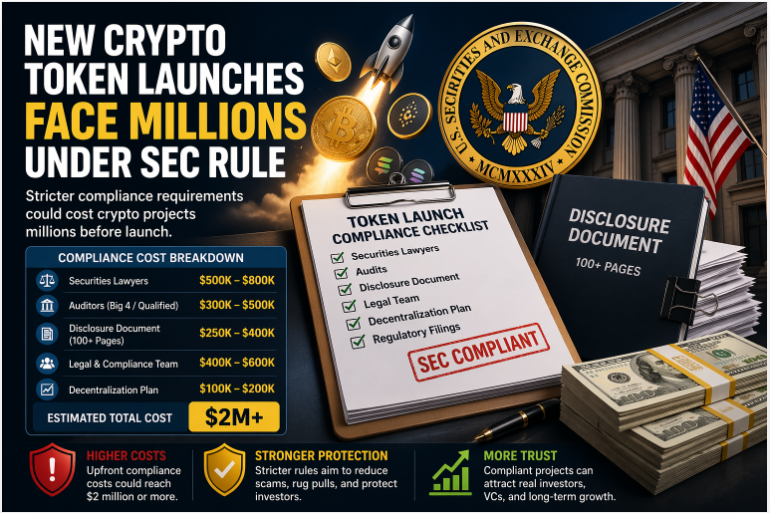
That said, there is a steep price to pay if you want to comply with these new regulations. Under the new regime, crypto startups that want to launch tokens will have to establish an entire legal and financial structure before making any token available for purchase.
That means hiring securities lawyers, enlisting the help of Big Four or equivalent auditors, creating a robust 100-page-plus disclosure document and building an entire legal team.
In addition, projects need to plan out a “decentralization graduation project,” which specifies the path that the token will take to transition from a centralised entity into a more decentralised network over time.
These requirements are costly, an important point reinforced by industry estimates. Projects could require an upfront cost of around $2 million just to develop the legal and compliance infrastructure, said Alexander Lorenzo, founder and CIO at investment firm CoinPicks Capital.
This cost is incurred before a single token is sold and stands in stark contrast to the post-2018 world where one of the things that allowed almost anyone to launch a token with near-zero oversight was lack of any sort of up-front costs.
The higher number of funds required might deter smaller or less serious projects to set up this structure but it should provide an essential reduction in risk from scams, rug pulls and low-quality token launches.
Regulators are trying to boost confidence in investors by imposing audits, disclosures, and accountability in order to pull in institutional participation. Such projects are more likely to receive venture capital participation as well as maintain market credibility over the long term.
You can also find several exemptions in the framework intended to promote innovation. And so, the startup exemption allows for four years of free regulatory relief from early-stage projects and imposes a funding cap around $5 million, in addition to significantly simplified disclosure requirements. Fundraising exemption for larger projects, which permits raises of up to $75 million in a 12-month period with disclosures being filed.
The investment contract safe harbor also provides a roadmap for transitions away from potential classification as securities due to change in decentralization and functional utility.
To this end, regulators are developing a tokenization innovation exclusion that would allow both crypto businesses and antiquated financial institutions to test blockchain goods in controlled for an undetermined amount of time without taking full regulatory responsibility.
In conclusion, Reg Crypto is a step in the direction of creating a more equitable and transparent crypto ecosystem. Indeed, while this does increase the barrier to entry, it also bolsters market integrity and may serve as a signifier of growth and maturation for the digital asset industry.