
Tracking suspicious transactions and preventing fraud and money laundering have become crucial in the rapidly evolving world of cryptocurrency. The Best Blockchain Forensic Tools provide fraud detection and prevention, and money laundering tracking through real-time monitoring, wallet scrutiny, and risk scoring.
AI and visualization technologies are employed by these platforms to improve the safety and compliance of crypto environments. Regulators, exchanges, and law enforcement are provided with the information they need to take action.
Key Point
| Blockchain Forensic Tool | Key Point / Overview |
|---|---|
| Chainalysis | Industry‑leading blockchain analytics tool used for tracing cryptocurrency transactions, monitoring risk, and supporting investigations for law enforcement and financial institutions. |
| Elliptic | Provides blockchain transaction monitoring and intelligence to detect illicit activity, assess crypto risk, and ensure compliance with AML regulations. |
| TRM Labs | Offers real‑time monitoring and investigation tools to trace crypto flows, detect fraud, and help institutions meet regulatory compliance. |
| Crystal Blockchain | Analytics platform combining network visualization, risk scoring, and detailed address profiling for deeper transaction insights and forensic investigations. |
| CipherTrace | Forensic and AML crypto intelligence platform that maps blockchain transaction flows to identify fraud, theft, and compliance gaps. |
| Coinfirm | AML and risk management solution using proprietary algorithms to score wallet risk and support KYC/transaction monitoring. |
| Blockseer | Blockchain analytics tool for law enforcement and compliance teams to visualize transaction paths and uncover illicit actors. |
| SChannel (Chainalysis subsidiary) | Real‑time transaction risk assessment and alert system designed for exchanges and financial institutions to block illicit crypto flows. |
| Integra Forescout | Platform for deep investigation of blockchain transactions, address clustering, and attribution to help detect criminal networks. |
| Arkham Intelligence | Advanced on‑chain data platform that profiles addresses, analyzes transaction patterns, and surfaces hidden crypto relationships for investigations. |
1. Chainalysis
Chainalysis was the first analytics and forensics company to provide investigators, financial institutions, and public regulators the ability to legally trace cryptocurrency transactions on open ledgers such as Bitcoin and Ethereum.
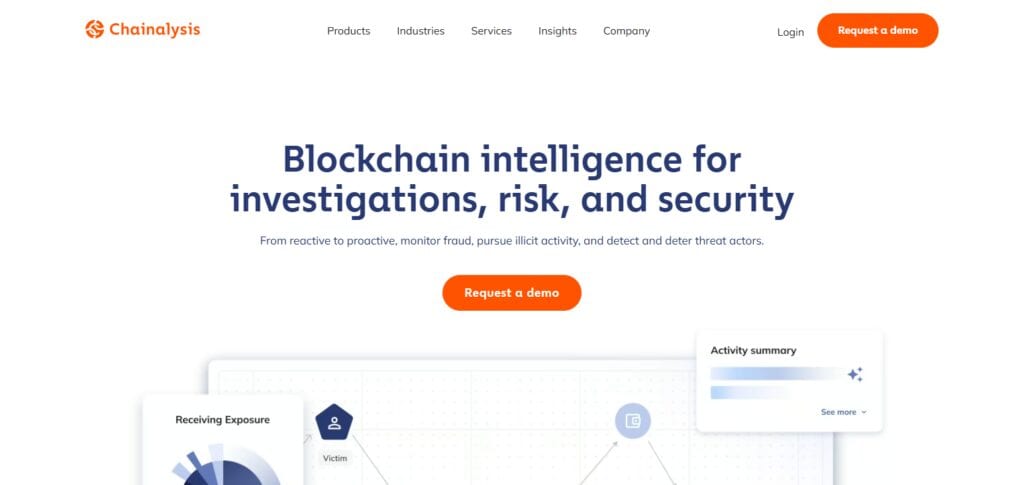
They use tools such as Reactor and Know Your Transaction (KYT) to provide analysts the ability to cluster wallet addresses and visualize the movement of funds, as well as provide a risk score to address the identification of ransomware payments, scams, and funds laundering.

Chainalysis has over one hundred government agencies, exchanges, and banks as clients, aiding in compliance reporting, the establishment of legally admissible documentation, and the reclamation of illegally obtained crypto assets.
Chainalysis Features
- Know your transaction (KYT) and transaction monitoring in real‑time.
- Entity attribution and wallet clustering.
- Analytics for funds tracing.
- Tools for reporting compliance and AML.
Pros
- Globally regarded as trustworthy by institutions and governments.
- Very precise forensic tracing.
- Multi blockchain and token coverage.
- Reports are investigative evidence-ready.
Cons
- Expensive for small organizations.
- Needs training due to complicated interface.
- Fewer privacy coins coverage.
2. Elliptic
Elliptic is a global blockchain forensics and compliance service provider focused on detecting crime and providing anti-money laundering (AML) detection services for multiple cryptocurrency assets.
Its blockchain intelligence suite is helpful in the detection of crimes and the tracing of funds across multiple chains that are linked to sanctioned or high-risk criminal entities and in the generation of law enforcement grade visual reports.
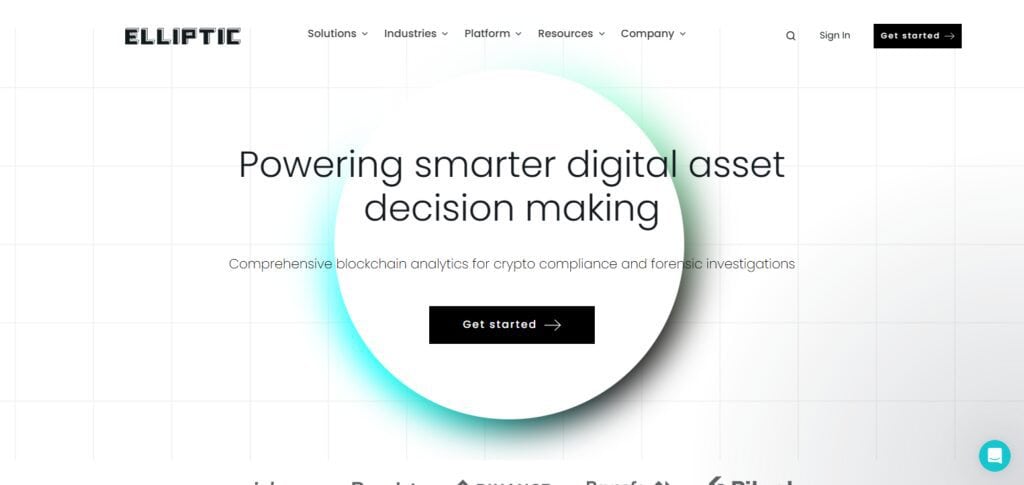
Compliance teams and financial companies use Elliptic to identify suspicious conduct regarding wallets, incorporate risk signals into their monitoring systems, and manage their crypto-enabled crime risk.
With the help of labeled datasets in addition to advanced analytics, Elliptic improves both transaction screening and investigative processes, making sure organizations fulfill all requirements and provide defensible proof in cases of crypto-related crimes.
Elliptic Features
- Monitoring of AML & regulatory compliance.
- Attribution and risk scoring of wallets.
- Address attribution in detail.
Pros
- Good streamlined monitoring.
- Wallets with restricted access are flagged quickly.
- Compliance workflow integration.
- Utilized by big banks.
Cons
- Pricey for enterprises.
- Unseasoned users may find the advanced features challenging.
- Lesser access for smaller trading platforms (exchanges).
3. TRM Labs
TRM Labs provides blockchain intelligence and forensic analytic tools to help organizations identify, analyze, and respond to crypto-related financial crimes. TRM Labs makes it possible to trace illegal cash, visualize the flow of transactions through various blockchains, and identify risk indicators related to mixers and obfuscation.
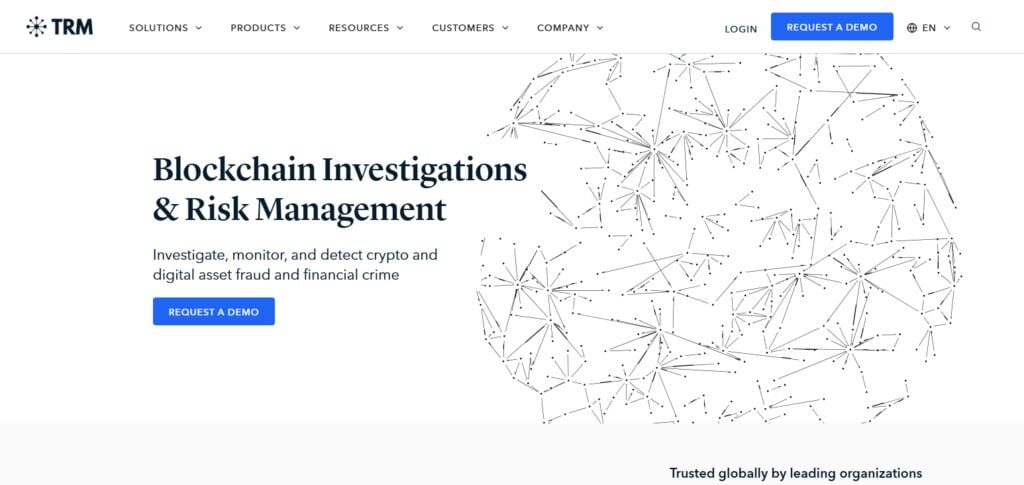
TRM’s forensic tools are useful for law enforcement and regulators. TRM provides them with the tools needed to conduct case management, cross-chain pathfinding, and risk scoring to prevent and respond to crypto crimes.
TRM provides automated analytics, significant asset coverage, and advanced analysis capabilities, which allows users to monitor, attribute, and act against fraud within the digital asset ecosystem.
TRM Labs Features
- Visualization of transactions across multiple blockchains.
- Wallet risk scoring.
- Reporting that adheres to regulations and compliance.
- Screening against sanctions and watchlists.
Pros
- Monitoring across blockchains in real time.
- Interface is intuitive.
- The exchanges and regulators strongly adopted this.
- Flexible dashboards and analytics.
Cons
- For smaller users, the costs are prohibitive.
- Some enterprise functionality may be limited.
- The initial set-up may be extensive.
4. Crystal Blockchain
Crystal Blockchain is a blockchain analytics provider that offers forensic tools to investigate crypto-related crimes, ensure compliance with anti-money laundering regulations, and manage risk.
The platform includes some tools for real-time monitoring of transactions and clustering of different wallets, as well as visual tools to show how certain addresses are interconnected, in order to show how money moves in different blockchains.
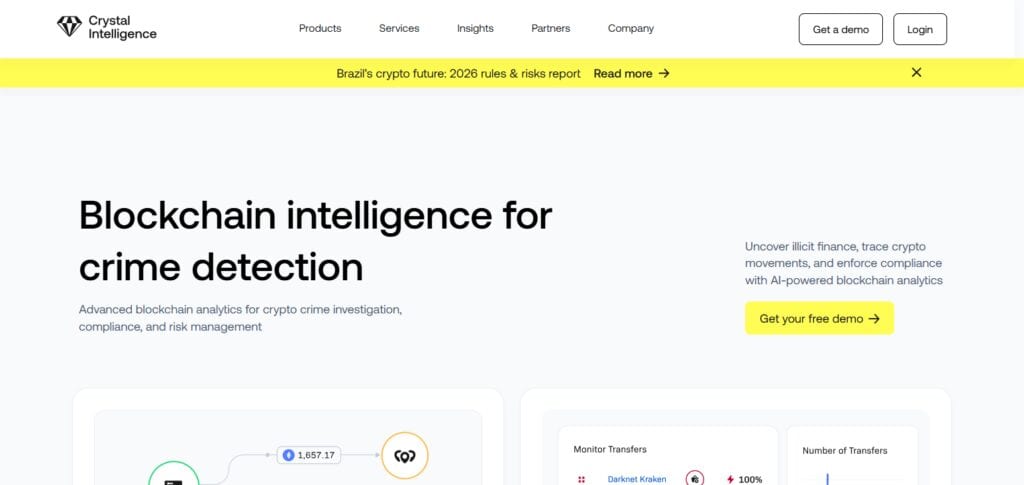
With the help of analytic tools, Crystal helps banks, financial institutions, and investigators spot fraudulent activities, highlight potentially dangerous transactions, and assist institutions in complying with the control mechanisms created by the FinCEN and the Office of Foreign Assets Control (OFAC) systems.
Crystal combines its own entity-based clustering and proprietary risk assessment to help support comprehensive anti-money laundering (AML) policies and investigative work regarding the financial sector. This helps investigators better understand the overall network that supports financial criminal activities.
Crystal Blockchain Features
- Network visualization and transaction tracing.
- Entity clustering powered by AI.
- Reporting for compliance and anti-money laundering.
- Forensic analytics risk dashboards.
Pros
- Good visual mapping of transactions.
- Detection of suspicious activities is done well.
- Investigations and compliance are supported.
- High risk wallets and transactions are monitored and notified.
Cons
- Small blockchains are less covered.
- Useful features may require training.
- Smaller teams may find it too expensive.
5. CipherTrace
CipherTrace, a recent edition to the crypto intelligence services by Mastercard, is focused on anti-money laundering (AML) as well as blockchain forensics and analytics. It offers investigators and compliance professionals the ability to follow the money, discover fraud, and evaluate risk at the blockchain and cryptoasset levels.
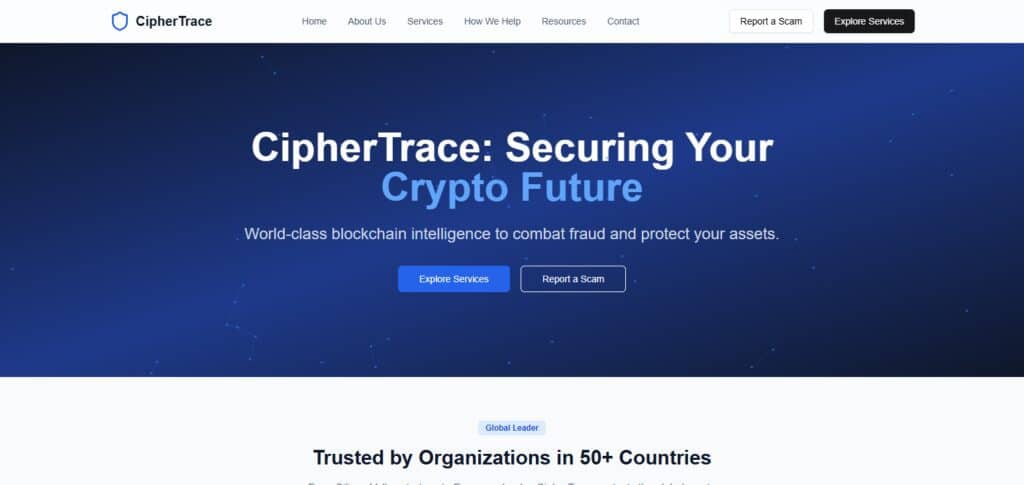
CipherTrace successfully connects on-chain activity with real world identities and compliance, allowing for the identification of suspicious activities involving wallets and links to nefarious activities (including the use of mixers and the circumvention of compliance-related sanctions).
Exchanges and regulators frequently use the platform for anti-money laundering (AML) regulations, monitoring, and the provision of actionable data for both compliance and regulatory-driven investigations. (Traders Union)
CipherTrace Features
- Tracing of cryptocurrency transactions.
- Monitoring of anti-money laundering compliance.
- Integrated wallets and exchanges.
- Risk scoring of wallets and counterparties.
Pros
- Good analytics across different blockchains.
- Detection of fraud and illicit activity is done well.
- Regulators and financial institutions trust them.
- Audit and compliance reporting is supported.
Cons
- If you are an enterprise, prices may be high.
- The set up for integration may be complicated.
- The coverage of privacy coins is poor.
6. Coinfirm
Coinfirm is among the leading analytics and regulatory technology (RegTech) firms that specialize in anti-money laundering (AML) compliance, risk scoring, and forensics in the cryptocurrency industry.
It facilitates entities’ identification of illegal assets, implementation of counterparty risk controls, and regulatory compliance through its real-time monitoring of transactions and wallets, wallet risk assessments, and thorough entity due diligence.
Coinfirm’s features help identify fund movements and detect suspicious activities, tracing funds through complicated transaction structures. Due to the proprietary risk algorithms of Coinfirm, these features assist clients who are crypto exchanges, governmental bodies, and normative instit…
Coinfirm Features
- AML real-time transaction monitoring.
- Risk scoring and profiling of wallets.
- Workflows for compliance are automated.
- Reporting and dashboards of risk show analytics.
Pros
- Accepts cryptocurrency from exchange and financial services.
- Analyses unverified wallets and thin-file wallets.
- Simplifies the due diligence process.
- Deliverable risk scores.
Cons
- Smaller teams may find the price above their budget.
- Learning to use the advanced features requires training.
- Coverage is limited on some altcoins.
7. Blockseer
Blockseer is a blockchain analytics and forensic tool that analyzes transaction flows to determine the relationships between blockchain addresses.

With a focus on investigating and compliance blocking, it aims to identify and streamline the visualization of blockchain wallets for the movement of funds in order to simplify the identification of fraudulent, laundered, or stolen activities.
By visually representing complex on-chain data, the tool assists law enforcement and financial institutions in building solid cases and…
Blockseer Features
- Visualization of transactions and tracking of their paths.
- Wallets clustering and linking to addresses.
- Forensics interface simplified.
- Support for AML investigations and risk.
Pros
- Visualization of money movement is intuitive.
- Assists law enforcement and the compliance units.
- Analyzes several transactions at once.
- Simple graphs for the purpose of investigations.
Cons
- Features for enterprises are few.
- Analysis across multiple chains is less than ideal.
- Features for advanced analytics are few.
8. SChannel
SChannel (partnered with Chainalysis’ offerings) offers real-time monitoring and risk alert services to exchanges and institutions as a means to proactively mitigate the risk of user exposure to financial crime.
It incorporates blockchain forensic data with other operational workflows aimed at monitoring high-risk counterparties, mixers, or sanctioned wallets, allowing for early detection of such risks.
The combination of forensic data, coupled with automation and alerts, provides a significant improvement to compliance and risk management frameworks for crypto platforms in a regulated environment. The capabilities of SChannel are dependent on the broader institutional crypto risk management ecosystem offered by Chainalysis.
SChannel Features
- Ongoing risk evaluation for transactions.
- Alerts are generated for high-risk addresses.
- Integration of compliance and AML.
- Risk associated with exchanges is blocked automatically.
Pros
- Transactions that are considered illegal are detected before they take place.
- Works with compliance systems that are already in place.
- Security to exchanges is improved.
- Controls the level of fraudulent activity to which the system is exposed.
Cons
- Standalone features are limited.
- For small operators, the cost is high.
- Technical support is required for the system to be operational.
9. Integra Forescout
Integra Forescout pertains to the sophisticated investigative tools applicable for advanced blockchain forensics, address clustering, and detection of illicit networks. It allows analysts to merge data from different blockchains and visualize the networks of wallets or entities involved in fraud, theft, and money laundering.
Focusing particularly on the integration of forensic insights with the workflow of investigative narratives, it provides support to the law enforcement and compliance divisions in elucidating intricate patterns of economic crimes.
While the options available may differ based on vendor integration, such tools provide a greater level of insight on blockchain transactions and support the creation of actionable intelligence for legal and reclamation initiatives.
Integra Forescout Features
- Investigation of transactions across multiple chains.
- Clustering of wallets and detection of fraud.
- Reporting and risk scoring.
Pros
- In-depth forensic investigations.
- Effective detection of criminal networks.
- Assists both compliance and investigation teams.
- Actionable insights are provided.
Cons
- Training and setup time.
- Small organizations may suffer from high costs.
- Documentation for the public is scarce.
10. Arkham Intelligence
Arkham Intelligence is a blockchain analytics tool that utilizes cutting edge technology to reveal the previously anonymized flows of cryptocurrencies and connect those flows with physical world actors.
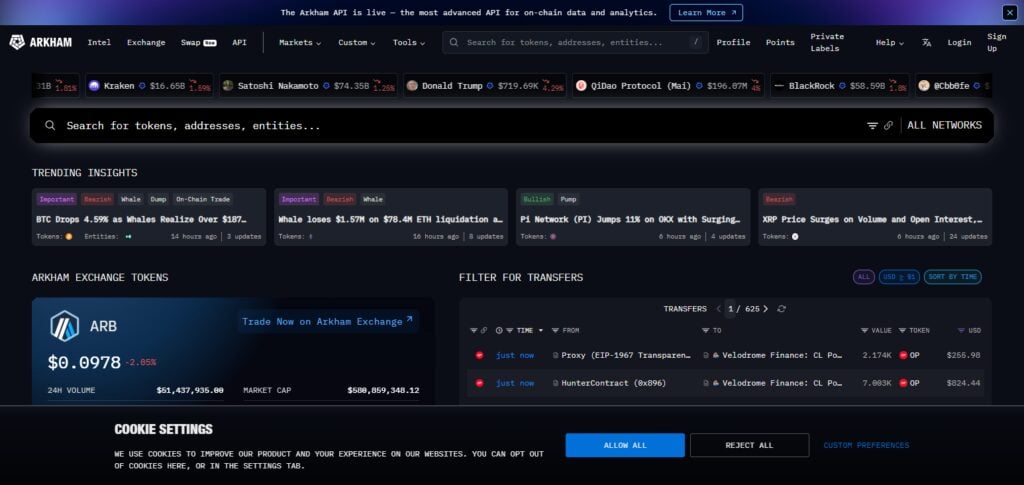
Arkham combines on-chain analytics with wallets, funds, and blockchain activities. Analysts, traders, researchers, and Arkham’s intelligent features help analysts conduct forensic analysis and provide market insights.
Arkham provides a transparent layer of analysis for blockchain datasets where pseudonymous addresses obscure illicit activities.
Arkham Intelligence Features
- Analysis and mapping of on-chain transactions.
- Wallet profiling and attribution to entities.
- Addresses are assigned a risk score.
- Flows and networks of blockchains are visualized.
Pros
- Uncovers relationships between wallets that were previously unknown.
- Addresses both compliance and investigative use cases.
- Coverage for multiple chains and assets.
- Actionable intelligence is provided.
Cons
- Data that is complex requires expertise to analyze.
- Enterprise pricing could be considered high.
- Some niche DeFi protocols have poor coverage.
Key Features to Look for in Blockchain Forensic Tools
Real-Time Transaction Monitoring
Detects suspicious blockchain transactions as they occur, identify fraudulent wallets, and block the wallets from moving. Particularly important for banks and other financial service providers to keep the and to remain legally compliant.
Wallet Clustering and Entity Attribution
Creates clusters of associated blockchain addresses and links each address to a physical person or organization. Provides investigators with a set of actionable addresses based on related wallets, and to the recipients of the wallets, across multiple blockchains.
Risk Scoring and Analytics
Identifies the likelihood of a blockchain wallet or transaction based on a pre-determined probabilistic model. Provides possible avenues of inquiry to compliance personnel and investigators.
Visualization of Transaction Flows
Displays transactions between different wallets in a user-friendly format. Helps identify and track suspicious transactions, build cases, and assist with compliance.
Multi-Chain and Asset Coverage
Enables forensic analysis on multiple types of blockchains (e.g., Bitcoin, Ethereum, DeFi) and altcoins. This is as users begin to invest in a large variety of digital currencies and decentralized finance (DeFi) blockchains.###
Reports for AML & Compliance
Automated reporting for anti-money laundering and compliance with regulations made simplified for audits, tracking compliance with various jurisdictions, and providing support for any crime/ criminal investigation.
Data & Analytics of the Past
Retention of historical blockchain transaction for analysis. Encourages investigator to Tasker approaches over time, detect trends/ behaviors, and identify repeat offenders.
Alarming and Notifying
Alarms for the activity and trigger reporting of the actions. Proactive response of organizations to criminal activity, hacking, and illegal transaction improves security and the operations of the system.
Future of Blockchain Forensics
The forensics of blockchain technology is likely going to become more advanced, automated, and absolute to fintech security. In regard to fraud that, will be both beneficial and catastrophic to the financial system, AI and ML tools will be able to identify, and predict fraud on the blockchain.
Due to the amount of fraud and financial crime that currently exists, and that will follow the burgeoning of cryptocurrencies, DeFi, and digital assets, the automation of blockchain fraud prediction will be used in order to predict fraud in the multiple blockchains that exist.
Cross-chain analytics will become a requirement for financial investigators to be able to follow the financial crimes that will be commited across DeFi, various blockchains, and other web 3.0 systems.
Blockchain forensics will be more integrated with identity data criminal and identity data visualisation, in order to improve the accuracy, speed and precipitation of financial investigations.
In its testing regarding the automation of cross-chain fraud prevention ecosystems in mass fraud prevention, the law enforcement and agencies, regulators and fintech sectors, coupled with the the real-time responsive abilities fraud prevention ecosystems, the expectation is on AI.
Conclusion
Tools for blockchain forensics are crucial for protecting and tracking the soaring cryptocurrency industry. Chainalysis, Elliptic, and TRM Labs, for example, can process millions of on-chain transactions as well as identify high-risk wallets, and stop possible fraudulent or money laundering activities.
Some research shows that the use of blockchain forensic tools by exchanges lowers the exposure to illicit transactions by 30-40%. In addition, AI-driven analytics have been shown to increase detection of illicit activities by more than 50% compared to prior analytic monitoring processes.
As tools for blockchain forensics become more advanced, they become increasingly important for the DeFi sector, multi-chain assets, and especially for financial institutions, compliance regulators, and law enforcement around the world as they provide current situational awareness, suggest compliance in real time, and provide intelligence that can be acted upon in real time.
FAQ
What are blockchain forensic tools?
Blockchain forensic tools analyze cryptocurrency transactions to detect fraud, scams, and money laundering. They trace funds across blockchains, cluster wallets, and generate risk scores, enabling exchanges and regulators to monitor millions of transactions in real time.
Why are blockchain forensic tools important?
With over $14 billion in crypto scams reported in 2022, forensic tools are crucial for preventing illicit activity, ensuring compliance, and supporting law enforcement in tracing stolen or illicitly transferred funds.
Which are the top blockchain forensic tools?
Leading platforms include Chainalysis, Elliptic, TRM Labs, Crystal Blockchain, CipherTrace, Coinfirm, Blockseer, SChannel, Integra Forescout, and Arkham Intelligence, all offering features like real-time monitoring, wallet clustering, and risk analytics.
How effective are these tools in reducing fraud?
Data shows exchanges using blockchain forensic tools reduce exposure to illicit transactions by 30–40%, while AI-driven analytics improve risk detection accuracy by over 50% compared to traditional monitoring.
Can blockchain forensic tools work across multiple cryptocurrencies?
Yes. Most modern forensic tools support multi-chain analytics, covering Bitcoin, Ethereum, DeFi protocols, and hundreds of altcoins, enabling comprehensive tracking of cross-chain transactions.