
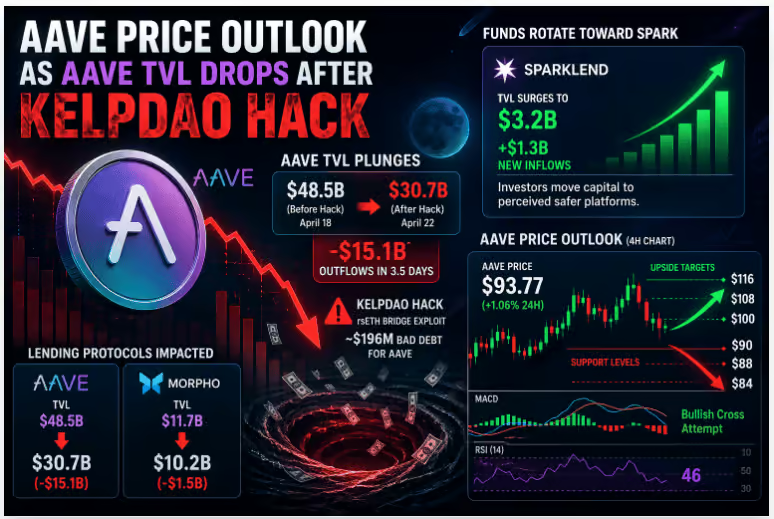
On Wednesday, Aave traded slightly higher at $93.45 for a mere one day increase of 1.06%. However, this immediate bounce back is short lived as the token had declined by 7.09% over the course of the week and nearly 11% in the last month.
This varied performance coincides with a general uptick in the crypto market as total market cap increases 2.28% to about $2.61 trillion. The temporary international ceasefire between the US and Iran has improved global sentiment, with risk appetite returning in the wider financial media driving supporting news flow to crypto assets like Bitcoin ( up to USD 78K+) Ethereum (up to all-time high USD 2,300+).
But none have shaken Aave’s ecosystem as much as the surprise hack of KelpDAO this week, which saw a large portion of funds pulled from it. After the rsETH bridge exploit on April 18, investors fled many decentralized lending platforms at light speed.
Over a mere three and a half day period, Aave experienced a cumulative outflow of nearly $15.1 billion. At the time of the attack, the platform was managing around USD 48.5 billion in total value locked (TVL), which has since plunged to nearly USD 30.7 billion on April 22.


That means about 1/3rd of Aave’s entire capital left the protocol in just under a week, showing how drastically the market reacted. The exploit, in addition, apparently led to June 16th taken as bad debt for Aave of approximately $196 million dollars having since raised some protocol stability and risk management issues.
The shockwaves extended beyond Aave. DeFi lending competitors like Morpho were no exception either, with its TVL slipping from $11.7 billion to $10.2 billion — nearly a $1.5 billion withdrawal of funds as well.
As investors recalibrate around security, and the risk-return profile of decentralized lending protocols in the wake of the exploit, aggregated data from DeFiLlama reflects a more structural loss of confidence.
Well, it turns out that all platforms didn’t see the red. One of the biggest beneficiaries during this uncertainty sky is SparkLend. Its TVL exploded to $3.2B, with approximately $1.3B in new capital flows.
Users were actively moving funds from Aave and equivalent platforms onto Spark seeking safety/stability of the perceived safe to move w/a “Fresh Start” style change diet. This change highlights the highly dynamic and competitive nature of DeFi lending, where trust and security are pivotal to capital allocation.
Even with the outsized redemptions, some caution is warranted optimism. The increased accumulation of AAVE tokens by whales suggests that they are preparing for a potential recovery. Technical indicators also suggest a potential rebound.
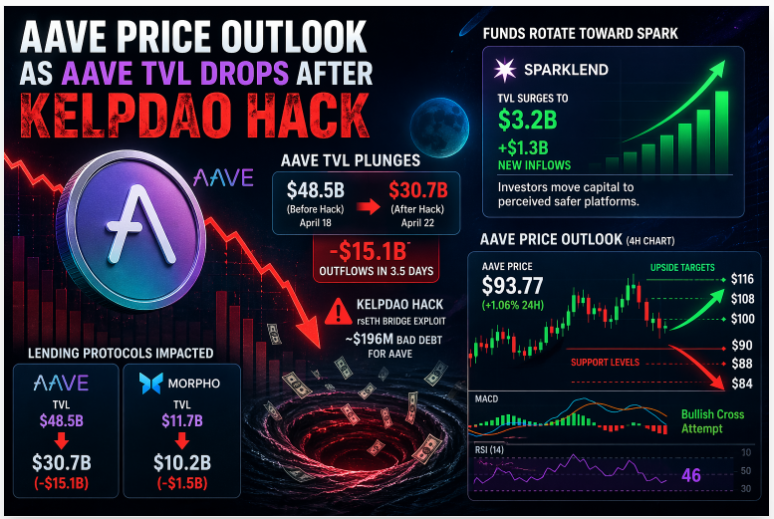
The MACD histogram turned pos itive on the four-hour chart, with the MACD line testing bullish crossover over the signal line. Simultaneously, the Relative Strength Index (RSI) sits at 46, just under the neutral threshold of 50, indicating further upside potential.
Price Levels for AAVE Price, immediate resistance at near $96. If it manages to close above this level, the price may settle around $100 level and a medium term area being at 108$ as well as 116$ respectively. However, if the critical support at $90 is lost, price might slump towards $88 and possibly even test $84 should bearish pressure continue to grow.
In summary, Aave’s immediate outlook hinges largely on how quickly confidence can return to its ecosystem after the KelpDAO exploit, although macro conditions and whale activity have provided some support.