
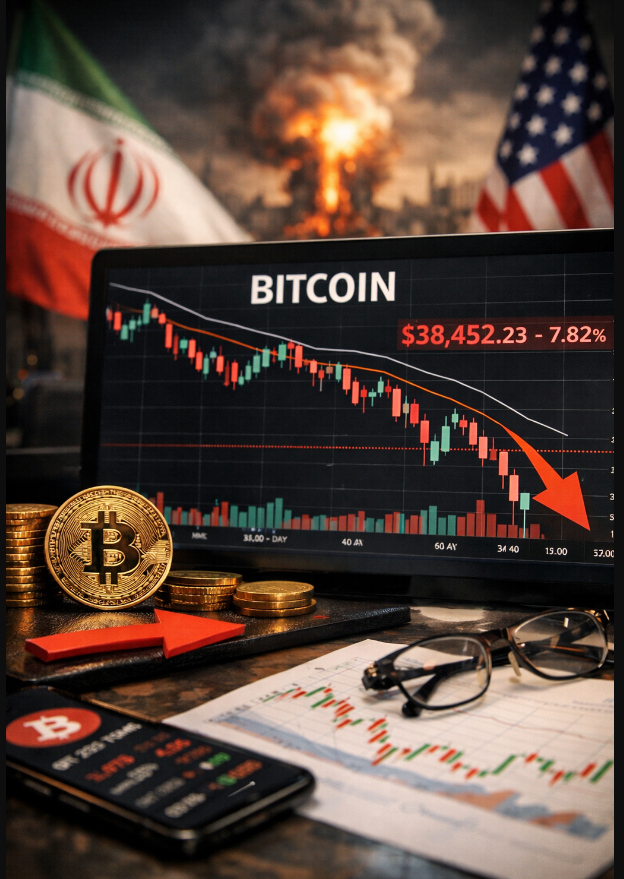
Bitcoin Drops to $72,700 as Markets Become Geopolitically Risk Averse
Rising geopolitical tensions between the US and Iran saw Bitcoin lose 1.4% to trade at approximately $72,700 on June 1. With the US targeting Iranian military sites, and Iran responding by striking a US airbase, the situation sent crypto to the sell-off, with Global Ventures describing the situation as a response to an air raid.
The sell-off saw Bitcoin break below support, with the 100-day Simple Moving Average placing support at $73,200. Analysts state that breaking below support levels shows weak momentum, leaving the coin susceptible to further downward pressure.
Oil Prices Increasing as Bitcoin Declines

With Bitcoin declining, the opposite was true for oil which increased from $88 to $90. In the Iranian air strike case with the US, Energy Markets showed that the safe-haven assets of Crude Oil increased by 3.6% in a day, while Digital Assets showed the exact opposite.
CoinGape described that the Middle East increasing in turmoil caused panic selling for all risk-based assets, and Bitcoin, especially in the early Asian markets, saw $23 billion in BTC positions liquidated.

Outflows from Exchanges and Inactivity in Networks
While there was selling pressure in the short-term, there was mixed investor positioning given that traders withdrew an estimated $545 million worth of Bitcoin from exchanges in the three days to May 31. The results were not one-sided. Data from the Santiment website indicates that the demand for Bitcoin is declining. The data shows that there were only 606,730 daily active Bitcoin addresses and user activity decreased from 575,610 on May 30 to 465,800 on May 31. The reduction in user activity and network participation decreased the support for buying, increasing the overall market selling pressure.
Bearish Sentiment for Technical Breakdown
Bitcoin’s breakdown below $73,229, the 100 SMA, has analysts concerned because, historically, support for Bitcoin has not deviated below this level since October 2025. It is also considered a significant support area. The sentiment is also bearish because of the deviation from a typical bullish trend. Currently, there is a bear flag pattern for which the target price level is $68,000, if support is not maintained, marking a 6% downward potential from the current price. Additionally, the MACD indicator shows a bearish trend.
Market analyst Daan Crypto has noted that Bitcoin is currently stuck in a trading range of $72,700 to $74,200. A breakout trade is imminent and could significantly impact the overall price of Bitcoin. A bullish breakout is expected if the price breaks above $77,295.
The Bitcoin derivatives market is concerning because it has a high degree of market leverage as noted by analyst Joao Wedson. This makes the potential for cascading liquidations for Bitcoin very high. The derivatives market has maintained positive funding rates for the last two weeks. Market participants have maintained long positions, but the price of Bitcoin has significantly decreased from $82,000 to $72,000. The continued selling pressure will increase the risk of liquidation in the market.
Conclusion
Conclusion
The current value of Bitcoin’s drop to $72,700 exemplifies the rapid shifts in the general market’s macroeconomic conditions and how they affect Bitcoin. With the escalation in tensions of the United States and Iran, there has been a definite ‘risk-off shift’ as investors leave to secure financial assets. Safe assets are oil, which has spiked in value, while Bitcoin has fallen below its significant support level of the 100-day SMA at $73,200.
The indications are more negative with on-chain data of a weaker outlook as there are a diminishing number of active addresses and a lack of engagement in the network, which shows a lack of demand. Panic and ‘knee-jerk’ market exits are the new norm of short-term players, hence the increased sell pressure on the asset.
From a technical standpoint, the $70,000 support level is very important as many price indicators, such as MACD, and the existence of a bearish flag suggest that the price has more room to fall if this level is broken. Given the heavy use of leverage in the futures market, however, the price could also go the other way if people are liquidated.