
I will identify the Best Cross-Chain Bridges with the Lowest Fees and the Best Security. These solutions allow users to transfer assets across different blockchains.
I will analyze the functionality of these bridges and their main attributes. Also, I will rank the bridges and the supporting platforms based on their reliability for DeFi users and blockchain investors.
Why Cross-Chain Bridges with Lowest Fees & Top Security
Affordable Cross-Chain Transfers: Low fees are important for cost-conscious DeFi users, traders, and investors because low-fee bridges reduce costs for cross-chain transfers.
Increased DeFi and Trading Usage: Low fees encourage users to move liquidity across chains and increases the use of DeFi, yield farming, and cross-chain trading.

Lost Asset ProtectionHigh security protects funds that users transfer via cross-chain bridges from hacks, exploits, and the vulnerabilities of smart contracts.
Reliable and Trusted Bridges: High security is the most important factor in the reliable use of cross-chain bridges, and allows users to transfer assets of great value without fear.
Bridge Exploit Security: High security protects the bridge from many of the exploits, such as oracle manipulation, replay attacks, and liquidity pool attacks.
Optimized Growth of the Web3 Ecosystem: The combination of the highest possible security and the lowest possible fees allows for effortless interoperability across chains, and helps the entire blocked ecosystem to grow more efficiently and more securely.
Key Point & Best Cross-Chain Bridges with Lowest Fees & Top Security
| Protocol | Key Point |
|---|---|
| LayerZero | Omnichain messaging layer enabling direct chain-to-chain communication |
| Axelar | Decentralized network connecting blockchains via secure validator set |
| Wormhole | Popular bridge enabling asset + data transfer across ecosystems |
| Synapse | Uses liquidity pools for fast asset swaps across chains |
| Stargate | Built on LayerZero for unified liquidity pools across chains |
| Celer cBridge | Layer-2 scaling + cross-chain asset transfer solution |
| deBridge | Decentralized validation network for fast asset movement |
| Multichain | Router-based bridge supporting many blockchains |
| Connext | Uses optimistic verification for trust-minimized transfers |
| SushiSwap Bridge | within the SushiSwap ecosystem that enables |
1. LayerZero
LayerZero is a protocol designed to avoid cross-chain communication bottlenecks through the use of Ultra Light Nodes and a messaging framework. Lightweight nodes create opportunities to minimize trust barriers.
Developers are empowered to create composable applications across chains. In terms of creating a more advanced metric for DeFi services, Best Cross-Chain Bridges with Lowest Fees & Top Security is a critical measurement tool.

With its innovative features and a rapidly increasing developer base, LayerZero is receiving more attention.
As a tradeoff for this, complexity has increased, and application developers may require greater technical know-how to work with the framework in its full potential (advanced omnichain applications) across different blockchains.
LayerZero Features
- Omnichain messaging protocol for cross-chain communication
- Uses Ultra Light Node Technology for verification
- Enables chain-to-chain data transfer
- Modular design for developers
- Fully interoperable dApps can be built
LayerZero
| Pros | Cons |
|---|---|
| Ultra-fast omnichain messaging | Requires advanced technical integration |
| Highly modular for developers | Not beginner-friendly |
| Low latency cross-chain communication | Complex architecture |
| Strong dApp composability | Limited direct user-facing tools |
| Scalable across many chains | Still evolving ecosystem |
2. Axelar
Built on a proof-of-stake validator network, Axelar is a decentralized protocol concerned with cross-chain communication. Based on a cryptographically secure generalized messaging framework,
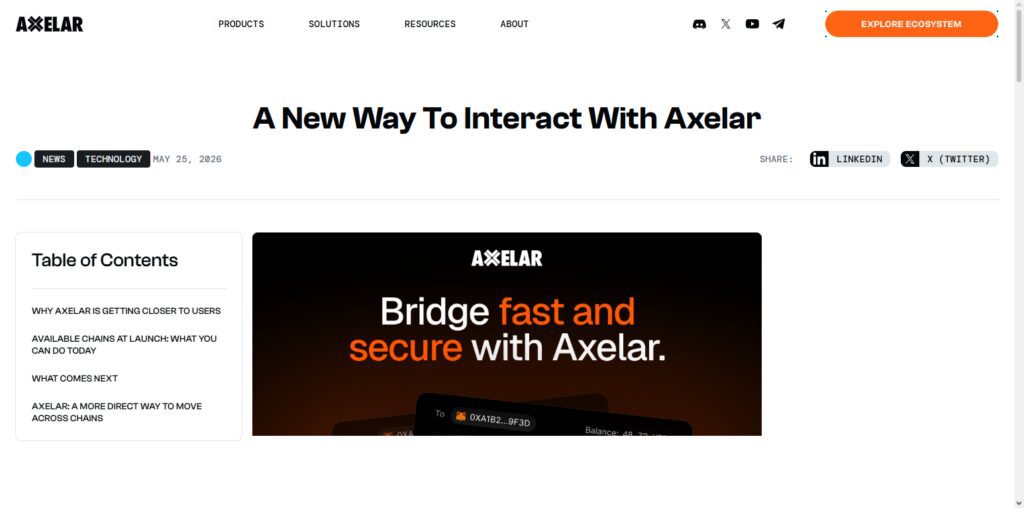
Axelar provides the ability to swap assets and freely transfer messages across many chains, including Ethereum and Cosmos. When determining Best Cross-Chain Bridges with Lowest Fees & Top Security,
Axelar is noted for its strong reliability and a focus on security and decentralization. For applications in cross-chain DeFi, Axelar is ideally suited for its secure and scalable infrastructure, although, as a trade-off to significant liquidity, other cross-chain options may provide quicker transaction finality.
Axelar Features
- Decentralized validators focused interoperability network
- Generalized message passing across blockchains
- Uses a cryptography security model
- Supports Ethereum, Cosmos, and more
- Cross-chain applications at an enterprise level
Axelar
| Pros | Cons |
|---|---|
| Strong decentralized validator network | Slightly slower transaction finality |
| High security and reliability | Higher operational complexity |
| Supports generalized messaging | Can feel heavy for simple transfers |
| Wide blockchain compatibility | Less optimized for instant swaps |
| Enterprise-grade infrastructure | Requires staking-based consensus |
3. Wormhole
Wormhole is among the leading cross-chain messaging protocols, making it compatible with Solana, Ethereum, and Binance Smart Chain, among others. Wormhole facilitates both token transfer and cross chain data messaging.
Wormhole has broad ecosystem adoption and great on-chain developer support. As one of the options in Best Cross-Chain Bridges with Lowest Fees & Top Security, Wormhole enjoys a spot due to its extensive guardian network model, which has seen improvements following previous security incidents.
Wormhole’s flexibility is one of the main reasons it’s great for NFT transfers, DeFi apps, and multi-chain dApps, where high cross-chain operability is required.
Wormhole Features
- Cross-chain messaging and asset transfer
- Supports NFT’s, tokens, and arbitrary data
- Compatible across many chains
- Guardian validation model
- Used widely in DeFi and NFTs
Wormhole
| Pros | Cons |
|---|---|
| Massive ecosystem support | Past security vulnerabilities |
| Supports NFTs, tokens, and data | Trust concerns in earlier versions |
| Strong developer adoption | Complex guardian model |
| Works across major blockchains | Fees can vary |
| Flexible cross-chain messaging | Requires continuous audits |
4. Synapse
Synapse is a liquidity cross-chain bridge and a fast way of asset transfers between the different blockchains by liquidity pools. It does not use the slower lock-and-mint mechanism, allowing for fast transfers and minimal slippage.
Because of this, it attracts a lot of potential users and DeFi traders. Considering Best Cross-Chain Bridges with Lowest Fees & Top Security, Synapse gains a good spot due to its fast and easy-to-use swap bridging. Slippage and transfer speed are, however, very dependent on the market, due to liquidity pools that can lead to a poor user experience in volatile markets.
Synapse Features
- Based on a liquidity pool model
- Fast token swaps with low slippage
- Automated routing across chains
- Many EVM and non-EVM compatible chains
- A DeFi focused model
Synapse
| Pros | Cons |
|---|---|
| Very fast swaps | Dependent on liquidity pools |
| Low slippage trading | Limited messaging features |
| Simple user interface | Pool imbalance risk |
| Efficient for DeFi traders | Not ideal for complex dApps |
| Broad chain support | Liquidity fragmentation possible |
5. Stargate
Building on LayerZero, Stargate Liquidity Pools offer instantaneous finality for cross-chain transfers. Stargate eschews the use of wrapped tokens, resulting in reduced cross-chain fragmentation. Its efficient design and deep liquidity pools make it the go-to solution for stablecoin transfers.
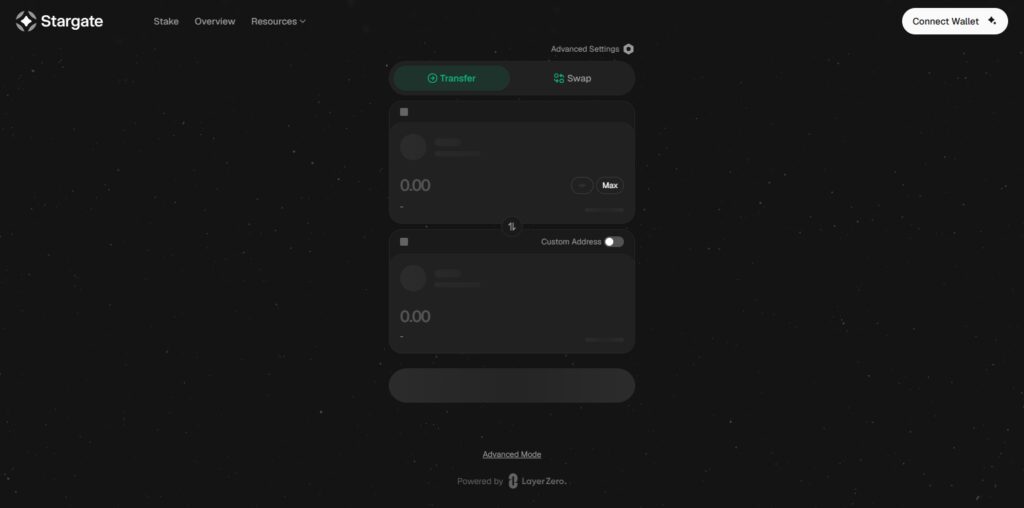
Within the framework of Best Cross-Chain Bridges with Lowest Fees & Top Security for its capital efficiency and instantaneous finality, Stargate provides seamless cross-chain transfers and guarantees users receive their assets in the native format. Stargate uses liquidity pools, and so users may experience delays in receiving their assets if there is insufficient liquidity.
Stargate Features
- Based on LayerZero’s interoperability model
- Cross chain unified liquidity pools
- Instant finality for transfers
- Native asset transfers are supported
- Optimized for DeFi liquidity
Stargate
| Pros | Cons |
|---|---|
| Instant guaranteed finality | Liquidity dependent system |
| Deep unified liquidity pools | Requires sufficient pool depth |
| Strong for stablecoin transfers | Limited asset flexibility in some pools |
| Built on LayerZero security | Complexity in liquidity management |
| Efficient capital utilization | Network dependency on LayerZero |
6. Celer cBridge
Celer cBridge is a cross-chain bridge built on celer network. Using Layer-2 scaling, it provides efficient and quick transfers across numerous blockchains. cBridge offers a high level of versatility to DeFi users as it provides multi-network and multi-token support.
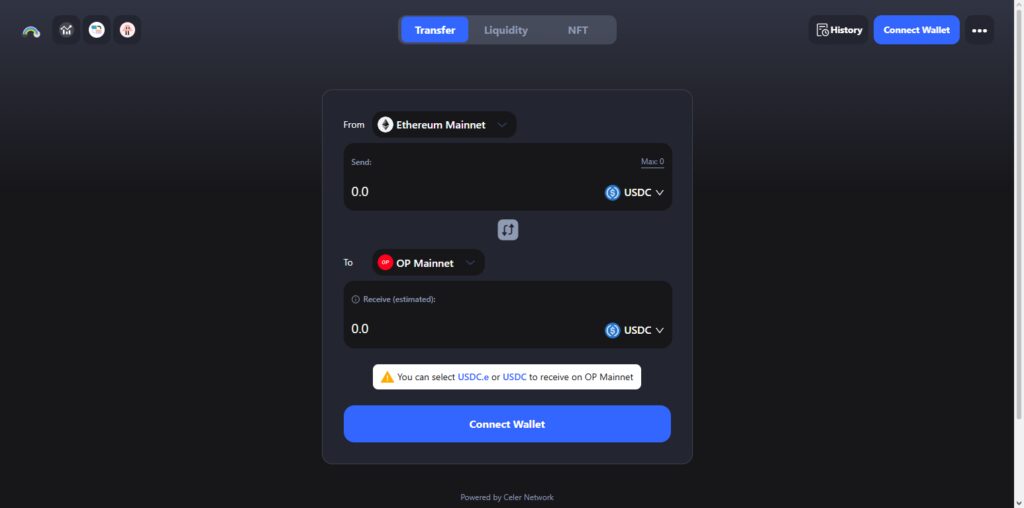
cBridge is one of the Best Cross-Chain Bridges with Lowest Fees & Top Security due to its sheer efficiency and speed, which is especially the case with frequent and arb trading.
Compared to some of the more basic bridging options available, cBridge may present a more complex user experience for traders who are not familiar with bridge tools.
Celer cBridge Features
- Layer-2 cross-chain asset transfers
- Low-cost and fast
- Many blockchains and tokens supported
- Smart routing model
- Part of the Celer Network
Celer cBridg
| Pros | Cons |
|---|---|
| Very low transaction fees | UI can be confusing for beginners |
| Fast Layer-2 scaling integration | Advanced settings required |
| Wide blockchain coverage | Not fully beginner-friendly |
| Reliable cross-chain routing | Occasional liquidity constraints |
| Efficient for frequent transfers | Requires network selection care |
7. deBridge
deBridge is a decentralized interoperability protocol designed to allow fast and secure asset transfers and messaging across blockchains. It employs a validator-based framework to maintain transfer integrity and enables flexible configurations for DeFi applications.

deBridge is created with developers and liquidity providers in mind who desire fast cross-chain interoperability.
Within Best Cross-Chain Bridges with Lowest Fees & Top Security, deBridge is recognized for its speed and composability, providing developers a streamlined path to integration in dApps. Although, in comparison to its more seasoned competitors, its ecosystem is less developed.
deBridge Features
- Decentralized interoperability and messaging
- Validator model for secure transaction
- Rapid cross-chain asset transfers
deBridge
| Pros | Cons |
|---|---|
| High-speed cross-chain transfers | Smaller ecosystem vs competitors |
| Strong interoperability design | Lower adoption compared to leaders |
| Flexible developer integration | Limited mainstream awareness |
| Secure validator-based system | Still expanding network support |
| Efficient DeFi connectivity | Fewer liquidity pools |
8. Multichain
Multichain is a router-based cross-chain bridge that features support for a large variety of blockchains and tokens. It allows users to cross chains by determining the best routes for the transfers through smart routing.
Multichain became famous due to its large coverage, and ease of use. Within Best Cross-Chain Bridges with Lowest Fees & Top Security, it was previously a top interoperability solution due to its wide chain support. Users, however, should be cognizant of legacy security issues that have affected its popularity in the greater DeFi.
Multichain Features
- Contains a router-based Cross-Chain Asset Transfer System.
- Supports many blockchains.
- Chooses optimal routes automatically.
- Includes token bridging and swapping.
- Has a design meant to support the entire DeFi ecosystem.
Multichain
| Pros | Cons |
|---|---|
| Very wide chain support | Past security incidents |
| Easy-to-use interface | Trust issues in ecosystem |
| Supports many tokens | Centralization concerns in past |
| Strong routing mechanism | Reputation impact |
| Good for general users | Risk perception remains |
9. Connext
Connext is a cross-chain interoperability protocol that provides a way to make secure, trust-minimized transfers by employing optimistic verification models.
Connext makes it possible to rapid bridge rollups and layer-1 networks while decreasing the reliance on centralized validators. Connext is particularly useful in modular blockchain ecosystems, making it the most attractive option for scalable DeFi applications.
In Best Cross-Chain Bridges with Lowest Fees & Top Security, Connext is appreciated for the high degree of decentralization and security design. Its settlement process, however, will likely take more time in comparison to liquidity-based bridges due to its verification.
Connext Features
- Is a bridging protocol based on optimistic verification.
- Is a trust-minimized system for cross-chain transfers.
- Is mainly focused on rollup-to-rollup interactions.
- Includes a safe cross-chain communication system.
- Is meant to support modular blockchains.
Connext
| Pros | Cons |
|---|---|
| Highly secure optimistic verification | Slower settlement time |
| Strong decentralization model | Not instant transfers |
| Ideal for rollup ecosystems | Limited liquidity-based speed |
| Trust-minimized design | More complex architecture |
| Good for modular DeFi systems | Requires waiting for finality |
10. SushiSwap Bridge
SushiSwap Bridge connects various blockchains and offers DeFi users an easy, fee-transparent way to transfer assets.
Users can bridge assets from Ethereum, Polygon, Arbitrum, Avalanche, and more. SushiSwap Bridge is part of the SushiSwap DeFi suite, which combines swapping, staking, and liquidity features onto one platform. It facilitates permissionless, smart contract-based transfers that maintain control of funds.
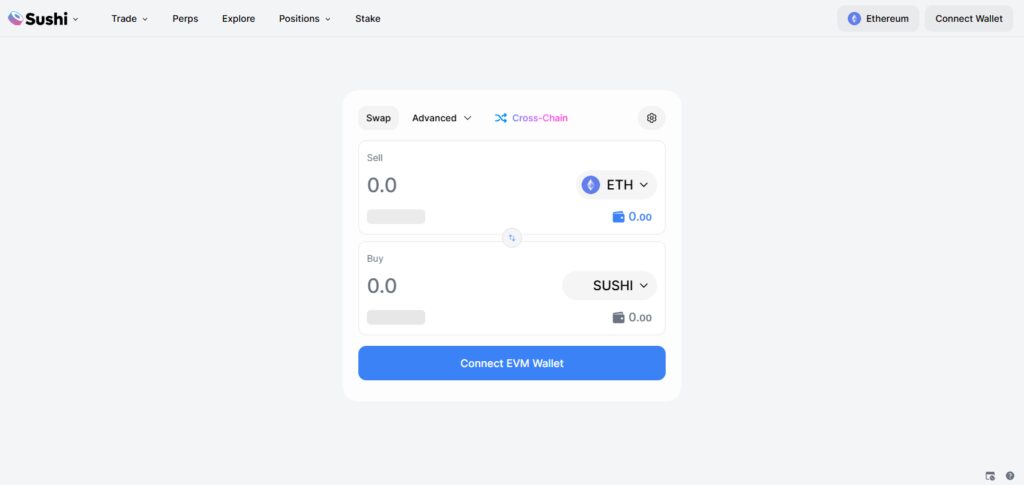
SushiSwap Bridge is one of the most user-friendly cross-chain bridges available. Designed to maximize security and minimize fees, its routing system decreases reliance on third-party services. Audits of SushiSwap Bridge’s smart contracts ensure a strong focus on security.
However, like other cross-chain services, usage fees can fluctuate based on network congestion. SushiSwap Bridge is a good option to transfer cross-chain assets within Web3 and DeFi sectors. Users can expect a low cost, high security, and fully decentralized experience for asset transfer.
SushiSwap Bridge Features
Multi-Chain Asset Transfers: SushiSwap Bridge supports cross-chain asset transfers on several blockchains including Ethereum, Polygon, Arbitrum, Avalanche, and BNB Chain. This functionality promotes cross-chain flexibility and interoperability.
Decentralized Smart Contract System: SushiSwap Bridge is entirely built on smart contracts, meaning there is no custody and users maintain control of their funds and are able to conduct transfers without trust.
Low-Cost Cross-Chain Swaps: For users who frequently access bridges, SushiSwap Bridge is optimal due to its low cost. Transaction fees are lower than most traditional bridges due to liquidity pools and more efficient routes.
Integrated DeFi Ecosystem: The Bridge’s integration with the SushiSwap ecosystem means users can access the Bridge and also Swap, Stake, and provide liquidity on the same platform.
Decentralized Liquidity Pool Transfers: SushiSwap Bridge utilizes decentralized liquidity pools to provide faster and more efficient cross-chain asset transfers without the need for centralized validators.
SushiSwap Bridge
| Pros | Cons |
|---|---|
| Enables easy movement of tokens across major blockchains; improves interoperability and flexibility for users | Limited support for some newer or niche blockchains; transfer times may vary depending on network congestion |
| Non-custodial and trustless; users retain full control of assets; enhances transparency and security | Smart contract risks if vulnerabilities exist; no central authority for dispute resolution |
| Generally lower fees compared to centralized bridges; cost-efficient for frequent DeFi users | Fees still depend on gas prices of underlying chains, which can become expensive during peak times |
| Seamless access to swapping, staking, and liquidity within SushiSwap platform; improves user experience | Ecosystem dependency may limit flexibility outside SushiSwap services |
| Faster and efficient transfers without centralized intermediaries; improves liquidity utilization | Requires sufficient liquidity pools; low liquidity can lead to slippage or delays |
Conclusion
Interoperability in today’s cross-chain DeFi sphere is an absolute necessity. LayerZero, Axelar, Wormhole, Stargate, Synapse, Celer cBridge, deBridge, Multichain, and Connext each provide unique advantages (i.e., secure messaging via validators or the ability to offer instant liquidity swaps) and are recognized as the Best Cross-Chain Bridges with Lowest Fees & Top Security.
Liquidity-based bridging solutions are focused on the efficiency and cost of transfers, while bridging solutions based on protocols focus more on decentralization and the minimization of trust. Choosing a bridging solution is about balancing the depth of liquidity, cost, the security model of the bridging solution, and the support of the network.
No bridging solution is the best for every situation. The goal of cross-chain bridging solutions is to provide the highest level of security, combined with the highest level of scalability and the least amount of friction.
FAQ
What are cross-chain bridges in crypto?
Cross-chain bridges are protocols that allow users to transfer assets and data between different blockchains. They improve interoperability in DeFi by connecting networks like Ethereum, Solana, and BNB Chain. The Best Cross-Chain Bridges with Lowest Fees & Top Security ensure fast transfers while maintaining strong security standards and minimal transaction costs.
Which cross-chain bridge is the safest?
Safety depends on architecture. Protocols like Axelar and Connext are often considered highly secure due to their decentralized validator systems and trust-minimized designs. They are widely used in enterprise and DeFi applications requiring strong security guarantees.
Which cross-chain bridge has the lowest fees?
Liquidity-focused bridges like Synapse and Celer cBridge are known for low transaction fees. They use efficient routing and liquidity pools, making them cost-effective for frequent traders and small transfers.
What is the fastest cross-chain bridge?
Bridges such as Stargate and LayerZero are among the fastest due to instant finality or lightweight messaging layers. They enable near real-time asset transfers across supported blockchains.