Modern businesses implement AI-driven automation in the quest for efficiency and to lessen repetitive work and expedite decision-making at all levels. The Best Agentic AI Platforms for Automating Corporate Workflow Lines allow sophisticated AI agents to handle complex workflow automation, seamlessly integrate with enterprise applications, and conduct tasks with little to no human involvement.
This article analyzes the top platforms, describing their primary features and advantages, what they do, and their applicability. We will also discuss how to pick the best one for your company’s workflow automation preferences.
What Is an Agentic AI Platform?
An Agentic AI platform enables the development of autonomous AI agents to plan, reason, make decisions, and complete tasks largely on their own. Traditional forms of automation allow only the execution of rigidly specified rules.
Agentic AI creates the means to analyze data, adapt to changing contexts, incorporate memory, employ applications through APIs, and facilitate coordination across several workflows.

While Agentic AI tools proliferate, businesses are primarily deploying them to automate customer support, HR, finance, IT, sales, and document processing. Through Agentic AI, organizations can further develop corporate workflows by scaling improvements to efficiency and manual work as well as accelerating decisions.
Key Point & Best Agentic AI Platforms for Automating Corporate Workflow Lines
| Agentic AI Platform | Key Point |
|---|---|
| LangGraph | Builds stateful AI agents that automate complex corporate workflows with multi-step reasoning, memory, and decision-making across business processes. |
| Microsoft Copilot Studio | Enables enterprises to create AI agents that automate workflows across Microsoft 365, Dynamics 365, Teams, and Power Platform with minimal coding. |
| Salesforce Agentforce | Automates customer service, sales, and CRM operations using autonomous AI agents that perform tasks, answer queries, and trigger business workflows. |
| Google Vertex AI Agent Builder | Helps organizations develop enterprise AI agents that integrate with cloud applications, automate operations, and provide intelligent workflow orchestration. |
| CrewAI | Coordinates multiple specialized AI agents that collaborate on business tasks, making it ideal for automating research, reporting, and operational workflows. |
| AutoGen | An open-source multi-agent framework that enables AI agents to communicate, solve problems collaboratively, and automate enterprise business processes. |
| IBM watsonx Orchestrate | Uses AI assistants to automate repetitive business activities such as HR, procurement, finance, and IT support while integrating with enterprise systems. |
| UiPath Autopilot | Combines robotic process automation (RPA) with agentic AI to automate end-to-end corporate workflows, document processing, and employee productivity tasks. |
| Amazon Bedrock Agents | Allows businesses to build autonomous AI agents that connect with enterprise data sources, APIs, and AWS services to automate business operations. |
| ServiceNow AI Agent Studio | Creates intelligent AI agents that automate IT, HR, customer support, and enterprise service management workflows within the ServiceNow ecosystem. |
1. LangGraph
LangGraph is an innovative platform for creating AI agents designed to handle complex business workflows that entail multiple tasks. It is geared to handle enterprise-level automations and offers support for memory, conditional logic, human approvals, and various tools.
It is ideal for use in the creation of AI systems that manage tasks, handle documents, and perform data analysis and decision making across business units. Customers particularly appreciate the graph-based design for its reliability in executing workflows and its ability to place enhanced control over the behavior of the agents.
Among the Best Agentic AI Platforms for Automating Corporate Workflow, LangGraph naturally ranks high. It is fit for use in flexible and scalable automation. LangGraph is particularly suitable for the integration of large language models into APIs, as well as database and enterprise apps, without losing the overall consistency of the workflow.
It is extensively used to optimize business units that deal with functional processes like customer support, finance, operations, and compliance, and also for the automation of internal knowledge processes.
LangGraph
| Pros | Cons |
|---|---|
| Excellent for building stateful AI agents | Requires programming knowledge |
| Supports complex multi-step workflows | Steeper learning curve for beginners |
| Flexible integration with LLMs and APIs | Limited no-code capabilities |
| Human-in-the-loop workflow support | Deployment can be technically complex |
| Open-source and highly customizable | Requires infrastructure management |
Core Features
- Persistent memory in AI stateful agent workflows
- Graph-based execution to organize complex tasks
- Human-in-the-loop approval and intervention
- LLM, API, DB, and tool integration
- Conditional branching, multi-step logic
Best Use Cases
- Knowledge assistant
- Automated document processing
- Support workflow automation
- Business process orchestration with multiple agents
2. Microsoft Copilot Studio
Microsoft Copilot Studio allows enterprises to develop AI copilots and agents with minimal coding. The platform auto-generates code to seamlessly integrate MS 365 and Dynamics 365 apps to automate most corporate workflows. It allows users to develop conversational agents that can assist employees by answering questions and performing business tasks.
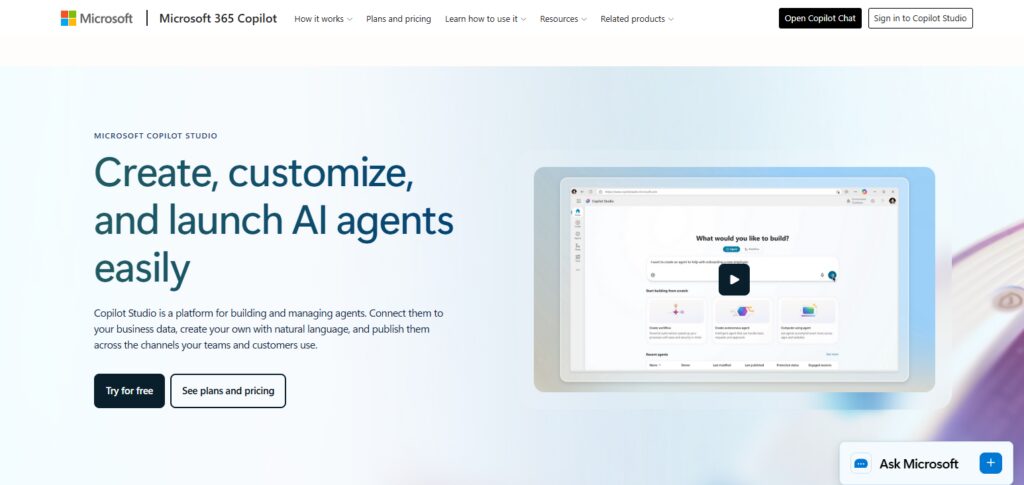
Due to the integration with Microsoft apps, strong security and compliance features, and low-code orchestration, most enterprises list Microsoft Copilot Studio among the Best Agentic AI Platforms for Automating Corporate Workflow. The workflow automation features can be used to transform service desks, HR requests, finance approvals, customer support, and document management.
Microsoft Copilot Studio
| Pros | Cons |
| Low-code AI agent development | Best suited for Microsoft ecosystem |
| Seamless Microsoft 365 integration | Advanced features may require premium licensing |
| Strong enterprise security | Limited flexibility outside Microsoft services |
| Easy workflow automation | Custom development can become complex |
| Rich Power Platform connectors | Subscription costs may increase for large organizations |
Core Features
- Low-code AI agent and chatbot development
- Microsoft 365 and Dynamics 365 embedded use
- Power Platform for automated workflows
- Security and governance controls
- Conversational automation via AI
Best Use Cases
- HR employee self-service
- IT desk automation
- Business assistants
- Microsoft 365 productivity automation
3. Salesforce Agentforce
Salesforce Agentforce supplies self-operating AI agents that facilitate customer interaction, sales management, and CRM task automation. Capable of answering questions, record-keeping, crafting tailored text, setting up reminders, and business tasking, these agents work without the need for supervision. The system optimizes both internal and external processes using the Salesforce CRM.
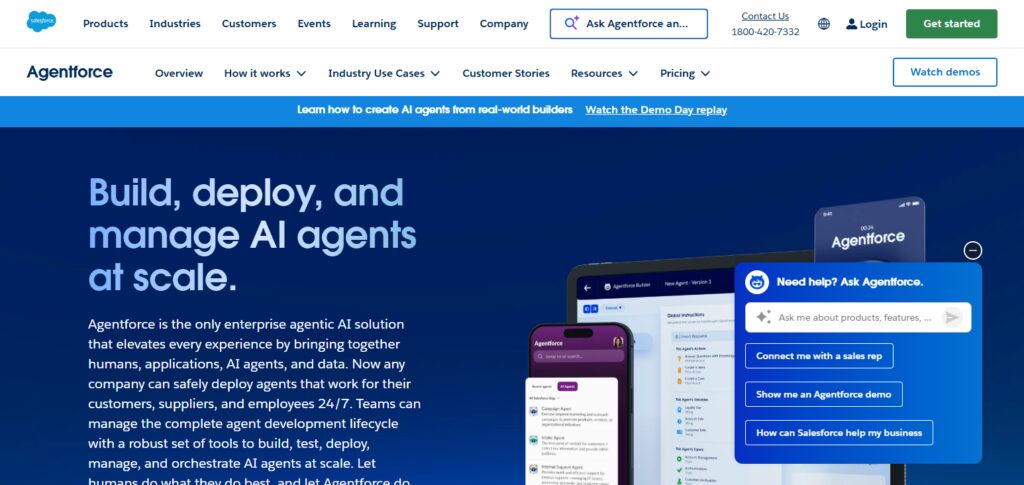
Salesforce Agentforce is often the selected option for the Best Agentic AI Platforms for Automating Corporate Workflow for organizations looking for sophisticated automation using trusted CRM data.
With Salesforce Agentforce, companies are able to realize automation in lead qualification, customer support, marketing automation, and managing customer accounts, all the while meeting their compliance and security requirements. The platform’s AI agents learn from the organization’s business data, thereby enhancing the accuracy of the task and quality of the response.
Salesforce Agentforce
| Pros | Cons |
| Deep Salesforce CRM integration | Highest value within Salesforce ecosystem |
| AI-powered customer engagement | Enterprise licensing can be expensive |
| Automates sales and service workflows | Limited benefits without Salesforce CRM |
| Strong governance and compliance | Customization may require Salesforce expertise |
| Scalable enterprise deployment | Initial implementation takes time |
Core Features
- Autonomous AI agents for sales and support
- Salesforce CRM embedded use
- AI for customer engagement and sales
- Enterprise data workflow automation
- Governance and compliance for enterprises
Best Use Cases
- Automated customer service
- Sales qualification
- Support for marketing campaigns
- Automation of CRM workflows
4. Google Vertex AI Agent Builder
Using Google Cloud’s AI infrastructure, the Google Vertex AI Agent Builder enables businesses to create sophisticated AI agents. It utilizes retrieval-augmented generation (RAG), enterprise search, API connections, and large language models. With this AI service, businesses can automate the retrieval of knowledge, the processing of documents, support of employees, and the orchestration of workflows.
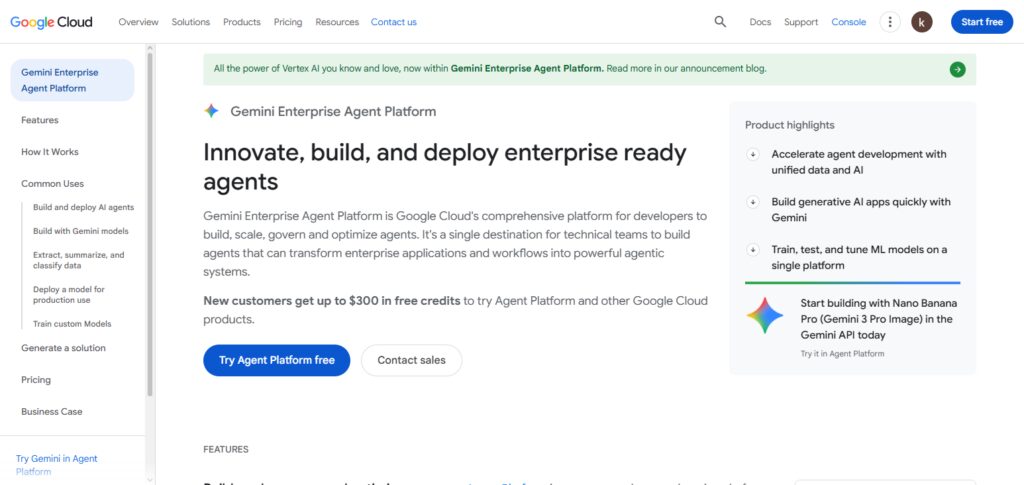
Among the Best Agentic AI Platforms for Automating Corporate Workflow, the Google Vertex AI Agent Builder stands out for the flexibility it offers to businesses that operate on the Google Cloud.
This aids businesses in the advanced machine learning deployment, automated workflows, and the strong frameworks of protection and integration of Google Cloud and enterprise applications. Used across finance, healthcare, retail, manufacturing, and customer service automation.
Google Vertex AI Agent Builder
| Pros | Cons |
| Powerful Google Cloud integration | Requires Google Cloud knowledge |
| Supports Retrieval-Augmented Generation (RAG) | Cloud costs may grow with usage |
| Highly scalable infrastructure | Configuration can be complex |
| Enterprise-grade AI development | Limited on-premises deployment options |
| Strong machine learning capabilities | Best suited for cloud-first organizations |
Core Features
- AI agent development on Google Cloud
- RAG support
- Enterprise search and knowledge retrieval
- API integration and cloud services
- ML on-demand infrastructure
Best Use Cases
- Knowledge management for enterprises
- Automation of customer support
- Document searches
- Cloud-based workflow automation
5. CrewAI
CrewAI allows different AI agents to operate as teams to complete tasks. It features a neat interface for organizing several agents performing specialized business functions (research, planning, coding, analysis, reporting). CrewAI’s framework is useful for automating business processes across multiple functions.
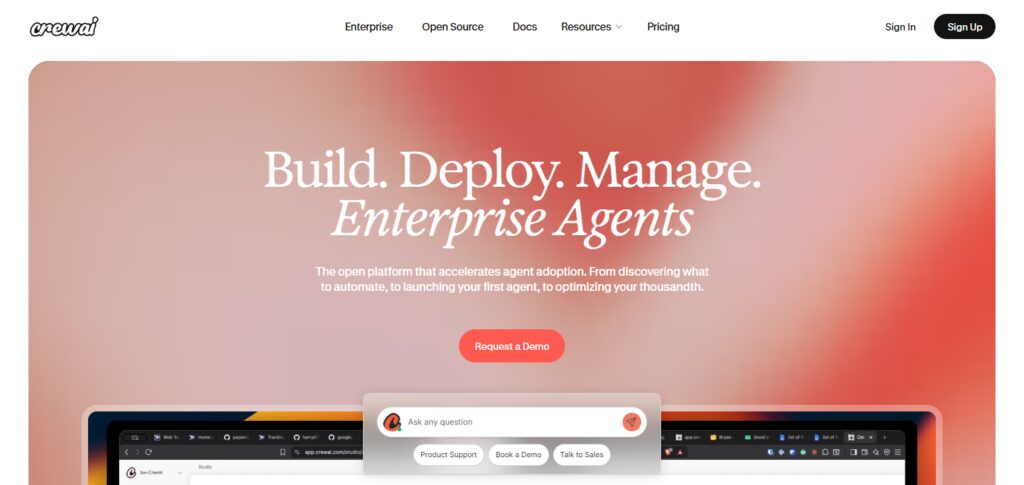
For many developers, CrewAI is one of the Best Agentic AI Platforms for Automating Corporate Workflow. Its flexible architectural design means that several processes (content generation, project management, agile software development, financial analysis, business research) can be automated with ease.
CrewAI users can develop intelligent systems for automation and improvements to business functions by factoring in custom flows, API integrations, and large language models.
CrewAI
| Pros | Cons |
| Open-source and free to use | No official enterprise support |
| Excellent multi-agent collaboration | Requires Python programming skills |
| Highly customizable workflows | Limited built-in enterprise governance |
| Lightweight framework | Fewer visual development tools |
| Active developer community | Production deployment requires planning |
Core Features
- Engages many agents.
- Assigns AI tasks by role.
- Constructs customizable workflows.
- Extensively customizable.
- API and LLM friendly.
Best Use Cases
- Automates business research.
- Creates content.
- Assists with management.
- Aids in developing software.
6. AutoGen
Like CrewAI, AutoGen enables a lot of specialized AI agents to solve tasks that require planning and rationalization. Its primary design focus is facilitating conversations among AI agents, humans, and software tools.
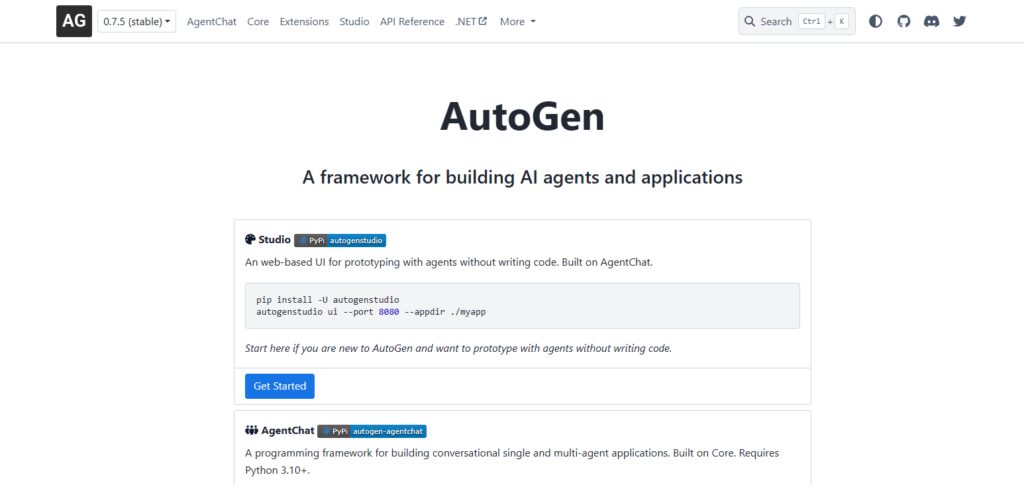
With this framework, businesses are able to automate sophisticated workflows that require a lot of rationalization and planning. It has a modular design, making AI development for businesses much easier.
Businesses reviewing the Best Agentic AI Platforms for Automating Corporate Workflow will likely have AutoGen on their shortlist as it enables building highly customizable autonomous systems. It is particularly useful in engineering, business intelligence, document analysis, and collaborative enterprise problem solving.
AutoGen
| Pros | Cons |
| Advanced multi-agent conversations | Developer-focused framework |
| Open-source flexibility | Requires coding experience |
| Supports human-AI collaboration | Complex for non-technical users |
| Easy integration with external tools | Enterprise features require customization |
| Strong research community support | Documentation continues evolving |
Core Features
- Framework for multi-agent dialog.
- Collaborative workflows with humans and AI.
- Integration of tools and APIs.
- Autonomous agents with flexible dialog.
- Custom enterprise solutions from the ground up.
Best Use Cases
- Automating tasks for software engineering.
- Business intelligence.
- Generation of code.
- Research tasks within an enterprise.
7. IBM watsonx Orchestrate
IBM watsonx Orchestrate helps businesses automate their specific use cases involving AI assistants that work across various enterprise applications to handle routine tasks. IBM watsonx Orchestrate connects systems in HR, finance, procurement, IT, and customer service to enhance operational efficiency. Employees can offload torturous admin work to AI and will execute and manage work tasks seamlessly.
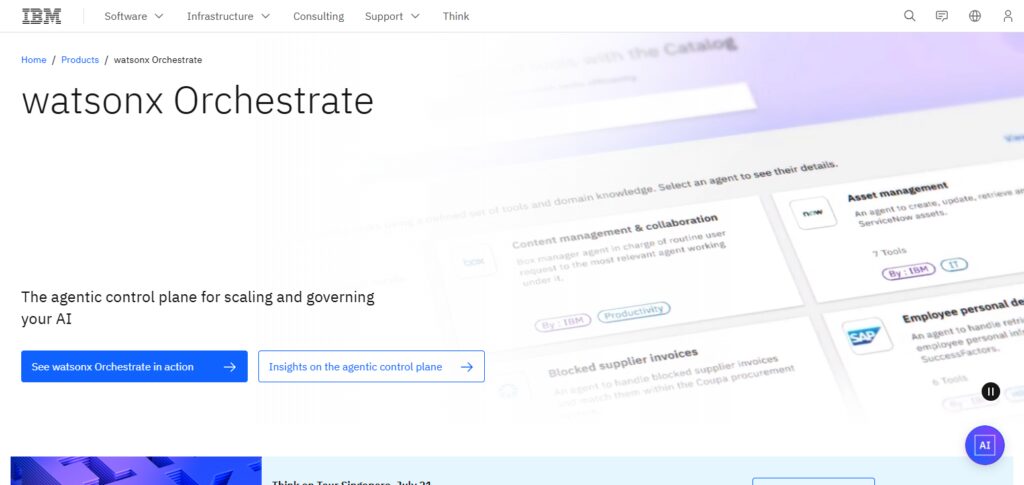
IBM watsonx Orchestrate is one of the Best Agentic AI Platforms for Automating Corporate Workflow for its enterprise-grade governance, security, and hybrid cloud support. From the automation of processes and routing tasks to orchestrating workflows and enabling natural language, businesses can use the platform to boost productivity and minimize operational costs and highly manual tasks within any of their business units.
IBM watsonx Orchestrate
| Pros | Cons |
| Enterprise-grade security | Premium enterprise pricing |
| Excellent business workflow automation | Best optimized for IBM ecosystem |
| Hybrid cloud deployment | Smaller developer community |
| Natural language task execution | Customization may require IBM specialists |
| Strong governance and compliance | Setup can be time-intensive |
Core Features
- Task automation for enterprises using AI.
- Orchestration of workflows between business systems.
- Execution of tasks via natural language.
- Support for hybrid cloud deployments.
- Enterprise-level security and governance.
Best Use Cases
- Automation of HR tasks.
- Business processes within finance.
- Automation of procurement tasks.
- Automation of IT services.
8. UiPath Autopilot
UiPath Autopilot combines robotic process automation (RPA) with generative AI and agentic capabilities to automate sophisticated workflows across an enterprise. This platform helps employees automate document processing, email handling, navigation, data retrieval, and other mundane tasks needed to run a business. It enhances conventional automation by incorporating cognitive, AI-decided actions into the framework.
UiPath Autopilot is a popular choice among those reviewing Best Agentic AI Platforms for Automating Corporate Workflow because of its capability to embed AI agents into existing RPA bots.
The platform allows the automation of tasks across numerous business sectors while preserving the necessary governance. The enterprise automation platform enables large organizations to attain operational and productive automation with improved task execution within workflows.
UiPath Autopilot
| Pros | Cons |
| Combines AI with RPA automation | Licensing can be expensive |
| Excellent document processing | Full capabilities require UiPath platform |
| Enterprise-ready scalability | Initial deployment requires planning |
| Large integration ecosystem | Learning curve for advanced automation |
| Strong governance features | Some AI features are relatively new |
Core Features
- RPA boosted by AI.
- Advanced Document Understanding.
- Generative AI assisted tasks.
- Business workflow automation.
- Additional UiPath automations made seamless.
Best Use Cases
- Automated processing of invoices.
- Customer service operations.
- Business automation within the finance sector.
- Automation of administrative tasks in healthcare.
9. Amazon Bedrock Agents
With Amazon Bedrock Agents, organizations can develop their own self-sufficient AI agents by accessing foundation models through AWS. These agents are capable of making decisions, performing actions, and automating tasks in a secured cloud environment. Utilizing AWS services further contributes to the ease of deployment in large-scale enterprises.
Amazon Bedrock Agents have been recognized among the Best Agentic AI Platforms for Automating Corporate Workflow because of the extensive options for creating secure enterprise AI tools. Companies use AWS to automate the functions of customer support, IT, and internal operations, as well as document processing and knowledge retrieval. The strong cloud capabilities of the framework makes it suitable for the automation needs of future enterprises.
Amazon Bedrock Agents
| Pros | Cons |
| Native AWS ecosystem integration | Primarily designed for AWS users |
| Supports multiple foundation models | Cloud costs vary by usage |
| Highly scalable architecture | Requires AWS technical expertise |
| Secure enterprise infrastructure | Limited outside AWS environment |
| Flexible API connectivity | Configuration complexity for beginners |
Core Features
- Autonomous agents on AWS.
- Integration of foundation models.
- Secure access to APIs and enterprise data.
- Knowledge with reasoning for retrieval.
- Direct access to AWS services.
Best Use Cases
- Automation of business operations in the cloud.
- Supports the creation of knowledge assistants for enterprises.
- Creates workflows for customer support scenarios.
- Automates business processes for internal use.
10. ServiceNow AI Agent Studio
With ServiceNow AI Agent Studio, businesses can create AI agents that automate virtually all IT and corporate operations. The platform helps enterprises design AI agents that understand intent, perform tasks, trigger actions, and interact with employees through text and voice, all the while decreasing the need for human input.
Given that the studio is a direct add-on to the ServiceNow platform, it is not surprising that many businesses view it as one of the Best Agentic AI Platforms for Automating Corporate Workflow.
Companies use the studio to securely automate the AI-driven orchestration of tasks like incident resolution, employee onboarding, and service requests and approvals. Its automation, enterprise governance, and workflow capabilities greatly improve efficiency across businesses.
ServiceNow AI Agent Studio
| Pros | Cons |
| Excellent ServiceNow integration | Best suited for existing ServiceNow customers |
| Strong enterprise workflow automation | Premium enterprise licensing |
| AI-driven employee support | Custom workflows require configuration |
| Robust governance and security | Less flexibility outside ServiceNow platform |
| Automates IT and HR operations | Implementation may require specialist expertise |
Core Features
- AI agents for enterprise service needs.
- Seamless ServiceNow workflow integration.
- Automation for intelligent tasks.
- Conversational AI for employee assistance.
- Governance and security for enterprises.
Best Use Cases
- Management of IT services.
- Delivery of HR services.
- Automation of employee onboarding.
- Support for customer service functions.