
This article will cover the top Crowdfunded Real Estate Platforms for Passive Investing. You will find their standout features, ticket sizes, costs, pros and cons and more.
This article is designed to be a useful tool to anyone from first time to seasoned investors who want to diversify their real estate investment portfolio and build out a stream of passive income.
What is Crowdfunded Real Estate Platforms?
Crowdfunded real estate platforms are investment websites that allow a large number of people to pool their money to invest in commercial, residential, or mixed real estate projects.
These platforms allow users to buy fractional ownership of a real estate project or invest in a real estate investment trust (REIT), a private fund, or real estate backed loans.

These platforms buy and manage the properties for the users. Investing in real estate is typically a very active, time-consuming endeavor, however, these platforms are trying to make investing in real estate more passive.
These platforms typically have diversified portfolios and lower investor minimums. Investors are able to earn returns through interest and appreciation.
Why Choose Crowdfunded Real Estate Platforms for Passive Investing
Affordable Minimum Investment Levels: The required minimum investment levels are lower via real estate crowdfunding compared to direct property investing.
Expenses with the Potential for Passive Income: Make money through rental distributions, dividends, and interest payments while avoiding the burden of rental property management.
Risk Reducing Asset Diversification: Real estate crowdfunding allows more investment opportunities, therefore increasing the number of properties and the balance of the investment.
Dedicated Management Teams: Professional teams are responsible for the purchase and maintenance of the property, tenant leasing, and property operation.
Access to Commercial Real Estate: Commercial real estate is often difficult to access due to the amount of required capital. RE crowdfunding reduces this issue.
No Responsibilities for Management of Investments: Real estate crowdfunding delegates the burden of property maintenance, tenant management, and rent collection.
Detailed Investment Report Transparency: Crowdfunded platforms offer detailed reports and financial projections along with performance and market updates for the property.
Variety of Investments: Equity investments, REITs, private funds, debt investments, and fractional property ownership are all available.
Value Appreciating with Reliable Income: Properties can be expected to appreciate while offering investors regular income payments.
Real Estate Investing via the Internet: Investing can be done from anywhere and at any time and offers the ability to track investments.
Benefits Of Crowdfunded Real Estate Platforms for Passive Investing
Less Money to Start – Less total cash is necessary to start investing, as you do not need enough to buy an entire property.
Earn Passive Income – The management burden associated with earning passive income from real estate is absent. You can earn rental income, and dividends and interest.
Investment Risk Is Reduced – You can choose to invest in many different kinds of properties.
Great Professional Property Management – Real Estate Crowdfunding Companies hire professional property managers to handle property purchasing, maintenance, tenant leasing, and the day-to-day operations of the property.
Excellent Real Estate Offerings – It is easy to invest in commercially and residentially popular real estate ventures that retail investors typically do not have access to.
No Management Headaches – There are no tenants to deal with. You will not be responsible for maintenance and repairs. Rent collection is also not required.
Income and Appreciation – Besides getting dividends and interest, you also benefit from the appreciation in the value of the property.
Much Control Over Investments – Depending on your goals, you can choose to invest in equity, real estate investment trusts (REITs), private funds, debt, fractional ownership, or other investments.
Online, Often, and Transparent – You can invest, monitor your investments and portfolios, and view reports in a secure online environment.
Solid Long Term Investing – Investing profits means that you are spending an income that is inequity to invest, and are diversifying your real estate. This continues to build wealth over time and stabilize your portfolio.
Key Point & Best Crowdfunded Real Estate Platforms for Passive Investing
- Fundrise – Best for beginners seeking diversified commercial real estate portfolios with low minimum investments.
- CrowdStreet – Ideal for accredited investors looking for direct access to institutional-quality commercial properties.
- RealtyMogul – Offers REITs and private commercial real estate deals with professionally managed investments.
- DiversyFund – Focuses on long-term multifamily real estate growth with no management fees for investors.
- Yieldstreet Real Estate – Provides alternative real estate investments targeting higher potential returns through diversified assets.
- EquityMultiple – Specializes in commercial real estate syndications, preferred equity, and debt investments.
- Groundfloor – Enables passive investing in short-term real estate loans with low investment minimums.
- PeerStreet – Invests primarily in real estate-backed private credit and short-term lending opportunities.
- Roofstock One – Allows passive ownership of professionally managed single-family rental property portfolios.
- HoneyBricks – Uses blockchain technology to offer fractional ownership in commercial real estate projects.
10 Best Crowdfunded Real Estate Platforms for Passive Investing
1. Fundrise
Since starting up in 2012, Fundrise has made a name for itself as a leading equity based crowdfunding source for passive investors and for those just starting out and/or in the market for a long range investment.
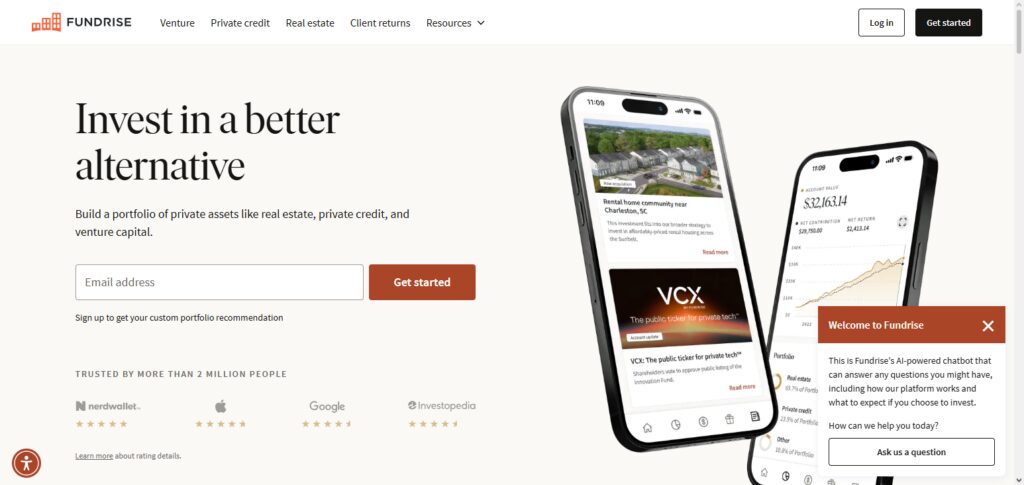
Fundrise users are able to invest in eREITs and eFunds from a much lower starting point than the traditional real estate market. Unlike other platforms, Fundrise takes care of all the heavy lifting from acquisition to reconstruction to occupancy to finally making distributions.
Fundrise’s users earn passive income in the form of dividends and appreciate the value of their investment over time. With a user friendly interface, allows users to continue investing without having to worry about the daily fluctuations of their portfolio, and encourages long term investment.
Fundrise Characteristics, Benefits & Drawbacks
Characteristics
- Low investment threshold
- Varied eREIT and eFund portfolios
- Open to all investors
- eREITs and eFunds are professionally managed
- Easy to use investment dashboard
Benefits
- Good option for beginning investors
- Income generated through dividends
- Good diversification among real estate
- No management necessary
- Good long-term potential
Drawbacks
- Trade restrictions
- Market dependent returns
- Limits on redemption
- Fees will negatively impact returns
- Limited choice concerning real estate
2. CrowdStreet
As a pioneer in the commercial real estate (CRE) online investment space, CrowdStreet has successfully launched a platform that connects accredited investors directly with real estate developers and sponsors for the investment of office, multi-family, industrial, hospitality and mixed use development projects.

Started in 2014, CrowdStreet has established a nation-wide sponsor and a client base who appreciate the firm’s transparent due diligence, diversified portfolios and superior, institutional quality commercial real estate with long term passive investments and higher than average returns.
CrowdStreet Characteristics, Benefits & Drawbacks
Characteristics
- Commercial real estate focus
- Mostly accredited investors
- Direct investments
- Institutional properties
- Sponsor due diligence
Benefits
- Excellent commercial real estate project access
- Potential for strong returns
- Lots of property choices
- Good transparency
- Good network of developers
Drawbacks
- High investments
- Accredited investors only
- Limited liquidity
- Lots of Individual deal risk
- Long holding periods
3. RealtyMogul
RealtyMogul provides both accredited and non-accredited investors access to professionally managed commercial real estate. Founded in 2012 and positioned as a leading real estate crowdfunding platform, it offers diverse REITs, private placements, apartment communities, office buildings, industrial, and retail real estate.

Before offering investment opportunities, RealtyMogul conducts thorough diligence. The firm offers investors a great deal of information regarding the risks associated with a property, as well as potential returns.
RealtyMogul supports the management of its properties by Professional asset management, regular reporting, and dividends, and offers a well-developed portfolio. Investing in RealtyMogul is a great opportunity for investors with a desire for passive investing with a limited level of management and a focus on the appreciation of the investment over the long term.
RealtyMogul Characteristics, Benefits & Drawbacks
Characteristics
- Offers REITs and private placements
- Open to accredited and some non-accredited investors
- Professionally managed investments
- Focus on commercial properties
- Comprehensive due diligence
Benefits
- Good diversification
- Income distributions
- Strong management
- Good reputation
- Easy to use online investments
Drawbacks
- Some investments require accreditation
- Fees will negatively impact return
- Limited withdrawal options
- Investments are market risk
- Higher minimums for some deals
4. DiversyFund
At DiversyFund, investors enjoy a combination of long-term wealth generation and no traditional management fees. Started in 2016, the firm purchases and then improves, manages, and sells apartment communities for appreciation.
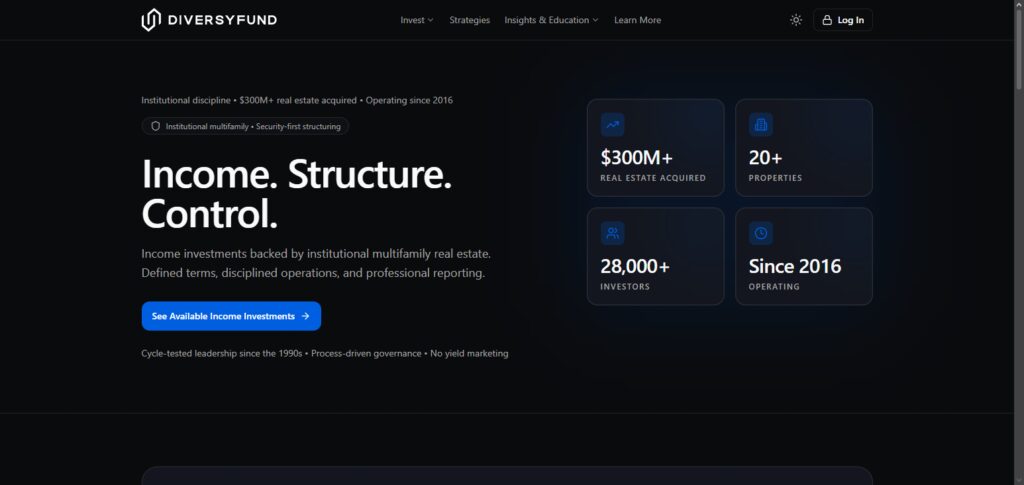
During the investment period, DiversyFund reinvests rental income to assist in improvements, therefore dividends are not distributed.
The multifamily focus of the firm, combined with its vertically integrated business model, low investment minimum, and focus on value-add, makes DiversyFund an excellent choice over its competitors for passive, long-term investors in real estate.
DiversyFund Characteristics, Benefits & Drawbacks
Characteristics
- Focus on multifamily apartments
- No management fees
- Focus on long-term strategies
- Property improvements add value
- Low minimum investment requirement
Benefits
- Free investment model
- Properties are managed
- Capital appreciation is likely
- More investors can participate
- Invest with minimal effort
Drawbacks
- Dividends are not paid
- Investments are long-term
- Hard to cash out
- Profits come from sale of properties
- Invested in only a few properties
5. Yieldstreet Real Estate
Yieldstreet Real Estate’s parent company, Yieldstreet, is an alternative investment platform. It focuses on commercial real estate and private market investments. Yieldstreet Real Estate offers opportunities to invest in residential real estate developments, multi-family real estate, commercial real estate, bridge loans, and real estate that generates cash flow.

Yieldstreet Real Estate invests time and resources in the vetting process (both professionally and in detail) and only markets the opportunities to investors after the vetting process.
Yieldstreet Real Estate offers the opportunity to invest in the debt and equity side of real estate and to earn passive cash flow. It offers professional management of real estate and detailed reporting. These traits make Yieldstreet Real Estate a good fit for seasoned, passive investors.
Yieldstreet Real Estate Characteristics, Benefits & Drawbacks
Characteristics
- Alternative investment methods
- Mixed projects
- Debt/Equity offerings
- Focus on accredited investors
- Underwriting is professionally done
Benefits
- Different investment options
- Access to Private Real Estate
- Undervalued deals
- Investment updates given
- Multiple asset classes
Drawbacks
- Higher minimums to invest
- Must be an accredited investor
- Hard to cash out
- Fees are charged
- Public REITs are safer
6. EquityMultiple
EquityMultiple focuses on creating an investment platform that offers accredited investors access to high-quality commercial real estate.

Since its development in 2015, EquityMultiple has focused on offering investment opportunities for equity, preferred equity and debt on commercial real estate such as office, industrial, multi-family, hospitality and self-storage. EquityMultiple conducts detailed due diligence on sponors and real estate prior to offering the opportunity for investment.
Throughout the investment period, EquityMultiple provides investors with transparent cash flow and tax reporting as well as performance updates. EquityMultiple’s facilitated due diligence, and a range of investment offerings on commercial real estate, makes EquityMultiple a highly regarded real estate income investment platform.
EquityMultiple Characteristics, Benefits & Drawbacks
Characteristics
- Commercial properties for institutions
- Equity, debt, and preferred equity
- Must be an accredited investor
- Favorable sponsor selection
- Due diligence is completed
Benefits
- Variety of options
- Easy to invest
- Passive income opportunity
- Less risk with commercial real estate
- Investments can be tracked
Drawbacks
- High minimums
- Must be an accredited investor
- Long-term investing
- Hard to cash out
- Uncertain income
7. Groundfloor
Founded in 2013, Groundfloor allows passive real estate investing, funding short-term real estate debt rather than direct ownership. Investors make low minimum investments to fund short-term renovation and construction loans.
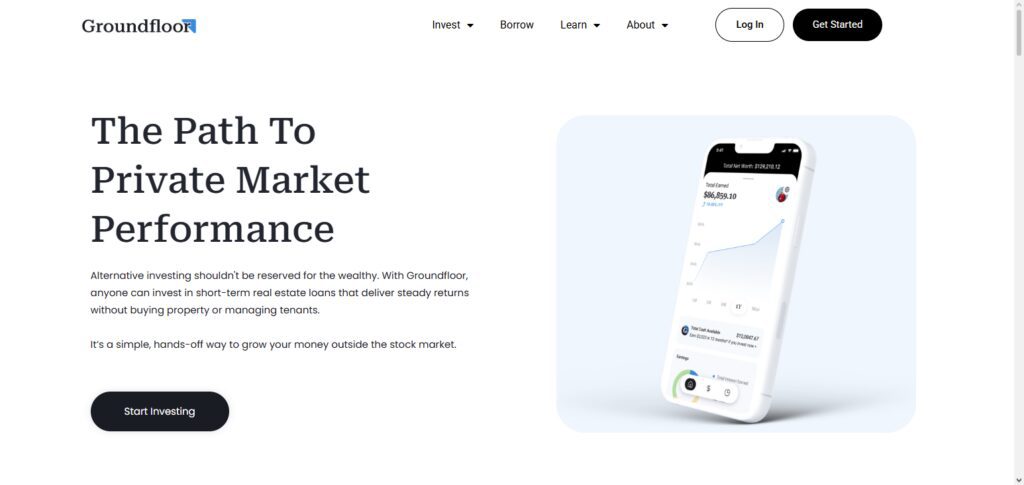
Groundfloor manages loan evaluation and servicing for the duration of the loan through its assigned loan risk grades. Borrowers’ loan repayments provide interest payments.
With transparent loan grades, a diversified lending portfolio, and short investment terms, Groundfloor services non-accredited investors and passive income real estate investors. Groundfloor has positioned itself as a beneficial platform for income-focused real estate investors.
Groundfloor Characteristics, Benefits & Drawbacks
Characteristics
- Invest in real estate loans
- Low minimum investment
- No accreditation needed
- Short-term investing
- Loans rated by grade
Benefits
- Low cost to enter
- Interest is paid regularly
- Shorter investment duration
- Diversified loan portfolio
- Easy online investing
Drawbacks
- Risk of default by borrower
- No ownership of property
- Returns depend on loan performance
- Limited secondary market
- Effect of economic downturns
8. PeerStreet
PeerStreet offers accredited investors access to real estate debt investments rather than direct real estate ownership through a private lending framework.
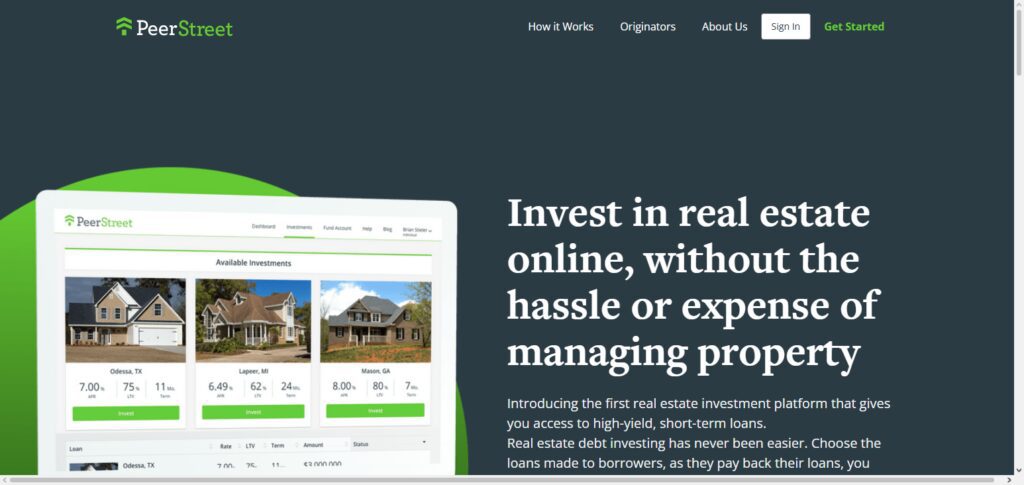
PeerStreet’s primary lending focus is first lien loans, both residential and commercial, that are secured to real estate. PeerStreet goes beyond the normal due diligence scope of a loan and independently validates the loan originator, borrower, and the related real estate and the market before funding a loan it has made available for investment.
Investors earn passive interest income from funding loans and benefit from portfolio diversification. PeerStreet’s secured loans and quality underwriting are appealing to private real estate investors.
PeerStreet Characteristics, Benefits & Drawbacks
Characteristics
- Backed by real estate lending
- First-lien loan investments
- Targeted at accredited investors
- Short-term loans
- Underwritten by professionals
Benefits
- Receive monthly interest
- Backed by real estate
- Diversification of portfolio
- Easy passive investment
- Easily obtainable loan information
Drawbacks
- Must be an accredited investor
- Risk of borrower default
- Poor liquidity
- No platform guarantee
- Market and lending risk
9. Roofstock One
Roofstock One gives its investors the ability to buy partial interests in a portfolio of single-family rental homes which are managed by a professional team. Historically, to invest in rental properties, one must purchase and manage the homes.
Investors now have the ability to invest in rental portfolios that are passive and diversified. Roofstock One manages the purchase of homes, the management of tenants, the upkeep of the homes, the leasing of the homes, and the financial operations and reporting to investors.
Diversification of a portfolio helps to mitigate the risk of a single property and simultaneously gives the investor the ability to anticipate cash flow and the appreciation of the portfolio over time. Users of the platform enjoy the highly professional management, the transparency of the operations, and the ability to invest in rental homes without the need to manage tenants.
Roofstock One Characteristics, Benefits & Drawbacks
Characteristics
- Fractional ownership of rental properties
- Property management provided
- Focused on single family rentals
- Passive rental income
- Diversified property portfolio
Benefits
- No landlord duties
- Rental income is reliable
- Management provided
- Diversification of portfolio
- Property value can appreciate over time
Drawbacks
- Investment liquidity is low
- Value of property can decline
- Management fees
- Risk of having no tenants
- Control of property is limited
10. HoneyBricks
HoneyBricks combines commercial real estate and blockchain technology to invest in commercial real estate through the purchase of fractional interests. Investors are able to purchase fractional interests in multi-family, commercial, and industrial properties which are of a higher class and which have a greater level of security in regard to the digital record of ownership.
HoneyBricks controls all of the property operations and the upkeep of the unit, and the property owners are able to receive passive income. The company invests a great amount of focus in the diversity of the investments, the transparent nature of the company, and the long term wealth of the investments.
Because of the nature of its technology and its focus on commercial real estate, HoneyBricks takes a modern approach to passive investing in commercial real estate.
HoneyBricks Characteristics, Benefits & Drawbacks
Characteristics
- Real estate investing on the blockchain
- Fractional ownership of commercial real estate
- Digital records of ownership
- Institutional-grade assets
- Technology based
Benefits
- Backed by innovative technology
- Easier access to fractional ownership
- Less work for investors
- Diversification of commercial real estate
- Potential for passive income
Drawbacks
- Risk of investment in a newer platform
- Cost of investing is lower
- Learning the blockchain may be difficult
- Market fluctuations
- Pricy to invest and cash out
- Risk of long wait times to liquidate investment
Conclusion
These platforms combine crowdfunding and real estate to allow passive investment to a whole new extent. You can now invest in both commercial and residential properties while avoiding the concerns that arise with directly owning property.
You can choose Fundrise to invest with small numbers if you are a beginner. If you are an accredited investor and are interested in investment opportunities of an institutional quality, then use CrowdStreet or EquityMultiple. If you are interested in newer fractional ownership strategies, use HoneyBricks.
Compare the investment risks, expected returns, fees, and requirements before you invest. Using the appropriate crowdfunded real estate platform, you can construct a diversified investment portfolio, create passive income, and financially grow over time.
FAQ
What is a crowdfunded real estate platform?
A crowdfunded real estate platform is an online marketplace that allows multiple investors to pool their money to invest in residential or commercial real estate projects. Investors earn returns through rental income, interest payments, or property appreciation without owning or managing properties directly.
Which crowdfunded real estate platform is best for beginners?
Fundrise is often considered one of the best platforms for beginners because it offers low minimum investment requirements, diversified portfolios, and an easy-to-use investment dashboard.
Do I need to be an accredited investor?
Not always. Platforms like Fundrise, Groundfloor, DiversyFund, and RealtyMogul offer options for non-accredited investors, while CrowdStreet, EquityMultiple, and many Yieldstreet opportunities are generally available only to accredited investors.
How much money do I need to start investing?
The minimum investment varies by platform. Some platforms allow you to start with as little as $10 to $100, while others may require $5,000, $10,000, or more depending on the investment type.
How do investors earn returns from crowdfunded real estate?
Returns typically come from rental income, loan interest payments, dividend distributions, and long-term property appreciation. The exact return depends on the investment structure and market performance.