

This article reviews some of the best open-source AI Agent frameworks for developers to build AI apps with intelligent assistants and multi-agent networks. Frameworks provide builders with a range of tools for workflow and AI model automation as well as deployment and reasoning.
I will review the key features of a few of the most popular libraries. Knowing the key features of these tools will aid you in picking a suitable agent library for your project.
What Are Open-Source AI Agent Frameworks?
An open-source AI agent framework is a software development kit for making AI agents with reasoning and decision-making capabilities and tools to automate and process various forms of data. These frameworks enable developers to rapidly build applications with a high degree of automation.
These tools can be used to build everything from assistive and intelligent suites to fully automated enterprise solutions. Most open source frameworks allow for customization at the source code level.

This means that developers have complete control over their tools and can modify and augment them as they see fit. Most of these frameworks incorporate large language models and external tools to build assistive tools and multi-agent systems.
Why Choose Open-Source AI Agent Frameworks in 2026?
Increased Control Through Customization
Developers have more control when building tailored frameworks around specific tasks when using an open-source AI agent framework versus using a closed-source framework. Developers can create customized agents, change the workflow and the tools, and optimize performance.
Cheaper AI Development
Compared to closed-source frameworks that charge substantial license fees, open-source frameworks decrease the overall cost of developing AI. Development teams are able to divert their resources to modeling and application development instead of incurring expensive licensing fees.
More Control and Better Data Privacy
Having an AI agent framework that uses open source code allows for greater control over the agent’s deployment, data processing, and data security. Organizations are able to maintain control of sensitive information and are able to audit the AI to check for transparency in the operation of their systems.
Use of Multi-Agent Systems
AI systems likely require more than a single agent working in conjunction. Open-source frameworks have the ability to create and manipulate task delegation, agent collaboration, and communication to enable complex task workflow systems of advanced AI.
Quicker Innovation by the Community
The open nature of AI development frameworks allows change and improvement to be done through community contributions. Since open source frameworks allow community developers to build, create, integrate and improve, more advanced frameworks and applications are able to be built.
Integration With Multiple AI Models
Open source frameworks work with many large language models (LLMs), AI models that are open as well as AI models that are available for a cost. Once a model is chosen by the developer, its performance can be evaluated, and dependency on a single AI provider can be avoided.
Improved Transparency and Reliability
Code can be inspected and the behavior of the agents can be understood by developers, which helps a developer improve the reliability of a system. Inspectability also lets an organization build trustworthy AI applications in a safer and a more predictable fashion.
Scalable Enterprise AI Solutions
Ready made, open-source AI agent frameworks which can be utilized for production, help organizations automate their customer support and analyze their data while keeping an intelligent business assistant to support their business processes.
Faster Prototyping and Development
AI development powered by templates and ready-made libraries and tools helps developers very quickly create prototypes and begin testing. The use of open source frameworks improves the development process for teams.
Future-Proof AI Development
Rapidly evolving AI technology in 2026 can have frameworks that are open source, incorporate flexibility and adaptability to give developers a competitive advantage by helping them integrate newer technologies when upgrading their AI systems, and keeping their AI systems competitive in the fast growing ecosystem of AI.
Key Point
| Framework | Best For | Key Features |
|---|---|---|
| LangGraph 1.x | Stateful production workloads | Graph‑based orchestration, checkpoints, persistence |
| Microsoft Agent Framework 1.0 | Enterprise .NET + Azure | Semantic Kernel + AutoGen merged, MCP + A2A support |
| Claude Agent SDK | Anthropic‑native agents | Hierarchical subagents, deep MCP integration |
| OpenAI Agents SDK | OpenAI‑first shops | Sandbox harness, TypeScript support, tool calling |
| Google ADK 2.0 | Cloud‑native teams | Multi‑language SDKs (Python, TypeScript, Java, Go) |
| CrewAI 1.14.7 | Multi‑agent teams | Role‑based orchestration, pluggable memory/RAG |
| LlamaIndex Workflows 1.0 | RAG‑grounded agents | Event‑driven workflows, Python + TypeScript parity |
| Pydantic AI 2.0 | Type‑safe Python agents | Capability primitive, schema validation |
| Mastra @mastra/core | TypeScript developers | Workflow orchestration, npm ecosystem |
| Smolagents | Lightweight scripting | Minimalist Python framework, fast prototyping |
1. LangGraph 1.x
LangGraph 1.x is a framework for building advanced AI agents and workflows with precise execution control and statefulness. LangGraph is built using LangChain. Developers can build Memory and Looping agents as well as agents that have approval milestones (as and when), and agents that can make complex decisions.
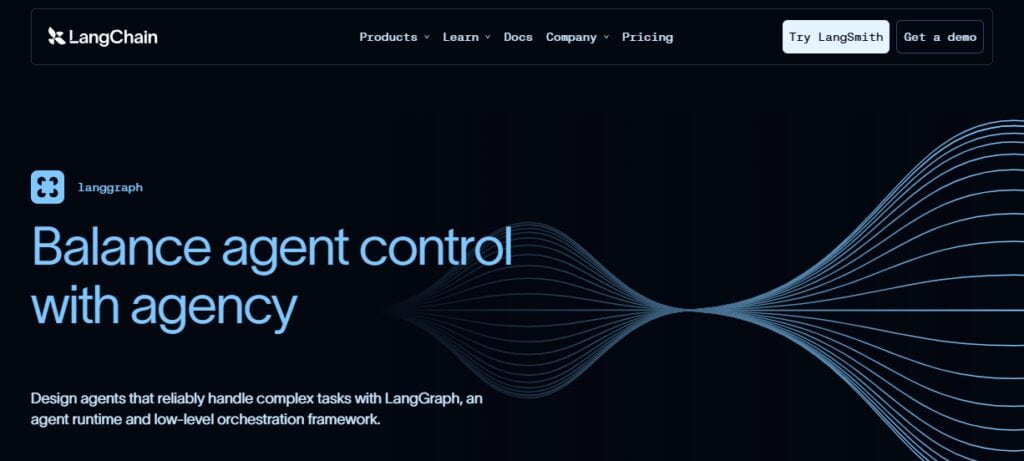
It has a graph-based architecture that represents each node as an AI action, tool, or step in a workflow. LangGraph is useful in building autonomous assistants, research agents, enterprise automation, and production-grade applications that require reliability and transparency, as well as scalable agent orchestration.
LangGraph 1.x Features, Pros & Cons
Key Features:
- Ability to build sophisticated AI agent workflows.
- Persistent memory for long-running jobs and state management.
- In-the-loop approval and decision-making for humans.
- Integrations for multi-agent collaboration and tools.
- Purpose built for production applications in AI.
Pros:
- powerful automation of agent workflows.
- advanced memory and state management.
- ecosystem integration with LangChain.
- built for large scale enterprise AI.
- multi agent system framework.
Cons:
- Concepts of graph based workflow systems.
- Framework.
- heavy dependency on LangChain.
- requires many configurations compared to lightweight frameworks.
- complex workflow debugging.
2. Microsoft Agent Framework 1.0
The Microsoft Agent Framework 1.0 is an open-source toolkit for developing intelligent AI agents that collaborate and reason with one another in order to accomplish goals in enterprise environments.
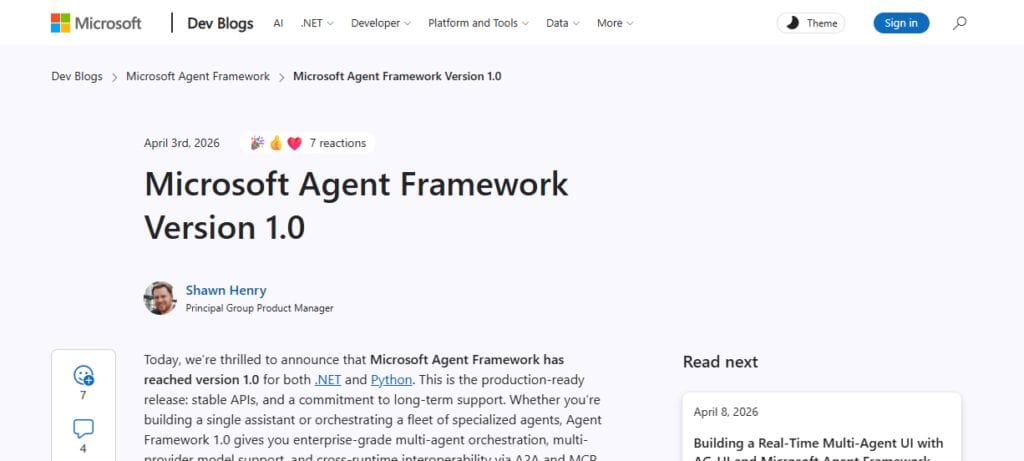
The Microsoft framework combines Microsoft’s AI services with flexible agent design, integrating tools, workflows, and multi-agent collaboration. Compared to the other Best Open-Source AI Agent Frameworks for Developers, the Microsoft Agent Framework stands out for its design and features that address security and enterprise concerns, as well as cloud-based AI services.
Using this framework, developers are able to maintain control over the behavior and data of agents, as well as workflow execution in order to build AI copilots, automation systems, business assistants, and intelligent applications.
Microsoft Agent Framework 1.0 Features, Pros & Cons
Key Features:
- AI agents aimed at large scale enterprise deployment.
- Collaboration and workflow automation for multiple agents.
- Microsoft Integration with AI and cloud technologies.
- Security, monitoring, and deployment.
- Integration of tools and external services.
Pros:
- designed for the enterprise.
- integration with Microsoft.
- ai deployment framework.
- structured agent development.
- designed for automation of business processes.
Cons:
- built for example incorporation frameworks.
- for users of the Microsoft ecosystem.
- may need cloud infrastructure knowledge.
- limited flexibility compared to a lightweight framework.
- enterprise features increase complexity.
3. Claude Agent SDK
Claude Agent SDK is an open-source software development kit for building AI agents with Claude models. Developers can build apps that will let an application reason, use external tools, manage its own workflow, and communicate with other applications.
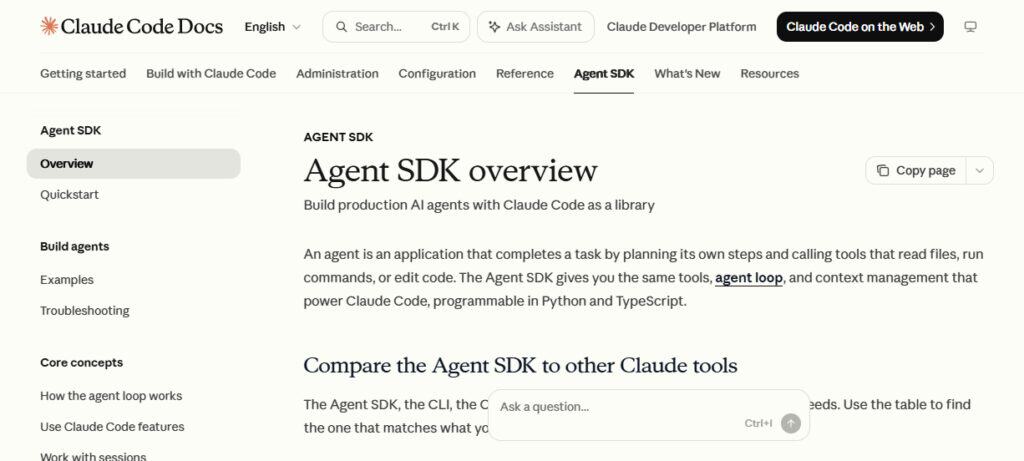
Based on reviews by developers in Best Open-Source AI Agent Frameworks, Claude Agent SDK is unique in the market because of its focus on reliable reasoning and safety, as well as the management of context and related concepts.
Based on its approach, developers can build coding assistants, research assistants, customer support assistants, and a range of enterprise AI solutions.
Claude Agent SDK Features, Pros & Cons
Features:
- Development of AI agents using Claude models.
- Organizes complex task context.
- Promotes usage of autonomy for complex task design.
- Manages execution of complex autonomy.
- Increases trust in AI.
Cons:
- Generally optimized for Claude models.
- Access to Claude API required.
- Smaller ecosystem compared to some competitors.
- Limited model flexibility.
- More advanced customization may require more development.
Pros:
- Excellent context handling for large tasks.
- Robust natural language reasoning.
- AI safety focus.
- Easy setup with Claude-powered apps.
- Can be used for automation and research agents.
4. OpenAI Agents SDK
The OpenAI Agents SDK is an open-source development kit that enables developers to build agents for AI that can perform all tasks autonomously with reasoning and tool use through workflow management. This software development kit provides features for agent handoffs, built-in tools, guardrails, tracing, and easy to define instructions.
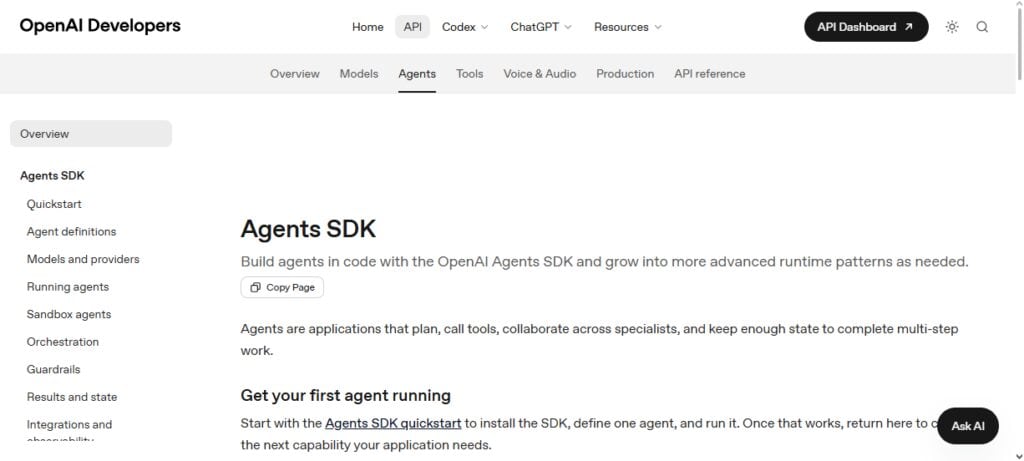
As noted in Best Open-Source AI Agent Frameworks, the OpenAI Agents SDK helps developers to build autonomous AI applications, but gives a lot of flexibility to developers to build solutions for a variety of purposes. Developers can build virtual assistants, programming assistants, and customer support assistants to automate services, and more.
OpenAI Agents SDK Features, Pros & Cons
Key Features:
- SDK for creation of autonomous AI Agents.
- Facilitates agent handoffs and complex workflows involving multiple agents.
- Includes tool invocation and framework integration.
- Provides built-in traces and logs.
- Includes configurable instructions and guardrails.
Pros:
- Excellent developer ecosystem.
- Good documentation.
- Advanced APIs for AI models.
- Good for developing AI for production use.
Cons:
- Primarily optimized for OpenAI models.
- Significant costs may be incurred with API usage.
- Requires knowledge of agent architectures.
- Less model flexibility than open architecture based models.
- Extensive configurable options may require additional development.
5. Google ADK 2.0
Google ADK 2.0 is an open-source agent development framework that facilitates building applications that incorporate advanced reasoning and automation across large numbers of collaborating AI agents.
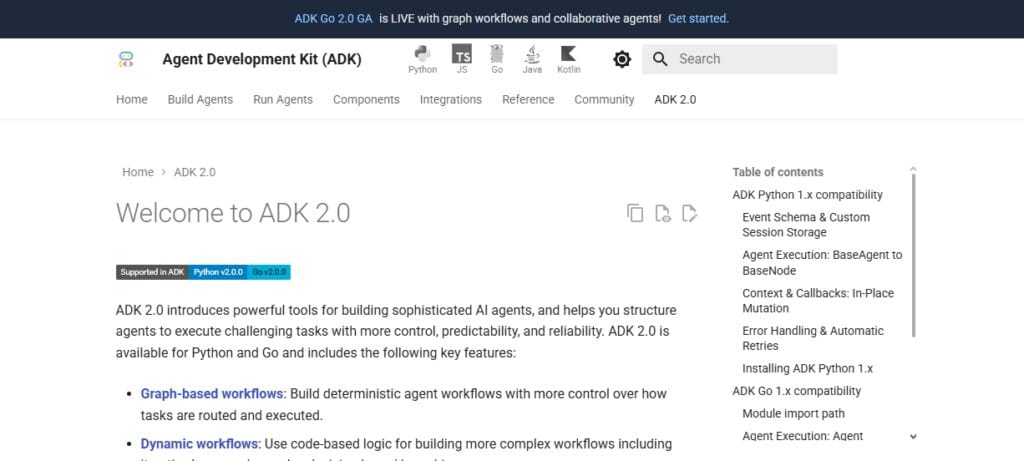
It supports integration with Google’s AI Platform and tools for designing, testing, and deploying agents. Best Open-Source AI Agent Frameworks for Developers include Google ADK due to its frameworks that help developers build flexible agent architectures with scalable data and facilitate strong workflows.
It is applicable for enterprise use cases; AI assistants; data analysis agents; automating business processes; and serverless development. Developers experience improved performance and easier deployment across modern AI infrastructures.
Google ADK 2.0 Features, Pros & Cons
Key Features:
- Framework for creating intelligent AI agents.
- Supports multi-agent workflows and automation.
- Integrates with Google’s AI ecosystem.
- Provides tools for testing and deploying agents.
- Supports scalable cloud-based AI applications.
Pros:
- Strong Google Cloud integration.
- Suitable for enterprise AI solutions.
- Supports advanced agent workflows.
- Good scalability options.
- Provides structured development tools.
Cons:
- Best experience requires Google ecosystem.
- Can have a learning curve for beginners.
- Cloud dependency may increase costs.
- Smaller community compared to older frameworks.
- Requires knowledge of Google AI services.
6. CrewAI 1.14.7
CrewAI 1.14.7 is an open-source multi-agent framework that assists in creating groups or teams of collaborating AI agents to accomplish complex tasks. It follows a role-based system in which each AI agent has unique responsibilities, goals, and capabilities.
Best Open-Source AI Agent Frameworks for Developers include CrewAI, as it simplifies the challenging nature of collaborating across multiple agents without requiring high level frameworks and complex infrastructures.
Developers employ this framework to create research teams, content generation systems, automate tasks, and create intelligence agents for use in business. Collaborative problem-solving AI systems are built using CrewAI’s task delegation, agent communication, and workflow creation features.
CrewAI 1.14.7 Features, Pros & Cons
Key Features:
- Features a role-based multi-agent collaboration system.
- Agents can perform tasks as teams.
- Supports custom roles, goals, and responsibilities.
- Automates workflow.
- Eases the creation of collaborative AI systems.
Pros:
- The multi-agent structure is easy to understand.
- Efficient for automation and research tasks.
- Requires simple coding.
- Flexible for customization of agent roles.
- Good for rapid AI prototyping.
Cons:
- Not efficient for complex workflows.
- Limited advanced state management.
- Performace is affected by the design of the agents.
- Built for smaller complex applications and may require other tools for production application.
- Debugging multiple agents can be challenging.
- May require additional AI infrastructure.
7. LlamaIndex Workflows 1.0
LlamaIndex Workflows 1.0 is an open-source framework designed to help developers build AI agents that can communicate with external systems including data, documents, APIs, and enterprise knowledge systems.
It uses a toolkit based on workflows to help developers build intelligent data and retrieval augmented generation (RAG) applications. Some of the Best Open-Source AI Agent Frameworks for Developers highlight LlamaIndex Workflows because it helps developers build AI systems that can interact with private data.
LlamaIndex Workflows is suited for knowledge assistants, document analysis tools, and applications for performing research and enterprise search systems that require high automatic information retrieval and reasoning.
LlamaIndex Workflows 1.0 Features, Pros & Cons
Key Features:
- Connects AI agents with private data sources.
- Supports retrieval-augmented generation (RAG).
- Provides workflow automation capabilities.
- Enables document processing and knowledge assistants.
- Supports integration with databases and APIs.
Pros:
- Excellent for data-driven AI applications.
- Strong RAG capabilities.
- Easy integration with enterprise data.
- Supports knowledge-based assistants.
- Flexible workflow customization.
Cons:
- Primarily focused on data applications.
- Requires understanding of RAG concepts.
- Complex workflows need more configuration.
- Performance depends on data quality.
- May require additional AI infrastructure.
8. Pydantic AI 2.0
Pydantic AI 2.0 is an open-source Python framework that helps developers build confident and structured AI agents with powerful and advanced data validation tools. Pydantic AI uses Pydantic’s type-safe technology and design to help developers produce AI systems that are accurate, predictable, and safer to deploy in production.
Some of the Best Open-Source AI Agent Frameworks for Developers also consider Pydantic AI because it helps interact with many AI models and control responses, tools, and workflows. Pydantic AI is used to develop enterprise assistants, automation, and API-based AI tools that are intelligent and can be deployed in production.
Pydantic AI 2.0 Features, Pros & Cons
Key Features:
- AI agent creation with Python.
- Use case validation for predictable answers.
- Users can choose from several AI model providers.
- Tool integration and workflow management system.
- Building production applications.
Pros:
- Great for data validation.
- Very Python developer friendly.
- AI output answers become even more trustworthy.
- Users can choose from several model integrations.
- Clean UI and design.
Cons:
- For solo developer usage vs. LangChain.
- Building applications requires knowledge of Python.
- More developer driven vs. frameworks like LangChain.
- More advance features would require coding.
- Small community.
9. Mastra @mastra/core
Mastra @mastra/core is a TypeScript based open source framework that allows devs to build modern AI applications. The framework includes tools for building workflows, managing agent memory, and integrating tools along with tools for building production ready AI systems.
Best Open-Source AI Agent Frameworks for Developers applaud Mastra for creating an environment for developers to build more sophisticated AI agents using web and application integrations. The framework is excellent for building AI assistants, automated workflow tools, intelligent application development tools, and other developer tools.
The framework has a flexible structure, giving developers a lot of control in designing the behaviors of the agents while still allowing them to build systems on top of the application.
Mastra @mastra/core Features, Pros & Cons
Key Features:
- TypeScript for AI agent development.
- Workflow, memory, tool integrations.
- Framework for web application development.
- Designing applications allows building with AI.
- Flexible customization of agents.
Pros:
- TypeScript framework.
- Modern architecture.
- Integration with web applications.
- Development of workflows with AI.
- Production.
Cons:
- Compared to the Python framework, има ляма по-малък екосистема.
- Новa е Abdма Survey, without большой resource.
- without knowledge of TypeScript framework.
- fewer examples from the community.
- more integrations are needed for complex use cases.
10. Smolagents
Smolagents is a lightweight open source AI Agent framework designed to help build simple yet powerful autonomous agents. Simplicity and efficiency are at the forefront of Smolagents, enabling agents to execute tasks, use tools, and communicate with external systems with a low code base.
Best Open-Source AI Agent Frameworks for Developers applaud Smolagents for creating a framework for developers testing algorithms for agents.
This framework is optimal for building simple AI assistants, for use in research and prototype development, and for building simple automation tools. Smolagent’s simplicity enables rapid agent development while maintaining optimal flexibility.
Smolagents Features, Pros & Cons
Features:
- Lightweight AI agents framework.
- Simple tool-based agent execution.
- Very little code for development.
- intentionally made for development.
- different model integrations.
Pros:
- Very simple for beginners.
- Fast to set up.
- For fast experiments
- Buffer needed very little code.
- It takes less development time.
- It is great for experiments and prototypes.
- Its simple architecture enhances flexibility.
Cons:
- It has limited features that could be challenging to adapt to large enterprise systems.
- It works best for small to medium size applications.
- It has limited workflow controls.
- It has limited built in monitoring.
- It may need other frameworks for more complex projects.
Conclusion
The Best Open-Source AI Agent Frameworks For Developers are making it easier than ever for developers to construct AI applications that can operate autonomously, develop intelligent assistants, or construct multi-agent systems. With LangGraph, OpenAI Agents SDK, CrewAI, LlamaIndex Workflows, Microsoft Agent Framework among others, developers construct highly flexible and reliable AI solutions equipped with a variety of different tools.
Currently, agent frameworks possess the ability to construct flow and task automation, integrate data, and develop advanced reasoning interoperable with other agents and systems. With advances in different programming platforms and frameworks, developers have more flexibility on how they wish to deploy their application and choose to create next-generation AI solutions.
FAQ
What Are Open-Source AI Agent Frameworks?
Open-source AI agent frameworks are development platforms that allow developers to build, customize, and deploy autonomous AI agents. These frameworks provide tools for reasoning, decision-making, memory management, workflow automation, and integration with external tools or APIs. Developers can modify the source code, improve functionality, and create AI applications such as virtual assistants, automation systems, research agents, and enterprise copilots.
Why Should Developers Use Open-Source AI Agent Frameworks?
Developers use open-source AI agent frameworks because they provide flexibility, customization, transparency, and cost advantages. These frameworks allow teams to control agent behavior, integrate different AI models, build specialized workflows, and avoid dependence on a single vendor. They are ideal for creating scalable AI solutions tailored to specific business and technical requirements.
Which Is the Best Open-Source AI Agent Framework for Developers?
The best framework depends on the developer’s needs and project goals. LangGraph is suitable for complex workflows, CrewAI is ideal for multi-agent collaboration, LlamaIndex Workflows works well for data-driven AI applications, and OpenAI Agents SDK provides powerful tools for building intelligent assistants. Developers should choose a framework based on programming language support, features, scalability, and integration requirements.
Is LangGraph Good for Building AI Agents?
Yes, LangGraph is one of the leading open-source frameworks for building advanced AI agents. It provides a graph-based architecture that supports memory, state management, human approvals, and complex workflows. Developers can use LangGraph to create reliable AI assistants, autonomous systems, and enterprise-level agent applications with greater control over execution processes.