
XRP Price Prediction: More Likely to be the CLARITY Act or US Spot XRP ETF for the Next Rally?
XRP Price Struggles Near Critical Support
XRP was trading at approximately $1.04 in late June 2026 as selling pressure swept across the cryptocurrency market and XRP’s price continued to show weakness. In the previous week, selling pressure caused XRP’s price to fall by nearly 5%. In addition, XRP was trading well below the July 2025 cycle high of $3.66.
Compared to other cryptocurrencies, XRP’s selling pressure was relatively high. Bitcoin traded below $60,000 and Ethereum was below $1,600. Despite selling pressures, the market is looking to two major unknowns to trigger the next movement in XRP price; the proposed regulation of the CLARITY Act and growing institutional interest via the U.S. Spot XRP ETFs.
The CLARITY Act and its Potential Impact on XRP Price
The proposed CLARITY Act is one of the more important upcoming cryptocurrency regulations in the U.S. Unlike putting immediate pressure to buy, creating new legislation improves investor confidence through improving rules for digital assets.
The proposed legislation attempts to outline the jurisdiction of the Securities and Exchange Commission (SEC) and the Commodity Futures Trading Commission (CFTC) and establish rules for registration and company disclosures for crypto firms.


Regulatory clarity is significant for XRP specifically because of Ripple’s protracted dispute with U.S. regulators. A clear regulatory framework could eliminate the uncertainty surrounding the valuation of XRP for a number of years. In this context, greater legal certainty could attract institutional investors, exchanges, custodians, and financial services to provide XRP-related services.
Clearer regulations could also invite issuers of Spot XRP ETFs to engage in the compliance process, diminishing regulatory uncertainty and strengthening the case for introducing these ETFs.
This will remain uncertain, however, as the U.S. Senate will be in recess until July 13, and while there are discussions about a possible July voting, investors are being cautious until the situation advances and more formal legislative steps are undertaken.
Spot XRP ETFs Keep Attracting Institutional Demand
Institutional interest is one of the most powerful and bullish drivers for XRP and the numbers support this. As of June 29, 2023, U.S. Spot XRP ETFs had net inflows of $15.34 million per the report of SoSoValue. Total net inflows had approached $1.48 billion, and total ETFs traded an approximate value of $12.50 million.
Within the ETFs, Bitwise took the lead with $11.94 million in daily inflows, purchases of approximately 11.18 million XRP. Following Bitwise, in terms of inflows, was Canary with $3.40 million (3.19 million XRP).
Comparatively, Bitwise and Canary had significantly disparate net assets, $312.30 million and $243.90 million, respectively. Franklin did not report any new daily inflows while exhibiting a cumulative total of $410.35 million. 21Shares and Grayscale, similarly to Franklin, did not report new daily investments.
XRP Technical Analysis and Prediction
XRP traded at $1.0437, and after failing to break above $1.10, which is a major resistance level, XRP is trading in this range. Buyers are more inclined to trade and are more comfortable trading in the $1.00 price zone. If XRP trades below the $1.00 mark, the price could crash below $0.95.
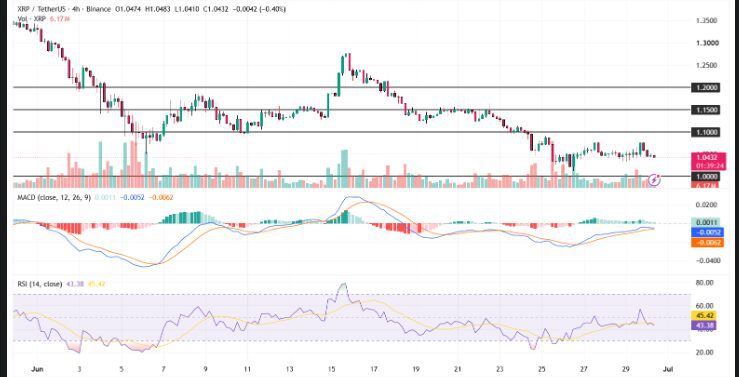
Currently, XRP seems to have a bearish sentiment. The MACD indicator also shows a negative trend since the indicator is below zero, but there is a slight MACD recovery. The MACD lines have shown no bullish movements since the lines remain below the zero. The RSI which is at 43.57, shows no bullish movements as the buying strength is weak.
In order for bulls to control the price of XRP, there is a need for XRP to first trade above $1.10, and subsequently move above $1.15. If this occurs, bullish movements toward $1.20 resistance could also be expected.
The main price drivers for XRP will largely be dependent on the continued inflow of the ETF along with the meaningful advancement of the CLARITY Act. If these two factors occur, it could provide a boon of market confidence and optimism for the long term.