

In this article, I will go over the Top Dappnode Rivals for Self-Hosted Eth Nodes and how each option caters to different node running needs. They vary from plug and play platforms like AVADO, to Docker-based setups, to Ethereum clients like Geth, Nethermind, Besu, Reth, and Erigon, with varying degrees of control, flexibility, and resource requirements.
I will also discuss Lighthouse and Nimbus for consensus layer operations to help you choose the solution that fits best for your hardware, technical experience, staking goals and preferred way of self hosting your Ethereum infrastructure.
Why Look for DappNode Rivals for Self-Hosted ETH Nodes?
Additional Deployment Options: DappNode alternatives offer multiple deployment options including dedicated hardware, Docker, command line installations and custom Linux environments for those with particular infrastructure preferences.
More Client Flexibility: Some alternatives offer operators a choice of different Ethereum execution or consensus clients, allowing users to customize their node architecture based on performance and infrastructure requirements.

Lower Hardware Requirements: Light Clients for Ethereum can offer solutions for operators with less CPU, memory, or storage capabilities and make it easier to operate a self-hosted node.
Advanced Configuration: Experienced operators may prefer alternatives that provide more control over networking, storage, APIs, synchronization, monitoring and other technical node configuration parameters.
Performance Tuning: Clients differ in architecture and implementation, so operators can pick the software that works best for performance-critical workloads, RPC services, indexing or specialized infrastructure.
Open Source Control: If you are a technically savvy Ethereum node operator, you may find self-hosted alternatives appealing as they give you more control over software configuration, deployment, upgrades and infrastructure.
Use Cases: Different solutions are optimized for different use cases such as home staking, development, enterprise infrastructure, low-resource environments, validator operations, and specialized Ethereum execution or consensus workloads.
How to Choose the Right DappNode Alternative for a Self-Hosted ETH Node
Verify ethereum support: Make sure the solution supports Ethereum Mainnet and the necessary execution or consensus client components for your chosen full-node or validator configuration.
Assess Hardware Needs: Take a look at CPU, RAM, SSD storage, bandwidth and power requirements and see whether your alternative can run reliably on the self-hosted hardware you have available.
Think About How You’ll Deploy: Based on your technical skills, preferred level of control and infrastructure environment, you can choose a dedicated hardware, Docker, Linux installation or manual deployment.
Test Client Flexibility: Ensure the solution supports multiple execution and consensus clients so you can mix and match to meet your performance, reliability and operational requirements.
Review Management Tools: Consider helpful monitoring, logging, updates, configuration controls, dashboards and recovery options that can simplify running and maintaining an Ethereum node.
Fit Your Use Case: Choose from the following depending on whether you require home staking, development infrastructure, RPC services, validator operations, enterprise deployment or resource efficient node hosting.
Understand Technical Complexity: Consider who will handle installation, synchronization, upgrades, troubleshooting, and security before you decide. With more experienced operators, you have more options for customizing, but more beginner operators might prefer easier platforms.
Key Points
| DappNode Rival | Key Point |
|---|---|
| Avado | Preconfigured hardware designed to simplify running Ethereum and other blockchain nodes at home. |
| eth-docker | Uses Docker-based configurations to deploy Ethereum execution and consensus clients without requiring a dedicated node appliance. |
| Geth | Official Go Ethereum execution client that handles transactions, EVM execution, state, and JSON-RPC access. |
| Nethermind | Production-grade Ethereum execution client and one of the major alternatives for operators seeking execution-client diversity. |
| Besu | Java-based, Apache 2.0-licensed Ethereum client with enterprise-oriented features, monitoring, tracing, and GraphQL support. |
| Erigon | Re-architected Ethereum implementation focused on performance, modularity, and disk-space efficiency, with archive and pruned-node options. |
| Reth | Rust-based Ethereum execution client designed for performance and available for full, archive, and pruned configurations. |
| ethrex | Minimalist, modular Rust Ethereum execution client designed with zero-knowledge proving in mind and usable for L1 and ZK-rollup environments. |
| Lighthouse | Rust-based Ethereum consensus client supporting beacon-node and validator operations, suitable for both individuals and larger deployments. |
| Nimbus | Lightweight Ethereum consensus client designed to perform well on constrained hardware, including embedded systems. |
1. AVADO
AVADO is a plug-and-play hardware platform allowing users to run blockchain nodes and Ethereum validators at home, without the need for extensive Linux administration. It supports an execution client like Geth or Nethermind and consensus clients like Nimbus, Teku, or Prysm for Ethereum.

AVADO OS is installed on the device and there’s a browser-based Admin UI that can install the node software via its DappStore. The setup is mostly about connecting the hardware to a router, installing the required clients, configuring them and letting the blockchain sync. The interface allows users to manage packages, restart services, see resources and install updates.
Major Benefits
- Plug-and-play hardware for easy deployment of Ethereum nodes and validators.
- Browser-based management reduces the need for command-line administration.
- Supports multiple combinations of Ethereum nodes.
- Dedicated hardware is an isolated node environment.
- Easy installation and updates using DappStore.
Best For
- New users running their first self-hosted ethereum node.
- Home stakers with dedicated hardware.
Users who want easier node management. - Operators that want to configure Linux less manually.
2. eth-docker
eth-docker is a Docker-based automation project to run Ethereum nodes on self-managed hardware instead of a dedicated node appliance. It’s designed to make deploying Ethereum execution and consensus clients easier with configurable Docker environments.
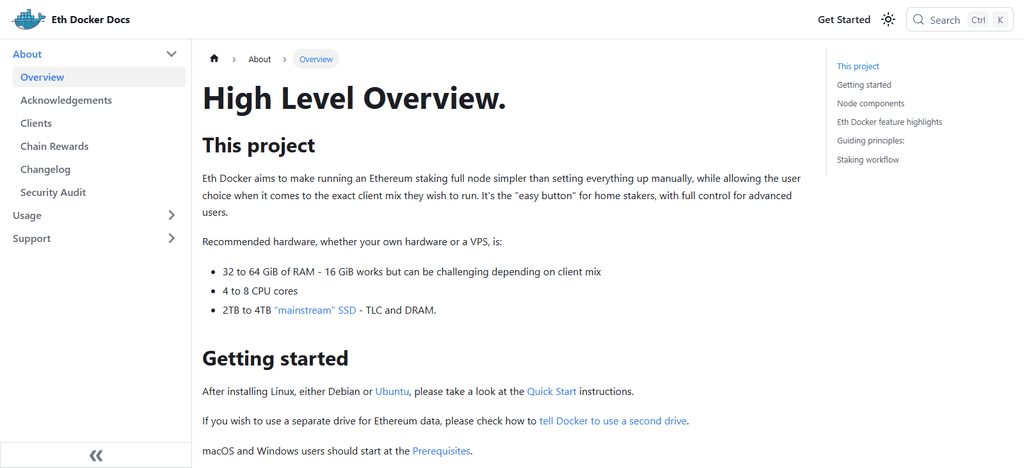
They install the project on their own Linux system, run the install and configuration commands, and select the client setup they want to run. This method involves more technical know-how than a plug-and-play platform since the user is responsible for the host machine, storage, networking and maintenance.
Its configuration allows for various combinations of ethereum clients, giving experienced operators more flexibility around their execution and consensus stack.
Major Benefits**
- Docker-based deployment makes client management repeatable.
- Multiple Ethereum execution and consensus clients supported.
- Lets users run nodes on their own hardware.
- Configuration offers greater control than appliance-based platforms.
- To build custom Ethereum infrastructure.
Recommended For
- Technically experienced home bettors.
- For Linux and Docker users.
- Operators who want to be flexible in choosing clients.
- Users creating custom self-hosted node configurations
3. Geth
Geth, or Go Ethereum, is an open-source Ethereum execution client implemented in Go. It handles transaction processing, smart-contract execution via the EVM, transaction gossip, and Ethereum state management. But it is not the full post-Merge node on its own. To run a full Ethereum node , geth needs to be combined with a consensus client .

It can be deployed on supported operating systems using packages, containers or source builds, allowing self-hosters to choose how they deploy it. Operators primarily configure Geth via the command line , data directories , RPC endpoints , and client settings . Its wide tooling and mature ecosystem make it a big option for an execution-client.
Top Benefits
- Mature and widely deployed Ethereum execution client.
- Great documentation and strong ecosystem.
- Provides execution layer functionality on Ethereum Mainnet.
- Exposes JSON-RPC interfaces for applications and tooling.
- Flexible deployment to multiple self-hosted environments.
Great For
- Ethereum node operators overall.
- Developers building apps on top of the Ethereum infrastructure.
- Users familiar with command-line administration.
- Operators who want a tried and tested execution client.
4. Nethermind
Nethermind is a high performance Ethereum execution client built on .NET, providing flexible node operation. It executes transactions in Ethereum, keeps state, and provides interfaces like JSON-RPC for applications and consensus-client communications. It is an execution client, and a full Ethereum node needs to be run with a consensus client.
Nethermind is available on Linux, Windows and macOS and supports configurable deployment through its documented installation process. Its modular architecture and plugin system give further flexibility . There are built in monitoring capabilities and Prometheus metrics so operators can view the health and performance of nodes . Thus it is suitable for sophisticated self-hosted infrastructure.
Major Advantages
- Simple to deploy (modular and configurable).
- Ethereum execution client with high performance.
- Adds monitoring and Prometheus metrics.
- Compatible with multiple operating systems.
- Extensive configuration for advanced operators.
Best For
- Advanced operators of Ethereum node.
- Professional infrastructure teams.
- detailed node monitoring
- Operators looking for an alternative execution clien
5. Besu
Hyperledger Besu is an open source Ethereum execution client written in Java and released under the Apache 2.0 license. It supports Ethereum Mainnet and public test networks, and it can run on private, permissioned Ethereum networks too. With Ethereum’s transition to proof of stake, Besu requires a consensus client to run a full Ethereum node.
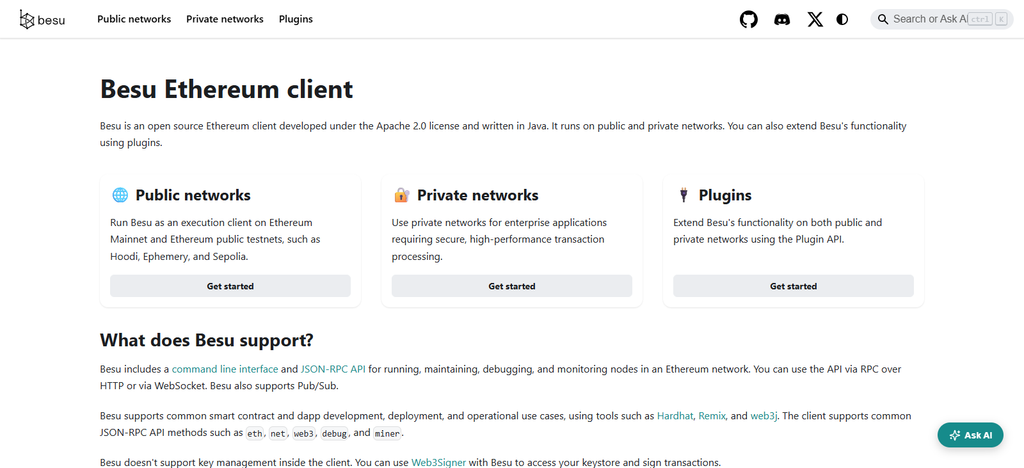
Operators can install it directly and configure it through its command-line interface. JSON-RPC over HTTP or WebSocket is available for applications and node operations. Besu also supports plugins that can be used to extend functionality It is especially useful for technically managed infrastructures, because it has monitoring, debugging, tracing and enterprise management capabilities.
Main Advantages
- Open-source Ethereum execution client on Apache 2.0.
- Support for public Ethereum networks and private networks.
- Offers JSON-RPC, GraphQL, and operational tooling.
- Provides plugins to extend functionality.
- Strong monitoring, enterprise capabilities.
Best For
- Developers developing on private or permissioned networks.
- Enterprise Ethereum infrastructure
- Organizations requiring configurable node infrastructure.
- Ethereum software based on Java for experienced operators
6. Erigon
Erigon is a execution client for Ethereum that focuses on performance, modular architecture, and efficient storage of blockchain data. It can be used to run a full Ethereum node with a compatible consensus layer and supports Ethereum Mainnet. Operators can choose between manual and more streamlined deployment options, including binary installation, Docker, and guided setup tools, available through Erigon.
Its architecture separates components, such as RPC, transaction pool and downloader processes which can provide flexibility for larger deployments. Operators can configure pruning, storage, logging, synchronization and APIs as per their needs. This makes Erigon particularly critical for self-hosters looking to optimize for storage efficiency and infrastructure flexibility.
Important Benefits
- Modular architecture provides flexible deployments.
- Built on efficient blockchain data management.
- Provides pruning options to limit storage requirements.
- Supports execution on Ethereum Mainnet.
- Includes deployment options such as Docker and binaries.
Ideal For
- Advanced self-hosted node runners.
- Users concerned about data stored on the blockchain.
- Infrastructure teams running specialized RPC setups
- Operators that require a modular execution client
7. Rethink
Reth (Rust Ethereum) is a modular Ethereum execution client written in Rust. Built for high performance, efficiency and flexible infrastructure deployments. Use cases include staking, RPC services, MEV, indexing, simulations and P2P operations. Reth is built on Ethereum mainnet, can be coupled with a consensus client to run as a full node.
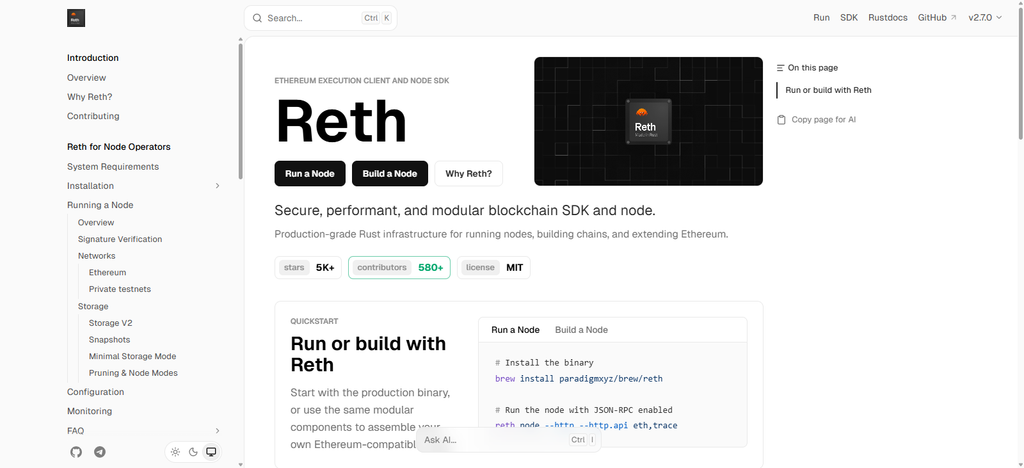
Deployment means configuring the client and its node and authentication settings, such as the connection to the Engine API used by the consensus client. Configuration options give the operator control over data location, RPC access and other node parameters. The Rust implementation and modular design is attractive to performance-centric self-hosters.
Major Advantages
- Performance-oriented Rust-based architecture.
- Modular design to support different infrastructure use cases.
- Ethereum Mainnet execution support.
- Good for RPC, indexing, MEV, and node workloads.
- Offers configurable storage and RPC options.
Ideal For
- Performance-oriented Ethereum operators .
- Developers creating specialized node infrastructure.
- RPC and index operators.
- For advanced users who are comfortable with newer client software.# 8. eth-rex
8. ethrex
ethrex is a minimalist, modular Ethereum execution client written in Rust, with a focus on zero-knowledge proving. It supports Ethereum Mainnet and test networks, and is designed so that the same codebase can be used as an L1 execution client and for supporting ZK-rollup environments. Like other execution clients it has to work with a consensus client for a normal full Ethereum node.
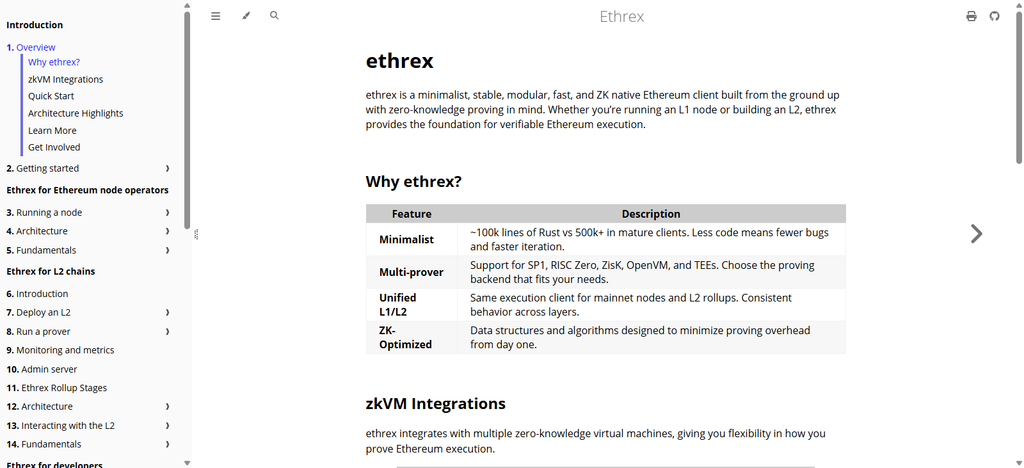
The deployment is intended for technically savvy users comfortable installing and configuring open source client software. Its modular architecture allows developers flexibility and its Rust implementation and ZK-centric design set it apart from more established general purpose clients like Geth or Nethermind.
Major Benefits
- Rust implementation, lightweight and modular.
- Built with zero-knowledge proving in mind.
- Handles workloads in Ethereum execution layer.
- Can be used in L1 as well as ZK-rollup environments.
- Open source architecture offers flexibility in development.
Ideal For
- Developers and researchers working on ZK.
- Advanced users trying out alternative clients.
- Developers interested in modular Rust infrastructure
- Ethereum protocol developers.
9. Light house
Lighthouse is a Ethereum consensus client in Rust with a strong focus on performance and security. It’s not an execution client like Geth, Nethermind, Besu, Erigon, Reth and ethrex but runs on Ethereum’s consensus layer. Lighthouse will need to be paired with an execution client through the Engine API for a full self-hosted Ethereum node. It can also run validator software for users staking on Ethereum.

Installation includes installing the beacon node and, if applicable, validator configuration and keystores. Lighthouse also has dedicated validator tooling for importing keys, and operators maintain control of their node and validator infrastructure.
Major Benefits**
- Ethereum consensus client written in Rust.
- Supports running the Ethereum beacon-node.
- Includes validator feature.
- Built for performance and security.
- Can be used with multiple execution clients .
Good for
- Home stakers with their own infrastructure.
- Ethereum validators.
- Operators looking for an alternative to consensus clients.
- For advanced users running independent staking setups
10. Nimbuse
Nimbus is an implementation of the Ethereum client that is designed to be lightweight on system resources, and hence suitable for home servers, constrained hardware, and multi-purpose machines. Its production consensus client is designed to run on the Ethereum consensus layer.

A typical full Ethereum node will have to run Nimbus together with an execution client like Geth or other compatible implementations. Validators can also make use of Nimbus. Its lightweight architecture is the main reason self-hosted operators can save CPU, memory and other resources.
Operators install and configure the client according to its documentation . Operators manage validator keys and settings locally and they can decide how to deploy the consensus and validator components .
Conclusion
The right DappNode alternative for self-hosted ETH nodes depends on the hardware, the technical expertise, the deployment preferences and the node requirements. Eth-docker provides flexible deployment using Docker, AVADO provides a more simple hardware-based implementation. Infrastructure needs are served by different Ethereum execution-client options: Geth, Nethermind, Besu, Erigon, Reth, and ethrex.
Lighthouse and Nimbus are focused on validator and consensus layer operations. When choosing between the two, users should consider resource requirements, client compatibility, management tools, configuration flexibility, and maintenance needs. The best DappNode alternative varies from user to user. The user should be able to meet the operator’s needs for control, performance, simplicity and self-hosting.
FAQ
What are the top DappNode rivals for self-hosted ETH nodes?
Top alternatives include AVADO, eth-docker, Geth, Nethermind, Besu, Erigon, Reth, ethrex, Lighthouse, and Nimbus. However, they are not all direct equivalents; some are deployment platforms, while others are Ethereum execution or consensus clients.
Which DappNode alternative is best for beginners?
AVADO is one of the simpler options because it combines dedicated hardware with a browser-based management interface. It can reduce the amount of manual Linux and command-line configuration required for running node software.
Is Geth a complete alternative to DappNode?
Not directly. Geth is an Ethereum execution client rather than a complete node-management platform. A post-Merge Ethereum node generally requires an execution client such as Geth together with a compatible consensus client.
Which alternatives support Docker-based Ethereum node deployment?
eth-docker is specifically designed around Docker-based Ethereum node deployment. It gives technically experienced operators greater control over client selection and configuration while allowing them to use their own hardware.