

Choosing the right Ethereum node provider can make all the difference in Web3 application performance. Developers need reliable RPC access, fast responses and pricing that fits their budgets – whether they are deploying smart contract technology, building DeFi platforms, NFT marketplaces or blockchain wallets.
But with different APIs, different levels of performance and free-tier limits, it can be hard to find the right option. In this guide, I’ll review the Best Ethereum Node Providers for Web3 Developers and compare their features, pricing, pros and cons so you can make an educated decision.
What to Look for in an Ethereum Node Provider?
Support for the Ethereum Network: Confirm your provider offers support for Ethereum Mainnet and testnets such as Sepolia and Hoodi, allowing you to test smart contract functionality, develop, and deploy your applications in the environments you require.
Pricing and Free Plans: To accurately estimate infrastructure costs as application traffic and blockchain data requirements grow, compare the free-tier quotas, compute-unit costs, request limits, and subscription fees.

API and RPC Features: Look for JSON-RPC method support, HTTPS, WebSockets, transaction broadcasting, event subscriptions and specialized APIs needed for efficient smart contract interactions and real-time application updates.
Archive Data Access: Choose archive providers that support applications needing historical states of the blockchain, timestamped details of transactions, or advanced analytics and smart contract queries over previous Ethereum blocks.
Security and Access Control: Verify API-key authentication, request throttling, access management and secure endpoint configurations to safeguard infrastructure from unauthorized use, abuse and unanticipated consumption charges.
Scalability and Rate Limits: Evaluate the ability to handle concurrent requests, the throughput limits, and potential upgrade paths to ensure your provider can accommodate increasing traffic without frequent throttling, request failures, or expensive infrastructure changes.
Developer Tools and Support: Look for clear documentation, debugging tools, monitoring dashboards, responsive technical support, and practical integration guides to ease development, solve issues, and keep production applications running efficiently.
How to Choose the Best Ethereum Node Provider?
Test RPC performance. Measure response latency, successful request rate, and error rate under realistic workloads. Compare results across providers when you select infrastructure for production applications.
Network support: Ensure the provider supports Ethereum Mainnet, Sepolia and other required networks. Make sure it’s compatible with your intelligent contracts, development frameworks and deployment workflows.
Assess API Features: Check for JSON-RPC methods, WebSocket connections, archive queries, transaction tracing, and event subscriptions. Choose features that directly meet the technical requirements of your app.
Examination of security measures: Consider API-key management, control of access, authentication mechanisms and usage tracking. Strong controls protect endpoints from unauthorized requests and unnecessary infrastructure costs.
Think Scalability Options: Select a provider that provides suitable rate limits, greater throughput and flexible upgrades. Make sure your infrastructure can support spikes in traffic without impacting transactions or application functionality.
Check Support and Reliability: Look for published uptime commitments, the quality of documentation, incident communication, and the availability of technical support. Developers are able to solve their problems and keep the app running smoothly with dependable support.
Key Points
| Ethereum Node Provider | Key Point |
|---|---|
| Alchemy | Provides highly scalable Ethereum RPC infrastructure with enhanced APIs, analytics tools, WebSockets, and extensive support for Ethereum, Layer 2 networks, and other blockchains. |
| Infura | One of the most established Ethereum infrastructure providers, offering reliable RPC endpoints, WebSocket support, and broad adoption across major Web3 applications. |
| QuickNode | Delivers low-latency blockchain access, global node distribution, dedicated endpoints, and advanced developer tools for production Web3 applications. |
| Chainstack | Offers managed Ethereum nodes with predictable pricing, archive node access, enterprise-grade infrastructure, and multi-cloud deployment options. |
| Ankr | Provides decentralized and multi-chain RPC infrastructure, helping developers access Ethereum and numerous other networks through a unified platform. |
| Tenderly | Combines Ethereum node services with powerful debugging, monitoring, simulation, and smart contract development tools for Web3 teams. |
| dRPC | Focuses on decentralized RPC infrastructure, offering Ethereum connectivity with distributed backend architecture and multi-chain support. |
| NOWNodes | Supplies Ethereum full nodes, archive nodes, RPC access, and multi-chain infrastructure through a single API platform. |
| GetBlock | Enables instant access to Ethereum shared and dedicated nodes with support for JSON-RPC, REST, and WebSocket connections. |
| BlockPi | Provides high-performance Ethereum RPC services with load-balanced infrastructure, developer-focused APIs, and support for multiple blockchain networks. |
1. Alchemy
Alchemy offers managed Ethereum RPC infrastructure for developers building decentralized applications, DeFi platforms, NFT projects, wallets and blockchain analysis tools. The platform provides access to the Ethereum mainnet and testnet, APIs, webhooks and developer tools to query blockchain data and monitor application activity.
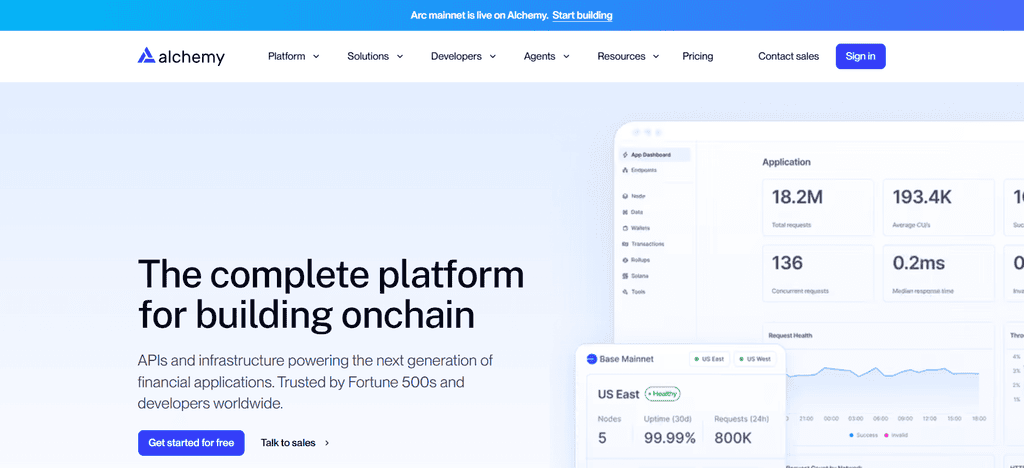
Official pricing page for Free plan says it offers 30 million compute units (CUs) per month and 25 requests per second. The Pay as You Go plan is priced at $0.525 per million CUs, with throughput capacity priced separately. When choosing a plan, developers should take into account the CU consumption and rate limits that are specific to the method.
Benefits
- Provides a large free tier of 30 million compute units per month.
- Offers better APIs for NFTs, tokens and blockchain data.
- Supports app building on Ethereum mainnet and testnets.
- Monitoring and debugging tools, developer dashboards.
Cons:
- Cost estimation for compute-unit billing can be hard with complex workloads.
- Some intensive API methods may use more credits than simple requests.
- Free-tier throughput limits could impact high-traffic workloads.
- Advanced infrastructure features may be only available on paid plans.
2. Infura
Infura provides managed infrastructure for Ethereum that enables Web3 applications to connect to blockchain data, send transactions and interact with intelligent contracts through APIs. Available for Ethereum and other blockchain networks, it is useful for wallets, decentralized applications and multichain projects.
The platform also offers JSON-RPC access, archive data and other developer features such as debugging and transaction tracing on eligible plans. Published prices list a free Core plan, a Developer plan at $50 per month, and a Team plan at $225 per month. Developers should compare the daily credit quotas, throughput limits and required features before choosing a subscription.
Benefits
- Provides proven infrastructure for Ethereum RPC for Web3 apps.
- Provides blockchain interaction via HTTPS and WebSocket.
- Supports archive queries and other Ethereum RPC methods.
- It works nicely within the Consensys and MetaMask developer ecosystem.
Cons:
- Daily credit limits need to be used wisely.
2.heavy trace & debugging requests can consume substantial credits. - Throughput Limitations impact applications with sudden traffic spikes.
- Advanced infrastructure needs can lead to a higher tier plan.
3. QuickNode
QuickNode is an Ethereum node infrastructure provider with HTTPS and WebSocket endpoints to interact with intelligent contracts, broadcast transactions, query the blockchain and listen to events in real-time. Its Ethereum services offer support for Mainnet, Sepolia and Hoodi testnets, as well as archive data, debug and trace APIs, and Streams for blockchain data pipelines.
QuickNode says it has 17+ regions around the world and a 99.99% uptime SLA for their platform. Prototyping is available on a free tier, and paid plans scale with usage and API credits. Before deploying, developers should take into account regional latency, endpoint limits, and archival requirements.
Pros:
- Provides Ethereum RPC endpoints with HTTPS and WebSocket support.
- Streams for sending blockchain data to external systems.
- Supports multiple blockchain networks for multichain applications.
- It offers developer tools and add-ons for specialized workloads.
Disadvantages
- Estimating credit-based billing for mixed workloads may be challenging.
- More throughput could mean you need to upgrade to a more expensive plan.
- Some advanced features available as paid add-ons.
- Developers may pay for features on the platform they don’t need
4. Chainstack
Chainstack offers managed blockchain infrastructure for Ethereum applications, including shared RPC endpoints, WebSocket connectivity, archive data, and dedicated node deployments. It helps developers who need blockchain access, without the hassle of maintaining their own node hardware and software. Its Developer plan comes in at $0 with 3 million requests per month and 25 requests per second.
The Growth plan costs $49/month and includes 20 million requests and a limit of 250 requests per second. More features and more capacity are available on higher plans. Developers should compare request-unit costs, dedicated-node requirements, archive access, and support levels when estimating production infrastructure costs.
Benefits
- Provides Ethereum RPC access and supports many other blockchain networks.
- Offers a pay-as-you-go model for scaling API usage.
- It supports HTTPS and WebSocket connections for blockchain apps.
- Provides Verifiable RPC features to authenticate the supported responses.
Cons
- API-credit calculation monitoring as usage grows
- Features may vary between shared and premium infrastructure.
- Developers should check whether certain Ethereum RPC methods are supported.
- Further configuration may be required for specialized infrastructure and enterprise requirements.
5. Ankr
Ankr also offers Ethereum RPC access, along with infrastructure and APIs for several other blockchain networks. Services include HTTPS and WebSocket endpoints, premium RPC access, advanced APIs for blockchain data, and infrastructure options for projects with different workloads.
Ankr’s official documentation lists support for more than 80 chains across its Web3 infrastructure offering. On the free tier it’s got 30 requests per second for the Node API access, and the premium pay-as-you-go plan starts at $10 for 100 million API credits. The actual costs depend on request types and API usage. Before selecting a plan, developers should check availability, rate limits and credit usage for Ethereum-specific endpoints.
Advantages
- Offers transaction simulation for testing behavior of intelligent contracts.
- Includes debugging tools to analyze failed transactions.
- Provides virtual test environments to simulate scenarios of blockchain
- Assists developers to inspect execution traces and gas usage.
Cons
- Its most powerful features may not be needed for simple RPC-only applications.
- Production Node RPC costs should be decoupled from debugging features.
- Teams may need to spend time learning the advanced debugging workflow.
- Have to incorporate specialized testing features into the current development processes
6. Tenderly
Tenderly is particularly useful if you’re a developer who needs Ethereum infrastructure along with smart contract debugging, transaction simulation, and application monitoring. The platform provides tools to check transaction execution, find contract errors, estimate gas consumption and test changes against the state of the blockchain.
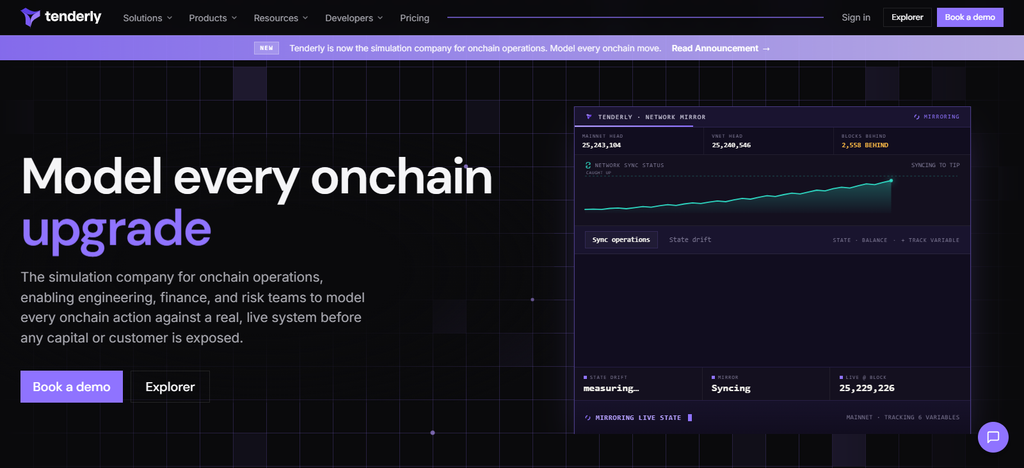
Tenderly also provides Node RPC infrastructure for production apps, with multichain access, authentication, request analytics, and service-level agreements as part of its team-focused offering. Its free plan allows debugging and single-transaction simulation via the interface, but not API access on that plan. Node RPC pricing and capacity should be evaluated separately when planning a production integration.
Benefits
- Routes requests through a distributed network of node operators
- Compatible with Ethereum and many other blockchains.
- Provides load balancing and geographical routing features.
- Has a free tier so you can develop and test at first.
Disadvantages
- Performance may become less predictable when routed across multiple providers.
- Different underlying providers have different ways and capabilities.
- Usage-based billing requires metering of compute-unit consumption.
- Teams that need highly customized infrastructure may have less direct control than they do with self-managed nodes.
7. dRPC
dRPC is the distributed RPC infrastructure that connects developers to blockchain networks via a network of independent node providers. Its Ethereum services are tailored for decentralized applications, wallets, DeFi protocols, and other projects that require reliable access to blockchain data.
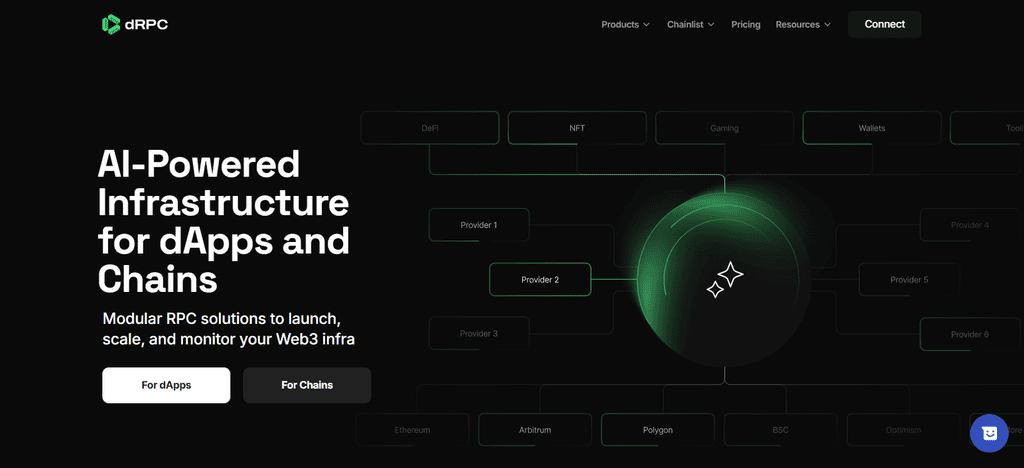
The platform provides load balancing, geographic distribution, and usage monitoring, with paid access that offers additional routing and verification features.
Its documentation mentions a free tier of 210M compute units per 30-day period, limited to public nodes. The paid tier is billed on a pay-as-you-go basis, so developers should estimate the cost of requests and consider reliability requirements before choosing their setup.
Advantages:
- Lets you access Ethereum and lots of other blockchain networks via RPC.
- Supports WebSocket connections for real-time blockchain subscriptions.
- Provide Blockbook APIs for indexed address and transaction data.
- Provides shared access and dedicated node options.
Cons:
- Free access, with limits on requests and throughput.
- Dedicated node pricing may require custom quotes.
- Indexed APIs versus raw RPC endpoints serve different purposes, and may require separate implementation effort.
- Before deployment, developers should check the archive depth and the availability of the specialized API
8. NOWNodes
NOWNodes offers Ethereum APIs to access blockchain data, send transactions, and get real-time events. Standard blockchain interactions can be done via JSON-RPC endpoints, while subscriptions to new blocks, pending transactions, and logs can be done using WebSocket connections.
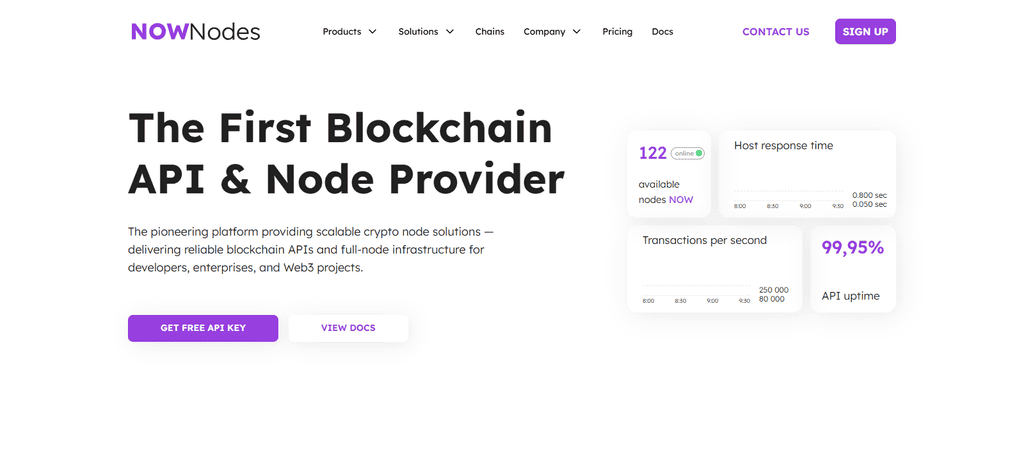
Other interfaces include Blockbook for indexed address and transaction lookups, Trace and Debug APIs for execution analysis and archive access for historical-state queries.
Getting an API key and picking Ethereum Mainnet or Sepolia testnet is easy from the provider’s dashboard. Pricing is based on the service selected and usage limits, so developers should check current quotas and archive availability before using it in production applications.
Benefits
- Offers shared and dedicated node infrastructure.
- Allows Ethereum RPC access on a broader multichain platform.
- Provides WebSocket connectivity for supported networks.
- Infrastructure choices for applications with higher capacity and control requirements.
Cons
- Dedicated infrastructure can be expensive for smaller dev teams.
- Pricing and limits depend on the subscription configuration.
- The developers have to check for the availability of archives and debugging for their selected network.
- Additional planning and configuration may be required for higher capacity deployments
9. GetBlock
For developers building decentralized apps, trading tools, wallets and data intensive Web3 services, GetBlock provides managed blockchain nodes and RPC endpoints. Its infrastructure includes shared and dedicated nodes, WebSocket connectivity, archive data on select networks, and much more, including MEV protection.
The pricing page shows a Pro configuration of $399 per month when billed annually, with configurable compute-unit allocations, up to 800 requests per second in the displayed configuration, and 24/7 support with a stated response target of less than five minutes.
These numbers are plan-specific and not guarantyd in all cases. Developers should compare endpoint limits, historical data requirements, and billing terms before purchasing.
Benefits
- Offers shared and dedicated node infrastructure.
- Allows Ethereum RPC access on a broader multichain platform.
- Provides WebSocket connectivity for supported networks.
- Infrastructure choices for applications with higher capacity and control requirements.
Cons
- Dedicated infrastructure can be expensive for smaller dev teams.
- Pricing and limits depend on the subscription configuration.
- The developers have to check for the availability of archives and debugging for their selected network.
- Additional planning and configuration may be required for higher capacity deployments
10. BlockPI
BlockPI offers Ethereum RPC infrastructure with HTTPS & WebSocket access for decentralized applications, smart contract integrations and blockchain monitoring. Ethereum network options: Mainnet, Sepolia, Hoodi, Beacon endpoints. Based on the service you choose, you can use features like JSON-RPC, archive access, debugging methods, and MEV protection.
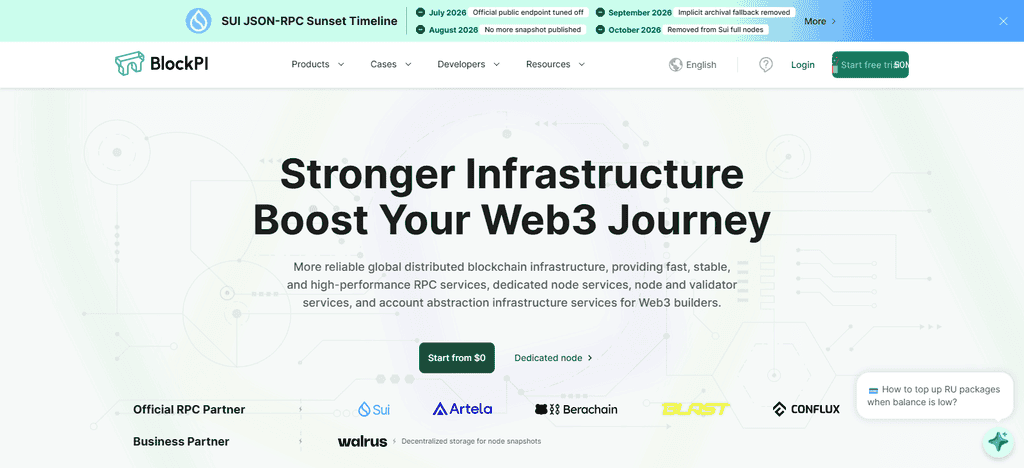
The published pricing for BlockPI is a free package of 50 million resource units (RUs) and 20 requests per second. The Elementary plan costs $49 for 500 million RUs and the Premium plan costs $299 for 4 billion RUs. These packages have expiry dates and individual rate limits – developers should check expiration and consumption rules before picking a plan.
Advantages
- It provides Ethereum RPC endpoints to interact with smart contract protocols.
- Supports connection via HTTPS and WebSocket.
- offers free and paid packages that outline resource-unit allocations.
- Advanced options like archive access and debugging methods on eligible services.
Cons:
- Applications with heavy API usage, Resource-unit limits
- Different methods might consume resources at different rates.
- Different quotas and throughput limits for paid plans.
- As a developer, check the validity time and renewal terms of packages to avoid unexpected interruptions.
Conclusion
Your project’s performance requirements, budget, and development objectives will determine the best Ethereum node provider for you. Providers like Alchemy, Infura and QuickNode provide robust RPC infrastructure, whereas Chainstack, Ankr and dRPC offer flexible options for different workloads. Tenderly is different in the area of smart contract debugging and transaction simulation.
NOWNodes, GetBlock and BlockPI offer different infrastructure and pricing models. Then compare free-tier limits, compute-unit costs, API features, archive access, and published uptime commitments before deciding. And finally, and most importantly, test response times and reliability with real workloads to make sure the provider you choose can support scalable, secure and efficient development of Web3 applications.
FAQ
What is an Ethereum node provider?
An Ethereum node provider offers managed infrastructure and RPC endpoints that allow Web3 applications to read blockchain data, submit transactions, interact with smart contracts, and monitor network activity without running their own nodes.
Which are the best Ethereum node providers for Web3 developers?
Popular options include Alchemy, Infura, QuickNode, Chainstack, Ankr, Tenderly, dRPC, NOWNodes, GetBlock, and BlockPI. The best choice depends on pricing, API features, reliability, scalability, and project requirements.
Which Ethereum node providers offer free plans?
Alchemy, Infura, QuickNode, Chainstack, Ankr, dRPC, and BlockPI offer free access options, subject to their respective terms and limits. Developers should verify current quotas, request rates, and feature restrictions before choosing a plan.
How much does an Ethereum node provider cost?
Costs vary by provider and usage model. Some offer free tiers, while paid plans use monthly subscriptions, compute units, API credits, or resource units. Actual expenses depend on request volume and required features.
What is the difference between an Ethereum RPC endpoint and an archive node?
An RPC endpoint enables applications to interact with Ethereum through supported API methods. An archive node retains historical blockchain state, allowing queries about account balances and contract storage at previous block heights.