


This becomes even more critical when dealing with large sums of money, multiple investments, and complex financial obligations. High-net-worth individuals require more than simple budgeting tools; they need sophisticated tools for portfolio management, tax optimization, retirement forecasting and estate planning.
With so many platforms out there, it can be tough to know which one to pick. In this guide, I’ll walk you through the Best Financial Planning Software for High-Net-Worth Individuals, comparing the key features, benefits, limitations and fit for different wealth management needs.
What Is Financial Planning Software for High-Net-Worth Individuals?
Complete Wealth Management: Financial planning software allows high-net-worth individuals to manage numerous assets, investment portfolios, bank accounts, and financial holdings in a single location for greater visibility of their net worth.
Sophisticated investment tracking: These platforms monitor stocks, bonds, mutual funds, real estate and alternative investments, helping people assess the performance of their portfolio, diversification and long-term investment opportunities.

Tax Planning and Optimization: Specialized software is used for tax forecasting, capital gains analysis, tax-loss harvesting and retirement account strategies to assist individuals in making tax-efficient financial decisions.
Retirement Income Planning: Financial planning software can help wealthy individuals maintain financial stability throughout retirement by providing retirement projections, income forecasting, withdrawal strategies, and scenario analysis.
Estate and Legacy Planning: These solutions help organize estate information, evaluate wealth transfer strategies, manage inheritance considerations, and support financial planning across generations.
Cash Flow and Financial Forecasting: Users can assess income, expenses, liabilities, and future financial obligations, while creating projections to understand their long-term financial position.
Risk Assessment and Portfolio Analysis: Financial planning platforms assess investment exposure, asset allocation, and potential financial risks, aiding individuals in identifying portfolio vulnerabilities and making informed adjustments.
Financial Reporting and Automation: These platforms collect financial data, automate reporting, generate tailored insights and facilitate collaboration between high-net-worth individuals, financial advisors and wealth managers.
How to Choose the Best Financial Planning Software for High-Net-Worth Individuals?
How to Pick the Best Financial Planning Software for High-Net-Worth Individuals?
Assess Your Financial Planning Needs. Do you require investment management, retirement forecasting, tax optimization, estate planning, or all-encompassing wealth management? Choose software that meets your financial objectives.
Assess Wealth Management Capabilities: Choose platforms that manage different types of investment portfolios, bank accounts, real estate, alternative assets, and consolidated financial reporting for a clearer picture of your total wealth.
Compare Tax Planning Features Look for tax forecasting, capital gains analysis, tax-loss harvesting and Roth conversion tools, which help you make tax-efficient investment decisions and preserve your wealth for the long haul.
Estate Planning Support: Find software that offers estate analysis, inheritance planning, trust management, and wealth transfer features to help you organize your assets and address multi-generational financial planning needs.
Check Integration Options: Choose platforms that integrate with banks, brokerage accounts, investment custodians, accounting systems and financial institutions to keep your financial information accurate and consolidated.
Invest in Security and Data Protection: Examine encryption standards, multi-factor authentication, user permissions and privacy controls to safeguard sensitive financial information, investment records and personal wealth data.
Examine Pricing and Scalability: Assess subscription fees, setup costs, and extra charges, while confirming the software’s ability to scale to meet expanding portfolios, various financial institutions, and intricate wealth management needs.
Assess Usability and Customer Support: Pick software that provides user-friendly dashboards, simple navigation, reliable onboarding, punctual customer support, and advisor collaboration tools that will make financial planning and daily tasks easier.
Key Points
1. eMoney Advisor
eMoney Advisor is an enterprise-level financial-planning platform with a reputation for deep cash-flow modeling, interactive client engagement and broad integrations. The tiers, Plus, Pro, Premier and Enterprise, range from goals-based planning to more sophisticated cash-flow, tax and estate capabilities; pricing is quote-based rather than publicly listed.

Estate planning includes beneficiary modeling, gifting strategies and estate-tax exposure analysis. Tax tools include retirement income, capital gains and Roth-conversion planning in higher tiers.
All packages include a client portal with account aggregation, budgeting, secure documents and goal tracking. It’s perfect for established RIAs and complex HNW households seeking sophisticated, advisor-led planning.
Main Features
- Full financial planning and wealth management.
- Forecast retirement income and cash flow.
- Aggregation of accounts and net worth tracking in aggregate.
- Tax, estate, insurance and investment scenario analysis.
- Automated financial reporting & interactive client portals.
The main limitations are:
- high costs for smaller advisory firms
- Complex tools need training and experience.
Some data integrations depend on third party providers. - A lot of functionality can make it harder to navigate
2. MoneyGuidePro
MoneyGuidePro, which is now Envestnet MoneyGuide, is a goals-based planning platform that enables advisors to communicate retirement and financial decisions to clients more easily. Its published subscription is $2,000 per advisor annually or $175 per advisor monthly, and features include stress testing, Social Security optimization, healthcare-cost goals, risk analysis and distribution planning.

It has tax-planning features and “what-if” scenario testing, but it is less document-heavy than tools used by estate professionals. The Client Planning Portal is designed for collaboration, and tools such as the Play Zone enable advisors to test variables live with clients.
It is ideal for advisory firms looking for scalable, presentation-friendly retirement planning for affluent, but not necessarily ultra-complex, HNW clients.
Main Features
- Retirement and financial planning based on goals.
- Financial outcome analysis based on probability.
- Scenario modeling (what-if) (interactive).
- Assessment of investment risk and distribution planning.
- Financial reports and client presentations in visual format.
Major Limitations
- Advanced customizations can be time consuming.
- Complex financial situations may require additional analysis.
- Smaller advisory firms may find the subscription costs challenging.
- Specialty tax and estate planning may need external tools
3. RightCapital
RightCapital combines goals-based and cash-flow planning with strong visuals, tax planning, insurance analysis and business-planning tools. Published pricing begins at $149.95 per advisor per month and increases to $209.95 and $254.95 per advisor per month at higher tiers.
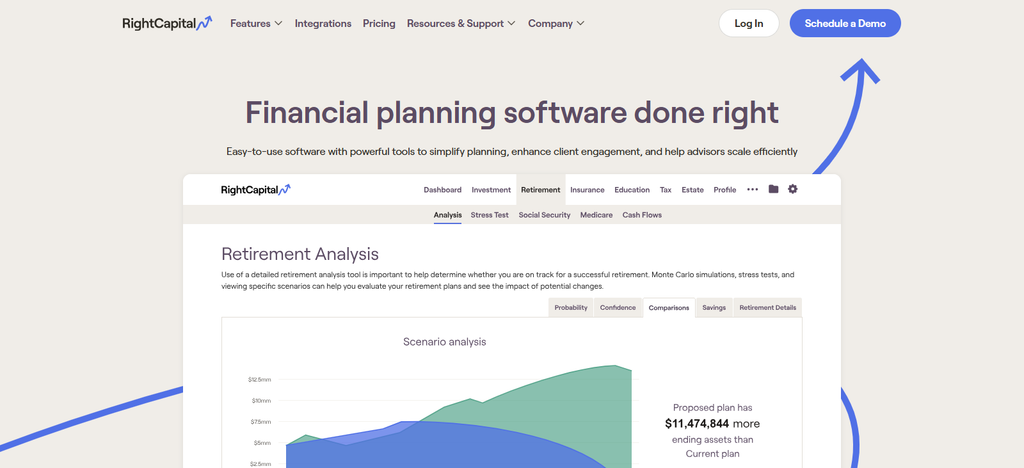
Applicable plans include estate planning to help advisors illustrate wealth transfer and legacy considerations in conjunction with retirement and investment strategies. Tax planning includes strategy modeling. Snapshot and Blueprint reports break down complicated plans for client-friendly visuals.
The client portal is collaborative and transparent regarding the plan, which works well for ongoing engagement. RightCapital is a fit for modern RIAs serving mass affluent to HNW clients that want clear, visual planning and integrated tax and insurance insights.
Main Features
- Retirement and financial planning in full.
- Roth conversion analysis and tax optimization.
- Maximize Social Security Benefits.
- Cash flows and income in retirement projections.
- Client dashboards and interactive financial scenarios.
Major Limitations
- It takes time to learn advanced features.
- Limited specialized estate planning capabilities.
- The quality of financial data defines the accuracy of forecasting.
- Advanced advisory features require additional software.
4. NaviPlan
InvestCloud’s NaviPlan is a planning platform for advisors dealing with complex financial situations that require a lot of calculations. It includes advanced cash flow planning, Monte Carlo analysis, stock options, insurance needs, business planning and detailed federal and state tax projections.

A key strength is estate and trust planning, including modeling of wealth-transfer structures such as GRATs, CRATs, CRUTs, QPRTs and family partnerships with estate and liability reporting. Legacy published pricing started around $2,195/year but these days enterprise pricing is often sales driven.
Interactive client site with eFact Finder onboarding and plan progress tracking. NaviPlan is particularly well suited for HNW and ultra-HNW clients with businesses, equity compensation, trusts and multigenerational planning needs.
Main Features
- A detailed cash flow model for the household.
- Long term financial planning and retirement.
- Tax and estate planning analysis.
- Monte Carlo simulations and scenario analysis.
- Distribution of investments & evaluation of insurance needs.
Main limitations
- Complicated interface, so there is a learning curve.
- The initial financial data entry can be time-consuming.
- Some workflows might not be as intuitive.
- Implementation and subscription costs may be high
5. Advyzon
Advyzon is an all-in-one wealth management platform that combines portfolio accounting, performance reporting, trading, rebalancing, billing, CRM, document management, business intelligence and client portals. Its strength in planning is less about modeling estate documents on their own and more about integrating investments, tax-aware portfolio management, and client reporting into a single system.
Tax capabilities include tax-loss harvesting, tax-lot tracking, tax optimization and tax-aware rebalance. The white-labeled portal also allows for secure document sharing and configurable client dashboards.
Estate information and documents are tracked with customizable CRM fields. Quoted pricing; older references say about $25/account for larger firms. Advyzon is the right choice for smaller to mid-sized RIAs looking for an integrated operating system for affluent and HNW households.
Important Features
- Portfolio management and integrated financial planning;
- Client relationship management and process automation.
- Track your portfolio performance and investment analytics.
- Combined household financial information.
- Client reports & customizable dashboards.
Key Limitations
- Planning depth may not be as extensive as dedicated planning platforms.
- Specialized estate and tax strategies may need more tools.
- The platform needs onboarding and training to be functional.
- Prices vary depending on services selected
6. Mapping Assets
Asset-Map is a visual financial-planning platform that translates household data into an intuitive map of people, entities, assets, liabilities, cash flows and insurance. Professional is $149 per month or $1,699 per year. Elite adds white-labeling and custom reporting.
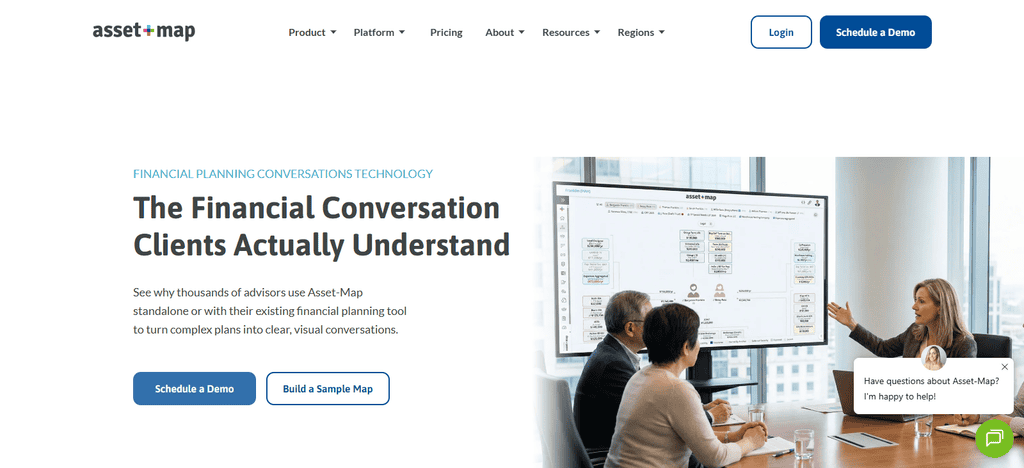
The estate and legacy tools include beneficiary visualization and scenario modeling, helping advisors make ownership, beneficiary and protection issues easier to discuss. Tax, estate, investment and retirement planning tools provide support for what-if comparisons and goal-funding analysis.
The client portal can share financials, relationships, balance sheets, policy summaries and beneficiaries in view-only or suggestion mode. Asset-Map is perfect for advisors who want to turn complex HNW household structures into simple, conversation-ready visuals.
Main Features
- Visual financial maps and asset summaries of households.
- Combined information on assets, liabilities, income and insurance.
- Mapping of beneficiary and household relation.
- Awareness of shortfalls in financial planning.
- Presenting to clients & visual reporting.
Large limitations
- It is more focused on financial visualization than on complete planning.
- Advanced retirement projections need additional software.
- A low level of sophistication of tax optimization tools.
- Quality of reporting is contingent on accurate information about the client.
7. FP Alpha
FP Alpha’s advisor-trained AI reviews client documents to identify tax, estate, insurance and planning opportunities. Its all-in-one platform is $1,995 per advisor per year and its modular tax and estate plans are credit-based, such as 75 tax credits for $1,125 or 10 estate credits for $1,790.
The platform reads tax returns, wills, trusts and insurance policies, pulling out key terms and flagging actionable planning ideas. Estate tools include Estate Snapshot, Estate Insights and Estate Lab, which create visual flowcharts and model strategies.
Tax tools: Tax Snapshot, Tax Projector, Roth-conversion analysis and tax-wrap preparation. FP Alpha is excellent for HNW-focused advisors seeking AI-assisted document review and high-value tax, estate and insurance insights.
Main Features
- AI tax return and financial document analyzes.
- Identifying tax saving opportunities.
- Analysis of estate planning and wealth transfer.
- Evaluation of insurance policies and coverage.
- Financial advisor automated planning insights.
Major Limitations
- Insights generated by AI should be professionally validated.
- Not a complete portfolio management solution.
- The analysis depends on the quality of the documents.
- Additional software may be needed for complete wealth management.
8. MaxiFi Planner –
MaxiFi Planner is a consumer and advisor friendly retirement planning tool focused on lifetime spending, sustainable retirement consumption and careful modeling of taxes, social security and household resources. On its pricing page, it offers optional modules for real estate, annuities, HSAs, and 529 plans, suggesting a modular approach rather than a broad enterprise platform.
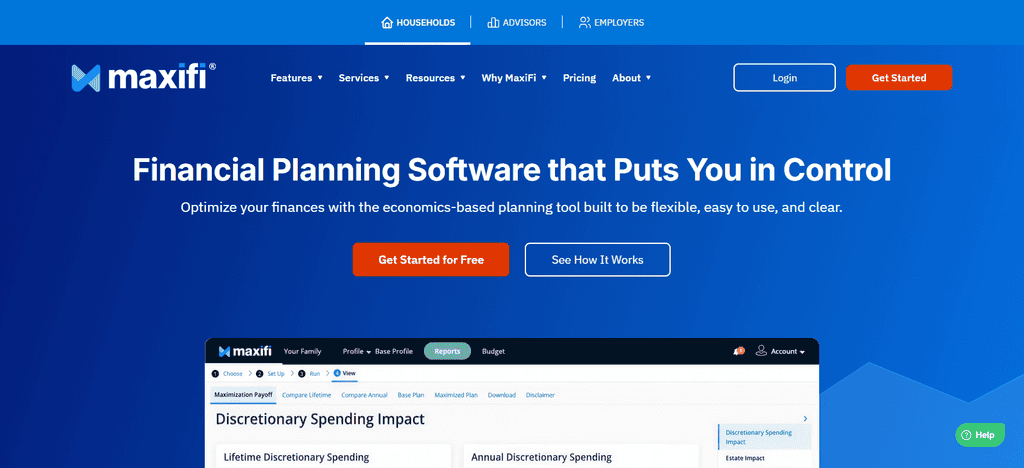
Its strength is in optimizing retirement spending and withdrawal decisions, not managing complex trust structures or business entities. Not as comprehensive as NaviPlan, eMoney or FP Alpha for estate and legacy planning. Tax planning is aimed at retirement income and lifetime tax efficiency, not full return-analysis workflows.
The client-portal and advisor workflow capabilities are fairly lightweight. MaxiFi is better suited for wealthy individuals and planners who want to do rigorous retirement-sustainability analysis, not comprehensive HNW estate administration.
Main Features
- Lifetime financial planning and spending optimization.
- Review of Social Security claiming strategy
- Retirement planning tax smart.
- Estimates of lifetime income and expenses.
- Savings and retirement decision scenario modeling.
Main Limitations
- Interface could be difficult for beginners.
- Advisors have limited portfolio management capabilities.
- Financial forecasts rely on manual accuracy.
- Complex family office and estate management needs additional tools
9. Projection Lab
ProjectionLab is a modern, scenario-based financial planning tool for individuals and advisors focused on flexible cash-flow projections, tax optimization and “what-if” modeling. The Premium plan is $129 per year and includes tax optimization, withdrawal strategies, Roth conversions, capital-gains harvesting, ACA subsidies, tax estimating and international planning.

Estate planning is included at the Premium tier, though usually lighter-weight than dedicated estate platforms. The Advisor tier adds client management and an Advisor Dashboard, making it doable for tech-forward planners serving self-directed or digitally engaged clients.
It’s got a clean interface and scenario comparison tools that make it strong for retirement, FIRE, relocation and lifestyle-planning cases. ProjectionLab is targeted at HNW DIY planners and boutique advisors who prefer flexible modeling over enterprise integrations.
Key Features
- Individualized retirement and financial independence projections.
- Customizable income, expenses and investments scenarios.
- Monte Carlo simulations to study financial outcomes.
- Tax-aware planning of retirement and withdrawal.
- Interactive financial charts and progress dashboards
Key Shortcomings
- Mainly targeted toward people and families.
- Complex financial configurations need to be set up manually.
- Advanced modeling may have a learning curve.
- Little attention paid to institutional and family office workflows
10. Boldin
Boldin (formerly NewRetirement) is a retirement planning platform that pulls taxes, Social Security, Medicare, withdrawals, and long-term decisions into one plan. The basic planner is free. PlannerPlus is $168/year and adds Monte Carlo simulation, Roth conversion modeling and side-by-side scenario comparison. Premium is $129/year.
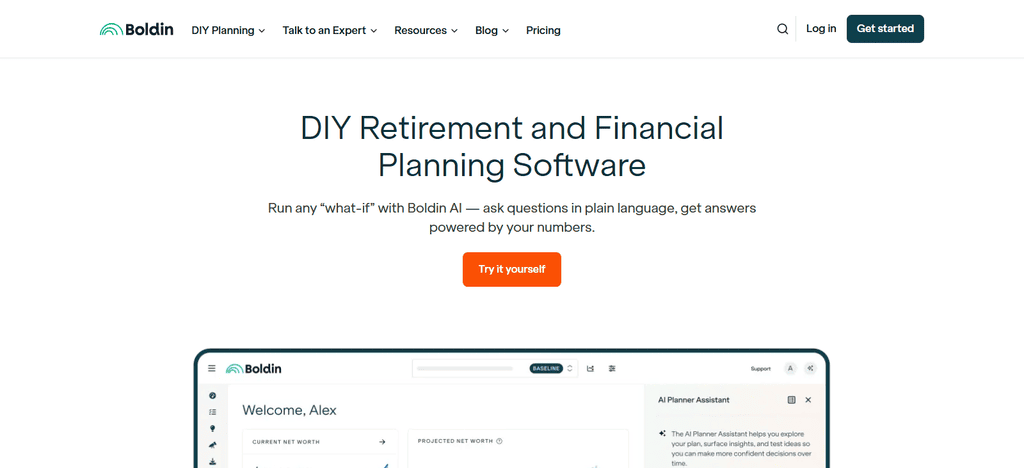
Key tax features include federal and state projections, Roth-conversion exploration, RMDs and IRMAA considerations, and its Social Security Explorer compares claiming ages for individuals and couples.
Estate and legacy capabilities are useful for retirement planning, but not as deep as dedicated HNW estate platforms. Boldin is great for affluent pre-retirees and retirees who want an affordable, self-serve planner with meaningful tax and withdrawal analysis.
Main Features
- Comprehensive forecasting of retirement income and expenses.
- Optimization of social security benefits.
- Roth conversion and tax planning tools.
- Retirement scenario testing, and Monte Carlo simulations
- Monitor your net worth, savings and retirement progress.
Key Limitations
- Focuses mainly on individual retirement planning.
- Some advanced features are only available with paid subscriptions.
- Complex trust and estate planning may require additional tools.
- Financial projections require accurate user inputs.
Conclusion
The complexity of the planning and the type of client will determine which is the best platform. eMoney and NaviPlan are best for deep HNW and ultra-HNW planning, especially where cash flow, tax, estate and business structures are complex. RightCapital and MoneyGuidePro provide scalable, client-friendly advisor planning, while Advyzon is a good fit for RIAs looking for an integrated portfolio and operations platform.
Asset-Map is best at visualizing household complexity. FP Alpha is best at AI-driven analysis of tax, estate and insurance documents. MaxiFi, ProjectionLab and Boldin provide affordable retirement-focused tools for individual or boutique planning. Bigger firms should focus on depth and integration, with smaller practices and clients focusing on usability, tax insight and cost.
FAQ
Which platform is best for high-net-worth clients?
eMoney Advisor and NaviPlan are generally the strongest choices for HNW and ultra-HNW clients because they support advanced cash-flow planning, complex tax scenarios, estate structures, business planning, and multigenerational wealth transfer.
Which tools are best for estate and legacy planning?
NaviPlan offers the deepest estate-structure modeling, including trusts and wealth-transfer strategies. FP Alpha is excellent for analyzing wills, trusts, and tax returns with AI, while eMoney and RightCapital provide strong estate-planning modules within broader planning platforms.
Which software is strongest for tax planning?
FP Alpha is especially strong for document-based tax analysis, Roth conversions, and tax projections. ProjectionLab, Boldin, NaviPlan, and eMoney also provide meaningful tax-optimization and scenario-modeling tools.
Which option is most affordable?
ProjectionLab starts at $129 per year, Boldin PlannerPlus at $168 per year, and MaxiFi uses modular pricing. These are best for individuals or smaller planning practices rather than large advisory firms
Which platform is best for visual client communication?
Asset-Map is the standout for visualizing household members, assets, liabilities, insurance, and relationships. RightCapital is also strong because its Snapshot and Blueprint reports make complex plans easier for clients to understand.