

The trading of event contracts is gaining attention as more people look for ways to bet on real-world outcomes in sports, politics, economics and financial markets. There are other options besides Kalshi, one of the known platforms here. There are a number of competitors offering different market categories, pricing models, trading features and forecasting tools. In this guide, I’ll cover the Top Kalshi Competitors for Event Contract Trading, comparing their key features, benefits, and limitations to help you understand the available alternatives.
What Is Event Contract Trading?
Event contract trading is a financial activity where people buy and sell contracts based on the outcome of future events. These events could be elections, sports, economic indicators, financial markets or major events around the world. Each contract relates to a specific outcome and is generally priced at the market’s best estimate of the probability of that outcome. If the trader guesses right and the contract works out in their favor, they can make money. With event contract trading, you’re not buying stocks, commodities or other financial assets—you’re predicting measurable outcomes. That’s what makes it different from traditional investing.
How to Choose the Best Kalshi Competitor
Market Categories Available: Select a platform that offers the event categories you are interested in, such as sports, politics, economics, finance and entertainment, so that you can have access to the relevant contracts and suitable trading opportunities.
Trading Fees: Compare transaction fees, commissions, spreads, and withdrawal fees between platforms to learn about overall trading costs and not to pay more than necessary when buying or selling contracts.

Market Liquidity: Consider trading volume, market depth, and the number of available contracts to facilitate order execution, obtain competitive pricing, and encounter fewer obstacles when initiating or closing out positions.
Regulatory Compliance: Verify the platform’s registration, regulatory oversight, and any geographical restrictions to ensure the service is legally operating and provides adequate protections in your region.
Payment Methods: Review the deposit and withdrawal options available, transaction times, minimum funding amount and fees to find a platform that makes it easy to fund your account.
Trading Features: Compare mobile apps, desktop interfaces, market analysis tools, order types and real-time pricing features to find a platform that suits your trading experience and needs.
Security and Reliability: Examine the security of your account, login methods, the safety of your money, transaction processes, and system stability to minimize business risks and secure your trading account.
Contract Settlement: Learn about contract settlement rules, how to confirm the outcome, payout options, and settlement periods to prevent misunderstandings and pick a platform with transparent trading conditions.
10 Top Kalshi Competitors for Event Contract Trading
| Competitor | Key Point |
|---|---|
| Polymarket | One of the largest prediction market platforms, offering event-based contracts on politics, economics, sports, cryptocurrency, and global news with strong market liquidity. |
| PredictIt | Popular prediction market focused primarily on political and public policy events, allowing traders to speculate on election and legislative outcomes. |
| Manifold Markets | Community-driven prediction market platform that enables users to trade on a wide variety of real-world events using virtual currency markets. |
| Metaculus | Forecasting platform that aggregates predictions from forecasters and analysts, specializing in science, technology, economics, and global events. |
| Interactive Brokers ForecastEx | Event forecasting marketplace integrated with a major brokerage platform, providing event contracts on economic and political outcomes. |
| FanDuel Predict | Event trading platform that allows users to participate in prediction-style contracts tied to sports and other real-world outcomes. |
| Robinhood Prediction Markets | Prediction market offering eligible users the ability to trade contracts based on future economic, political, and sports-related events. |
| Smarkets | Exchange-style platform that enables peer-to-peer trading on sports, politics, entertainment, and other event-based outcomes. |
| PredictNow.ai | AI-enhanced forecasting marketplace that combines market-driven predictions with analytical tools for trading future events. |
| Insight Prediction | Prediction platform focused on forecasting real-world outcomes across business, economics, public policy, and current affairs markets. |
1. Polymarket
Polymarket is a crypto-based prediction market where users can trade binary “Yes/No” contracts on real-world outcomes: a contract pays $1 if correct and $0 if not. It has markets for politics, sports, crypto, finance, economics, weather, culture, tech and world events.
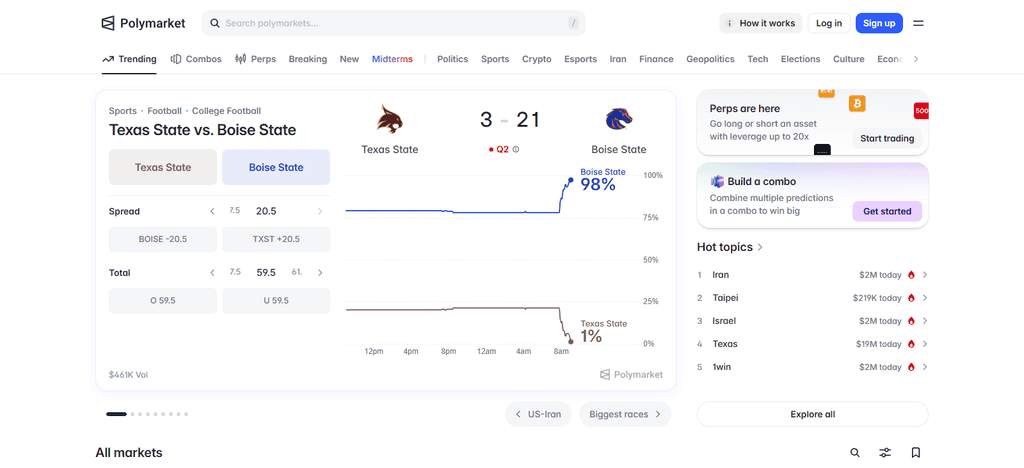
The U.S. business is a Designated Contract Market regulated by the CFTC and is separate from the international platform. Fees vary based on the category, with geopolitical and world-event markets being fee-free. U.S. users can fund accounts via debit cards, ACH, wires, Apple Pay and crypto/USDC.
Polymarket is known for deep liquidity and very high trading volume, with monthly volume reported in the billions of dollars. Its interface allows for limit orders, order books, early exits and maker rebates, making it a good choice for active traders.
Benefits
- Large selection of prediction markets
- Good worldwide trading activity
- Prices competitive with market
- Trading flexibility with cryptocurrency
cons
- Regulatory constraints in certain areas
- Must know about cryptocurrency
- Market liquidity changes due to events
- Could be challenging for beginner
2. Predict It
PredictIt is a real-money political prediction market for the United States. It was launched in 2014 as a not-for-profit academic project by Victoria University of Wellington. It’s about elections, political events and other current-affairs questions, not broad-ranging sports or crypto markets.

It is not fully registered as an exchange but operates under a CFTC no-action letter; it has a limit of $3,500 in individual positions per contract; and it lifted the previous cap on 5,000 traders in 2025. PredictIt takes 10% of any profits you make by selling shares for more than you paid for them and 5% on withdrawals; deposits by credit card are subject to a 3% processing fee.
Payment is usually made by card or bank transfer with a minimum balance of $10. Simple and user-friendly is its interface, but liquidity and market breadth are thinner than on larger commercial exchanges.
Advantages
- A strong focus on political events
- Easy Trading of Contracts
- Founded a prediction market community
- Helpful election prediction markets
Cons:
- Narrow market segments
- Trading and position limits
- Fees can eat into returns
- Rarely accessible internationally
3. Manifold Markets
Manifold Markets is a community prediction market platform, but instead of trading real money, it uses Mana (M), a virtual play-money currency with no cash value. Users ask questions and trade shares on the probability of how they will play out on politics, technology, science, sports, entertainment, business and niche internet topics.
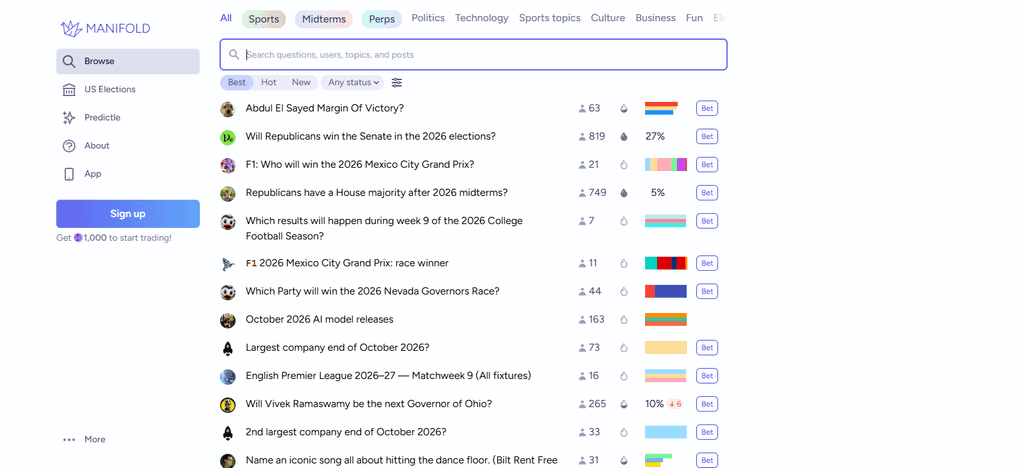
Because it is play-money there are no traditional trading commissions. Market creators generally fund liquidity pools through a creation fee. Optional Mana packages can be purchased. It is available to everyone and is easy to access, allowing for experimentation, forecasting practice and community discussion.
Liquidity is not driven by institutional market makers but by participants and an automated Maniswap mechanism. The platform features comments, market creation, APIs, leaderboards and a fast, social trading experience, but is not to be treated as a venue for cash winnings.
Benefits
- Wide spectrum of prediction topics
- Trading interface is user-friendly
- Markets created by the community
- Tools for valuable research and forecasting
Cons
- Trading system for play money
- Limited real cash functionality
- Quality of market varies
- Not as good for financial trading
4. Metaculus
Metaculus is not a traditional trading exchange. It is a forecasting and aggregation platform. Users provide probability estimates and reasoning and the platform provides machine-learning-optimized aggregate forecasts. Questions range from science and technology, geopolitics, health, economics, AI, climate and policy.
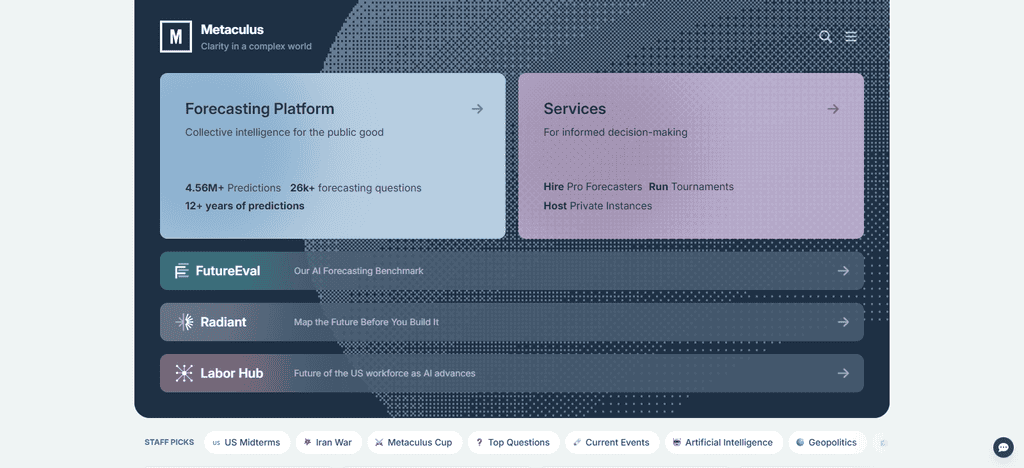
There is no real-money order book, contract pricing or trading fee; participants predict, but do not buy, shares. Accuracy is assessed via Baseline, Peer and Relative scoring systems, with leaderboards displaying your performance on answered questions. Metaculus hosts time-limited tournaments, with some including cash prizes and medals.
They run contests on market trends and AI forecasting benchmarks. It’s open to the world, and focused on reasoning, calibration, and high-level community discussion. The experience is for skill development and collective intelligence for forecasters, not for speculative trading.
Advantages
- Platform for researchers to predict
- Good community participation
- Specific forecasting questions
- Monitoring of good prediction accuracy
Disadvantages
- Not a regular trading exchange
- Poor financial incentives
- No traditional trading of event contracts
- Requires forecasting knowledge
5. Interactive Brokers
Interactive Brokers owns ForecastEx, a CFTC-registered Designated Contract Market and Derivatives Clearing Organization, which is a wholly-owned subsidiary of Interactive Brokers Group. It provides binary forecast contracts for elections, economic releases, Federal Reserve actions, climate patterns and other quantifiable events.
Contracts cost between $0.02 and $0.99 and pay $1 if you’re right, so you can only lose what you wager. IBKR lists ForecastEx contracts with a $0 commission and a $0.01 per contract third-party exchange fee. Funding is done through an existing Interactive Brokers brokerage account, which means users get access to traditional banking and brokerage infrastructure rather than crypto wallets.
The platform is mainly aimed at eligible U.S. residents and election contracts are available only to eligible U.S. customers. Strengths include institutional level compliance, integration with a full brokerage platform and an interest-like incentive coupon currently at 3.38% APY.
Benefits
- Exchange of contract for regulated event
- Access to economic and financial markets
- Brokerage account aggregation
- Professional level trading infrastructure
Cons
- Hard platform for beginners
- Account eligibility criteria
- Some event categories have limited availability
- You may have to learn a brokerage interface
6. FanDuel Predict
FanDuel Predicts is a standalone prediction-market app that was created out of a joint venture between FanDuel Group and CME Group. It provides binary yes/no event contracts that settle at $1 or $0 with prices generally between $0.01 and $0.99. Markets include finance, economics, commodities, crypto, culture and sports, but sports contracts are only available in select states.

FanDuel charges a 2% transaction fee on potential payout, including some early cash-outs. The app is available in all states, but market access varies state by state and some jurisdictions, including states with legal online sports betting, do not include sports markets.
Visa and Mastercard debit cards are accepted too, as well as other payment options. If you’re a sports-betting customer, you’ll find the mobile-first experience familiar, with simple trade entry, early exit options and clear payout displays.
The pros
- Prediction trading experience friendly to users
- Contracts for sports events
- Popular FanDuel ecosystem
- Easy access from mobile
Drawbacks
- Geographic availability limitations
- Some areas have limited choice of market
- Contract availability varies
- Not applicable for all types of forecasts
7. Robinhood Prediction Market
Robinhood Prediction Markets is now allowing eligible customers to trade event contracts directly within its mobile app, making it one of the most accessible mainstream entry points to prediction markets. Contracts are priced between $0.01 and $0.99, and pay $1 if the outcome is correct.
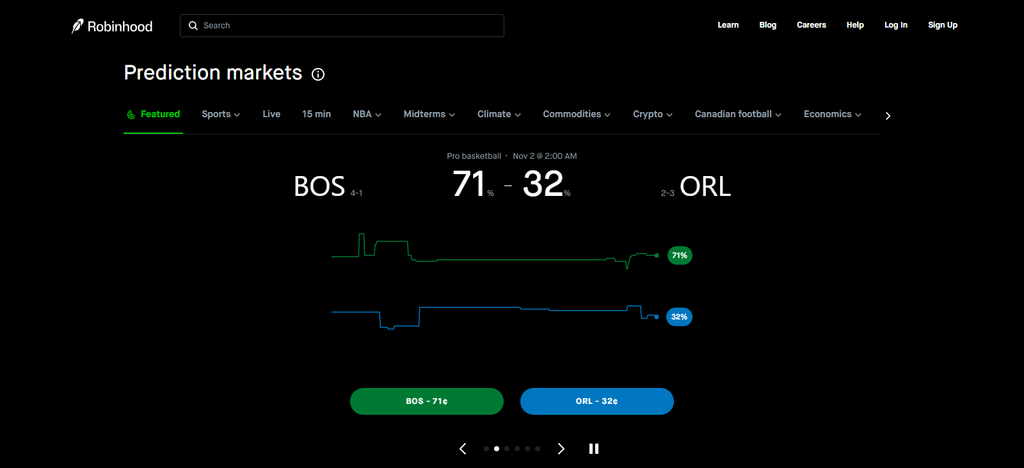
Robinhood offers contracts on regulated exchanges like KalshiEX, ForecastEx, Rothera Exchange, and the North American Derivatives Exchange. Since June 2026, fees have been based on a probability-weighted model: 10% tier constant for regular users or 5% for Robinhood Gold subscribers, plus exchange fees that can be as high as $0.01 per contract.
Markets include sports, esports, politics, finance and other current events, though availability varies by state; Maryland, Nevada and Michigan have specific restrictions. The funding uses your existing Robinhood brokerage account. The experience is streamlined and mobile-only for trading, and best for casual users already comfortable with Robinhood.
Benefits
- Connected to brokerage accounts
- User-friendly trading interface
- Access to various event categories
- Simple mobile trading experience
Cons
- Availability may differ by market
- limited control over the choice of contracts
- Risks of event contracts
- Not all markets are suited to experienced traders
8. Smarkets
Smarkets is a peer-to-peer betting exchange and prediction market where people back or lay outcomes against each other, not against a bookmaker. It covers sports, politics, elections, current affairs and entertainment, with particular strength in UK and European sports markets. Standard commission is 2 % of net winnings per market ( not per bet ). Users with net losses do not pay commission .

Active traders might be eligible for a 1% Pro Tier, and a small subset of highly profitable users might be subject to a 3% Select Tier. Smarkets is licensed in the UK, Malta, Ireland, Sweden and Indiana, and has applied for U.S. federal approval to run event-contract prediction markets.
It’s available mostly in the UK, large parts of Europe and international markets but not currently live in the U.S. The platform has a live trading, cash-out, competitive odds and an exchange-style interface.
Benefits
- Competitive betting exchange prices
- Peer-peer market structure
- Good coverage of sports events
- Variety of betting markets
Cons
- Limited coverage of traditional prediction markets
- Geographic limitations
- Different liquidity of markets
- Learning betting exchange interface
9. PredictNow.ai
PredictNow.ai appears to be an early-stage or limited-access prediction-market intelligence product, not a mature, fully public trading exchange. Its public website describes itself as being focused on “Prediction Market Intelligence” and says product details, beta access and availability will be announced at meaningful milestones.
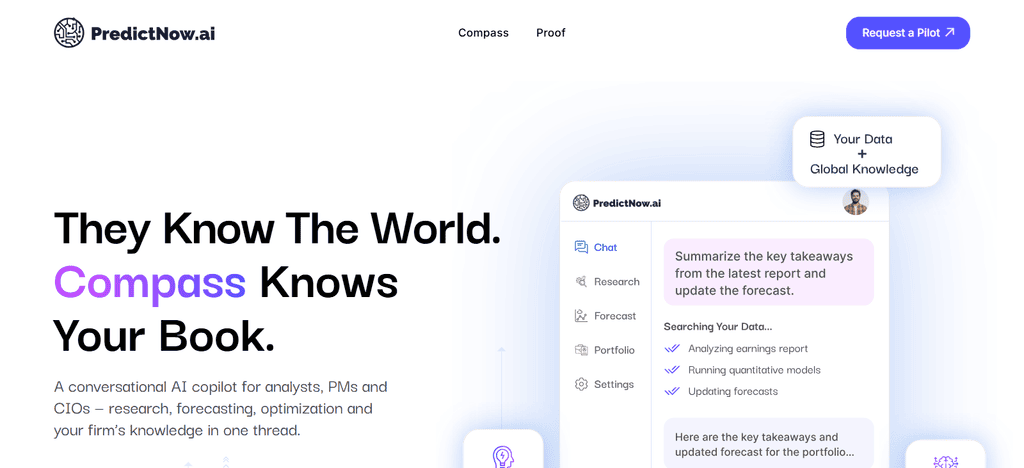
There is also a separate domain, predictnow.ai, which refers to financial data like prices, yields, spreads, flows and macro indicators on a point in time per mandate basis which appears to be more related to market and macro forecasting than consumer sports betting.
Limited public documentation makes it impossible to reliably confirm its event-market selection, fee schedule, liquidity, payment rails, regulatory status, and geographic availability. So users should regard it as an emerging or beta platform and check whether it permits real money trading and verify licensing and fund-safety arrangements before depositing money.
Benefits
- Forecast capabilities powered by AI
- Data-driven predictive insights
- Tools for useful analysis
- Helps you make decisions with confidence
Cons
- Limited traditional event contract features
- AI predictions can be incorrect
- Advanced analytics learning curve
- Limited suitability for conventional event trading
10. Insight Predicting
Insight Prediction is a crypto funded prediction market site where you can trade binary contracts on elections, sports, policy, climate and other current events. Contracts won are worth $1, contracts lost are worth $0, and the current price is the implied probability of the market.
Its fee structure depends on the market: newer markets use a taker fee of 7.5% of price times potential profit and a maker subsidy of 2.5% of price times potential profit. Some policy relevant markets may be fee free.
People deposit cryptocurrency or stablecoins and the platform converts it to dollars with no stated fee. Insight Prediction has a relatively niche market catalog and smaller liquidity pool than major exchanges but offers direct on-chain settlement and straightforward interface.
The regulatory posture and geographic eligibility of this exchange are less clearly documented than those of CFTC-regulated U.S. exchanges so users should confirm local legality before trading.
Pros
- Platform concept with focus on prediction
- Data-driven insights potential
- Useful for evaluating future results
- Support for forecasting-based analysis
Disadvantages
- Restricted publically established platform information
- No clear event market coverage
- Minimal verified trading experience
- Pricing and liquidity model uncertainty
Conclusion
Selecting the right Kalshi competitor depends on your trading preferences, the markets you want to trade, the fees, liquidity and platform accessibility. Polymarket, PredictIt, ForecastEx, and Robinhood have a variety of event trading opportunities, while Manifold Markets and Metaculus focus more on forecasting and community predictions.
Alternative approaches to event-based markets are offered by platforms like FanDuel Predict and Smarkets. Look at regulatory compliance, payment options, contract settlement and security features when picking a platform.
By understanding these differences, traders can find suitable alternatives, manage potential risks and make informed decisions when looking for event contract trading opportunities.
FAQ
What are the best Kalshi competitors for event contract trading?
Popular Kalshi alternatives include Polymarket, PredictIt, Interactive Brokers ForecastEx, Robinhood Prediction Markets, FanDuel Predict, and Smarkets. Each platform offers different markets, trading features, and pricing structures.
Is Polymarket a good alternative to Kalshi?
Yes, Polymarket is a popular alternative offering prediction markets across politics, sports, cryptocurrency, economics, and global events. It primarily uses cryptocurrency for trading and settlement.
Which Kalshi competitors offer real-money trading?
Polymarket, PredictIt, ForecastEx, Robinhood Prediction Markets, FanDuel Predict, and Smarkets offer real-money market participation, subject to eligibility and geographic restrictions.
Are Manifold Markets and Metaculus similar to Kalshi?
Both platforms focus on forecasting future events. However, Manifold Markets primarily uses virtual currency, while Metaculus emphasizes probability forecasting and community research rather than conventional financial contract trading.
Which Kalshi alternative is best for political predictions?
Polymarket and PredictIt are popular choices for political prediction markets. They provide opportunities to forecast elections, government decisions, and other political developments, depending on market availability.